When a Big Rig Hits: What Your New Orleans Truck Accident Settlement Could Be Worth
A big rig accident settlement New Orleans can range from tens of thousands to several million dollars — and the difference often comes down to the details of your case.
Here’s a quick snapshot of what victims typically recover:
| Injury Severity | Typical Settlement Range |
|---|---|
| Minor to moderate injuries | $50,000 – $200,000 |
| Serious injuries (surgery, long-term care) | $200,000 – $500,000 |
| Severe or catastrophic injuries | $500,000 – $5 million+ |
| Wrongful death or permanent disability | $1 million – $10 million+ |
These are benchmarks, not guarantees. Every case is different.
What is consistent? Louisiana 18-wheeler crashes are serious — and so are the legal battles that follow. More than 2,700 large truck crashes happened statewide in 2024, with nearly 120 people killed. About 7% of those crashes occurred right here in Orleans Parish.
When a loaded semi-truck hits a passenger vehicle, the results can be life-altering. Medical bills pile up fast. Work stops. And the trucking company’s insurance team starts building their defense immediately.
That’s why understanding how settlements work — and what drives their value — matters so much.
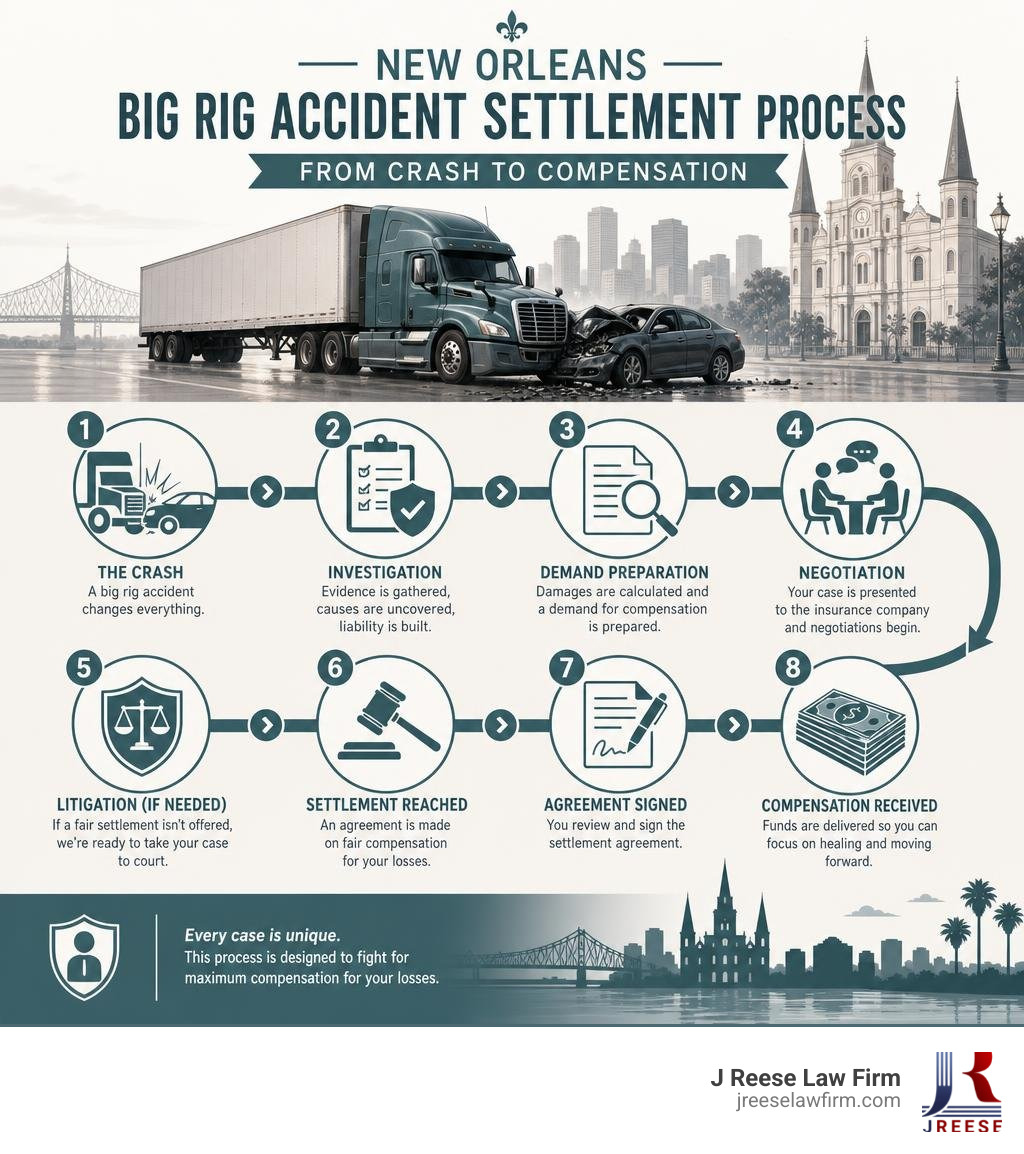
Understanding the Value of a Big Rig Accident Settlement in New Orleans
When we talk about the average big rig accident settlement in New Orleans, we have to address a basic truth: there is no single “average” number that fits every situation. A collision involving an 18-wheeler is fundamentally different from a standard fender-bender on Canal Street. Because commercial trucks weigh up to 80,000 pounds, the forces involved are massive, and the resulting financial and physical damage is often astronomical.
To understand how these settlements are calculated, we must look at how Louisiana evaluates personal injury claims. In many states, settlements are tightly capped by strict legislative limits. However, Louisiana handles commercial vehicle claims with a unique set of legal rules. If you are wondering Why Louisiana Personal Injury Cases Are Different, it often comes down to our civil law heritage, how our local courts operate, and how we stack insurance policies to cover catastrophic losses.
While a minor car wreck might settle for a few thousand dollars to cover vehicle repairs and a quick chiropractic checkup, commercial truck settlements routinely reach $500,000 to over $5 million. This is because commercial carriers are backed by substantial corporate insurance policies. Federal law requires most interstate commercial trucks to carry at least $750,000 in liability coverage, and those carrying hazardous materials must carry between $1 million and $5 million.
When we represent injured victims, we look at the entire “stack” of available insurance policies—including the driver’s policy, the trucking company’s corporate policy, and excess umbrella coverages—to ensure we are targeting the maximum possible recovery.
Key Factors That Influence Your Big Rig Accident Settlement in New Orleans
To build a strong case, we must analyze the specific variables that move the needle from a low-ball insurance offer to a high-value settlement. The total value of your claim is not pulled out of thin air; it is built on concrete evidence.
- Injury Severity and Medical Documentation: This is the single largest driver of settlement value. A traumatic brain injury (TBI), spinal cord damage, or complex orthopedic fractures requiring multiple surgeries will naturally command a much higher settlement than soft-tissue whiplash. Juries and insurance adjusters look closely at your future medical needs. Will you need ongoing physical therapy? Will you require joint replacements or pain management procedures like radiofrequency ablation down the road?
- Clear Proof of Liability: To secure a top-tier settlement, we must establish undisputed fault. If the trucking company can inject doubt into how the crash occurred, they will use it to slash their offer.
- Insurance Policy Limits: You cannot collect money that does not exist. If a negligent independent driver only has a basic commercial policy, the recovery ceiling may be lower unless we can identify other liable corporate parties with larger insurance towers.
- The Location of the Crash: Where the accident occurred plays a major role in negotiations. Certain intersections and highways in Orleans Parish are notorious for heavy commercial traffic and frequent collisions. If you look at the New Orleans Accident Hotspots, areas like the Interstate 10 corridor, the high-rise bridge, and the stretches near the Port of New Orleans see a disproportionate share of commercial truck traffic. Insurers know that Orleans Parish juries have a history of holding negligent corporations accountable, which often makes them more willing to settle out of court to avoid a runaway jury verdict.
How Recent Louisiana Laws Impact Your Big Rig Accident Settlement in New Orleans
The legal landscape in Louisiana has undergone massive shifts between 2024 and June 2026. If you are pursuing a big rig accident settlement in New Orleans, you must navigate these new rules, as they directly alter the “settlement math” of your case.
1. The 51% Comparative Fault Bar (Effective January 1, 2026)
Historically, Louisiana operated under a “pure” comparative fault system. This meant that even if you were 90% at fault for an accident, you could still recover 10% of your damages.
However, as of January 1, 2026, Louisiana has implemented a 51% modified comparative fault bar. Under this new law, if a jury or insurance adjuster determines that you were 51% or more responsible for the collision, you are completely barred from recovering any compensation.
This change makes the initial investigation and liability story incredibly dangerous. Trucking defense lawyers will fight tooth and nail to pin at least 51% of the blame on you to wipe out their financial liability entirely.
2. Medical Billing “Paid vs. Billed” Rules (Effective January 1, 2026)
Another major tort-reform hurdle is the restriction on how medical expenses are presented. Previously, plaintiffs could seek recovery for the full amount “billed” by their doctors, even if their health insurance negotiated a much lower “paid” rate.
As of January 1, 2026, Louisiana law limits medical expense recovery primarily to the amounts actually paid by the patient or their insurer, rather than the inflated sticker price on the initial medical bill. Because medical bills form the baseline multiplier for non-economic damages (like pain and suffering), this rule requires highly strategic legal framing to prevent your settlement value from being artificially deflated.
3. The Statute of Limitations (Prescription)
In Louisiana, the deadline to file a personal injury lawsuit is known as “prescription.” For decades, Louisiana had a notoriously short one-year filing window.
For accidents occurring after July 1, 2024, the state extended the prescriptive period to two years. While this gives victims more time to understand the full scope of their injuries, you should never wait. Evidence in trucking cases disappears rapidly.
To understand how these deadlines apply to your specific situation, it is highly beneficial to review Louisiana’s One Year Statute of Limitations and how the recent legislative extensions impact older versus newer claims.
4. Federal Motor Carrier Safety Administration (FMCSA) Regulations
Commercial trucking is heavily regulated at the federal level. The Federal Motor Carrier Safety Administration regulations dictate everything from how many hours a driver can legally operate without a break (Hours of Service rules) to mandatory drug testing and vehicle maintenance schedules. Proving that a trucking company violated these federal safety standards is the golden ticket in settlement negotiations. If we can prove the driver was operating on 15 hours of continuous sleep-deprived driving in direct violation of FMCSA rules, the corporate insurer’s leverage crumbles.
Determining Liability and Damages in Louisiana 18-Wheeler Crashes
To secure a fair big rig accident settlement in New Orleans, we must divide your losses into specific legal categories. In Louisiana, damages are classified into three primary groups: economic, non-economic, and punitive.
- Economic Damages: These are your tangible, out-of-pocket financial losses. They are calculated using receipts, invoices, tax returns, and expert economic projections. They include:
- Past and future medical bills (surgeries, hospital stays, medication, and rehabilitation).
- Lost wages from time missed at work.
- Lost earning capacity if your injuries prevent you from returning to your previous profession. For example, if a highly skilled union electrician can no longer perform physical labor due to a spinal fusion, we work with vocational experts to calculate the lifetime loss of income and pension benefits.
- Property damage, including the cost to repair or replace your vehicle and any diminished value claims.
- Non-Economic Damages: These compensate you for the physical and emotional toll of the crash. Because these do not come with a price tag, we must paint a vivid picture of how your life has changed. Non-economic damages cover:
- Physical pain and suffering.
- Mental anguish, anxiety, and Post-Traumatic Stress Disorder (PTSD) caused by the terror of the crash.
- Loss of enjoyment of life (the inability to play with your kids, enjoy hobbies, or participate in family events).
- Loss of consortium (the negative impact of the injuries on your relationship with your spouse).
- Punitive Damages: Known in Louisiana as “exemplary damages,” these are not meant to compensate you, but rather to punish the defendant for egregious, reckless behavior and to deter others from doing the same. While Louisiana generally limits punitive damages, they may be recovered in specific circumstances, such as when a commercial driver was operating under the influence of drugs or alcohol.
In the most tragic circumstances, where a collision results in a loss of life, surviving family members can pursue a wrongful death claim. Securing a compassionate and aggressive New Orleans Wrongful Death Attorney is critical to obtaining compensation for funeral costs, loss of financial support, and the profound emotional void left by the loss of a loved one.
Who Can Be Held Liable Beyond the Truck Driver?
One of the biggest mistakes an inexperienced lawyer can make is only suing the individual truck driver. The truck driver rarely has the personal assets or insurance coverage to pay for a multi-million dollar catastrophic injury.
To maximize your settlement, we look up the chain of commerce to hold all responsible parties accountable. Partnering with a dedicated Commercial Truck Lawyer New Orleans ensures that no stone is left unturned.
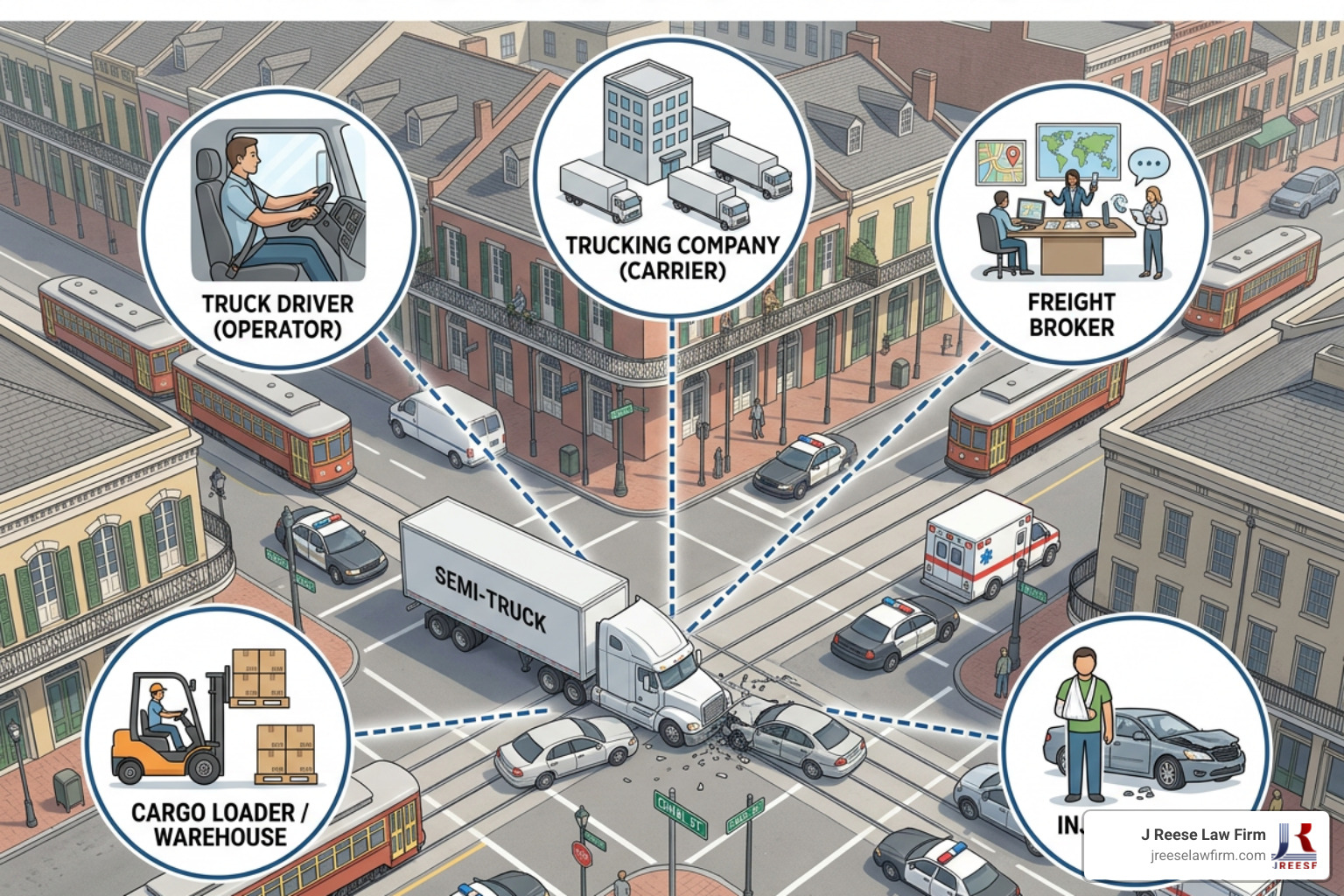
Beyond the driver, we can often hold the following parties liable:
- The Trucking Company (Employer): Under the legal doctrine of respondeat superior, employers are liable for the negligent actions of their employees while on the clock. Furthermore, we can sue the trucking company directly for corporate negligence, such as failing to perform background checks, negligent hiring of drivers with histories of reckless driving, or failing to properly train their staff.
- Freight Brokers: Brokers match cargo shippers with trucking companies. If a broker hires a “cut-rate” trucking company with a known history of safety violations or failed federal audits, the broker can be held liable for negligent selection.
- Cargo Loaders and Shippers: If a third-party logistics company improperly loads a flatbed or packs a trailer unevenly, the cargo can shift during a turn, causing a catastrophic jackknife or rollover accident on the interstate.
- Manufacturers and Maintenance Providers: If a crash was caused by a mechanical failure—such as a defective parking brake or a sudden tire blowout—we can pursue product liability claims against the parts manufacturer or hold the third-party maintenance shop liable for failing to repair known mechanical issues.
By naming multiple defendants, we shut down the “empty chair” defense (where defendants try to blame an absent party) and force multiple corporate insurance policies to contribute to your final settlement.
How Evidence and Timelines Shape Your Settlement
The success of your big rig accident settlement in New Orleans hinges entirely on the quality of the evidence gathered in the immediate aftermath of the crash. Trucking companies employ rapid-response defense teams who are often on the scene of a crash within hours, taking photos and finding ways to minimize their liability. We must act just as quickly.
When we take on a case, we immediately send a formal “spoliation letter” to the trucking company. This legally obligates them to preserve critical evidence that could otherwise be deleted or destroyed. This evidence includes:
- Black Box (EDR) Data: Most modern commercial trucks are equipped with Electronic Data Recorders. This data provides objective, indisputable proof of the truck’s speed, brake application, steering angles, and throttle position in the seconds leading up to the impact.
- Electronic Logging Devices (ELDs) and Driver Logs: These digital records track the driver’s hours of service. We cross-reference ELD data with GPS tracking, toll booth receipts, and fuel purchases to expose log violations and prove driver fatigue.
- FMCSA Safety Records: We mine federal databases to pull the trucking company’s historical crash data, vehicle inspection reports, and safety audit records.
- Maintenance History: We analyze the truck’s service logs to check for worn brake pads, bald tires, or ignored safety recalls.
Securing the help of a qualified Big Rig Accident Lawyer New Orleans ensures that this high-tech, digital evidence is preserved and analyzed by accident reconstruction experts before it is lost forever.
How Long Does It Take to Settle?
A common question we hear is, “How long will my settlement take?” The honest answer is that high-value truck cases take time. While a minor car wreck might resolve in a few months, a complex 18-wheeler case can take anywhere from 12 to 24 months—and sometimes longer if the case goes to trial.
There are two primary reasons for this timeline:
- Reaching Maximum Medical Improvement (MMI): We should never settle your case until your doctors have determined the full long-term impact of your injuries. If you settle early and later discover you need a $150,000 spinal surgery, you cannot go back and ask for more money.
- Discovery and Litigation: Gathering corporate records, taking depositions of company executives, and coordinating expert witnesses is a meticulous process.
While settling out of court is faster and avoids the unpredictability of a trial, sometimes corporate insurers refuse to offer a fair amount. In those cases, we are fully prepared to take your case to a jury to fight for every penny you deserve.
Real-World Louisiana Truck Accident Case Studies
To understand what is truly possible when a case is handled with precision, let’s look at several notable, anonymized Louisiana truck accident outcomes:
- The $51.5 Million Defective Equipment Verdict: In a landmark Orleans Parish Civil District Court case, a New Orleans woman was awarded $51.5 million after being pinned and dragged under a tractor-trailer in a local parking lot. The investigation revealed that the truck had a defective parking brake system. The jury held the manufacturer 90% at fault for the catastrophic crushing and brain injuries that left the victim requiring round-the-clock nursing care.
- The $15 Million Sideswipe Gasquet Settlement: A driver was sideswiped by a commercial vehicle on a Louisiana highway. While the vehicles showed minimal physical damage, the violent jarring motion triggered thoracic outlet syndrome, requiring multiple invasive surgeries and causing permanent disability. Despite the insurance company arguing that the injuries were pre-existing, a strategic “Gasquet settlement” (a unique Louisiana legal tool allowing partial settlement while preserving excess coverage claims) ultimately resulted in a total recovery of $15 million.
- The $1.45 Million Student Driver Federal Settlement: In a contested-liability case tried in federal court, a 70-year-old union electrician with a childhood polio injury was struck by an 18-wheeler. The trucking company claimed the student driver was properly supervised. However, discovery revealed the company allowed the student to drive independently after only four days of training instead of the mandated 30 days. The jury awarded $1.26 million, which ultimately settled for $1.45 million with interest before appeal.
- The $6 Million Illegally Parked Flatbed Settlement: A college student suffered a traumatic brain injury and multiple broken bones after rear-ending a flatbed commercial truck parked illegally in the left lane of an elevated highway during high winds. The investigation exposed that the trucking company had zero safety training records for the driver and had ignored his history of speeding. The case settled for the full insurance policy limits of $6 million.
Frequently Asked Questions About New Orleans Truck Accidents
Navigating the aftermath of a commercial truck wreck is incredibly overwhelming. To help you protect your health and your potential settlement, we have compiled answers to the most common questions we receive. For broader guidance on post-crash steps, you can also read our comprehensive guide on What to Do After a Car Accident in Louisiana.
How long do I have to file a big rig accident lawsuit in Louisiana?
For any commercial truck accident occurring after July 1, 2024, you have two years from the exact date of the crash to file a formal lawsuit in a Louisiana civil court. If your accident occurred before that date, the older one-year prescriptive period may still apply.
Regardless of the timeline, waiting is the worst thing you can do. Trucking companies often destroy driver logs after six months in the ordinary course of business unless a formal legal hold is placed on them.
Can I still recover compensation if I was partially at fault?
Yes, but with strict new limitations. Because Louisiana now utilizes a 51% modified comparative fault bar (as of January 1, 2026), you can recover compensation as long as your share of the blame is 50% or less.
For example, if a jury determines you were 20% at fault for changing lanes too quickly, but the truck driver was 80% at fault for speeding, your total compensation will be reduced by 20%. (A $1,000,000 award would become $800,000). However, if you are found 51% at fault, you will receive nothing.
Why shouldn’t I accept the insurance company’s first settlement offer?
The insurance adjuster who calls you a few days after the crash might sound incredibly friendly and sympathetic, but their job is to close your file for as little money as possible.
Early insurance offers are almost always “low-ball” numbers designed to tempt you before you realize the true extent of your injuries. Once you sign a release, you waive your right to seek any future compensation. Always consult with an experienced New Orleans Car Accident Lawyer or New Orleans Personal Injury Lawyer before speaking to an adjuster or signing any settlement documents.
Conclusion
Securing a fair big rig accident settlement in New Orleans requires aggressive investigation, a deep understanding of complex federal safety regulations, and the resources to stand up to multi-billion-dollar insurance conglomerates. The legal changes of 2026 have made these cases more challenging than ever, and a single misstep in proving liability can completely bar your recovery.
You do not have to fight this battle alone. At J Reese Law Firm, we are committed to protecting our community and helping injured victims rebuild their lives. If you or a loved one has been injured in an 18-wheeler crash, contact an experienced New Orleans Truck Accident Attorney today for a free, no-obligation consultation. Let us handle the insurance companies while you focus on your recovery.