When You’re Hurt on a Rig, the Clock Starts Immediately
An oil rig injury lawyer can be the difference between a full financial recovery and walking away with nothing after one of the most dangerous workplace accidents in the country.
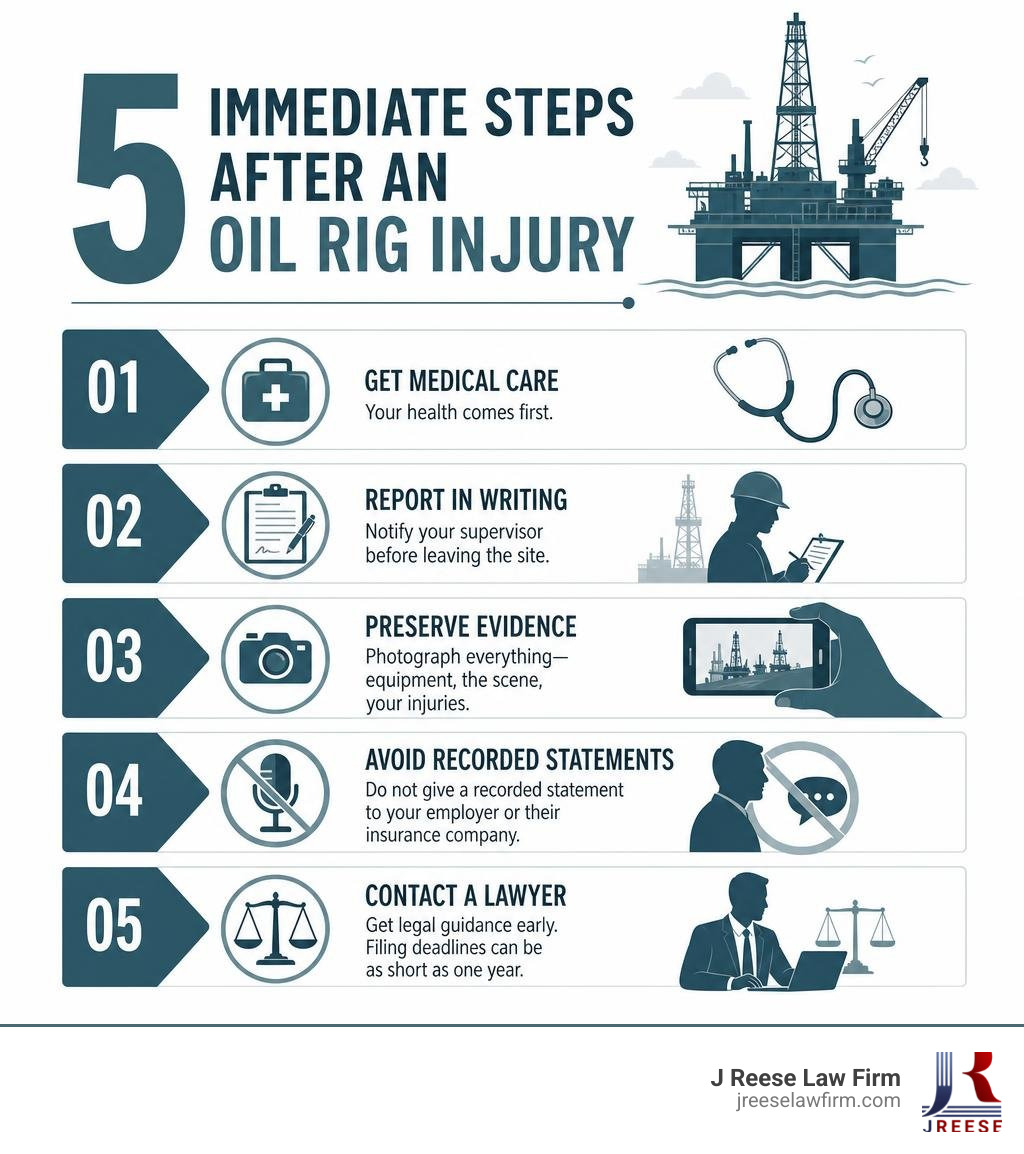
If you were hurt on an oil rig and need to know what to do right now, here is the short answer:
- Get medical attention immediately — even if you feel fine
- Report the injury in writing to your supervisor before leaving the site
- Do not give a recorded statement to your employer or their insurance company
- Photograph everything — equipment, the scene, your injuries
- Contact an oil rig injury lawyer as soon as possible — filing deadlines can be as short as one year depending on your state and the laws that apply to your case
Oil and gas work is one of the most hazardous industries in the United States. In just the first three quarters of 2025, the International Association of Drilling Contractors recorded over 304 million work hours — along with 633 recordable incidents and 177 lost-time injuries. OSHA reports that roughly four in ten oil and gas worker deaths are caused by vehicle accidents alone.
When something goes wrong on a rig, the injuries are rarely minor. Burns, amputations, spinal cord damage, traumatic brain injuries — these are life-altering events that carry lifelong financial consequences.
What makes oil rig injury cases especially complex is the web of federal maritime laws, state statutes, and multiple potentially liable parties that apply. The wrong move early on — like signing a document from the company or missing a filing deadline — can permanently damage your claim.
That is exactly why having the right legal advocate from day one matters so much.
Understanding Onshore vs. Offshore Oil Rig Accidents
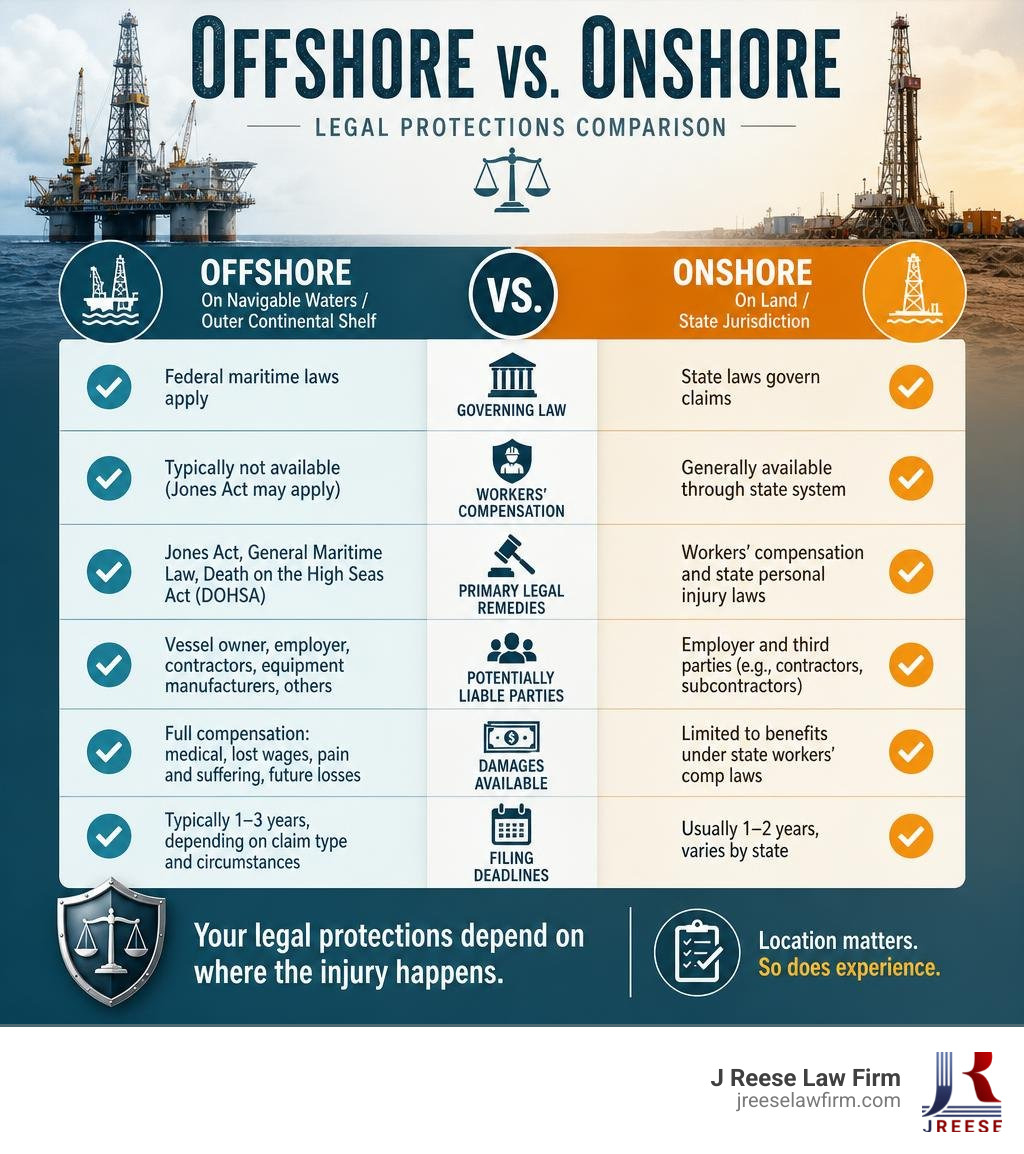
Not all oil rigs are created equal, and from a legal perspective, neither are the accidents that happen on them. Whether you are working on a dusty land-based drilling pad in West Texas or a massive semi-submersible platform floating miles out in the Gulf of Mexico, the physical environment dictates which laws protect you.
When a worker is injured onshore, state laws and traditional workers’ compensation systems generally dictate the recovery process. However, onshore operations still present massive risks, often overlapping with Refinery and Chemical Plant Accidents due to the volatile nature of the materials being extracted and processed.
Offshore oil platforms, on the other hand, exist in a jurisdictional gray area. Because they sit on navigable waters or the Outer Continental Shelf, state personal injury laws are frequently pushed aside in favor of powerful federal maritime laws. Navigating these waters requires specialized experience. If you are injured offshore, standard state workers’ comp rarely applies, and your path to recovery lies in maritime statutes. Whether you need an onshore specialist or a New Orleans Maritime Accident Lawyer, pinpointing the exact location and nature of your rig is the very first step we take when evaluating your claim.
Common Causes of Rig Injuries and Fatalities
Oil rigs are complex, high-pressure environments where heavy machinery, volatile gases, extreme heights, and unpredictable weather collide. It is an environment where even a minor oversight can lead to a catastrophic Personal Injury claim. Some of the most common causes of rig injuries include:
- Equipment Failure and Lack of Maintenance: Rigs operate 24/7, and when operators prioritize speed over safety, vital equipment like drawworks, top drives, and blowout preventers fail.
- Blowouts, Fires, and Explosions: High-pressure oil and gas reservoirs are inherently volatile. A single spark near a gas leak can trigger a massive explosion, leading to severe burns and blast-related trauma.
- Toxic Chemical Exposure: Workers handle hazardous chemicals, drilling muds, and hydrogen sulfide gas daily, which can lead to severe respiratory illnesses and chemical burns.
- Slips, Trips, and Falls: Rig decks are frequently slick with mud, oil, and water. When you combine these slippery surfaces with elevated platforms, falls are common and highly dangerous.
- Vehicle and Transport Accidents: As highlighted by the OSHA Oil and Gas Extraction Safety guidelines, vehicle accidents cause roughly 40% of all industry fatalities. This includes transport trucks on land and helicopter or crew boat transport accidents offshore.
Who Can Be Held Liable for Your Injuries?
One of the biggest mistakes injured workers make is assuming their direct employer is the only party they can hold accountable. Oil rig operations are highly collaborative, often involving dozens of independent contractors, subcontractors, and vendors on a single site.
If a third party’s negligence contributed to your accident, you can file a third-party personal injury lawsuit. Unlike standard workers’ compensation, a third-party claim allows you to recover full compensation for pain and suffering, mental anguish, and future lost earning capacity. Potential liable parties include:
- Equipment Manufacturers: If a defective tool, valve, or heavy machine failed and caused your injury, the manufacturer can be held liable under product liability laws.
- Subcontractors and Service Companies: If a third-party casing crew, mud logging team, or transport company acted negligently, their company can be held responsible.
- Vessel Owners and Operators: For offshore accidents, if the vessel itself was poorly maintained or lacked proper safety gear, the vessel owner may be held liable under general maritime law.
- Maintenance Contractors: Companies hired to perform routine inspections and repairs can be sued if their poor workmanship directly caused a safety hazard.
Navigating Complex Maritime Laws: The Jones Act and LHWCA
If your accident occurred offshore, your case immediately shifts into the realm of federal maritime law. This legal landscape is notoriously complex, filled with specialized terms and unique statutes. Depending on your job description, your location, and the type of structure you were working on, your rights will likely be governed by the Jones Act, the Longshore and Harbor Workers’ Compensation Act (LHWCA), or the Outer Continental Shelf Lands Act (OCSLA).
How an Oil Rig Injury Lawyer Evaluates Jones Act Seaman Status
The Jones Act is a powerful federal law that provides unique protections to “seamen.” Unlike traditional land-based workers, a qualified seaman has the right to sue their employer directly for negligence. However, qualifying as a seaman is not always straightforward. To establish seaman status, an oil rig injury lawyer must prove two main elements:
- The 30% Rule: You must spend a substantial amount of your working time—generally at least 30%—onboard a vessel in navigation.
- Contribution to the Mission: Your duties must contribute directly to the vessel’s overall function or mission.
In maritime law, floating oil rigs, drillships, jack-up rigs, and semi-submersibles are typically classified as “vessels.” If you work on these structures, you likely qualify as a seaman. Under the Jones Act, you are entitled to Maintenance and Cure. “Maintenance” is a daily living allowance to cover basic household expenses while you recover, and “Cure” is the absolute right to have your medical bills covered by your employer. Furthermore, if you can prove your employer’s negligence or the “unseaworthiness” of the vessel contributed even slightly to your injury, you can recover substantial economic and non-economic damages.
Longshore and Harbor Workers’ Compensation Act (LHWCA) vs. State Workers’ Comp
What if you work on a fixed, permanent offshore platform? Under maritime law, fixed platforms are generally not considered vessels. Therefore, workers on fixed platforms typically do not qualify as Jones Act seamen. Instead, their injuries are usually covered by the Longshore and Harbor Workers’ Compensation Act (LHWCA) or the Outer Continental Shelf Lands Act (OCSLA), which extends LHWCA benefits to workers on the outer continental shelf.
The LHWCA is a federal workers’ compensation program that provides significantly higher benefits than standard state workers’ compensation systems. It covers medical care, vocational rehabilitation, and roughly two-thirds of your average weekly wage while you are disabled.
| Feature | The Jones Act | LHWCA | State Workers’ Compensation |
|---|---|---|---|
| Who Qualifies | Seamen (vessel workers with 30%+ time on water) | Harbor workers, longshoremen, fixed platform workers | Onshore oil rig workers, land-based employees |
| Right to Sue Employer | Yes, if employer negligence is proven | No (except in limited vessel owner negligence cases) | No (immune from direct lawsuits in most situations) |
| Medical Expenses | Covered via “Cure” (choose your own doctor) | Fully covered (choose your own doctor) | Fully covered (often restricted to employer-approved doctors) |
| Pain and Suffering | Yes, fully recoverable | No | No |
Damages and Compensation: What Is Your Claim Worth?
Because oil rig accidents frequently result in severe, life-altering trauma, the financial stakes are incredibly high. A successful claim handled by a skilled oil rig injury lawyer can secure compensation for both economic and non-economic damages. If you have suffered severe physical harm, working with a New Orleans Catastrophic Injuries Attorney is critical to accurately calculating the long-term costs of your recovery.
- Past and Future Medical Expenses: This includes emergency room visits, surgeries, physical therapy, specialized medical equipment, and any long-term rehabilitation or home care you may require in the years to come.
- Lost Wages and Lost Earning Capacity: If your injury prevents you from returning to the high-paying oil industry, you can recover the difference between what you would have earned and what you can earn now in a lighter-duty role.
- Pain and Suffering: This compensates you for the physical pain, emotional distress, PTSD, and loss of enjoyment of life caused by the accident.
- Disfigurement and Permanent Disability: If you suffered severe burns, scarring, or lost a limb, you are entitled to additional compensation for these permanent changes to your body.
Wrongful Death Claims for Families of Deceased Workers
Tragically, some oil rig accidents are fatal. When a family loses a loved one in a rig explosion, blowout, or heavy machinery accident, they are left facing immense emotional grief alongside sudden, overwhelming financial stress.
Depending on where the accident occurred, the surviving family members can file a wrongful death claim under state law, the Jones Act, or the federal Death on the High Seas Act (DOHSA). These claims can help families recover compensation for funeral and burial expenses, the loss of financial support and future income the deceased would have provided, and the loss of companionship and guidance. While no amount of money can replace a loved one, a wrongful death claim ensures that negligent companies are held accountable and that your family’s financial future is protected.
Why You Need an Experienced Oil Rig Injury Lawyer
The oil and gas industry is backed by multi-billion-dollar corporations and aggressive insurance providers. The moment an accident occurs on a rig, the company’s defense machine springs into action. They will send investigators, adjusters, and attorneys to the scene to gather evidence, shape the narrative, and find ways to minimize their financial liability.
Without an experienced attorney on your side, you are at a massive disadvantage. We know the tactics these corporations use to avoid paying fair claims. We step in immediately to preserve vital physical evidence, obtain vessel logs, secure maintenance records, and interview key witnesses before they can be influenced by company pressure. We handle all communication with the insurance adjusters, ensuring you do not accidentally say something that could jeopardize your case. Our primary goal is simple: to build an undeniable case that forces the defense to the negotiating table or to a trial where our Results speak for themselves.
Crucial Steps to Protect Your Rights Immediately After an Accident
What you do in the hours and days following a rig accident can make or break your legal claim. To protect your physical health and your financial future, follow these steps:
- Seek Independent Medical Treatment: Do not rely solely on the company-approved doctor. Company doctors are often incentivized to downplay your injuries to save the employer money. Demand to see an independent physician who will provide an unbiased diagnosis.
- Report the Incident Immediately: Report your injury to your supervisor in writing. Ensure the report is accurate and contains all details of how the accident occurred. Keep a copy for your own records.
- Document the Scene: If you are physically able, take photos of the equipment involved, the physical state of the rig, and your injuries. Gather contact information for any co-workers who witnessed the accident.
- Do Not Sign Anything: The oil company may offer you a quick cash payment or ask you to sign a waiver. Do not sign any documents or give recorded statements to insurance adjusters without consulting an attorney first. For more details on protecting your rights after an unexpected accident, you can read our guide on What to Do After a Car Accident in Louisiana.
Understanding the Statute of Limitations for Oil Rig Claims
Time is not on your side after an oil rig injury. Every legal claim is subject to a strict deadline known as the statute of limitations. If you miss this deadline, you will lose your right to pursue compensation forever.
- The Jones Act: Generally has a three-year statute of limitations from the date of the injury.
- LHWCA Claims: Typically require you to notify your employer within 30 days and file a formal claim within one year.
- State Laws: If your claim falls under state personal injury laws, the deadlines vary wildly. For example, under Louisiana’s One Year Statute of Limitations, personal injury claims historically had a strict one-year filing window. While Louisiana recently extended the statute of limitations to two years for injuries occurring on or after July 1, 2024, older claims or specific maritime exceptions may still be bound by the shorter one-year rule. Because of these complex, overlapping deadlines, it is absolutely vital to consult a lawyer immediately to ensure your claim is filed on time.
Frequently Asked Questions About Oil Rig Injuries
Navigating the legal aftermath of a rig accident can feel overwhelming. Here are answers to some of the most common questions injured workers ask us:
Can I sue my employer if I am covered by workers’ compensation?
Generally, traditional workers’ compensation laws protect employers from direct personal injury lawsuits. However, there are major exceptions. If you qualify as a Jones Act seaman, you have the explicit right to sue your employer for negligence.
Additionally, even if you are covered by standard workers’ comp or the LHWCA, you can still file a third-party lawsuit if a negligent equipment manufacturer, subcontractor, or vessel owner contributed to your injuries.
How does an oil rig injury lawyer prove negligence?
Proving negligence requires demonstrating that the responsible party failed to provide a reasonably safe working environment. We do this by:
- Reviewing safety and maintenance logs to find skipped inspections.
- Analyzing rig security footage and photos of the scene.
- Interviewing eyewitnesses and co-workers.
- Hiring industry experts to testify about safety violations, OSHA non-compliance, and equipment design flaws.
Should I accept a quick settlement offer from the oil company?
No. Early settlement offers are almost always “lowball” offers designed to resolve your case before the full extent of your injuries and future medical needs are known.
Once you accept a settlement, you sign away your right to seek any additional compensation. Always have an experienced lawyer review any offer before you sign.
Conclusion
Working in the oil and gas industry is hard, honorable, and incredibly demanding work. But when an accident happens, the very companies that praised your hard work will quickly pivot to protecting their bottom line. You do not have to fight them alone.
At J Reese Law Firm, we believe in standing up for injured workers and helping them navigate the complex legal systems that govern Oil Rig Accidents. We are here to listen to your story, evaluate your options, and fight for the maximum compensation you deserve.
If you or a loved one has been injured on an onshore or offshore rig, do not wait until a deadline passes or crucial evidence is lost. Contact us today to schedule your free, no-obligation consultation. Let us help you right the ship.