
When a Loved One Is Harmed: What You Need to Know About the average nursing home neglect settlement
The average nursing home neglect settlement in the United States falls between $251,296 and $406,000, depending on the source and case type. Here’s a quick snapshot:
| Case Type | Typical Settlement Range |
|---|---|
| Overall average (skilled nursing facilities) | $251,296 |
| Broad national average | $400,000 – $406,000 |
| Most common settlement range | $150,000 – $350,000 |
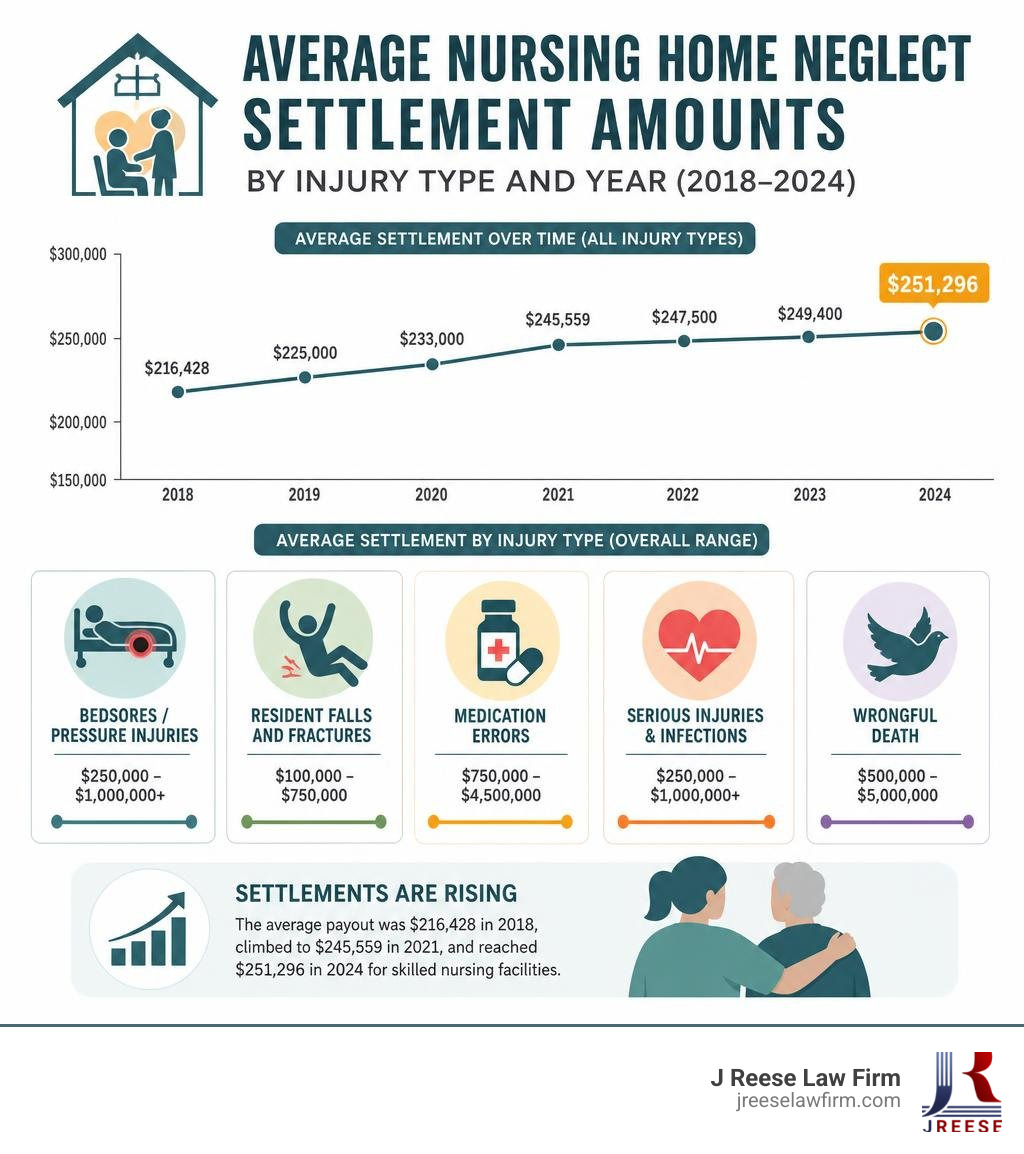
| Bedsores / pressure injuries | $250,000 – $1,000,000+ |
| Resident falls and fractures | $100,000 – $750,000 |
| Medication errors | $750,000 – $4,500,000 |
| Wrongful death | $500,000 – $5,000,000 |
These numbers have been rising steadily. The average payout was $216,428 in 2018, climbed to $245,559 in 2021, and reached $251,296 in 2024 for skilled nursing facilities alone.
Every family placing a loved one in a nursing home trusts that facility to provide safe, dignified care. When that trust is broken — through neglect, understaffing, or outright abuse — the consequences can be devastating. Bedsores. Broken bones. Infections. In the worst cases, wrongful death.
The financial cost of that carelessness falls on families. But the law says it doesn’t have to stay that way.
Nursing homes are legally obligated to meet a standard of care. When they fail, residents and their families have the right to pursue compensation. And with nearly 1 in 4 nursing homes cited for causing harm to a resident (according to a Government Accountability Office report), these cases are far more common than most people realize.
This guide breaks down what settlements actually look like, what drives the numbers up or down, and what steps families can take to protect their loved ones — and hold facilities financially accountable.
What Is the Average Nursing Home Neglect Settlement?
When families begin the process of seeking justice for their vulnerable loved ones, the first question they often ask is: What is the average payout we can expect?
While every situation is unique, looking at historical data and national trends gives us a solid baseline. In 2026, the data shows that the average nursing home neglect settlement has climbed significantly over the last several years. According to insurance industry data and legal market research, the typical settlement for a nursing home neglect claim sits around $251,296 for skilled nursing facilities, while the average across all types of senior care abuse and neglect cases hovers closer to $400,000 to $406,000 for severe harm.
This steady rise in settlement values is a direct response to a growing elder care crisis. Understaffing, a lack of proper training, and corporate cost-cutting have forced families to take legal action to protect their relatives. To understand how these numbers have evolved, let’s look at the historical trajectory:
- 2018: The average settlement was $216,428.
- 2021: The average rose to $245,559.
- 2024: The average reached $251,296 for skilled nursing facilities.
- 2026: Current projections and market research from platforms like Gitnux show the broader average abuse and neglect settlement sits at $406,000, with high-severity cases regularly crossing into seven-figure territory.
This upward trend is detailed further in the comprehensive analysis of Average Nursing Home Neglect Settlement Amounts (2026), which highlights how the legal system is increasingly penalizing systemic corporate neglect.
Furthermore, as families fight back against neglect, bedsores, and wrongful death, we are seeing major legal shifts. According to Nursing Home Abuse Lawsuit 2026, Average $400K Settlements As Families Fight Neglect, Bedsores, And Wrongful Death, courts and insurance providers are recognizing that neglecting basic human needs — such as regular movement to prevent bedsores or proper hydration — constitutes a severe breach of a facility’s legal obligations.
It is also important to note that settlement values can vary by the type of care facility involved:
- Skilled Nursing Facilities: Historically range from $216,000 to $251,000+. These facilities deal with highly vulnerable patients with intensive medical needs, meaning neglect quickly leads to catastrophic injury.
- Assisted Living Facilities: Average settlements range from $224,000 to $288,000. Because residents here are slightly more independent, cases often center around falls, elopement (wandering off), or medication mismanagement.
- Independent Living Facilities: Average settlements have seen the sharpest percentage increase, moving from $152,000 to $273,000. This reflects a growing legal consensus that even “independent” senior communities owe a basic, non-negotiable duty of safety to their residents.
Understanding the Average Nursing Home Neglect Settlement Range
While averages are helpful, they don’t tell the whole story. Most standard nursing home neglect lawsuits fall within a baseline range of $150,000 to $350,000.
Why is there such a wide spread? In the legal world, a “standard” neglect case might involve a single, non-fatal fall resulting in a fractured wrist, or a Stage 2 bedsore that was caught and treated before it could cause a systemic infection. These cases typically settle on the lower end of the spectrum because the medical bills are relatively contained and the resident made a full recovery.
However, when neglect is prolonged or results in permanent disability, the settlement value climbs rapidly. In cases of severe, systemic neglect, payouts frequently exceed $1,000,000. For example, a resident who develops a Stage 4 pressure ulcer that becomes septic, requiring multiple surgeries and months of intensive care, will naturally command a much higher settlement to cover those massive economic and non-economic losses.
As explored in What Is The Average Nursing Home Abuse Settlement Amount?, the final payout is highly dependent on the level of carelessness demonstrated by the facility and the long-term impact on the resident’s quality of life.
How Settlement Values Differ by Injury Type
The nature of the injury is one of the most reliable predictors of a settlement’s value. In senior care, certain injuries are considered “never events” — meaning they should never happen if a facility is providing even a basic standard of care. When these injuries occur, insurance companies know they have a weak defense, which often drives up the settlement offer.
Here is how different types of injuries typically impact the value of a claim:
- Bedsores (Pressure Ulcers): Often starting as minor skin redness, untreated bedsores can rapidly degrade into deep, open wounds that expose muscle and bone. Because bedsores are almost entirely preventable through simple measures like turning the resident every two hours, they carry high settlement values. Stage 3 or 4 bedsores typically settle for $250,000 to $1,000,000+.
- Resident Falls and Fractures: Falls are the leading cause of fatal and non-fatal injuries among older adults. If a facility fails to implement a proper fall-prevention plan (such as using bed alarms, low beds, or mobility assistance), they can be held liable. These settlements generally range from $100,000 to $750,000, depending on whether the fall resulted in a traumatic brain injury (TBI) or a broken hip requiring surgery.
- Medication Errors: Understaffed facilities often rush their nursing staff, leading to severe medication mistakes. Giving a resident the wrong dosage, the wrong drug, or failing to administer critical medication can lead to toxic shock, stroke, or organ failure. Because medical records provide a clear, undeniable paper trail of these errors, medication mistake settlements are among the highest, ranging from $750,000 to $4,500,000.
- Elopement (Wandering): When a resident with dementia or Alzheimer’s is not properly supervised and wanders off the property, they are exposed to extreme weather, traffic, and physical danger. Elopement cases are highly valued because they represent a complete failure of the facility’s security and supervisory systems, with settlements averaging around $361,000.
- Wrongful Death: If a resident passes away as a direct result of neglect — whether from an untreated infection, starvation, dehydration, or a fatal fall — the family can pursue a wrongful death claim. These settlements can range from $500,000 to upwards of $5,000,000, depending on the state’s laws regarding non-economic damages and the presence of punitive damages.
| Injury Type | Average Payout / Settlement Range | Why the Value Is High |
|---|---|---|
| Medication Errors | $750,000 – $4,500,000 | Clear medical paper trail; high risk of catastrophic internal organ damage or death. |
| Wrongful Death | $500,000 – $5,000,000 | Ultimate loss; covers funeral expenses, loss of companionship, and severe pain and suffering. |
| Bedsores (Stage 3/4) | $250,000 – $1,000,000+ | Considered a “never event”; clear evidence of prolonged physical neglect and lack of basic hygiene. |
| Elopement (Wandering) | $300,000 – $500,000 | Shows a complete failure of facility security and basic resident supervision protocols. |
| Falls & Fractures | $100,000 – $750,000 | Highly dependent on whether the facility ignored known fall risks or failed to use safety equipment. |
How Nursing Home Neglect Settlements Are Calculated
There is no magic formula or online calculator that can spit out an exact settlement figure. Instead, legal teams and insurance adjusters negotiate a number based on three distinct categories of damages.
If your loved one was injured due to facility carelessness, a dedicated Personal Injury claim will seek to recover compensation across these areas:
1. Economic Damages
These are the tangible, verifiable financial losses resulting from the neglect. They are calculated by adding up bills and receipts, which makes them the easiest part of a claim to prove. Economic damages include:
- Emergency Medical Expenses: Hospital stays, surgeries, diagnostic imaging, and medications required to treat the injury.
- Ongoing Care Costs: Physical therapy, specialized wound care, or the cost of transferring your loved one to a superior, safer facility.
- Funeral and Burial Costs: In the tragic event that the neglect leads to a wrongful death.
2. Non-Economic Damages
These damages compensate for the physical and emotional toll of the neglect. Because you cannot put a price tag on human suffering, calculating non-economic damages requires a deep understanding of how the injury impacted the resident’s daily life and dignity. These damages cover:
- Physical Pain and Suffering: The actual physical agony of enduring deep bedsores, untreated fractures, or severe infections.
- Mental Anguish and Trauma: The fear, anxiety, depression, and confusion that vulnerable seniors experience when they are left neglected or abused.
- Loss of Dignity and Enjoyment of Life: When neglect strips a senior of their mobility, their independence, or their ability to participate in social activities within their community.
For families dealing with severe, life-altering injuries, working with an experienced New Orleans Catastrophic Injuries Attorney is critical. We know how to paint a vivid picture of these non-economic losses to ensure the insurance company does not undervalue your loved one’s pain.
3. Punitive Damages
Unlike economic and non-economic damages, which are designed to compensate the victim, punitive damages are designed to punish the wrongdoer. These are only awarded in cases where the nursing home’s behavior was exceptionally reckless, malicious, or fraudulent. For example, if a facility intentionally altered medical records to cover up a fatal fall, or if management repeatedly ignored staff shortages that they knew would cause resident harm, a court may award punitive damages to send a clear message to the industry.
Key Factors Influencing an Average Nursing Home Neglect Settlement
No two nursing home neglect cases are identical. Even if two residents suffer the exact same injury, their final settlement amounts can look completely different. Several key variables drive these numbers:
- Severity of the Injuries: A resident who suffers temporary bruising from a fall will receive a much smaller settlement than a resident who suffers a hip fracture that permanently confines them to a wheelchair.
- The Facility’s History of Violations: If a nursing home has a clean record, the defense might argue the incident was an isolated accident. However, if state records show the facility has been repeatedly cited for understaffing, safety violations, or poor wound care, their leverage evaporates. A history of violations makes the facility look highly negligent in front of a jury, forcing their insurance company to offer a larger settlement to avoid trial.
- Duration of the Neglect: Was the neglect a single, tragic oversight, or did it occur over several weeks or months? Prolonged neglect — such as a resident losing 30 pounds due to malnutrition over a season — proves a systemic failure of care, which commands a higher settlement.
- The Resident’s Age and Prior Health Status: While it may sound harsh, insurance companies often try to discount settlements for residents who are very elderly or already have terminal illnesses, arguing their life expectancy was short regardless of the injury. We vigorously fight back against this bias, asserting that every senior has a right to spend their remaining days in comfort, safety, and peace.
- Insurance Policy Limits: A nursing home can only pay out what its insurance policy allows, unless the facility has massive independent corporate assets. If a facility carries a $1 million policy limit, securing a settlement above that amount can be incredibly difficult without going to trial and pursuing corporate parent companies.
- State Laws and Damage Caps: Some states place strict limits (caps) on non-economic damages in medical malpractice or nursing home cases. In states with low caps, the maximum amount a family can recover for pain and suffering is legally restricted, which artificially lowers the average settlement.
Proving Neglect: Essential Evidence for a Strong Claim

A nursing home will rarely admit they neglected your loved one. Their insurance company’s primary goal is to minimize their financial payout, and they will use every tactic available to blame the injury on the resident’s pre-existing health conditions or natural aging.
To secure a fair settlement, you must build an airtight case supported by undeniable evidence. When we represent families, we meticulously gather and analyze the following pieces of proof:
- Comprehensive Medical Records: We look for discrepancies between the nursing home’s daily logs and the hospital’s admitting records. For example, if a nursing home note says a resident’s skin is “intact,” but a hospital ER record from the same day notes a Stage 3 bedsore, we have clear proof of neglect and falsified documentation.
- Photographic and Video Evidence: Photos of bedsores, unsanitary living conditions, unexplained bruises, or a lack of basic safety equipment (like missing bed rails) are incredibly powerful. A picture is worth a thousand words to an insurance adjuster or a jury.
- Detailed Witness Statements: Eyewitness accounts from other residents, visiting family members, or even whistleblowing facility staff members can provide invaluable context about understaffing, slow call-light response times, or poor hygiene.
- Facility Staffing Logs: Many neglect cases are rooted in severe understaffing. By demanding the facility’s shift logs, we can prove that they did not have enough nurses or aides on duty to meet federal and state safety ratios.
- Expert Medical Testimony: We work closely with independent medical experts, wound care specialists, and senior care administrators who can testify that the resident’s injuries were the direct result of substandard care, rather than natural aging.
Building this level of proof is how we hold careless facilities accountable. You can read more about how strong evidence translates into real-world justice on our Results page.
The Timeline and Legal Process of a Settlement

Many families are hesitant to file a lawsuit because they fear a grueling, multi-year courtroom battle. However, the vast majority of personal injury cases — roughly 95% — are resolved through out-of-court settlements. In fact, statistics show that 61% of personal injury plaintiffs who rejected initial settlement offers to go to trial actually ended up with less compensation. Settling out of court is often the fastest, most private, and least stressful way to secure justice.
While some simple cases can resolve in a few months, a typical nursing home neglect claim takes 18 to 24 months to fully resolve.
Here is the step-by-step journey of a nursing home neglect claim:
- Initial Consultation & Investigation: We meet with your family, review the initial details, and begin gathering medical records, accident reports, and witness statements.
- Filing the Claim / Lawsuit: We file a formal complaint against the facility, laying out their negligent actions and the harm they caused your loved one.
- The Discovery Phase: Both legal teams exchange evidence. We take depositions (sworn out-of-court testimony) from facility administrators, nurses, and doctors to get their statements on the record.
- The Demand Letter: Once we have calculated the full extent of your loved one’s economic and non-economic damages, we send a formal demand letter to the facility’s insurance company, outlining our case and demanding a fair settlement.
- Negotiation & Mediation: The insurance company will counter our demand. We enter negotiations, which often include formal mediation — a meeting where a neutral third-party mediator helps both sides reach a mutually acceptable agreement.
- Trial (If Necessary): If the insurance company refuses to offer a fair payout that covers your medical bills and suffering, we are fully prepared to take the case to court and present it to a jury.
To learn more about what to expect during this process, visit our comprehensive FAQ page.
Frequently Asked Questions About Nursing Home Neglect
Navigating the legal system while caring for an injured parent or grandparent is incredibly overwhelming. Here are answers to the most common questions families ask us:
Who is eligible to file a nursing home neglect lawsuit?
If the resident is mentally competent, they have the primary right to file the lawsuit. However, if the resident is incapacitated (due to dementia, stroke, or severe injury), a legally designated representative can file on their behalf. This is typically:
- An individual holding Power of Attorney (POA) for health care or finance.
- A court-appointed legal guardian.
- A surviving spouse or adult child.
- The personal representative or executor of the resident’s estate (in wrongful death cases).
What is the statute of limitations for nursing home neglect claims?
The statute of limitations is the legal deadline for filing a lawsuit. If you miss this window, you lose your right to seek compensation forever.
In most states, the deadline is 2 to 3 years from the date the injury occurred or was first discovered. In wrongful death cases, the clock typically starts ticking on the date of the resident’s passing. Because calculating these deadlines can be complex — especially when dealing with cognitive decline or delayed discovery — it is critical to consult an attorney as soon as you suspect neglect.
Do I have to pay upfront to hire a nursing home abuse lawyer?
No. We handle nursing home neglect and abuse cases on a contingency fee basis. This means:
- You pay $0 upfront to hire us.
- We cover all the costs of investigating, gathering evidence, hiring experts, and filing the lawsuit.
- We only get paid if we successfully secure a settlement or jury verdict for your family.
- Our fee is a pre-agreed percentage (typically 33% to 40%) taken directly from the final payout. If we don’t win your case, you owe us nothing.
Holding Careless Facilities Accountable
When a nursing home chooses to cut corners, understaff its shifts, or ignore basic safety protocols, it is the residents who pay the price. The physical pain, emotional trauma, and financial burden of this neglect should never fall on your family’s shoulders.
Securing a fair average nursing home neglect settlement is about more than just recovering money to pay for medical bills. It is about holding these multi-million-dollar corporations financially accountable for their carelessness. By making neglect financially painful for these facilities, we force them to improve their standards of care, ultimately protecting future seniors from enduring the same suffering.
At J Reese Law Firm, we are deeply committed to fighting for the rights, safety, and dignity of vulnerable seniors. If you suspect your loved one has been harmed by facility carelessness, do not wait. Contact us today to discuss your legal options and learn how we can help your family secure the justice you deserve.
If you are ready to take the first step toward protecting your loved one, visit our Nursing Home Abuse page to schedule a free, compassionate, and completely confidential case review.