What a New Orleans Premises Liability Lawyer Can Do for You After a Property Injury

A New Orleans premises liability lawyer helps injured victims hold property owners legally responsible when unsafe conditions cause harm. If you were hurt on someone else’s property, here is what you need to know right away:
Quick answers:
- What is premises liability? Property owners must keep their premises reasonably safe. When they don’t, and you get hurt, they can be held liable.
- Who can file a claim? Anyone injured on another person’s property — a store, hotel, apartment, or private home — may have a valid claim.
- What laws apply? Louisiana Civil Code articles 2317 and 2317.1 govern property owner liability in Louisiana.
- How long do you have? For most injuries occurring on or after July 1, 2024, you have two years from the date of injury to file a lawsuit.
- What can you recover? Medical bills, lost wages, pain and suffering, and more.
- What should you do first? Seek medical care, report the incident, document the scene, and contact a lawyer before speaking to any insurance company.
Every day in New Orleans, people are hurt on property that should have been safe. A wet floor with no warning sign. A broken staircase in an aging French Quarter building. A poorly lit parking garage where an attack could have been prevented. These are not just accidents — they are often the result of a property owner’s failure to act.
The CDC reports that premises liability accidents account for as many as 30 million emergency room visits per year across the United States. More than one million people seek medical care after slip-and-fall accidents alone every single year.
When you step onto someone else’s property, you have a right to expect a basic level of safety. When that expectation is broken — and you pay the price with your health — Louisiana law gives you options.
Understanding Louisiana Premises Liability Law and Property Owner Duties
In Louisiana, premises liability is a specific legal concept grounded in civil law. Unlike other states that rely entirely on common law, our legal system is built on the Louisiana Civil Code. When it comes to keeping a property safe, property owners have a clear legal duty. If they fail in that duty, they can be held financially responsible for the resulting injuries.
The foundation of this responsibility lies in Louisiana Civil Code Article 2317 and Article 2317.1. Under these statutes, we must look at who has “custody” or “guard” over the property. The law states that a property owner or custodian is responsible for damages caused by a defect in their property if:
- They had ownership or custody of the thing that caused the damage;
- The property had a ruin, vice, or defect that created an unreasonable risk of harm;
- They knew or, in the exercise of reasonable care, should have known of the ruin, vice, or defect;
- The damage could have been prevented by the exercise of reasonable care; and
- They failed to exercise such reasonable care.
This means property owners cannot simply turn a blind eye to dangerous conditions. They are required to meet basic safety standards, perform regular inspections, and either repair hazards immediately or provide clear, visible warnings. Whether you are shopping in a grocery store, staying at a hotel, or visiting a friend’s apartment, the person in control of that space has a legal obligation to keep you out of harm’s way. To learn more about how these rules intersect with broader injury claims, check out our More info about personal injury claims page.
How a New Orleans Premises Liability Lawyer Establishes Owner Negligence
Proving that a property owner was negligent is not always a straightforward task. It requires a detailed legal strategy that links the property owner’s actions (or lack thereof) directly to your physical injuries. When we build a case, we must establish four core elements of negligence:
- Duty of Care: We prove that the property owner owed you a legal duty to keep the premises safe.
- Breach of Duty: We show that the owner failed to meet that duty by allowing a dangerous condition to exist without fixing it or warning you.
- Causation: We establish a direct link showing that the breach of duty (the hazard) was the direct cause of your accident and subsequent injuries.
- Damages: We document the actual physical, emotional, and financial losses you suffered as a result.
Because of our unique civil law system, proving these elements involves specific rules of evidence and notice. To understand why these claims require a specialized local approach, you can read about Why Louisiana Personal Injury Cases Are Different.
Visitor Status: Invitees, Licensees, and Trespassers
Historically, and in many jurisdictions, the specific duty a property owner owes to a visitor depends heavily on that visitor’s legal status. While Louisiana courts focus heavily on the general reasonableness of the owner’s conduct under Civil Code Article 2317.1, identifying your visitor status remains a vital part of analyzing a claim:
- Invitee: This is someone who enters the property for a business purpose, such as a customer in a retail store or a patron in a restaurant. Business owners owe the highest duty of care to invitees. They must actively inspect the property to discover hidden dangers and keep the premises safe.
- Licensee: This is a social guest who enters the property with the owner’s express or implied permission. Homeowners must warn licensees of any known hazards that are not easily visible.
- Trespasser: This is someone who enters a property without permission. Generally, property owners do not owe a duty of care to adult trespassers, other than refraining from intentionally harming them. However, a major exception is the attractive nuisance doctrine. If a property owner has something on their land that is highly appealing to children (like an unsecured swimming pool or a trampoline) and fails to secure it, they can still be held liable if a trespassing child is injured.
Common Types of Property Accidents in Orleans Parish
New Orleans is a city unlike any other, and our unique local environment brings unique property hazards. From the historic, centuries-old buildings of the French Quarter to the bustling modern commercial districts, property hazards are around every corner. Aging infrastructure, uneven brick walkways, settling foundations, and heavy tourist traffic create a perfect storm for property accidents.

Whether you are a local resident or a visitor enjoying a weekend in the Crescent City, the type of property where your accident occurred matters. The legal responsibilities can vary significantly between commercial and residential properties.
| Feature / Responsibility | Commercial Property (e.g., Retail, Hotels, Restaurants) | Residential Property (e.g., Private Homes, Apartments) |
|---|---|---|
| Primary Duty of Care | High duty to inspect, repair, and warn customers of hazards. | Duty to warn guests of known, hidden dangers; maintain safe structures. |
| Governing Law | La. R.S. 9:2800.6 (for merchants) & Civil Code 2317.1. | Louisiana Civil Code Articles 2317 and 2317.1. |
| Common Hazards | Freshly mopped floors, spilled drinks, cluttered aisles, broken stairs. | Loose porch steps, dog bites, unsecured swimming pools, poor lighting. |
| Typical Insurance Source | Commercial General Liability (CGL) insurance policies. | Homeowners insurance or renters liability coverage. |
Slip and Fall Accidents on Unsafe Walkways
Slip and fall accidents are the single most common type of premises liability claim. In New Orleans, these often happen on wet floors inside businesses, greasy restaurant walkways, or uneven pavements outside commercial establishments.
Under Louisiana Revised Statute 9:2800.6 (the Merchant Liability Act), if you slip and fall in a commercial business, you must prove that the merchant failed to exercise reasonable care, that the hazard presented an unreasonable risk of harm, and that the merchant had actual or constructive knowledge of the hazard before the fall. If you’ve suffered a fall due to a business’s carelessness, consulting a dedicated New Orleans Slip and Fall Attorney is the best way to protect your rights.
Negligent Security, Dog Bites, and Pool Hazards
Premises liability covers far more than just slipping on a wet floor. Other dangerous conditions on property can lead to severe, life-altering injuries:
- Negligent Security: Businesses like hotels, bars, and parking garages in high-crime areas have a duty to protect their guests. If an owner fails to provide adequate lighting, working locks, security cameras, or security personnel, and you are assaulted as a result, you may have a negligent security claim.
- Dog Bites: Louisiana follows strict liability rules for many animal attacks. If a dog owner fails to prevent their dog from biting someone who is lawfully on the property, they can be held liable. According to national statistics, about 12,480 citizens are hospitalized every year due to dog bites. If you have been attacked, our New Orleans Dog Bite Attorney can guide you through the recovery process.
- Swimming Pool Hazards: Drowning and near-drowning accidents are tragic and highly preventable. From 2019 to 2021, there was an average of 358 pool- or spa-related drowning fatalities reported per year in the U.S., and 75% of those victims were younger than 5 years old. Property owners must secure pools with proper fencing and self-latching gates.
Proving Your Claim: Notice, Control, and Key Evidence
To win a premises liability case in New Orleans, you cannot simply show that you got hurt on someone’s property. You must prove that the property owner had notice of the hazard and control over the area where the injury occurred.
- Actual Notice: The owner or their employees knew the danger existed (for example, a customer had already reported a spill).
- Constructive Knowledge: The hazard existed for such a length of time that the owner should have discovered and resolved it if they were exercising reasonable care.
To establish notice and control, we must dive deep into the property’s records. We look at maintenance logs, employee schedules, safety sweep sheets, and prior complaints.
Why You Need a New Orleans Premises Liability Lawyer to Preserve Evidence
The most critical piece of evidence is often surveillance footage. However, businesses routinely overwrite their security camera footage within days—sometimes even hours—of an accident.
When you hire a New Orleans premises liability lawyer, we immediately issue a formal preservation letter to the property owner. This legally demands that they preserve all video footage, incident reports, cleaning logs, and physical evidence related to your accident. We also locate and interview witnesses to secure written statements before their memories fade. If your fall resulted in a serious head injury, securing this evidence quickly is vital to your medical and legal recovery. You can learn more about this on our New Orleans Traumatic Brain Injury Attorney page.
How a New Orleans Premises Liability Lawyer Maximizes Your Compensation
Insurance companies are businesses, and their main goal is to settle your claim for as little money as possible. They may try to blame you for the fall or argue that your injuries are not as severe as you claim. A skilled attorney knows how to calculate the true value of your case and fight for the maximum compensation available.
Your recovery can include both economic and non-economic damages:
- Economic Damages: These are tangible financial losses with a clear paper trail, including emergency room bills, ongoing medical treatment, physical therapy, prescription costs, and lost wages from missed work.
- Non-Economic Damages: These cover the human cost of the accident, such as pain and suffering, emotional distress, loss of enjoyment of life, and permanent scarring or disfigurement. If you or a loved one has suffered a life-altering injury, please visit our New Orleans Catastrophic Injuries Attorney page to see how we handle these high-stakes claims.
Modified Comparative Fault and the 51 Percent Bar
Louisiana law regarding fault underwent a major change. Effective January 1, 2026, Louisiana transitioned from a pure comparative fault system to a modified comparative fault system with a 51 percent bar (Louisiana Civil Code Article 2323).
Under this current rule, your compensation will be reduced by your percentage of fault, but if you are found to be 51 percent or more at fault for your own accident, you are completely barred from recovering any damages from the property owner.
For example, if a court decides your total damages are $100,000, but determines you were 20 percent at fault because you were looking at your phone when you tripped, you can still recover $80,000. However, if the court decides you were 52 percent at fault, you will receive nothing. This change makes having an experienced lawyer on your side more critical than ever to fight back against unfair blame from insurance adjusters.
The Two-Year Statute of Limitations in Louisiana
Time is of the essence when filing an injury lawsuit in Louisiana. The legal deadline to file a lawsuit is known as the prescriptive period.
For injuries occurring on or after July 1, 2024, Louisiana Civil Code Article 3493.1 establishes a two-year statute of limitations for personal injury claims. While this is an extension from the historical one-year limit, waiting is still a major mistake. Evidence can disappear, witnesses can move away, and memories will fade. To understand the historical context of these deadlines and how they might affect older claims, you can read about Louisiana’s One Year Statute of Limitations.
Frequently Asked Questions About New Orleans Property Injuries
Navigating the legal aftermath of an injury can be overwhelming. Here are answers to some of the most common questions we receive from clients in Orleans Parish.
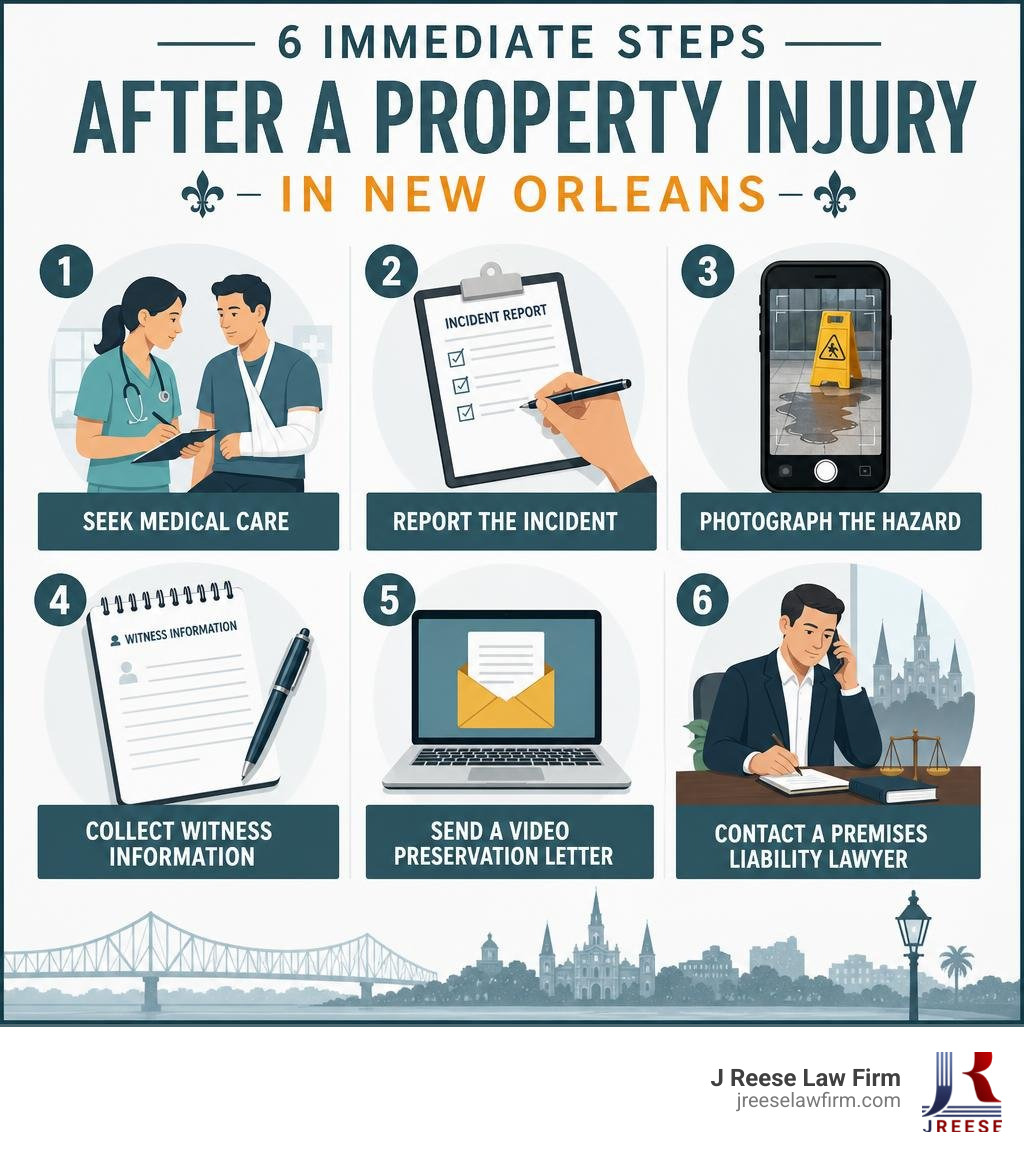
What should I do immediately after getting hurt on someone else’s property?
Your health and your legal rights depend on the actions you take immediately following an accident:
- Seek Medical Treatment: Your health is the top priority. Go to an emergency room or urgent care right away. This also creates an official medical record linking your injuries to the accident.
- Report the Incident: Notify the property owner, manager, or landlord immediately. Insist on filling out a written incident report and ask for a copy before you leave.
- Document the Scene: Take detailed photos and videos of the hazard that caused your fall (e.g., the puddle of liquid, the broken step, the lack of warning signs).
- Gather Witness Contact Info: If anyone saw you fall or noticed the hazard, write down their names and phone numbers.
- Keep Your Footwear and Clothing: Do not wash or throw away the shoes and clothes you were wearing during the fall, as they may be needed as evidence.
- Contact a Lawyer: Call an attorney before you speak to any insurance adjusters or sign any settlement offers.
Can I file a claim if I was injured at a friend’s house?
Yes, you can. Many people hesitate to seek compensation after getting hurt at a friend’s or family member’s home because they don’t want to cause personal conflict. However, it is important to understand that you are not suing your friend directly or taking money out of their pocket.
Your claim will be filed against their homeowners insurance or renters liability policy. This is exactly why people pay for insurance—to cover unexpected accidents on their property. An experienced attorney can handle the insurance company professionally, allowing you to get the financial help you need while preserving your personal relationship.
What damages can I recover in a premises liability lawsuit?
If you are injured due to a property owner’s negligence, you are entitled to seek comprehensive compensation for your losses. This includes:
- Medical Expenses: All past, current, and future medical bills related to the injury.
- Lost Wages: Compensation for the income you lost while recovering, as well as loss of earning capacity if you cannot return to your previous job.
- Pain and Suffering: Financial recovery for physical pain, mental anguish, and emotional trauma.
- Punitive Damages: In rare cases, if the property owner’s conduct was exceptionally reckless or intentional, Louisiana law may allow for punitive damages to punish the wrongdoer.
Conclusion
A sudden fall or unexpected injury on someone else’s property can disrupt your life, leave you with mounting medical bills, and make it difficult to support your family. You do not have to carry this heavy burden alone.
At J Reese Law Firm, we are dedicated to helping injury victims throughout Orleans Parish navigate the complexities of Louisiana’s premises liability laws. We will handle the investigations, preserve crucial evidence, counter comparative fault arguments, and negotiate aggressively with the insurance companies to secure the compensation you deserve.
If you or a loved one has been injured due to unsafe property conditions, contact us today for a free consultation. Let us stand up for your rights so you can focus on your recovery. Visit our Contact a New Orleans Premises Liability Lawyer page to get started.