
Types of Compensation for Car Crash Claims
When pursuing financial recovery after a collision, the law divides damages into specific legal categories. Understanding these buckets ensures you do not leave money on the table when negotiating with an insurance carrier.
Economic vs. Non-Economic Compensation for Car Crash Victims
Every personal injury claim revolves around two main types of compensatory damages: economic and non-economic losses.
Economic Damages (Tangible Losses): These represent out-of-pocket, calculable financial expenses caused directly by the wreck. They include:
- Past medical bills (emergency room visits, ambulance transport, diagnostic scans, surgeries, physical therapy, prescription medication).
- Estimated future medical treatment, ongoing rehabilitation, and home health care.
- Past lost wages from missed workdays.
- Diminished future earning capacity if your injuries permanently prevent you from returning to your prior trade.
- Property damage, including vehicle repairs or total loss fair market value compensation, rental car expenses, and personal property destroyed in the vehicle.
Non-Economic Damages (Intangible Losses): These cover the physical and psychological toll of an accident that cannot be quantified with an invoice. They encompass:
- Physical pain and suffering during treatment and daily recovery.
- Mental anguish, depression, insomnia, and post-traumatic stress.
- Loss of enjoyment of life (being unable to participate in hobbies, exercise, or family activities).
- Permanent physical disfigurement, scarring, or loss of bodily function.
According to average car accident settlement data, the average car accident injury settlement sits near $28,750, but claims with significant non-economic harm and extensive medical treatment frequently yield far more. Objective medical documentation serves as the single most critical piece of evidence when substantiating non-economic damages to an insurance adjuster.
Wrongful Death and Punitive Damages in Fatal Accidents
In tragic circumstances where a car crash results in a fatality, surviving family members can file a wrongful death claim to recover damages. These claims allow eligible relatives to recover:
- Funeral and burial expenses.
- Lost financial support and household contributions the deceased would have provided.
- Loss of consortium, companionship, protection, and parental guidance.
Additionally, when a defendant’s conduct demonstrates gross negligence, extreme recklessness, or intentional misconduct—such as driving under the influence of alcohol or drugs—courts may award punitive damages. Unlike compensatory damages, punitive awards exist to punish the wrongdoer and deter similar conduct across the community. Many states impose statutory rules or caps on punitive damages, requiring clear and convincing proof of reckless disregard for human life.
How to Calculate the Value of an Auto Accident Claim
Insurance companies do not guess what to offer you. Adjusters use standardized formulas and specialized claims software (such as Colossus) to establish settlement ranges based on medical codes, injury duration, and diagnostic severity.
Understanding these calculation methods allows you to determine whether a settlement offer reflects the true value of your case before signing any release agreements. For an independent look at updated figures, you can check 2026 settlement calculator metrics to see how insurers assess claim variables.
Average Settlement Values by Injury Severity and Type
The severity of your physical injury is the most influential factor determining claim value. Objective injuries visible on diagnostic imaging (X-rays, MRIs, CT scans) command significantly higher payouts than subjective soft-tissue complaints.
| Injury Category | Specific Injury Type | Typical Settlement Range | National Average Benchmark |
|---|---|---|---|
| Minor / Soft Tissue | Whiplash, cervical strain, contusions | $5,000 – $50,000 | $18,950 |
| Moderate | Broken bones, simple fractures | $50,000 – $250,000 | $125,000 |
| Moderate / Severe | Herniated / bulging discs (non-surgical) | $45,000 – $150,000 | $75,000 |
| Severe | Herniated discs requiring surgery / fusion | $150,000 – $350,000+ | $225,000 |
| Catastrophic | Traumatic Brain Injury (TBI) | $100,000 – $10,000,000+ | $850,000 |
| Catastrophic | Spinal cord injury / paralysis | $500,000 – $20,000,000+ | $1,200,000 |
Surgical cases consistently settle for 2 to 3 times higher than non-surgical claims because invasive procedures demonstrate undeniable physical trauma. Furthermore, sustaining multiple compounding injuries (such as whiplash paired with a lumbar disc herniation) typically increases overall claim value by 30% to 50% above single-injury baseline averages.
The Multiplier Formula Explained
The most widely accepted calculation standard used by attorneys and insurance adjusters is the Multiplier Method.
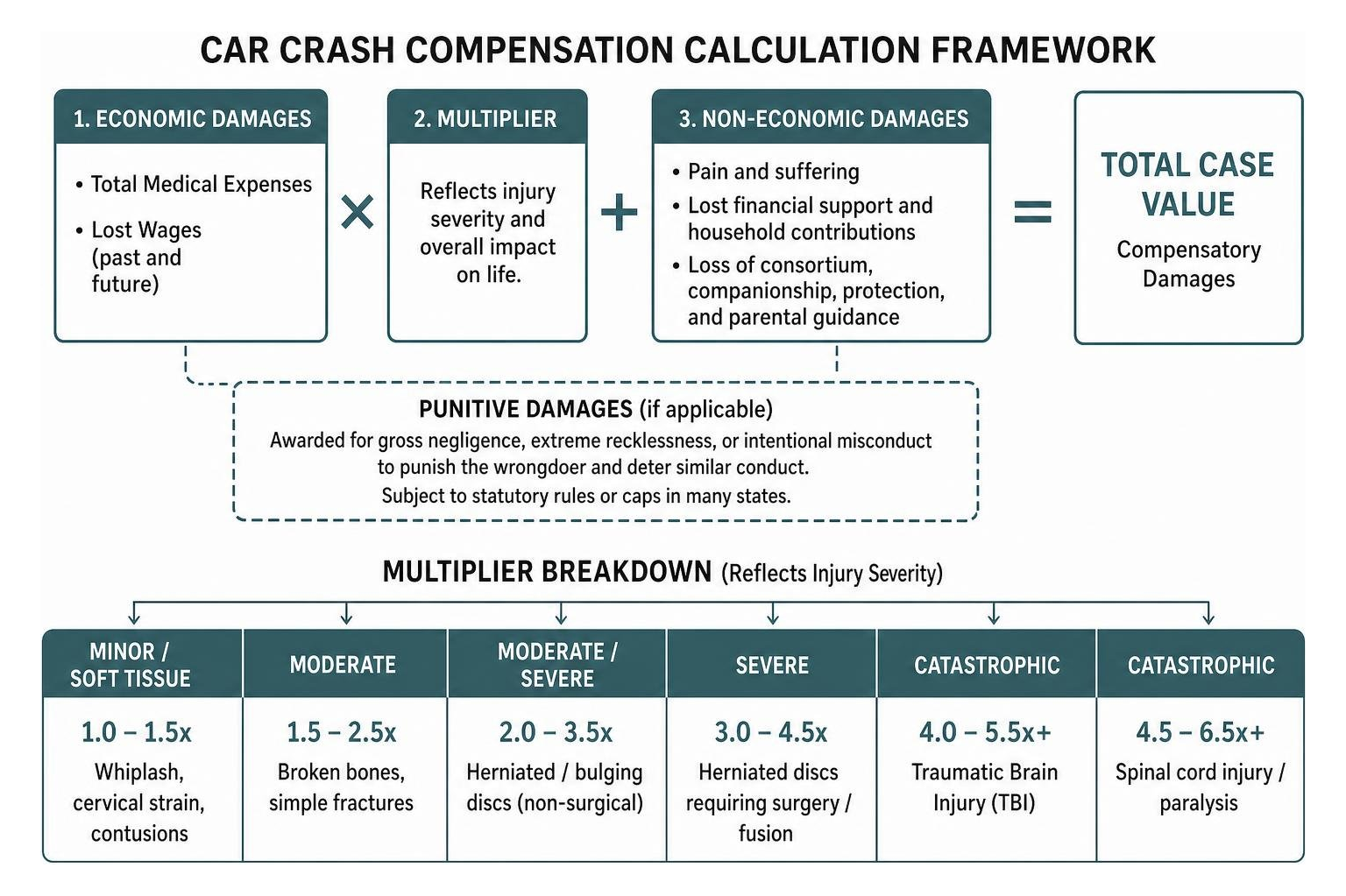
Under this approach:
$$\text{Total Case Value} = (\text{Total Medical Expenses} \times \text{Multiplier}) + \text{Lost Wages}$$
The multiplier scale reflects injury severity:
- 1.5x to 2x (Minor Injuries): Soft tissue strains, sprains, or minor whiplash resolving within several weeks of conservative therapy.
- 2x to 3x (Moderate Injuries): Bone fractures, torn ligaments, or concussions requiring several months of physical rehabilitation.
- 3x to 4x (Severe Injuries): Spinal disc herniations requiring injections, complex surgical interventions, or permanent partial impairment.
- 4x to 5x+ (Catastrophic Injuries): Permanent paralysis, severe traumatic brain injuries, extensive scarring, or lifelong disability.
Alternatively, some claims employ the Per Diem Method, assigning a specific daily dollar rate (often pegged to a worker’s daily wage) multiplied by the total number of days spent undergoing active medical recovery.
Never settle your claim before reaching Maximum Medical Improvement (MMI)—the point at which your treating physician determines your condition has stabilized and will not improve further. Settling before reaching MMI prevents you from recovering future surgery costs or long-term therapy bills that arise down the road.
How Fault and State Laws Impact Your Total Recovery
Legal liability rules dictate what portion of your calculated settlement you actually take home.
How Fault Rules Affect Your Compensation for Car Crash Injuries
States determine compensation through different negligence doctrines:
- Pure Comparative Fault: You can recover damages even if you are 99% at fault, though your payout is reduced by your exact percentage of liability. For instance, if your claim is worth $100,000 and you share 20% of the fault, your recovery becomes $80,000.
- Modified Comparative Fault (50% or 51% Bar): You can recover damages only if your share of fault is less than 50% (or 51%, depending on the state). If your liability crosses that statutory threshold, you receive $0.
- Pure Contributory Negligence (1% Rule): In pure contributory states, if you are found even 1% at fault for the collision, you are completely barred from recovering any financial compensation from the other party.
Knowing your state’s legal framework is essential right after a collision. You can read our guide on What to Do After a Car Accident in Louisiana to understand how evidence preservation directly protects your financial recovery under regional comparative negligence systems.
Insurance Coverage Limits and Subrogation Rights
Your total settlement recovery is ultimately constrained by available insurance policy limits. Even if your damages exceed $500,000, recovering that full amount directly from an individual driver with minimum statutory bodily injury coverage can be impossible unless they possess significant personal attachable assets.
To protect yourself against low policy limits:
- Uninsured/Underinsured Motorist (UM/UIM) Coverage: This covers the gap when the at-fault driver carries insufficient liability limits or no insurance at all (such as in hit-and-run crashes).
- Medical Payments (MedPay) / PIP: These cover immediate medical bills regardless of fault.
- Subrogation and Healthcare Liens: If your private health insurance or a government program (Medicare/Medicaid) pays for your accident-related medical bills, they may place a subrogation lien against your final settlement proceeds. Resolving and reducing these liens through formal negotiation ensures you keep the largest possible share of your final payout.
Step-by-Step Claim Process: From Scene to Settlement
Securing full compensation requires methodical action from the moment the collision occurs through the final signing of closing documents. Working with a dedicated New Orleans Car Accident Lawyer ensures your legal rights remain shielded from aggressive insurance adjuster tactics.

Immediate Actions and Evidence Collection
The value of your car accident case is largely determined in the first 30 days. To build an airtight foundation for your compensation claim:
- Call Law Enforcement: Ensure an official police crash report is filed at the scene.
- Document the Scene: Photograph vehicle damage, road skid marks, traffic signals, weather conditions, and visible bodily injuries from multiple angles.
- Seek Immediate Medical Treatment: Visit an emergency room or physician within 72 hours of the crash. Insurance adjusters use treatment gaps to argue that your injuries were caused by an unrelated event.
- Maintain a Pain Journal: Document your daily pain levels, physical limitations, missed family events, and emotional distress to create contemporaneous proof for pain and suffering damages.
- Decline Recorded Statements: Never give a recorded statement to the at-fault driver’s insurance adjuster without legal representation. Insurers are trained to ask questions designed to elicit statements they can interpret as admissions of shared fault.
Negotiating With Insurers vs. Going to Trial
Once you finish medical treatment, your legal team compiles a comprehensive demand package containing all medical bills, treatment narratives, wage loss verifications, and police records.
Insurance companies routinely issue initial settlement offers that are 30% to 50% below fair market value, hoping claimants accept out of financial desperation.
Through aggressive negotiation and counteroffers, most claims resolve out of court within 3 to 6 months after treatment concludes. However, if an insurer disputes clear liability or refuses to offer fair compensation, filing a formal lawsuit becomes necessary. Litigation allows your team to conduct depositions, issue subpoenas, retain economic and medical professionals, and present your case before a judge and jury for a binding verdict.
Frequently Asked Questions About Car Crash Settlements
What is the average car accident settlement in 2026?
The national average settlement for all car accident claims in 2026 is $30,416, with auto injury settlements averaging $28,750. However, these figures aggregate everything from minor rear-end fender benders to multi-million dollar catastrophic collisions. Claims involving broken bones average $125,000, while severe spinal trauma and traumatic brain injuries routinely settle between $500,000 and $2,000,000+.
How long do I have to file a car accident claim?
Every state enforces a strict statute of limitations (or prescriptive period) setting a legal deadline for filing a lawsuit. These deadlines typically range from 1 to 4 years from the date of the wreck. If you miss this statutory deadline, your legal right to pursue compensation is permanently extinguished. Claims involving government-owned vehicles or roadway defects often carry much shorter administrative notice requirements, sometimes as brief as 60 to 180 days.
How much do personal injury attorneys charge for car accident cases?
Most car accident attorneys represent clients on a contingency fee basis, meaning you pay zero upfront costs or out-of-pocket hourly legal fees. The attorney only collects a legal fee if they successfully recover a financial settlement or court verdict on your behalf—typically between 33.3% and 40% of the gross recovery.
Data from the Insurance Research Council shows that represented claimants consistently secure significantly higher gross recoveries than unrepresented individuals, even after attorney fees are deducted.
Protecting Your Legal Right to Full Financial Recovery
Navigating the aftermath of a serious auto collision can feel overwhelming when medical bills accumulate while you are unable to work. Insurance adjusters work on behalf of corporate carriers whose primary goal is minimizing claim payouts.
At J Reese Law Firm, we fight to level the playing field. Our team manages every detail of your claim—from securing crash reports and negotiating healthcare liens to holding negligent drivers accountable. If you or a loved one suffered injuries in a crash, consult with our New Orleans Personal Injury Lawyer team today to protect your recovery and demand the full compensation you deserve.