
Understanding Bad Faith Insurance: First-Party vs. Third-Party Claims
A bad faith insurance lawyer evaluates your claim, holds insurers accountable for unreasonable denials or delays, and pursues statutory penalties, attorney’s fees, and full compensation beyond the original policy amount. When you purchase an insurance policy, you enter into a legally binding contract. Beyond the written clauses on the page, the law imposes an implied covenant of good faith and fair dealing. This legal duty requires the insurer to treat policyholders honestly, investigate claims thoroughly, and resolve covered losses promptly. When an insurance company violates this obligation without a reasonable basis, it commits what the law terms insurance bad faith.
Insurance disputes generally fall into two categories:
- First-Party Claims: These involve disputes directly between you and your own insurer under policies such as homeowners, comprehensive auto, collision, health, life, or disability coverage. In a first-party bad faith scenario, your carrier refuses to pay benefits directly owed to you, delays payments without good reason, or undervalues the damage to your property or health.
- Third-Party Claims: These arise when someone else makes a liability claim against you—such as after a car crash—and your insurer fails in its duty to defend you or refuses to settle within your policy limits. When an insurer unreasonably gambles with your financial security by rejecting a reasonable settlement offer within policy limits, exposing you to personal liability via an excess judgment, it may be liable for third-party bad faith.
Understanding these distinctions is essential, especially when analyzing why Louisiana personal injury cases are different compared to other jurisdictions. In Louisiana, statutory provisions under the Insurance Code impose strict affirmative duties on insurance carriers. Insurers are required to adjust claims fairly and promptly and make reasonable efforts to settle claims with policyholders and third-party claimants. When a company ignores these legal duties, it faces liability beyond the original claim value.
Common Tactics Insurers Use to Undervalue and Deny Claims
Insurance companies are profit-driven corporations. While they market peace of mind, their claims-handling departments often use aggressive strategies to minimize payouts. Recognizing these unfair tactics is the first step toward protecting your rights.
Common practices that may indicate bad faith include:
- Unreasonable Delays: Stalling the claims process by constantly switching adjusters, failing to return phone calls, or needlessly prolonging investigations to pressure an exhausted policyholder into accepting less money.
- Biased or Inadequate Investigations: Conducting superficial inspections or hiring biased contractors whose primary role is finding reasons to deny coverage rather than objectively assessing the actual damage.
- Misinterpreting Policy Language: Citing vague exclusions, twisting policy definitions, or applying clauses out of context to claim that a covered loss is excluded.
- Excessive and Duplicative Documentation Demands: Requiring policyholders to submit the same receipts, medical records, or proofs of loss repeatedly in an effort to create procedural excuses for denial.
- Lowball Settlement Offers: Offering an initial settlement far below the actual cost of repairs, medical expenses, or business losses, hoping the claimant will take quick cash out of financial desperation.
- Threats and Intimidation: Falsely alleging claimant fraud or warning policyholders that pursuing a fair payment could result in policy cancellation or higher premiums.
These unfair practices occur across residential property damage, commercial business interruption, health, disability, and auto accident claims. When your claim involves physical injury, learning about New Orleans personal injury compensation and claim recovery helps you understand what a fair settlement should actually cover.
| Issue / Category | Legitimate Claim Dispute | Bad Faith Insurance Tactic |
|---|---|---|
| Investigation | Conducts timely, thorough, and objective review of all evidence. | Uses selective, biased reports and ignores clear evidence of loss. |
| Communication | Explains decisions promptly with specific policy citations. | Fails to reply, changes adjusters constantly, or gives vague reasons. |
| Claim Valuation | Bases repair estimates on standard regional market pricing. | Lowballs estimates by omitting major structural or medical damages. |
| Deadlines | Meets statutory review and payment timelines. | Delays without justification to create financial pressure on insured. |
| Policy Language | Applies clear, unambiguous exclusions supported by law. | Distorts clauses or manufactures ambiguities to avoid coverage. |
When to Hire a Bad Faith Insurance Lawyer for Your Claim
When an insurer reaches a total deadlock, offers insulting settlements, or issues a baseless denial, handling the dispute on your own becomes an uphill battle. Hiring legal counsel levels the playing field and signals to the insurer that their handling of the claim will face strict judicial scrutiny across relevant insurance dispute practice areas.
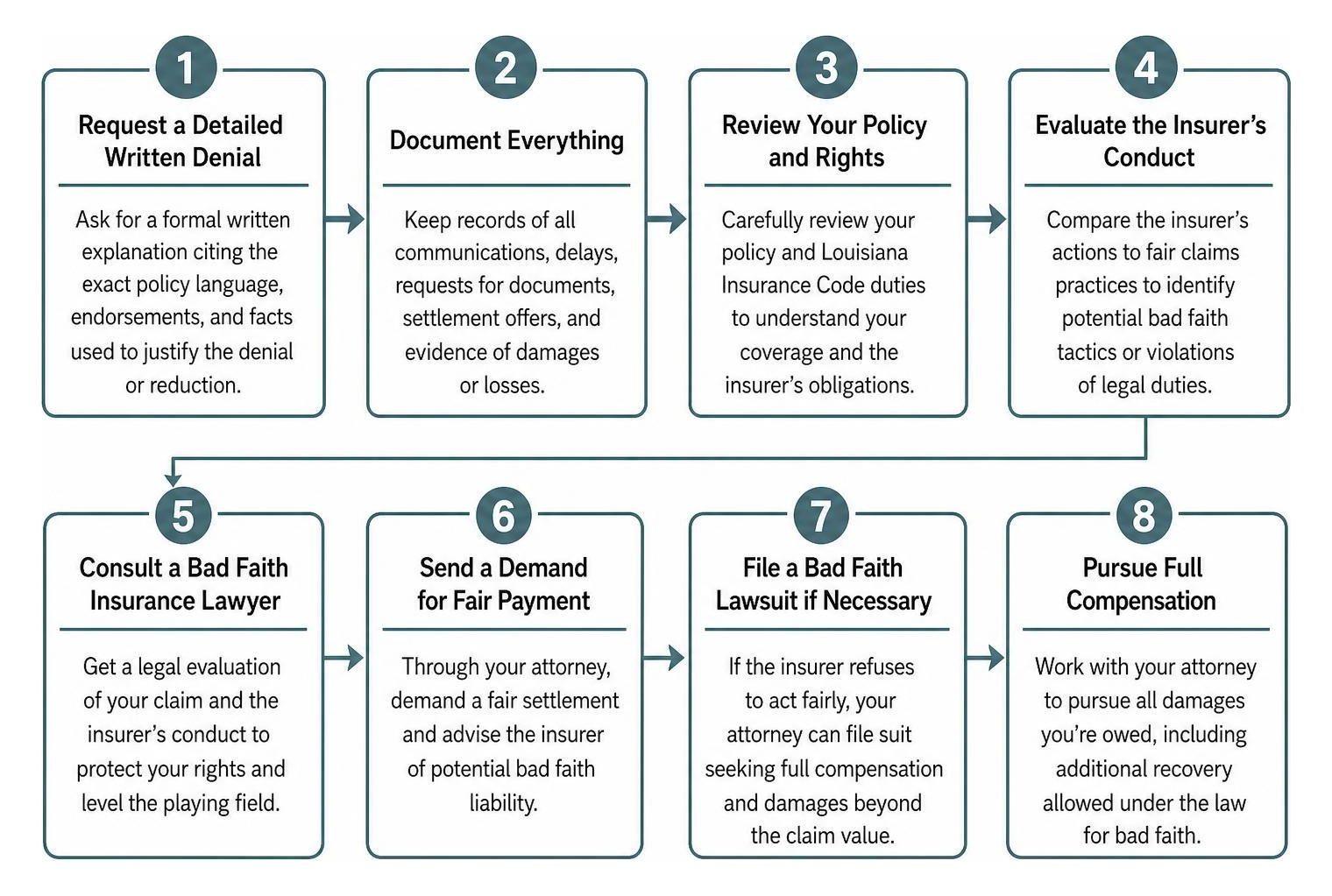
Steps to Take After an Unfair Claim Denial or Delay
If you suspect an insurer is handling your claim unfairly, taking specific, measured actions will help preserve your legal rights:
- Request a Detailed Written Denial: Ask the carrier to provide a formal written explanation citing the exact policy language, endorsements, and facts used to justify the denial or reduction.
- Preserve the Entire Claim File: Keep copies of your original policy, declaration pages, photographs of damage, receipts, invoices, medical records, and independent professional assessments. If your claim involves an injury from a slip and fall, take detailed photographs of the hazard (such as spilled liquid) and document whether warning signs were absent.
- Maintain a Detailed Communication Log: Record dates, times, names, phone numbers, and summaries of every conversation with adjusters and customer service representatives. Follow up every verbal discussion with a brief confirming email.
- Submit a Comprehensive Proof of Loss: File a complete, itemized formal proof of loss supported by repair estimates, medical bills, or independent appraisal reports.
- Avoid Signing Premature Releases: Never sign a global release or cash a check marked “full and final settlement” without a legal review of your claim.
How a Bad Faith Insurance Lawyer Proves Insurer Misconduct
Proving bad faith requires more than showing that an insurance company made an honest mistake. Your attorney must demonstrate that the carrier acted arbitrarily, capriciously, or without probable cause.
To build a compelling case, legal counsel uses formal discovery tools to uncover evidence that is otherwise hidden inside the insurance company’s internal files:
- Subpoenaed Claim Notes: Accessing internal adjuster logs, supervisor commentary, and audit trails to show what the insurer knew about the validity of your claim and when they knew it.
- Claims-Handling Guidelines: Comparing the company’s handling of your claim against its internal operating procedures and industry standards.
- Adjuster and Management Depositions: Questioning adjusters, claims managers, and third-party inspectors under oath to expose inconsistencies, lack of training, or financial incentives tied to claim denials.
- Objective Professional Testimony: Retaining independent engineers, general contractors, forensic accountants, and medical professionals to provide objective assessments of your damages.
Qualities to Look for in a Bad Faith Insurance Lawyer

Selecting the right attorney is critical when litigating against well-funded insurance carriers. As you evaluate your options, consider these essential qualities:
- Trial Experience: While many claims resolve through negotiation, insurance carriers know which attorneys actively try cases in court. A proven courtroom presence encourages serious settlement discussions.
- Deep Familiarity with Regional Insurance Law: State insurance codes and procedural requirements vary dramatically. Your lawyer must know local statutory deadlines, demand prerequisites, and bad faith penalties.
- Contingency Fee Structure: A client-friendly contingency model ensures that you pay no upfront legal fees, aligning your attorney’s focus directly with your recovery.
- Transparent Communication: You should work with a legal team that provides clear assessments of your case, explains potential risks, and keeps you informed at each phase of litigation.
Taking time to review criteria for finding trusted personal injury representation in New Orleans helps ensure you retain an advocate who is prepared for complex litigation. For direct legal representation, connect with J Reese Law Firm.
Recoverable Damages and Critical Deadlines in Bad Faith Claims
When an insurer is found liable for bad faith conduct, the damages available to policyholders go beyond the original contract balance. Depending on the applicable statutes and facts of the case, recoverable damages may include:
- Contractual Benefits: The full financial amount owed under the policy terms for property repairs, medical bills, or lost income.
- Consequential and Extracontractual Damages: Additional financial losses caused by the insurer’s delay or denial, such as temporary housing costs, business interruption losses, property deterioration, or damaged credit scores.
- Statutory Penalties: Specific statutory financial penalties designed to punish carriers for unreasonable behavior. For instance, in Georgia under O.C.G.A. § 33-4-6, a policyholder may recover a penalty of up to 50 percent of the covered loss, or $5,000 (whichever is greater), plus reasonable attorney fees. Under Florida Statute § 627.70131, insurers must pay, pay undisputed portions, or issue denials within 60 days of receiving notice. In California, insurers must adhere to strict timelines under the Fair Claims Settlement Practices Regulations, which mandate acknowledgment within 15 days and claim decisions within 40 days of proof of loss. In Louisiana, statutory penalties under the Insurance Code can add substantial monetary penalties directly to your recovery.
- Attorney’s Fees and Court Costs: Reimbursement for the legal fees and litigation expenses incurred to secure the policy benefits wrongfully withheld.
- Emotional Distress and Punitive Damages: In egregious cases involving fraud, malice, or intentional misconduct, courts may award compensation for mental anguish, as well as punitive damages to deter future bad behavior.
Understanding your state’s prescriptive periods and notice requirements is critical. Missing a statutory deadline—such as failing to submit a timely formal demand or filing after the statute of limitations expires—can bar your recovery. Evaluating these deadlines is a central step when choosing experienced legal representation in New Orleans.
Frequently Asked Questions About Insurance Bad Faith
For additional answers regarding claim options and legal procedures, explore our comprehensive insurance bad faith FAQ.
How do I know if my claim qualifies as insurance bad faith?
A claim qualifies as insurance bad faith when an insurance carrier denies, delays, or underpays your claim without a reasonable, justifiable basis under the policy terms and applicable law. Bad faith is not simply a minor disagreement over repair costs or a brief processing delay. It involves arbitrary actions, such as refusing to review submitted medical records, failing to conduct an on-site property inspection, misrepresenting policy coverage, or offering a settlement far below undisputed damages. Comparing the insurer’s formal denial letter directly against your policy language and documented losses often reveals whether bad faith has occurred.
What is the deadline to file a bad faith lawsuit against an insurer?
The deadline to file an insurance bad faith lawsuit depends on state-specific statutes of limitations and policy provisions:
- Louisiana: Bad faith actions are subject to strict prescriptive periods governing contract and statutory claims, making prompt legal review essential.
- California: Claimants generally face a two-year statute of limitations for tortious bad faith and four years for breach of contract.
- Georgia: Policyholders generally have up to six years to pursue contract-related claims, but must satisfy a mandatory 60-day statutory demand prerequisite.
- Florida: Strict notice requirements, including the filing of a formal Civil Remedy Notice (CRN), must be met before filing suit.
Because policy terms may also include shortened contractual limitation periods, you should consult an attorney immediately after receiving a denial.
How much does it cost to hire an attorney for an insurance dispute?
Most bad faith insurance attorneys handle claims on a contingency fee basis. Under this arrangement, you pay no upfront retainer fees or out-of-pocket costs. The legal team advances the necessary litigation expenses—such as filing fees, professional witness costs, and deposition court reporter fees. The attorney receives a predetermined percentage of the final financial recovery only if they successfully resolve your claim through settlement or a court verdict. Additionally, state bad faith statutes often allow policyholders to recover reasonable attorney fees directly from the insurer, reducing the impact on your underlying benefits.
Take Decisive Action to Protect Your Policyholder Rights
You paid your insurance premiums in good faith with the expectation that your carrier would stand by its promises when disaster struck. When an insurer relies on arbitrary denials, prolonged delays, or lowball payouts, you do not have to accept unfair treatment.
Holding insurance companies accountable requires a rigorous review of your policy, thorough preservation of evidence, and an unyielding litigation strategy. If your insurance company is refusing to honor your legitimate claim, our legal team is ready to evaluate your situation and fight for every dollar you are owed. Reach out to contact a New Orleans personal injury and bad faith attorney today to discuss your claim and secure the dedicated representation you deserve.