
Know Your Rights After a Traumatic Brain Injury
A traumatic brain injury personal injury claim may allow you to seek payment when another person’s or company’s careless actions caused a concussion, brain damage, or related symptoms. A TBI lawyer can review the accident, preserve evidence, assess medical records, identify responsible parties and insurance coverage, and pursue compensation for both current and future losses.
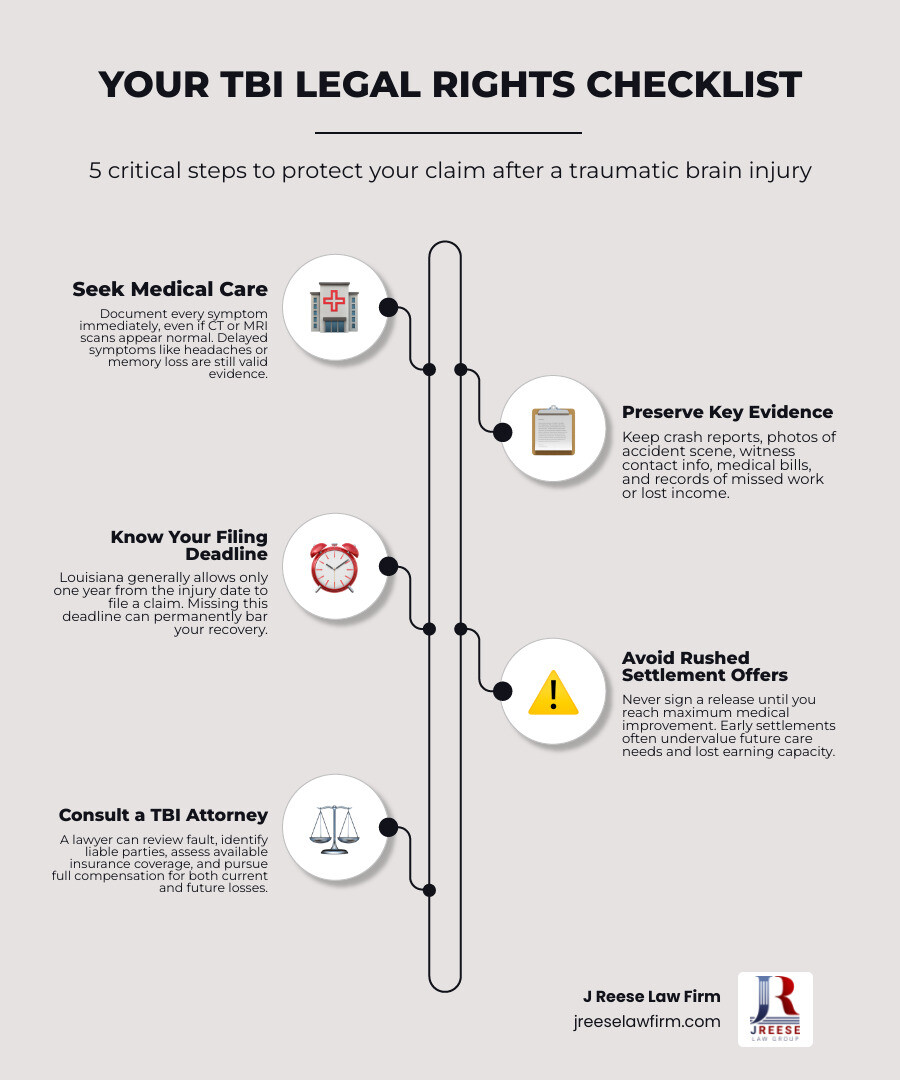
| If a TBI was caused by someone else | Your legal checklist starts here |
|---|---|
| Get medical care | Document every symptom, even if a CT or MRI is normal |
| Save evidence | Keep crash reports, photos, witness information, bills, and missed-work records |
| Know the deadline | State filing deadlines can be short, including Louisiana’s general one-year limit for many injury claims |
| Avoid a rushed release | A settlement is usually final, even if symptoms or care needs grow later |
| Speak with a lawyer | Review fault, available coverage, future costs, and the right claim path |
Brain injuries can follow a fall, vehicle collision, unsafe property condition, work accident, assault, medical error, or sports incident. Symptoms may be obvious right away, or they may show up later as headaches, dizziness, memory trouble, sleep changes, mood shifts, or difficulty concentrating. A normal standard scan does not automatically rule out a mild TBI.
I am Justin Reese, a civil litigation and personal injury attorney who has represented people and families facing catastrophic injuries, wrongful death, and auto collisions since 2011. My work in traumatic brain injury personal injury cases focuses on helping clients understand what happened, what evidence matters, and what is at stake before moving forward.
Key traumatic brain injury personal injury vocabulary:
- traumatic brain injury lawyer
- traumatic brain injury services
- brain injury resource center
Traumatic Brain Injury Personal Injury Claims: Symptoms and Causes

Understanding how head trauma impacts the human brain is the foundation of any legal claim. An estimated 1.5 million to 2 million head injuries occur annually across the United States. While around 250,000 of those individuals are admitted to a hospital, tens of thousands suffer long-term or permanent physical and cognitive impairments. TBI care and indirect recovery costs exceed $76 billion nationwide every year according to CDC data.
Primary brain damage happens at the exact second of physical impact, such as when a driver strikes their head against a steering wheel or when an unstrapped worker falls from a ladder. However, secondary damage develops gradually over hours, days, or weeks due to localized tissue swelling, elevated intracranial pressure, and biochemical shifts. When we evaluate a traumatic brain injury personal injury claim, capturing both primary trauma and secondary complications is critical to establishing the full impact on your life.
Causes of TBI: From Falls to Vehicle Collisions
Brain injuries arise from a wide variety of traumatic events. Falls remain the single most common cause of TBI overall, particularly among children aged four and under as well as older adults 65 and above. In workplace safety contexts, CDC reports indicate that falling accidents cause more than 800 deaths and 34,000 hospitalizations every year, with TBI being a primary contributor to fatalities.
Motor vehicle collisions—including passenger car crashes, commercial trucking crashes, motorcycle wrecks, and rideshare incidents—are a leading cause of severe head injuries among teenagers and young adults. Other frequent causes include unsafe commercial premises, defective consumer or industrial products, medical errors, contact sports injuries, and violent assaults.
To learn more about how head trauma litigation works locally, explore our guide on Louisiana Brain Injury Litigation 101 What You Need To Know.
Recognizing Symptoms Across Mild, Moderate, and Severe TBI
In civil claims, medical teams evaluate injury severity using clinical frameworks like the Glasgow Coma Scale (GCS), which measures eye opening, verbal responses, and motor function on a 3-to-15 point scale:
- Mild TBI (GCS 13–15): Often referred to clinically as a concussion. It may involve brief confusion, memory gaps surrounding the event, dizziness, light sensitivity, nausea, or mood swings. Loss of consciousness might last under 30 minutes or not happen at all.
- Moderate TBI (GCS 9–12): Typically involves loss of consciousness lasting between 30 minutes and 24 hours, post-traumatic amnesia lasting up to a week, pronounced executive dysfunction, slurred speech, persistent nausea, and localized weakness.
- Severe TBI (GCS 3–8): Involves prolonged loss of consciousness exceeding 24 hours, post-traumatic amnesia for over seven days, severe motor impairment, physical paralysis, or vegetative states requiring round-the-clock nursing care.
Even a mild TBI can turn into post-concussion syndrome, causing headaches, brain fog, and chronic fatigue that linger for months or years.
Types of TBI Lawsuits and Eligibility Requirements
To secure recovery in a traumatic brain injury personal injury civil action, we must establish four core elements of legal negligence:
- Duty of Care: The responsible party owed you a legal obligation to act safely (such as a motorist obeying traffic laws or a store owner keeping walkways clear).
- Breach of Duty: The party violated that obligation through action or inaction (texting while driving, ignoring a spill, or failing to install workplace safety railings).
- Causation: The negligent action directly caused the traumatic event and resulting brain trauma.
- Damages: You suffered real, quantifiable harm, such as emergency hospital bills, lost income, and emotional distress.
Who Is Eligible to File a Traumatic Brain Injury Personal Injury Claim?
In standard personal injury matters, the injured individual holds direct legal standing to file a claim. However, head injuries often impair cognitive capacity. If an injured person is temporarily or permanently incapacitated, a court-appointed legal guardian, conservator, or designated family representative can file the lawsuit on their behalf.
When head trauma proves fatal, surviving family members—such as spouses, children, or parents—may bring a legal action under state survival and wrongful death statutes. Read our section on Practice Area/New Orleans Wrongful Death Attorney to understand family compensation rights after a sudden loss.
Common TBI Lawsuit Categories
TBI lawsuits span several distinct legal areas depending on where and how the trauma occurred:
- Motor Vehicle Crashes: Involving passenger cars, commercial semi-trucks, buses, motorcycles, and pedestrians.
- Premises Liability Claims: Injuries caused by slip and fall accidents, tripping hazards, or unmaintained flooring. In slip and fall cases, gathering key evidence right away—such as taking clear pictures of the liquid or substance on the floor and noting missing wet floor warning signs—is crucial for proving property owner neglect.
- Workplace Accidents: Incident claims against third-party equipment contractors, vehicle operators, or property owners outside standard workers’ compensation insurance.
- Medical Malpractice: Claims arising when emergency room staff or surgeons fail to promptly diagnose an active brain hemorrhage or epidural hematoma.
- Product Liability: Lawsuits filed against manufacturers of defective motor vehicle seatbelts, malfunctioning airbags, or failing industrial safety helmets.
Our legal team at J Reese Law Firm evaluates each category to pinpoint every available insurance policy. You can review our dedicated Practice Area/New Orleans Traumatic Brain Injury Attorney page for further case insights.
Gathering Evidence and Proving “Invisible” Brain Injuries

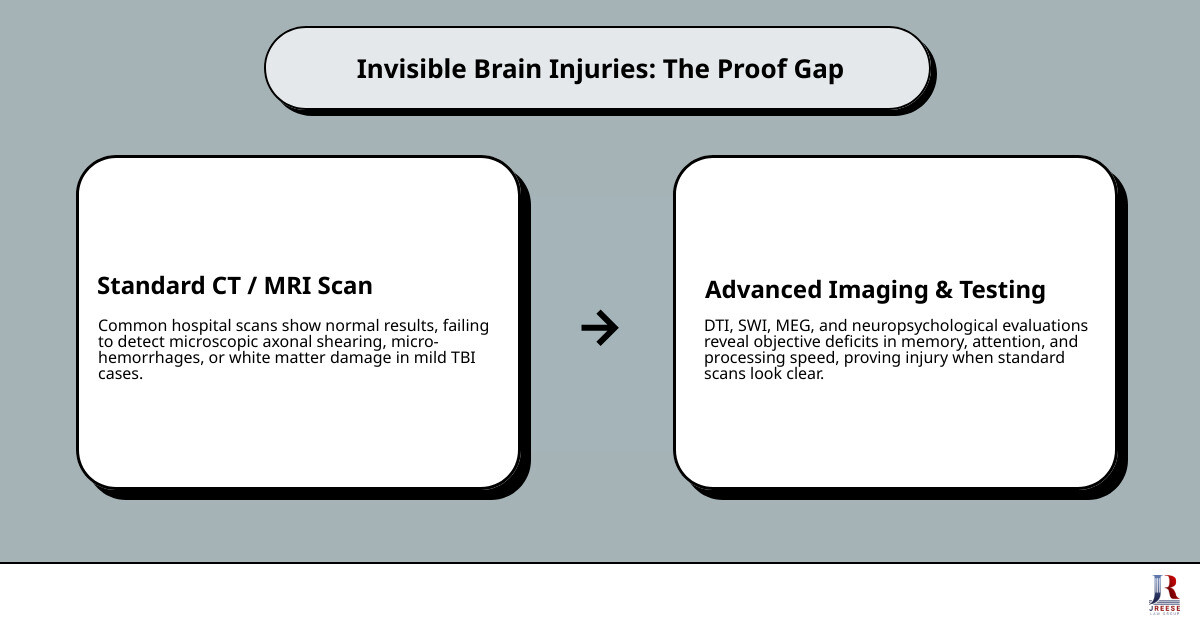
One of the biggest hurdles in traumatic brain injury personal injury cases is that mild brain injuries are frequently invisible on standard diagnostic tools. Conventional Computed Tomography (CT) scans and basic Magnetic Resonance Imaging (MRI) machines are designed to locate acute structural emergencies like skull fractures or active, large-scale brain hemorrhages. They regularly fail to detect microscopic cellular damage, microscopic bleeding, or white matter shearing.
Defense insurance adjusters often point to a clear CT scan to claim that a crash victim is exaggerating or faking their symptoms. Overcoming this defense requires building objective, comprehensive medical proof.
Proving Mild TBI When Standard Scans Look Normal
When standard hospital scans appear clear despite ongoing cognitive deficits, advanced neuroimaging tools can provide objective evidence:
- Diffusion Tensor Imaging (DTI): A specialized MRI technique that maps the movement of water molecules along white matter tracts, visually revealing microscopic axonal shearing and nerve damage.
- Susceptibility Weighted Imaging (SWI): Advanced imaging that detects tiny micro-hemorrhages and vascular disruption caused by sudden acceleration or deceleration forces.
- Magnetoencephalography (MEG) & functional MRI (fMRI): Advanced brain mapping tools that record magnetic fields created by neuronal activity, demonstrating functional deficits in regional brain processing.
- Neuropsychological Evaluations: Standardized multi-hour cognitive assessments administered by certified doctors to measure exact deficits in short-term memory, attention, processing speed, and executive function against established age and education baselines.
For a deeper dive into how legal teams combine medical data with trial strategy, check out How A Traumatic Brain Injury Lawyer Evaluates Your Case And Fights.
Medical and Lay Witness Testimony in Court
Winning full financial compensation requires connecting objective medical data to real-world daily struggles. Courts rely heavily on two main sources of testimony:
- Medical and Forensic Testimony: Neurologists, neuroradiologists, certified life care planners, and vocational counselors who establish the medical diagnosis, future care costs, and reduced earning capacity.
- Lay “Before-and-After” Witnesses: Spouses, family members, long-time friends, co-workers, and supervisors who can testify to observable behavioral changes. Testimony detailing how a once-organized manager now struggles to balance a checkbook or how a loving parent has become unexpectedly irritable provides compelling evidence to a jury.
Determining Case Value and Avoiding Early Settlement Risks
Every TBI case is unique, meaning overall settlement amounts vary based on injury severity, fault percentages, and policy coverage limits:
| TBI Severity Level | Typical Settlement / Verdict Range | Primary Case Drivers |
|---|---|---|
| Mild TBI / Concussion | $20,000 to $100,000+ | Medical bills, short-term missed work, post-concussion symptoms |
| Moderate TBI | $100,000 to $500,000+ | Long-term therapy, permanent cognitive changes, career adjustments |
| Severe / Catastrophic TBI | $1,000,000 to $10,000,000+ | Round-the-clock nursing care, full disability, life care plan costs |
Medical and legal resources note that lifetime management costs for severe head trauma frequently reach millions of dollars over a victim’s life.
Calculating Financial Recovery in a Traumatic Brain Injury Personal Injury Case
Financial damages fall into three main legal categories:
- Economic Damages: Direct, measurable financial losses. This includes past and future emergency medical care, physical therapy, specialized speech and occupational therapy, prescription medication, home modifications (such as wheelchair ramps), lost past income, and future lost earning potential.
- Non-Economic Damages: Intangible personal losses. This covers physical pain, mental anguish, permanent cognitive impairment, emotional distress, loss of enjoyment of life, and loss of spousal companionship.
- Punitive Damages: Extra monetary awards permitted in specific cases where the at-fault party acted with gross negligence, willful misconduct, or under the influence of alcohol or drugs.
Why Settling Too Early Can Be a Costly Mistake
Insurance company adjusters often attempt to contact accident victims within days of a crash to offer a fast cash settlement in exchange for signing a liability release waiver. Accepting an early settlement offer is almost always a mistake for several reasons:
- Settlements Are Final: Once you execute a release agreement, you permanently give up the legal right to ask for additional funds, even if your condition deteriorates later.
- Uncertain Prognosis: Doctors cannot accurately project your long-term recovery until you reach Maximum Medical Improvement (MMI)—the point where your medical condition has stabilized and further recovery can be assessed.
- Underestimating Lifetime Care Costs: Early offers rarely take into account long-term home health care, specialized equipment replacements, or decades of lost future promotion potential.
Learn more about maximizing compensation in our resource on New Orleans Personal Injury Your Guide To Getting Every Dollar You Deserve.
Filing Deadlines and Statutes of Limitations
Every state imposes strict deadlines—known as statutes of limitations—that restrict how long you have to file a personal injury lawsuit after an accident. Missing this strict legal window permanently bars you from pursuing compensation in court.
In Louisiana, civil injury claims are governed by a short prescriptive period. In most personal injury cases, you have just one year from the exact date of the accident to file a civil petition.
Certain narrow legal exceptions exist that may pause or extend (toll) statutory deadlines, such as cases where the injured victim is a minor or suffers from severe mental incapacity that leaves them unable to manage legal affairs. However, relying on tolling exceptions without early legal guidance is risky.
To protect your legal rights before evidence disappears, review Louisianas One Year Statute Of Limitations.
Frequently Asked Questions About TBI Claims
Can I file a TBI lawsuit if I never lost consciousness after the accident?
Yes. Losing consciousness is not required to diagnose a traumatic brain injury or file a valid personal injury claim. Many individuals who suffer serious concussions or permanent post-concussion syndrome never black out. The sudden violent movement of the head can cause the brain to bounce or twist inside the skull, tearing delicate neural tissue without causing loss of consciousness.
How does a life care plan impact the value of a severe brain injury settlement?
A life care plan is an extensive, court-tested report compiled by a certified medical life care planner. It details all anticipated future medical treatments, surgical interventions, prescription drugs, physical and cognitive therapies, adaptive home modifications, wheelchair-accessible vehicles, and home nursing care needed over the victim’s full life expectancy. Financial analysts then calculate the present value of those future expenses, turning intangible future care needs into concrete financial demands during settlement negotiations or trial.
What if my TBI symptoms didn’t appear until days or weeks after the collision?
Delayed symptom onset is very common in head injury cases. Inflammation, micro-bleeding, and pressure shifts inside the skull often build up slowly over time. If you begin experiencing persistent headaches, dizziness, sleep disruptions, or emotional changes days after an accident, seek an immediate medical evaluation and inform your doctor about the incident. Maintaining a daily symptom journal helps build a clear timeline connecting your delayed symptoms directly to the initial accident.
Protecting Your Future After a Head Injury
Navigating the legal, financial, and medical challenges following a traumatic brain injury can feel overwhelming for victims and their loved ones. Between managing diagnostic doctor visits, facing missed workdays, and dealing with aggressive insurance company adjusters, securing fair compensation requires taking structured, deliberate legal steps.
By preserving accident scene evidence, seeking prompt medical evaluations, documenting subtle cognitive changes, and partnering with experienced legal counsel before signing insurance releases, you take control of your long-term financial stability.
If you or a family member is dealing with the consequences of a head injury caused by someone else’s negligence, do not try to carry the burden alone. Contact our team at J Reese Law Firm today to schedule a confidential, no-obligation case evaluation. We are ready to stand by your side, protect your rights, and pursue the full recovery you deserve.