
When a Head Injury Changes Everything: What a TBI Lawyer Can Do for You
A traumatic brain injury lawyer is a legal advocate who helps people injured by another party’s negligence recover the full cost of their brain injury — including future medical care, lost income, and pain and suffering.
Here’s what you need to know right away:
- A TBI is not just a “bad headache.” It can permanently affect memory, personality, speech, and your ability to work.
- Normal CT and MRI scans do not rule out a serious brain injury.
- Insurance companies routinely downplay TBI claims — often before you know the full extent of your injury.
- Accepting an early settlement can leave you with nothing to cover years of future care.
- You have a limited window to file a claim in Louisiana. Acting quickly matters.
Brain injuries are one of the most financially devastating injuries a person can suffer. About 176 Americans died every day from TBIs in 2020, and over 223,000 were hospitalized in 2019 alone. In Louisiana, where car accidents, slip and falls, and industrial incidents are common causes of serious head trauma, the stakes are even higher.
The gap between what an insurer offers and what a TBI actually costs over a lifetime can be measured in millions of dollars — and that gap is exactly where experienced legal representation makes the difference.
I’m Justin Reese, a catastrophic injury and personal injury attorney with J Reese Law Firm, and I’ve spent my career recovering tens of millions of dollars for people whose lives were upended by serious injuries — including as a traumatic brain injury lawyer for clients facing some of the most complex, high-stakes claims in Louisiana. In the sections ahead, I’ll walk you through exactly how these cases work and how to protect your future.
Understanding Traumatic Brain Injuries vs. Standard Head Trauma
When people hear the term “head injury,” they often picture a minor bump, a small cut, or a mild concussion that clears up after a few days of rest. However, a traumatic brain injury (TBI) is fundamentally different from standard head trauma. While a standard head injury might only affect the outer skull or scalp, a TBI involves actual damage to the brain tissue, disrupting normal neurological function.
Medical professionals generally classify TBIs into three categories: mild, moderate, and severe.
- Mild TBI (Concussions): Although labeled “mild,” a concussion can still cause long-lasting cognitive deficits. Symptoms include headaches, dizziness, memory lapses, and mood swings.
- Moderate TBI: This involves a longer loss of consciousness (from several minutes to hours), persistent confusion, and noticeable behavioral changes.
- Severe TBI: Often resulting from high-impact collisions or falls, severe TBIs can cause prolonged periods of unconsciousness, comas, or permanent vegetative states.
One of the most complex types of brain trauma we handle is a diffuse axonal injury (DAI). Unlike a localized bruise on the brain (a contusion), a DAI occurs when the brain rapidly shifts inside the skull, tearing the long connecting nerve fibers (axons). This shearing effect happens on a cellular level, leading to widespread cognitive dysfunction, memory loss, and severe emotional disruption.
Understanding these distinctions is vital when building a legal claim. A general injury claim might focus purely on visible wounds, but a brain injury demands a deeper understanding of neurology and cognitive rehabilitation. If you or a loved one is dealing with the long-term fallout of a head blow, you should consult a New Orleans catastrophic injuries attorney to ensure your prognosis is legally and medically documented.
How Insurers Downplay Your Injury and Why You Need a Traumatic Brain Injury Lawyer
Dealing with insurance companies after a life-altering accident can be incredibly frustrating. Insurance adjusters are trained to protect their company’s bottom line, which means their primary goal is to pay out as little as possible. Because brain injuries do not always show outward physical signs—like a broken bone or a surgical scar—insurers frequently exploit this “invisibility” to downplay your symptoms.

A common tactic is to misclassify your injury. An adjuster might look at your initial emergency room discharge papers, see the word “concussion,” and argue that your injury is minor and should resolve within a few weeks. They may also look for gaps in your medical records. If you waited a few days to see a doctor because you hoped your headache would go away, the insurance defense will claim that your cognitive issues were caused by something else entirely, or that you are simply exaggerating.
We understand these corporate tactics. To protect your rights, we utilize the strategies outlined in our guide on Louisiana brain injury litigation to counter these defense arguments with objective, hard-to-refute medical evidence.
The danger of handling an insurance claim without a traumatic brain injury lawyer is the temptation to settle too early. TBI symptoms are notorious for evolving over 12 to 24 months. What feels like mild brain fog today could develop into severe, permanent executive dysfunction next year. Once you sign a settlement release, you cannot go back and ask for more money. If you settle before your long-term prognosis is fully understood, you may end up personally responsible for hundreds of thousands of dollars in future medical care.
Why Insurance Adjusters Avoid a Traumatic Brain Injury Lawyer
When you hire a dedicated legal advocate, the entire dynamic of your claim shifts. Insurance adjusters know they can no longer pressure you into accepting a lowball settlement.
Defense attorneys often rely on wearing victims down, hoping they will take a quick payout out of desperation. A legal team with deep experience in brain trauma understands how to accurately value your case. We calculate not just your current emergency room bills, but the lifetime cost of cognitive therapy, vocational retraining, and home health assistance, forcing the insurance company to take your claim seriously.
Proving the “Invisible Injury” When Standard Scans Show Nothing
One of the greatest hurdles in a brain injury lawsuit is proving the damage exists when standard medical tests look completely normal. It is incredibly common for a TBI victim to visit an emergency room, undergo a standard computed tomography (CT) scan or magnetic resonance imaging (MRI) scan, and be told, “Your brain looks perfectly fine.”
The truth is that standard CT and MRI scans are designed to detect structural issues like skull fractures, large brain bleeds, or major tumors. They do not have the resolution to show microscopic damage to nerve pathways or changes in localized brain metabolism.
To bridge this medical evidence gap, we work with advanced medical practitioners who utilize cutting-edge neuroimaging techniques:
| Scan Type | What It Detects | Why It Matters for Your Case |
|---|---|---|
| Standard CT / MRI | Major structural damage, skull fractures, large hemorrhages. | Useful for ruling out immediate life-threatening emergencies, but often misses mild-to-moderate TBIs. |
| Diffusion Tensor Imaging (DTI) | Microscopic damage to the brain’s white matter tracts (axonal shearing). | Provides objective visual proof of the cellular tearing caused by high-impact collisions. |
| Functional MRI (fMRI) | Real-time blood flow and metabolic activity in specific brain regions during tasks. | Demonstrates functional deficits by showing which parts of the brain are struggling to process information. |
| PET / SPECT Scans | Cellular metabolism and regional blood perfusion. | Highlights areas of the brain that are underperforming due to trauma, even when structural scans are clear. |
Beyond advanced imaging, neuropsychological testing is one of our most powerful tools. This involves a comprehensive battery of cognitive and psychological evaluations conducted by a highly-trained clinical neuropsychologist. These tests measure memory, attention span, problem-solving abilities, language processing, and emotional regulation. By comparing your results against established baselines, a neuropsychologist can objectively document your functional loss.
To build a comprehensive claim, we also gather non-medical evidence, such as testimonies from family members, friends, and coworkers who can describe the “before and after” picture of your daily life.
Calculating the True Lifetime Value of Your TBI Claim
Determining the value of a traumatic brain injury case is a complex process. Because a TBI can affect every facet of your existence, the financial recovery must cover both your immediate losses and your long-term needs.

When we evaluate a TBI claim, we look at several categories of damages:
- Future Medical Costs and Rehabilitation: A serious brain injury often requires years of physical therapy, occupational therapy, speech therapy, and psychological counseling. We work closely with life care planners to project these expenses over your estimated lifespan.
- Lost Earning Capacity: If your cognitive deficits prevent you from returning to your previous profession—or from working at all—you are entitled to compensation for your lost future income. We use vocational advocates and economists to calculate what you would have earned had the injury never occurred.
- Non-Economic Damages: These cover the intangible impacts of your injury, such as physical pain, mental anguish, depression, loss of enjoyment of life, and the frustration of losing your independence.
- Loss of Consortium: A brain injury does not just affect the survivor; it places an immense emotional strain on the entire household. Spouses can seek damages for the loss of companionship, affection, and support.
In the most tragic circumstances, a severe brain injury can result in a fatal outcome. If you have lost a family member due to a catastrophic head injury, you may be eligible to file a wrongful death lawsuit to seek compensation for funeral costs, lost financial support, and emotional grief. You can learn more about this process by speaking with a wrongful death claims attorney.
Establishing Liability Beyond the At-Fault Driver
While many brain injuries occur in simple two-vehicle car crashes, many cases involve multiple layers of legal liability. To maximize your financial recovery, we look beyond the driver who physically struck your vehicle to identify all potentially responsible parties.
- Trucking Companies and Commercial Vehicle Liability: If you were struck by an 18-wheeler or commercial delivery vehicle, the trucking company itself may be held liable. Commercial claims open up additional avenues of recovery, as trucking companies are required to carry much larger insurance policies. We investigate whether the company failed to properly train the driver, violated federal hours-of-service limits, or neglected vehicle maintenance.
- Premises Liability and Slip and Fall Incidents: Property owners have a legal obligation to keep their premises safe. If you suffered a head injury because you slipped on a wet floor or tripped over a hazard, the business or property owner may be responsible. To build a strong premises liability case, it is crucial to gather evidence immediately. If possible, you should take pictures of the substance (such as the liquid on the floor) that caused you to slip, and document that there were no wet floor signs posted in the area.
- Product Defects and Manufacturing Liability: Sometimes, a brain injury is made worse because a safety product failed to perform as designed. If your vehicle’s airbags failed to deploy during an accident, or if a motorcycle or bicycle helmet cracked under a minor impact, you may have a product liability claim against the manufacturer.
Exploring these alternative liability theories is essential for securing the funds needed for lifetime care. To learn more about how we investigate these complex claims in our local area, visit our page on New Orleans personal injury lawyer services.
Frequently Asked Questions About Brain Injury Claims
Navigating the legal system while recovering from a serious head injury can feel overwhelming. Below, we have answered some of the most common questions our clients ask about the legal process.
How long does a TBI lawsuit take to resolve?
Most traumatic brain injury lawsuits take anywhere from one to three years to resolve. Because these cases are highly complex and involve substantial compensation, they naturally take longer than standard personal injury claims.
A major factor in the timeline is reaching Maximum Medical Improvement (MMI). MMI is the point at which your medical team believes your condition has stabilized and is unlikely to improve further. We cannot accurately calculate your lifetime medical costs or lost earning capacity until you reach MMI. If we rush to settle your case before this point, we risk leaving valuable compensation on the table. Once MMI is established, we will enter intensive settlement negotiations, and if the insurance company refuses to offer a fair payout, we will prepare your case for trial.
Why You Need a Dedicated Traumatic Brain Injury Lawyer Over a General Practitioner
Personal injury law is a broad field. While a general practitioner may be highly capable of handling a straightforward car accident with soft-tissue injuries, a brain injury claim requires highly specialized legal and medical knowledge.
A dedicated TBI attorney understands neurolaw—the intersection of neuroscience and the legal system. We maintain a deep network of trusted neurologists, neuropsychologists, life care planners, and vocational advocates who can provide the expert testimony needed to win your case. Furthermore, we have extensive trial experience and are fully prepared to present complex scientific data to a jury in a clear, compelling way.
What should I do immediately after a head injury to protect my rights?
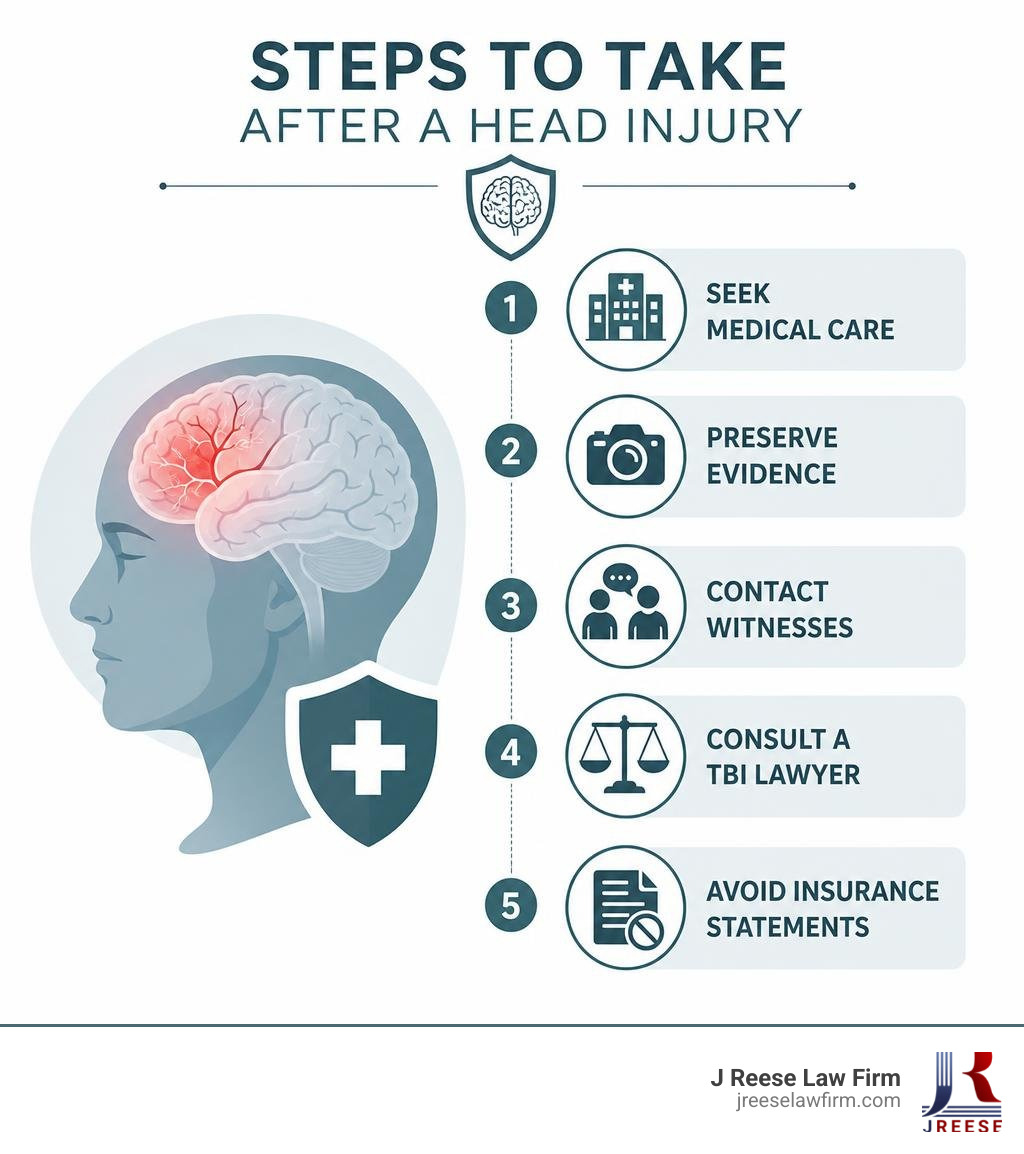
If you suspect you or a loved one has suffered a brain injury, taking the right steps early on can protect both your health and your potential legal claim:
- Seek Immediate Medical Attention: Go to an emergency room or see a doctor the same day as the accident, even if you did not lose consciousness. Detail every symptom you are experiencing, no matter how minor it seems.
- Preserve Physical Evidence: Keep any damaged property, such as a dented bicycle helmet, torn clothing, or your vehicle’s dashcam footage.
- Document the Scene: If you were injured in a slip and fall, take photos of the hazard, the surrounding area, and the lack of warning signs.
- Collect Witness Information: Get the names and contact details of anyone who saw the incident occur.
- Avoid Giving Insurance Statements: Do not provide recorded statements to the insurance company or sign any medical authorization releases until you have consulted with a legal advocate.
Secure Your Future with a Dedicated New Orleans Legal Advocate
A traumatic brain injury can disrupt your life, your career, and your family’s financial stability in an instant. You do not have to carry this immense burden alone. At J Reese Law Firm, we are committed to helping brain injury survivors in New Orleans secure the financial resources they need to rebuild their lives.
We work on a contingency fee basis, which means you pay absolutely nothing upfront, and we only collect a fee if we win your case. Let us handle the complex legal battles and insurance negotiations so you can focus on your recovery.
To learn more about how we can help you, schedule a consultation with a New Orleans Traumatic Brain Injury Attorney today. We will review the details of your accident, evaluate your medical records, and build a personalized legal strategy designed to protect your future.