How Does Louisiana Establish Legal Jurisdiction and Service of Process Over Non-Resident Motor Carriers?
When an out-of-state 18-wheeler causes a devastating collision on the Westbank Expressway, Belle Chasse Highway, or Interstate 90, foreign motor carriers often assume they can retreat behind state lines to avoid legal accountability. Under Louisiana law, that is simply not the case. We hold non-resident trucking companies accountable directly in local courts through well-established jurisdictional principles and statutory mechanisms.
Under Louisiana Revised Statutes § 13:3201—commonly known as the Louisiana Long-Arm Statute—our state courts exercise personal jurisdiction over non-residents who commit a tortious act (such as a negligent truck crash) within our borders or cause injury while regularly conducting business here. When a motor carrier routes an 80,000-pound commercial vehicle through Gretna to deliver cargo, haul freight, or navigate regional supply chains, that carrier actively engages in commerce within our jurisdiction.
Understanding why Louisiana personal injury cases are different is critical when managing claims against multi-state corporations. Our civil law framework, combined with specific procedural statutes, gives injured plaintiffs robust tools to bring out-of-state defendants before local judges and juries.
Following a crash, documenting liability begins immediately with regional law enforcement. Depending on where the collision occurred along the Westbank corridor, the investigating agency is typically the Gretna Police Department, the Jefferson Parish Sheriff’s Office, or the Louisiana State Police Troop B. For collisions along major arteries, understanding who investigates an 18 wheeler crash on Westbank Expressway helps us quickly obtain crucial accident reports, citations, and initial commercial vehicle inspection logs.
Louisiana Long-Arm Statute Requirements
To satisfy federal and state constitutional due process requirements, a foreign corporate entity must have “minimum contacts” with the forum state such that defending a lawsuit here does not offend traditional notions of fair play and substantial justice.
When an interstate trucking enterprise sends drivers onto Louisiana roadways, it purposefully avails itself of the privileges and protections of Louisiana laws. That operational presence establishes specific jurisdiction over any personal injury or wrongful death claim arising from a crash in Gretna.
Furthermore, Louisiana’s Direct Action Statute (La. R.S. § 22:1269) serves as a powerful procedural advantage. Under this statute, injured victims can, in qualifying circumstances, directly sue the out-of-state commercial liability insurer alongside the motor carrier and driver. Because commercial trucking insurers operate nationally, this ensures that the primary financial source of compensation is immediately joined as an active party to the litigation.
Serving the Out-Of-State Carrier and Process Agents
Filing a petition in court is only the first half of starting a lawsuit; the company must also be legally served with the lawsuit documents. Out-of-state motor carriers cannot hide behind state borders or evade local process servers. We execute legal service of process against non-resident trucking companies through several primary channels:
- FMCSA Process Agents (Form BOC-3): Federal law requires every interstate motor carrier registered with the Federal Motor Carrier Safety Administration (FMCSA) to maintain a designated agent for service of process in every state where they operate. We pull the carrier’s federal BOC-3 filing to serve their officially registered Louisiana process agent directly.
- Louisiana Secretary of State: Under La. R.S. § 13:3204, if a non-resident carrier lacks a designated registered agent in Louisiana, service of process can be executed by transmitting certified copies of the citation and petition to the Louisiana Secretary of State, who then forwards the legal process to the out-of-state defendant via certified mail.
- Certified Mail Direct to Corporate Headquarters: The Louisiana Long-Arm Statute permits service directly upon the foreign corporation’s principal place of business via registered or certified mail, return receipt requested.
If an out-of-state carrier attempts to dodge service by changing corporate addresses or hiding behind complex shell companies, our legal team tracks their corporate registry filings, parent entities, and active operating authorities to ensure service is perfected and default judgments can be pursued if they fail to answer.
What Are the Key Challenges in Pursuing Claims Against Interstate Trucking Companies?
Litigating against an out-of-state commercial motor carrier presents procedural hurdles that standard passenger vehicle claims do not. Out-of-state trucking companies and their national defense firms employ aggressive strategies to minimize liability, delay proceedings, and shift the case to jurisdictions they view as more favorable.
One primary tactic is removal to federal court. When an injured Louisiana resident sues a corporate defendant headquartered in another state and the damages exceed $750,000, the out-of-state defendant frequently attempts to “remove” the case from the 24th Judicial District Court in Gretna to the U.S. District Court for the Eastern District of Louisiana (located across the river in New Orleans) based on federal diversity jurisdiction (28 U.S.C. § 1332). Navigating these jurisdictional transfers requires strategic pleadings and a deep understanding of federal trial practice.
The following comparison illustrates how litigating in local state court compares to handling removed claims in federal court:
| Litigation Element | 24th Judicial District Court (Gretna) | U.S. District Court (Eastern District of LA) |
|---|---|---|
| Governing Rules | Louisiana Code of Civil Procedure & Evidence | Federal Rules of Civil Procedure & Evidence |
| Jury Pool | Jefferson Parish residents | Multi-parish regional district |
| Jury Size & Verdicts | 12 jurors (requires 9 to agree for verdict) | 6 to 12 jurors (must be unanimous) |
| Motion Practice | Local state motion calendars & bench hearings | Strict federal pre-trial scheduling orders & limits |
| Direct Action Applicability | Fully recognized under state civil procedure | Applicable, subject to federal diversity rules |
When commercial collisions occur, retaining a dedicated semi truck crash attorney in Gretna is critical to managing these venue challenges, preserving crucial data, and aggressively countering the carrier’s defense strategies.
Choice of Law and Interstate Regulations
Interstate trucking litigation involves a convergence of state tort law and federal safety mandates. While Louisiana substantive law governs fault allocation, premises of negligence, and recoverable damages, safety standards are governed by the Federal Motor Carrier Safety Regulations (FMCSR, Title 49 of the Code of Federal Regulations).
We review compliance with critical federal mandates, including:
- 49 CFR Part 391: Driver qualification, licensing, and medical certifications
- 49 CFR Part 392: Rules for safe driving, cargo securing, and avoiding distracted driving
- 49 CFR Part 395: Hours-of-Service (HOS) limits designed to eliminate driver fatigue
- 49 CFR Part 396: Fleet maintenance, systematic inspections, and repair logs
Louisiana utilizes a system of pure comparative fault (La. C.C. art. 2323). Even if an out-of-state trucking company attempts to argue that local traffic patterns or driver actions contributed to the collision, pure comparative fault ensures that the carrier remains financially liable for their exact percentage of fault.
Critical Evidence Preservation and Spoliation Prevention
The most time-sensitive challenge in any commercial collision is stopping the destruction of electronic evidence. Modern semi-trucks are rolling computers, equipped with Engine Control Modules (ECM “black boxes”), Electronic Logging Devices (ELDs), telematics systems, forward-facing dash cameras, and collision-avoidance sensors.
Under federal regulations, motor carriers are only legally required to retain certain records—such as driver logs and inspection reports—for limited periods ranging from six months to one year. Furthermore, ECM data can easily be overwritten if the truck is put back in service or repaired.
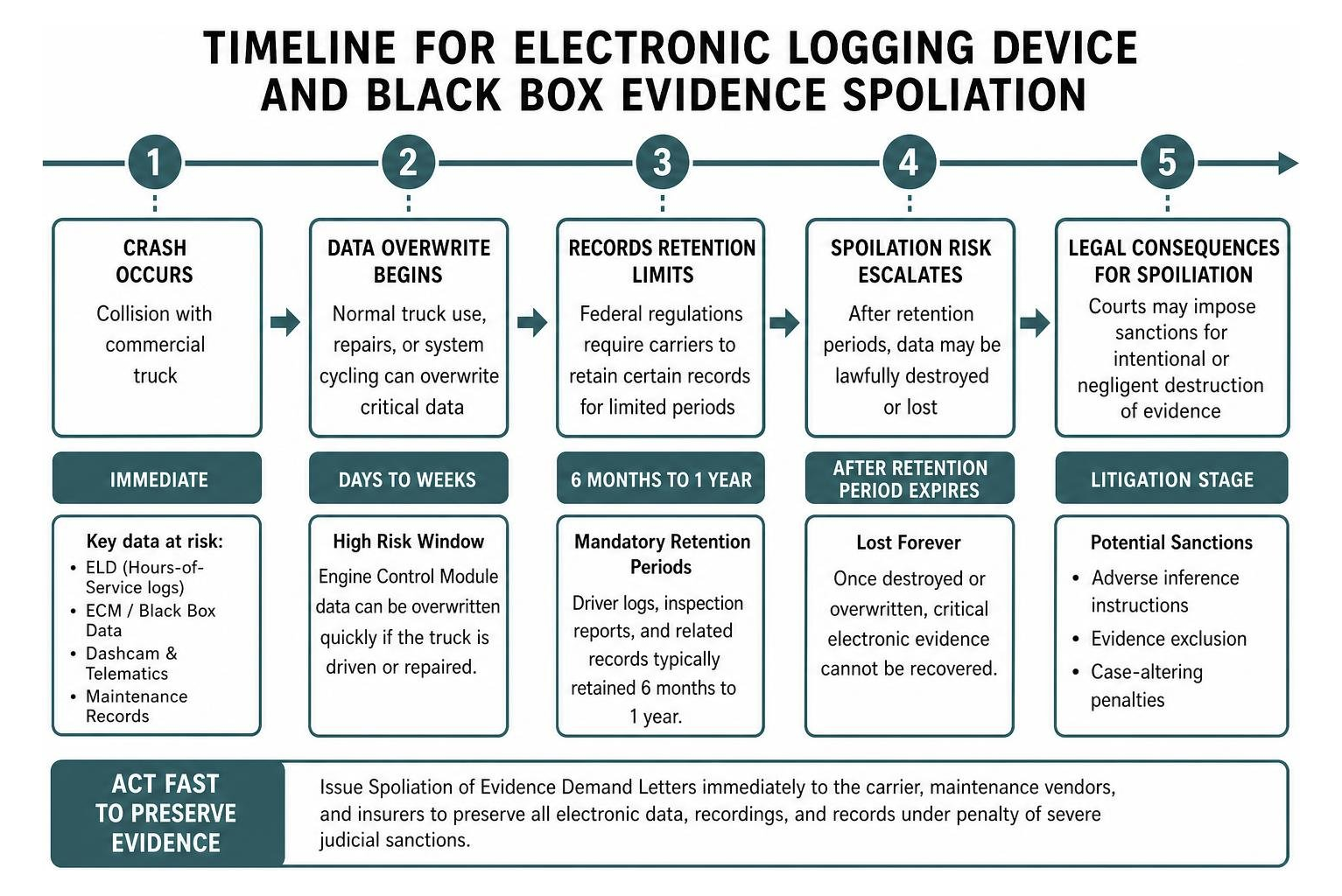
Because winning an 18 wheeler accident lawsuit in Gretna requires fast action, we immediately issue formal Spoliation of Evidence Demand Letters to the corporate headquarters of the out-of-state carrier, their maintenance vendors, and their insurance providers. These legal demands place the carrier on formal notice that they must preserve all digital downloads, dashcam recordings, maintenance histories, and driver qualification files under penalty of severe judicial sanctions.
What Steps Are Involved in Filing a Truck Accident Lawsuit in Gretna?
Taking on a multi-million-dollar interstate trucking company requires a structured, aggressive litigation strategy. We guide our clients through each phase of the process, ensuring all procedural rules are met and maximum compensation is pursued.
To understand the broader litigation landscape, review our comprehensive breakdown on everything you must know about a big rig accident lawsuit in Gretna. Partnering with an experienced New Orleans truck accident attorney ensures that out-of-state commercial insurers cannot minimize your injuries or escape liability.
Initial Investigation and Multi-Party Liability Assessment
Interstate trucking involves numerous separate corporate entities working in concert. We do not stop at suing just the truck driver; we investigate every entity in the transportation supply chain:
- The Motor Carrier: Liable directly for negligent hiring, improper training, failure to discipline unsafe drivers, and poor maintenance practices, as well as vicariously liable for the actions of their employee drivers under the doctrine of respondeat superior.
- The Freight Broker / 3PL Provider: Liable for negligent selection if they brokered cargo to an unsafe carrier with known safety violations or inadequate insurance.
- The Shipper / Cargo Loader: Liable if unbalanced, unsecured, or overweight freight caused a rollover, jackknife, or brake failure.
- Third-Party Maintenance Providers: Liable for improper brake repairs, substandard tire replacements, or overlooked safety defects.
Discovery, Depositions, and Out-of-State Witness Coordination
Once the lawsuit is filed, we enter the formal discovery stage. Because corporate witnesses, safety directors, and maintenance supervisors are typically located outside Louisiana, we coordinate across state lines to build your case.
We utilize interstate subpoenas, notice depositions for corporate representatives under Louisiana Code of Civil Procedure art. 1442 (or Federal Rule 30(b)(6)), and depose key personnel regarding internal safety policies, dispatch communications, and disciplinary histories. We also collaborate with industry-leading accident reconstruction engineers, mechanical safety analysts, and life-care planners to establish liability and calculate total lifetime financial damages.
What Damages Can You Recover and How Long Do You Have to File?
Due to the immense size and weight disparities between passenger vehicles and fully loaded tractor-trailers, commercial collisions often cause severe injuries, including traumatic brain injuries (TBI), spinal cord trauma, compound fractures, and fatal injuries.
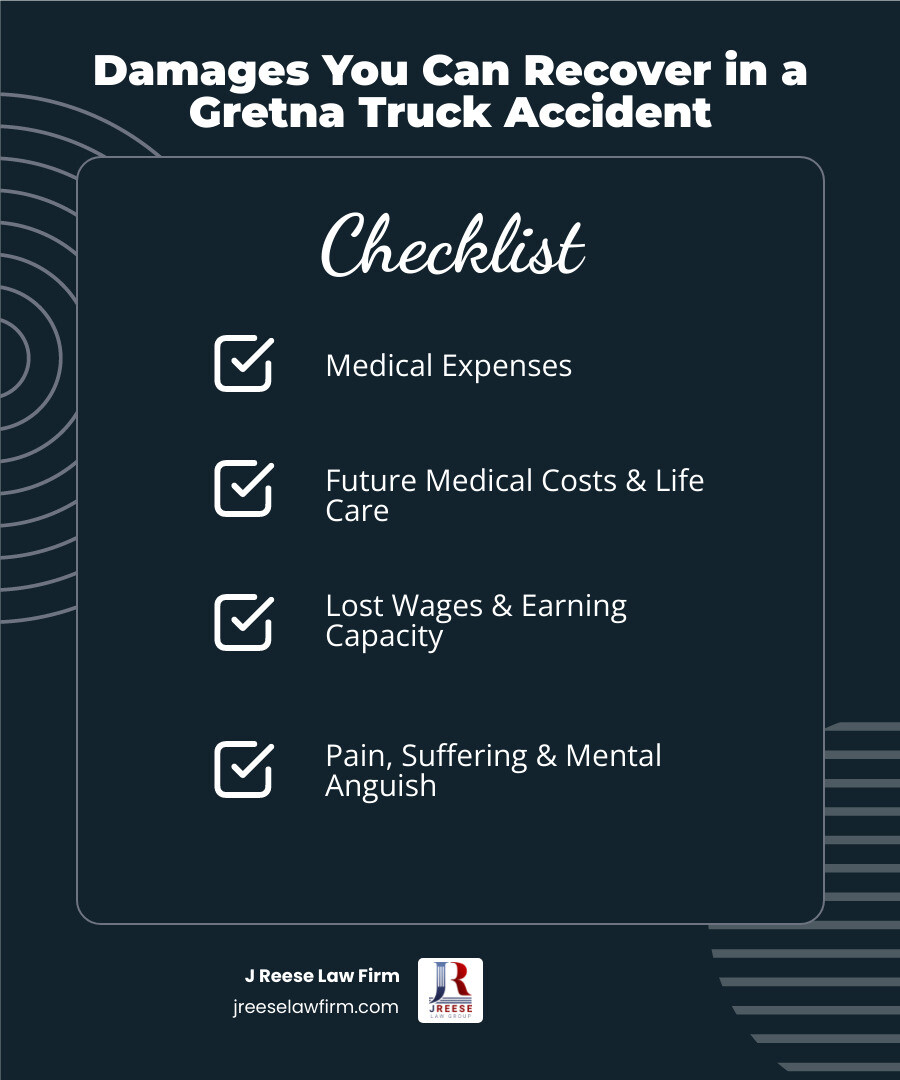
In a truck accident lawsuit in Gretna, we pursue two primary categories of compensatory damages on your behalf:
Economic Damages (Tangible Financial Losses)
- Medical Expenses: All emergency room treatment, surgeries, hospital stays, diagnostic imaging, prescription medications, and physical therapy.
- Future Medical Costs & Life Care: Ongoing care, long-term rehabilitation, assistive mobility equipment, home modifications, and in-home nursing support.
- Lost Wages: Income lost from missing work during your initial recovery.
- Diminished Earning Capacity: Compensation for your reduced ability to earn a living if you suffer permanent partial or total disability.
- Property Damage: Full repair or replacement value for your vehicle and personal belongings.
Non-Economic Damages (Intangible Personal Losses)
- Physical Pain and Suffering: Compensation for past and ongoing physical agony caused by your injuries.
- Mental Anguish and Emotional Distress: Compensation for post-traumatic stress, anxiety, depression, and psychological trauma resulting from the crash.
- Loss of Enjoyment of Life: Restitution for your inability to participate in hobbies, family activities, and daily routines you enjoyed before the injury.
- Loss of Consortium: Damages awarded to spouses and family members for the disruption of marital and family relationships.
- Permanent Disfigurement and Scarring: Compensation for physical alterations and lasting bodily impairment.
In specific scenarios, exemplary (punitive) damages may also be available under Louisiana Civil Code art. 2315.4 if the truck driver operated the commercial vehicle while intoxicated or under the influence of illegal drugs.
Crucial Filing Deadlines (Prescription)
In Louisiana, the timeframe to file a personal injury claim is strictly governed by state law. Reviewing Louisiana’s statute of limitations considerations is essential because failing to file your petition before the prescriptive deadline permanently bars your right to recover compensation.
Given the complexity of serving out-of-state entities, issuing preservation demands, and investigating multi-layered corporate structures, you must act without delay. If you or a loved one has suffered an injury, contact the team at J Reese Law Firm as early as possible so our trial attorneys can immediately launch an independent investigation.
Frequently Asked Questions About Suing Out-of-State Trucking Companies in Gretna
Can an out-of-state trucking company force my case to be moved to their home state?
No. An out-of-state commercial trucking company cannot force your injury claim to be transferred to their home state when the crash occurred in Gretna. Because the tort occurred within Jefferson Parish, Louisiana state courts maintain proper territorial and subject-matter jurisdiction.
While the defendant may attempt to remove the case from the 24th Judicial District Court to the U.S. District Court for the Eastern District of Louisiana under federal diversity jurisdiction, that federal court is still located in our immediate local area (New Orleans) and applies relevant state substantive law.
What happens if the out-of-state trucking company denies Louisiana jurisdiction?
If a foreign carrier files preliminary exceptions claiming lack of personal jurisdiction, we defeat those challenges by presenting tangible evidence of their minimum contacts with Louisiana.
This includes:
- Demonstrating their use of public roadways in Gretna and Jefferson Parish
- Showing their commercial shipping contracts, bills of lading, and delivery schedules within the state
- Proving their registration with the FMCSA and appointment of a Louisiana process agent
- Documenting their active commercial licenses and authority to conduct interstate transportation across Louisiana
Under the Louisiana Long-Arm Statute, operating a commercial vehicle on a public highway within our state provides all the jurisdictional basis necessary to maintain the lawsuit here.
How does having an out-of-state trucking company affect insurance claim settlements?
Commercial carriers operating across state lines are subject to federal insurance minimums under 49 CFR Part 387. Unlike personal auto policies that frequently carry minimal coverage limits, interstate motor carriers must carry substantial commercial liability policies:
- $750,000 minimum for general non-hazardous freight
- $1,000,000 for oil, large equipment, and specialized transport
- $5,000,000+ for hazardous materials, petroleum, or heavy industrial transport
Many multi-state carriers maintain multi-tiered insurance coverage consisting of a primary policy supplemented by secondary commercial umbrella and excess liability layers. While this means substantial financial coverage is available to compensate catastrophic injuries, it also means you will face aggressive national insurance adjusters and defense teams who protect these policies at all costs. We manage all communications, analyze every insurance layer, and counter lowball settlement offers with hard evidence.
Take Decisive Action to Protect Your Claim in Jefferson Parish
When an out-of-state commercial carrier turns your life upside down on a Gretna roadway, you do not have to fight national insurance corporations and foreign trucking entities on your own. At J Reese Law Firm, we stand up for injured individuals across Jefferson Parish and greater New Orleans, using Louisiana law to demand accountability from negligent out-of-state trucking operations.
Time is of the essence to secure electronic black box data, preserve maintenance records, and establish jurisdiction before crucial evidence disappears. Reach out to our team today to evaluate your case, assert your legal rights, and pursue the full compensation you deserve.