
Why You Need a Semi-Truck Crash Attorney for Commercial Vehicle Collisions
When an eighty-thousand-pound commercial vehicle collides with a typical passenger vehicle, the outcome is rarely a simple fender bender. The physics alone make these collisions devastating, but the legal framework surrounding commercial motor carriers creates an entirely separate battleground.
Unlike a collision between two standard passenger vehicles, a commercial wreck immediately sets multi-tiered corporate defense teams into motion. The motor carrier, its primary insurer, excess umbrella carriers, and corporate risk management personnel begin managing liability within hours of the incident. If you try to navigate this structure on your own, you face corporate adjusters whose single goal is to minimize your financial recovery.
Securing dedicated legal representation levels the playing field. Commercial collisions involve catastrophic injury thresholds, intricate federal record-keeping requirements, and complex corporate structures that require aggressive, methodical investigation.
The Complexities of Multi-Party Liability in Big Rig Crashes
In a standard passenger vehicle crash, liability usually falls squarely on one of the drivers. In an 18-wheeler collision, liability often spreads across a web of commercial entities. Determining who is financially accountable requires investigating multiple business contracts and employment arrangements:
- The Truck Driver: Responsible for hours-of-service compliance, safe vehicle operation, and maintaining situational awareness.
- The Motor Carrier (Trucking Company): Liable under the doctrine of respondeat superior (vicarious liability) for the negligent acts of employee drivers, as well as for direct negligence in hiring, training, and supervision.
- The Freight Broker or Shipper: May share liability if they negligently selected an unsafe motor carrier with poor safety ratings to haul freight.
- The Cargo Loading Entity: Improperly balanced, overloaded, or unstrapped freight can cause rollovers, jackknifes, or spilled cargo on major transit corridors.
- Third-Party Maintenance Providers: Independent repair shops that fail to perform required brake adjustments, tire replacements, or mechanical inspections.
- Equipment Manufacturers: Liable when defective braking systems, steering components, or tire blowouts directly trigger the collision.
Unraveling these layers requires a dedicated commercial truck lawyer in New Orleans who understands how to identify every available insurance policy to cover catastrophic losses.
Severe Stopping Distances and Catastrophic Injuries
The severe physical disparity between commercial vehicles and passenger cars dictates the severity of crash damages. A fully loaded tractor-trailer traveling at 65 miles per hour requires approximately 525 feet to come to a complete stop under ideal conditions—nearly the length of two entire football fields. When you factor in wet pavement, driver fatigue, or delayed reaction times, that stopping distance expands drastically.
| Metric | Standard Passenger Car (approx. 4,000 lbs) | Fully Loaded Semi-Truck (up to 80,000 lbs) |
|---|---|---|
| Stopping Distance at 65 mph | ~316 feet | ~525 feet |
| Kinetic Energy Impact Force | Baseline reference | Up to 20x passenger vehicle force |
| Common Collision Mechanics | Direct crumple zone engagement | Underride, override, jackknife, rollover |
| Typical Catastrophic Injuries | Whiplash, moderate fractures | Traumatic brain injury, spinal cord severance, severe burns |
Because the kinetic energy transferred into a passenger compartment during an underride or rear-end impact is massive, victims frequently suffer life-altering trauma, including traumatic brain injuries, spinal cord damage resulting in paralysis, crush injuries requiring amputation, and severe burns.
Critical Evidence to Secure Immediately After an 18-Wheeler Wreck
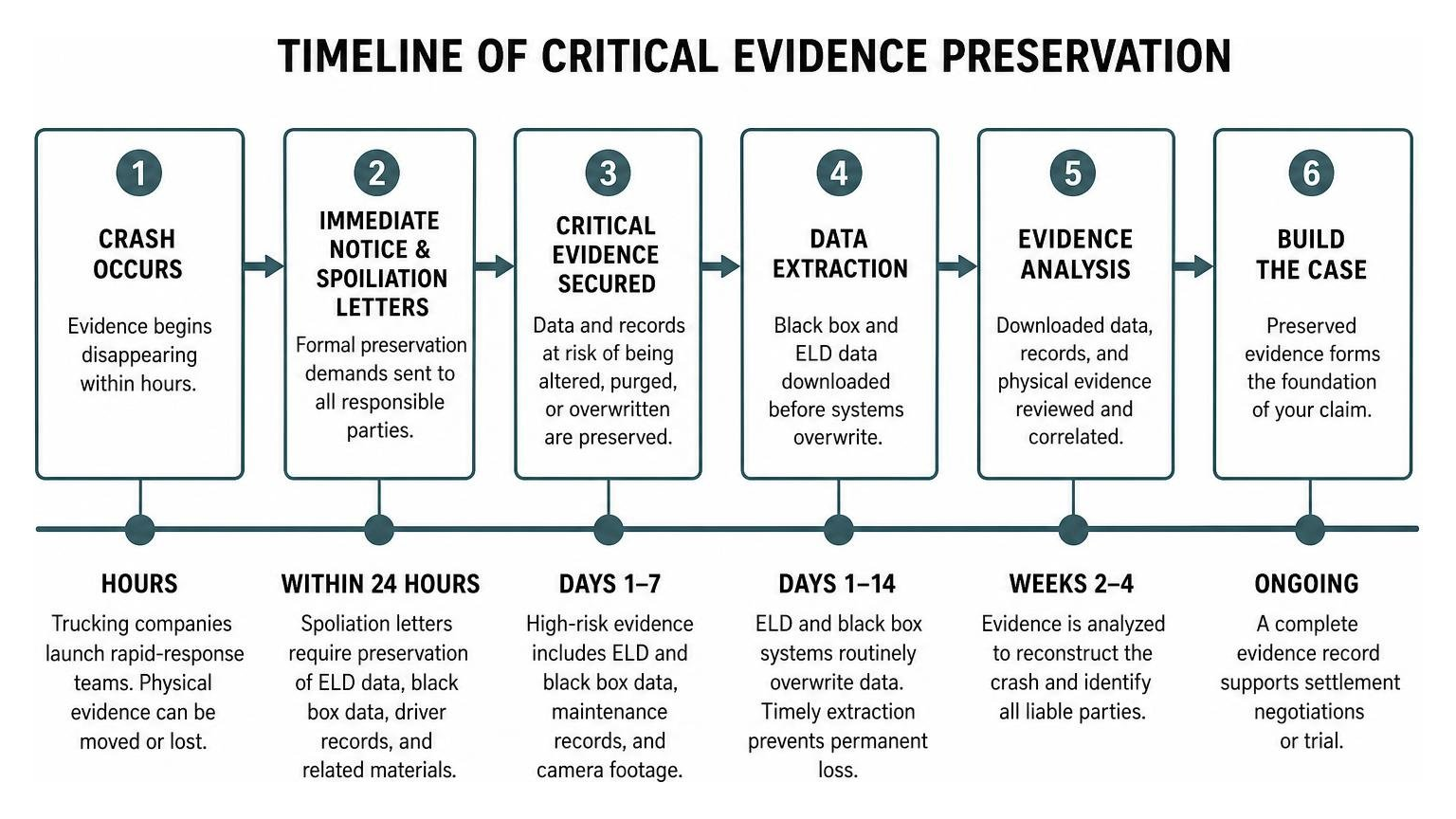
Evidence in a commercial trucking collision begins disappearing within days—and in some cases, within hours—after the crash. While injured victims focus on medical stabilization, trucking companies and their rapid-response teams are already gathering physical evidence, downloading vehicle diagnostics, and constructing their defense.
To prevent crucial records from being altered, purged, or routinely overwritten, we immediately serve formal spoliation letters on the trucking company, its insurer, and all associated third parties.
How a Semi-Truck Crash Attorney Extracts Black Box and ELD Data
Every modern commercial motor vehicle contains sophisticated digital hardware that records operational data before, during, and after an impact:
- Engine Control Module (ECM) / Black Box: Records critical telemetry including vehicle speed, throttle position, engine RPM, sudden deceleration, brake application timing, and cruise control status.
- Electronic Logging Devices (ELD): Mandated by federal safety law to record driving hours, duty status changes, engine hours, and GPS location points.
- Forward-Facing and Cabin Dash Cams: Digital video recording road conditions, lane positioning, and driver alertness.
- Collision Avoidance and Telematics Systems: Data detailing lane-departure warnings, automatic emergency braking events, and following distance metrics.
Without immediate legal action, automated system overwrites can permanently erase this high-value data.
Preserving Driver Qualification Files and Maintenance Logs
Under 49 CFR Part 391 of the Federal Motor Carrier Safety Regulations (FMCSR), motor carriers must maintain an exhaustive Driver Qualification (DQ) file for every commercial driver. When investigating a claim, we demand the immediate production of:
- The driver’s initial employment application and three-year commercial driving history verification.
- Annual motor vehicle records (MVR) reviews and current medical examiner certificates.
- Pre-employment, random, and post-accident drug and alcohol testing results.
- Driver training certifications and safety performance histories.
- Daily inspection logs and periodic maintenance records to verify brake, tire, and steering health.
Reviewing these files reveals patterns of negligent hiring, inadequate training, or deliberate corporate indifference to safety regulations. For a complete look at selecting legal representation for your claim, consult our guide to hiring a New Orleans truck wreck attorney.
Navigating Federal Regulations and Insurance Tactics in Gretna Claims

Commercial trucking operations do not operate under the same rules as ordinary passenger vehicles. They are heavily regulated by the Federal Motor Carrier Safety Administration (FMCSA) and state transportation agencies. Proving a regulatory violation often establishes direct evidence of negligence.
FMCSA Hours-of-Service Rules and Carrier Compliance
Driver fatigue remains one of the leading contributors to fatal commercial collisions. To combat this hazard, FMCSA regulations under 49 CFR Part 395 strictly limit commercial driving hours:
- 11-Hour Driving Limit: A commercial driver may drive a maximum of 11 hours after 10 consecutive hours off duty.
- 14-Hour On-Duty Window: Driving is prohibited beyond the 14th consecutive hour after coming on duty, following 10 consecutive hours off duty.
- Mandatory 30-Minute Rest Break: Drivers must take a 30-minute break after 8 cumulative hours of driving without at least a 30-minute interruption.
- 60/70-Hour Duty Limits: Drivers cannot drive after 60 hours on duty in 7 consecutive days, or 70 hours in 8 consecutive days, until completing a 34-hour restart.
When tight delivery deadlines incentivize carriers to push drivers past these limits, logbooks are sometimes manipulated. Comparing ELD data against fuel receipts, bill-of-lading timestamps, and toll records allows our team in the truck accident practice to expose hours-of-service violations.
Overcoming Commercial Insurance Defense Strategies and High Policy Limits
Federal law mandates high liability insurance minimums for commercial motor carriers:
- $750,000 for non-hazardous freight transported in vehicles over 10,000 lbs.
- $1,000,000 for oil, large equipment transport, and specific hazardous materials.
- $5,000,000 for bulk hazardous materials, portable tanks, and hazardous cargo.
Because the financial exposure is substantial, commercial insurance defense adjusters deploy aggressive tactics immediately. They may attempt to contact you while you are recovering in the hospital, offering quick, lowball settlement checks in exchange for a full liability release. They may also ask leading questions during recorded statements to shift fault onto you.
When catastrophic losses exceed standard limits, an experienced legal team investigates excess liability layers, umbrella coverage, and third-party corporate entities to pursue a fair big rig accident settlement in New Orleans.
Step-by-Step Actions to Protect Your Commercial Collision Claim
The actions you take in the hours and days following an 18-wheeler wreck significantly influence the success of your legal claim.

Immediate Steps at the Crash Scene and Medical Care
- Call 911 Immediately: Ensure emergency medical technicians and law enforcement arrive on the scene. The official police accident report provides an objective foundation for the initial investigation.
- Prioritize Medical Care: Accept emergency transport or visit an emergency room immediately. Internal bleeding, concussions, and spinal trauma may not display immediate symptoms due to post-crash adrenaline.
- Photograph the Scene Thoroughly: Capture wide-angle and close-up images of all vehicle damage, skid marks, broken road debris, traffic signals, weather conditions, and commercial carrier USDOT numbers marked on the truck cab.
- Gather Witness and Driver Details: Obtain the truck driver’s name, commercial driver’s license (CDL) number, employer, insurance carrier, policy number, and the contact details of any eyewitnesses.
- Decline Recorded Statements: Do not provide recorded audio statements or sign any insurance documents from the trucking carrier’s adjuster before speaking with legal counsel.
When to Hire a Semi-Truck Crash Attorney for Maximum Compensation
Securing legal counsel immediately after stabilizing your physical health allows your legal team to handle all communications, investigate the crash scene, and calculate the full financial scope of your damages.
Comprehensive compensation calculations include:
- Economic Damages: Past, present, and future medical costs, surgical interventions, physical therapy, prescription medications, lost wages, and loss of future earning capacity.
- Non-Economic Damages: Physical pain and suffering, emotional distress, loss of enjoyment of life, physical impairment, and disfigurement.
- Wrongful Death Damages: Funeral expenses, loss of financial support, and loss of consortium for surviving family members.
To protect your rights and ensure an exhaustive investigation, schedule a consultation with a semi-truck accident attorney in New Orleans as early as possible.
Frequently Asked Questions About Commercial Truck Accidents
How long do I have to file a semi-truck accident claim in Louisiana?
In Louisiana, personal injury and wrongful death lawsuits are governed by strict prescriptive periods (statutes of limitations). Following recent legislative updates, claims arising from collisions must generally be filed within two years from the date of the incident. Missing this deadline bars you permanently from recovering financial compensation in court.
In other jurisdictions, statutes vary. For example, Texas maintains a two-year personal injury statute of limitations, while New Jersey allows two years for personal injuries and six years for property damage claims. Regardless of the statutory deadline, critical electronic evidence can be lost within weeks if an attorney does not take swift action.
What damages can be recovered after a commercial truck wreck?
Victims of commercial vehicle collisions can pursue compensation for both direct economic losses and intangible personal harm. This includes reimbursement for emergency trauma care, ongoing hospitalizations, long-term rehabilitation, assistive mobility devices, past lost wages, and projected loss of earning power.
You may also recover compensation for physical pain, mental anguish, and loss of quality of life under Louisiana personal injury law.
How does comparative fault impact my financial recovery?
Louisiana operates under a pure comparative fault doctrine. Under this rule, each party is assigned a percentage of fault for the incident. If you are found to be partially at fault, your financial recovery is reduced in direct proportion to your share of responsibility.
For example, if total damages equal $1,000,000 and you are determined to be 10% at fault, your net recovery is $900,000. Trucking insurers routinely attempt to push an unfair percentage of blame onto passenger vehicle drivers to reduce their payout obligations.
By contrast, some states (such as North Carolina) follow strict contributory negligence rules that can bar recovery entirely if a plaintiff is found even 1% at fault. In modified comparative fault states like Texas, a plaintiff is barred from recovery if their fault exceeds 50% or 51%.
Take Action to Secure Your Future After a Commercial Truck Collision
A serious commercial truck wreck brings overwhelming physical, emotional, and financial challenges. Large trucking corporations and their insurers move quickly to protect their bottom line, and you deserve a dedicated legal advocate who will fight just as hard for your family.
At J Reese Law Firm, we stand up to commercial carriers, enforce federal compliance standards, and pursue the full financial compensation you need to heal. We take on the burden of investigating the crash, securing critical digital telemetry, and managing complex multi-party insurance claims so you can focus entirely on your recovery.
If you or a loved one has been injured in a commercial collision in Gretna, New Orleans, or surrounding communities, contact a skilled New Orleans truck accident attorney at J Reese Law Firm today for a free, no-obligation case evaluation.