Louisiana Bicycle Accident Victims Have Real Legal Rights — Here’s What You Can Recover
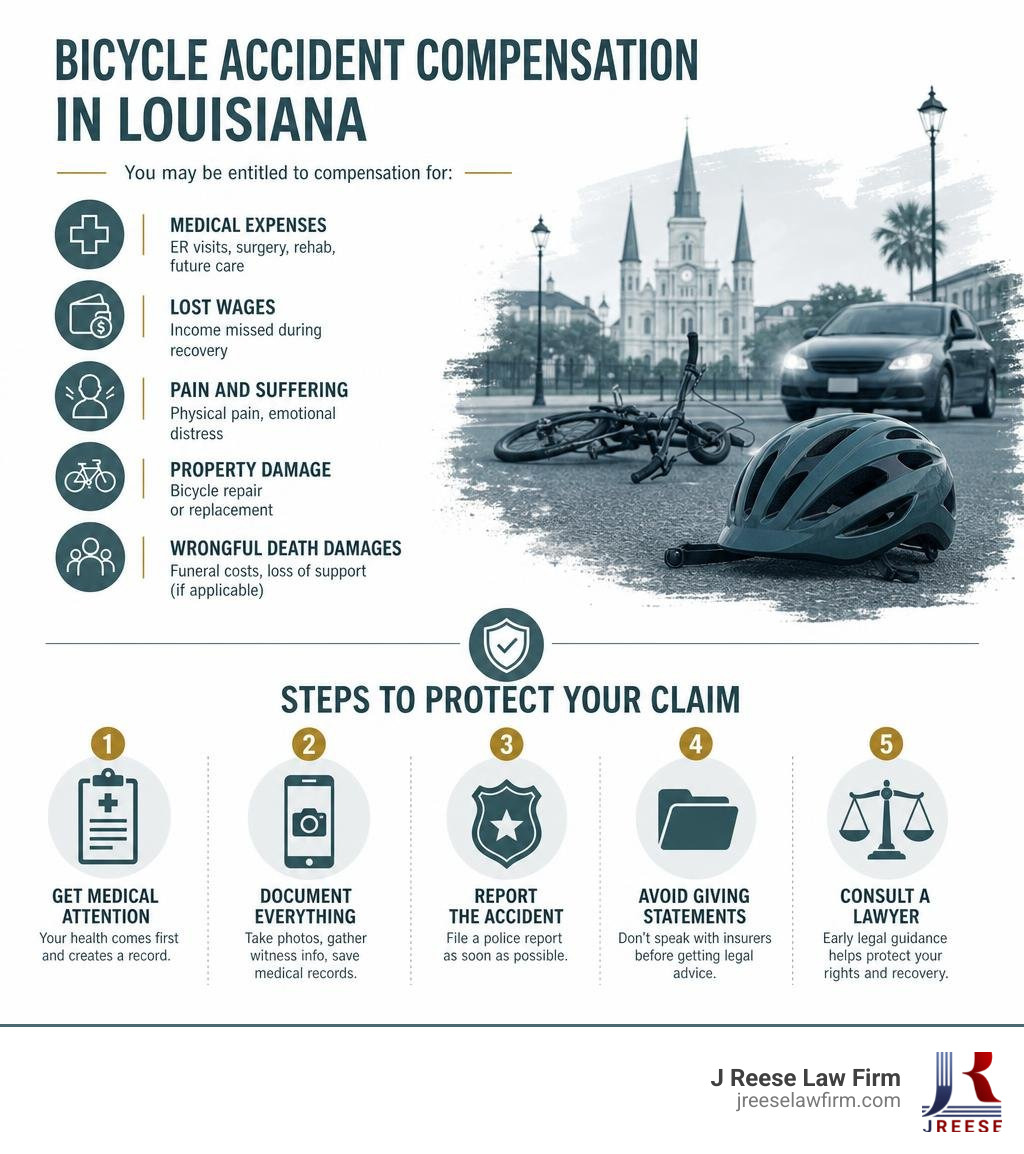
Bicycle accident compensation in Louisiana can include the following types of damages:
| Type of Compensation | Examples |
|---|---|
| Medical expenses | ER visits, surgery, rehab, future care |
| Lost wages | Income missed during recovery |
| Pain and suffering | Physical pain, emotional distress |
| Property damage | Bicycle repair or replacement |
| Wrongful death damages | Funeral costs, loss of support (if applicable) |
Louisiana is the second most dangerous state for cyclists in the U.S. In 2023 alone, 34 bicyclists were killed and 725 were injured in motor vehicle accidents across the state. If you were hurt while riding your bike, you may have a right to financial recovery — but only if you act before the clock runs out.
This guide walks you through exactly what compensation is available, how Louisiana’s fault rules affect your payout, and what steps protect your claim from day one.
I’m Justin Reese, a civil litigation and personal injury attorney with over a decade of experience recovering tens of millions of dollars for injury victims — including those seeking bicycle accident compensation in Louisiana. I’ve built my practice around holding negligent drivers and insurers accountable, and I’ll show you how to do the same.
Understanding Your Rights and Bicycle Accident Compensation Louisiana
When you are struck by a motor vehicle while riding your bicycle in New Orleans, the physical and financial consequences can be overwhelming. To secure fair bicycle accident compensation Louisiana laws allow you to pursue both economic and non-economic damages.
Economic damages are the objective, quantifiable financial losses you incur because of the wreck. These include immediate emergency room bills, ongoing physical therapy, medications, and any future medical care you may require. It also covers lost wages if your injuries prevent you from returning to work, as well as the cost to repair or replace your bicycle and safety gear.
Non-economic damages, on the other hand, compensate you for the subjective, non-monetary losses that drastically alter your quality of life. This includes physical pain and suffering, mental anguish, loss of enjoyment of life, and emotional trauma. Because these damages do not come with a neat receipt, proving their value requires a strategic legal approach. If you are struggling to manage these mounting pressures, partnering with a dedicated Bicycle Accident Lawyer Louisiana can help ensure every single dollar of your loss is accounted for and pursued.
How Louisiana Law Treats Bicycles as Vehicles
Under Louisiana Revised Statute (R.S.) 32:194, bicycles are legally granted the same rights and are subject to the same duties as the drivers of traditional motor vehicles. This means that as a cyclist, you have every right to occupy the road, but you must also obey traffic signals, stop signs, and lane markings.
However, there are a few key differences in how the law treats cyclists compared to motorists:
- Position on the Road: Cyclists are generally required to ride as close to the right-hand edge of the roadway as safe and practical, except when preparing for a left turn, overtaking another vehicle, or avoiding hazards.
- DUI vs. Public Inebriation: Interestingly, state driving-under-the-influence (DUI) laws do not technically apply to operators of non-motorized bicycles. However, riding a bicycle while highly intoxicated can still result in public inebriation charges or serve as strong evidence of negligence if an accident occurs.
- Passing Distance: Motorists are legally required to maintain a safe distance of at least three feet when passing a bicyclist on the road.
To establish driver liability in an injury claim, we must prove that the motorist breached their duty of care. Common examples include drivers failing to yield the right-of-way, failing to check their blind spots before turning across a bike lane, or “dooring” a cyclist by opening a car door without looking. If you have questions about how these rules apply to your crash, you can speak directly with our team.
Types of Damages in a Bicycle Accident Compensation Louisiana Claim
Because cyclists have virtually no physical protection when struck by a multi-ton vehicle, the resulting injuries are frequently catastrophic. We regularly represent victims who have suffered:
- Traumatic Brain Injuries (TBIs): Even with a helmet, the violent impact of a crash can cause concussions, contusions, or permanent cognitive damage.
- Spinal Cord Damage: Fractured vertebrae or herniated discs can lead to chronic pain, limited mobility, or complete paralysis.
- Severe Fractures: Broken collarbones, ribs, wrists, and legs often require surgical intervention and extensive hardware to heal.
- Road Rash and Soft Tissue Damage: Deep abrasions can cause permanent scarring and severe, long-term infections.
In the most tragic circumstances, a bicycle crash results in a fatal injury. When a family loses a loved one due to a driver’s negligence, they have the right to file a wrongful death claim to recover funeral costs, medical bills incurred prior to death, and the loss of financial and emotional support. To understand how these payouts are structured, you can explore our Wrongful Death Settlement Calculator Typical Payouts Explained guide.
How Comparative Fault Affects Your Recovery
One of the most critical aspects of securing bicycle accident compensation in Louisiana is understanding how fault is distributed. For many years, Louisiana operated under a “pure” comparative negligence system. However, the legal landscape has shifted.
As of July 2026, Louisiana utilizes a modified comparative fault system for personal injury actions. Under Civil Code Article 2323, your recovery is directly tied to your level of responsibility for the accident. If you are found partially at fault for the crash, your final compensation will be reduced by your percentage of fault.
For example, if a jury determines your total damages equal $100,000, but they find you were 25% at fault because you did not have proper reflectors at night, your recovery will be reduced by 25%, leaving you with $75,000. Under the current modified system, if your share of the blame exceeds 50%, you may be completely barred from recovering any compensation at all.
Insurance adjusters are fully aware of these rules. Their primary goal is to shift as much blame onto the cyclist as possible to protect their bottom line. They may claim you were riding erratically, failed to signal a turn, or were distracted. This is why having an advocate who understands these tactics is vital to protecting your claim.
Impact of Shared Liability on Bicycle Accident Compensation Louisiana
When insurance companies raise liability disputes, it can stall negotiations and significantly threaten your payout. They will use any minor inconsistency in your statement to argue that you caused or contributed to the collision.
To counter these efforts to reduce your payout, we gather and present irrefutable evidence, such as traffic camera footage, eyewitness accounts, and reports from accident reconstruction professionals. By establishing clear motorist liability, we protect your right to full compensation. If you are facing a tough battle with an insurance adjuster over shared fault, reaching out to a skilled New Orleans Personal Injury Lawyer is the best way to level the playing field.
Crucial Deadlines and Evidence to Protect Your Claim
To build a successful claim for bicycle accident compensation in Louisiana, you must act quickly to preserve physical evidence and secure witness testimony before it disappears.
Key evidence that can make or break your case includes:
- The Bicycle and Riding Gear: Do not repair your bike or throw away damaged helmets or torn clothing. These items serve as physical proof of the force and angle of the impact.
- Police Reports: A law enforcement officer’s crash report contains vital details, initial determinations of fault, and citations issued to the driver.
- Witness Statements: The contact information and recorded statements of bystanders who saw the crash occur.
- Medical Documentation: Consistent medical records that explicitly link your injuries directly to the bicycle accident.
Louisiana’s Strict Filing Deadlines
You have a very narrow window of time to take legal action after a bicycle accident. Under Louisiana’s statute of limitations (referred to legally as the “prescriptive period”), you generally have a limited time to file a lawsuit.
Historically, Louisiana maintained a strict one-year filing window. While recent legislative updates have expanded the prescriptive period to two years for personal injury claims arising from accidents occurring on or after July 1, 2024, it is absolutely vital to verify which deadline applies to your specific date of accident. Missing this deadline means you lose your legal right to seek compensation forever. To ensure you do not make a costly mistake, review our detailed guide on Louisiana’s One Year Statute of Limitations.
Steps to Take Immediately After a Crash
What you do in the minutes and days following a bicycle accident will directly impact the strength of your compensation claim. If you are physically able, take these immediate steps:
- Move to Safety: Get off the roadway to avoid being struck by oncoming traffic.
- Call 911: Request both police and emergency medical services to the scene.
- Document the Scene: Take high-quality photos of your bicycle, the vehicle that hit you, the driver’s license plate, the surrounding road conditions, and any visible injuries.
- Exchange Information: Collect the driver’s name, phone number, insurance details, and vehicle registration.
- Seek Immediate Medical Attention: Go to the emergency room or an urgent care clinic, even if you believe your injuries are minor. Adrenaline can mask severe pain and internal injuries.
- Consult an Attorney: Speak to a legal professional before giving any recorded statements to insurance companies.
For a comprehensive checklist of what to do next, read our guide on What to Do After a Car Accident in Louisiana.
How Insurance Companies Handle Bicycle Claims
Dealing with insurance adjusters after a bicycle accident can be a frustrating experience. Insurers are businesses, and their primary objective is to settle your claim for as little money as possible.
Often, an insurance adjuster will call you shortly after the crash, offering a quick cash settlement. While this might seem tempting when bills are piling up, these initial offers are almost always “lowball” figures designed to get you to sign away your rights before you know the true, long-term cost of your injuries.
| Offer Stage | Typical Insurance Approach | Real Value with Legal Advocacy |
|---|---|---|
| Initial Offer (First 30 Days) | Covers immediate ER visit only; ignores future rehab and lost wages. | Low — often represents less than 20% of your claim’s true value. |
| Middle Negotiations | Offers a small bump if you complain, but still pushes for a quick release. | Moderate — still fails to cover long-term suffering or full future medical needs. |
| With Proven Representation | Insurer is forced to evaluate full policy limits, future care, and real pain and suffering. | Maximum Value — accounts for all past, present, and future damages. |
In addition to low settlement offers, you must also navigate policy limits. If the driver who hit you carries only the state-mandated minimum liability coverage ($15,000 for bodily injury to one person), it may not be enough to cover a serious injury. In these situations, we look to your own auto insurance policy to see if you have Uninsured/Underinsured Motorist (UM) coverage, which can step in to cover the difference.
Never sign an early release form or agree to a recorded statement without legal guidance. Once you sign a release, you can never seek additional compensation, even if you discover you need surgery months down the road.
Frequently Asked Questions About Louisiana Bicycle Wrecks
What is the average settlement for a bicycle accident in Louisiana?
There is no “average” settlement because every bicycle accident claim is entirely unique. The value of your case depends on several critical factors, including the severity of your injuries, the total cost of your past and future medical care, the amount of income you lost, the clarity of liability, and the available insurance policy limits. A claim involving a fractured collarbone will be valued differently than a case involving a traumatic brain injury requiring lifetime care.
Can I still get compensation if I wasn’t wearing a helmet?
Yes, you can still recover compensation. Louisiana state law only mandates helmet use for cyclists under the age of 12 (though some local municipal ordinances may vary). If you were an adult riding without a helmet, the defense may try to use comparative fault to argue that your failure to wear a helmet contributed to the severity of your head injuries. However, this does not excuse the driver’s negligence in causing the crash itself, and you can still recover damages for other injuries, such as broken bones, road rash, and property damage.
What if the driver who hit me fled the scene?
Hit-and-run accidents are unfortunately common in bicycle crash cases. If the driver fled the scene and cannot be identified by police, you are not necessarily out of options. You may be able to file a claim through your own auto insurance policy if you carry Uninsured/Underinsured Motorist (UM) coverage. Because UM coverage follows the policyholder, it protects you even when you are walking or riding a bicycle.
Secure Your Financial Recovery with Proven Legal Advocacy
Recovering from a bicycle accident is hard enough without having to fight aggressive insurance adjusters for the money you need to rebuild your life. At the J Reese Law Firm, we handle the legal heavy lifting so you can focus entirely on your physical recovery.
We will investigate your crash, gather the necessary evidence, calculate the true value of your losses, and negotiate aggressively with the insurance companies to secure every dollar you deserve. We work on a contingency fee basis, meaning you pay us nothing upfront, and we only get paid if we win your case.
Don’t let an insurance company dictate what your recovery is worth. Contact us today to Get a Free Case Evaluation and take the first step toward securing the compensation you need and deserve.