When a Preventable Death Demands Justice in New Orleans
A wrongful death claims attorney helps surviving family members hold negligent parties legally accountable after a loved one dies due to someone else’s careless or wrongful actions.
If you’re in New Orleans and you’ve just lost a family member, here’s what you need to know right now:
Quick answers for Louisiana families:
- What is a wrongful death claim? A civil lawsuit filed by surviving family members when a death is caused by another party’s negligence or misconduct
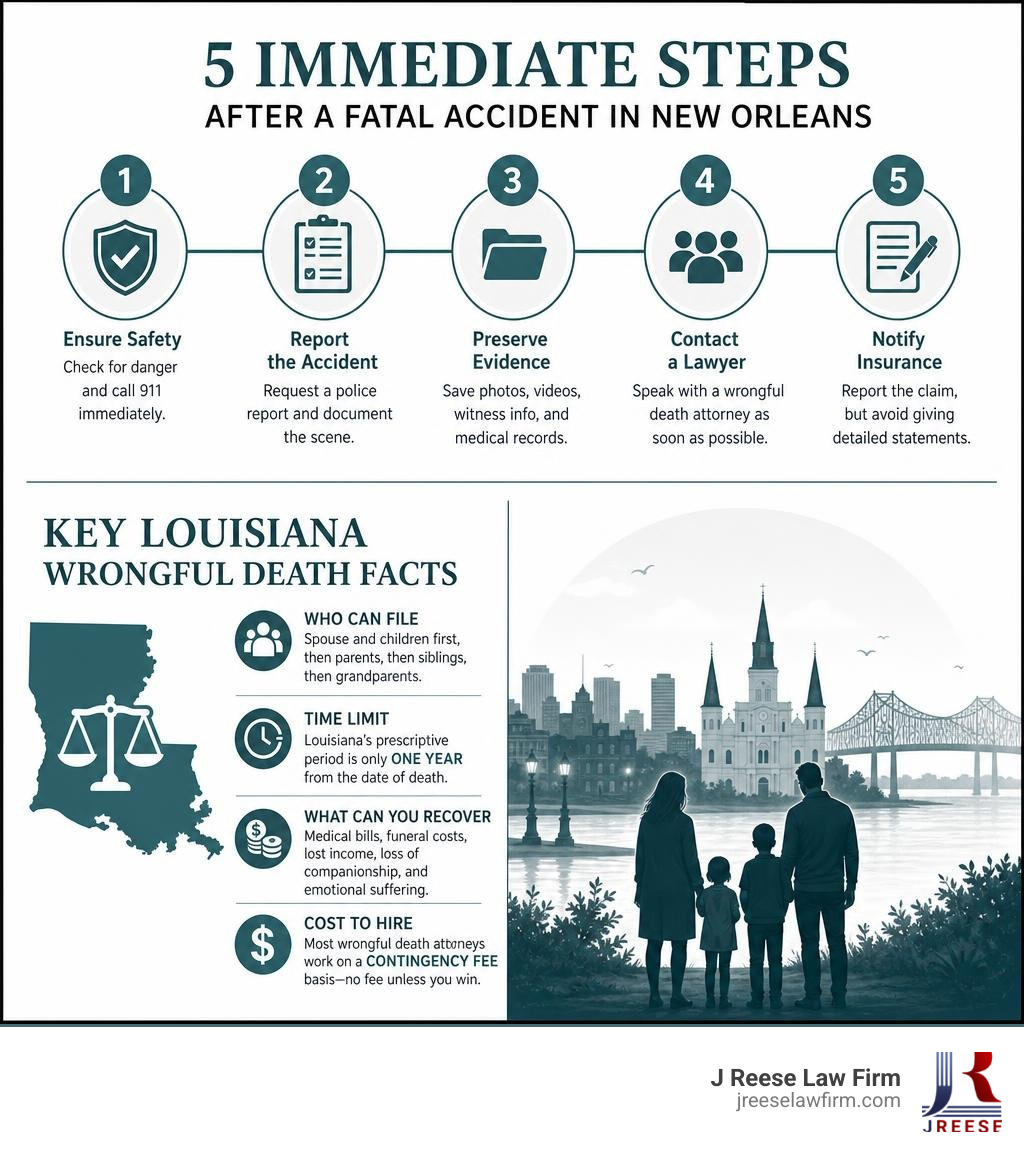
- Who can file in Louisiana? A strict beneficiary hierarchy applies — spouse and children first, then parents, then siblings, then grandparents
- How long do you have? Louisiana’s prescriptive period is only one year from the date of death — one of the shortest deadlines in the country
- What can you recover? Medical bills, funeral costs, lost income, loss of companionship, and emotional suffering
- What does it cost? Most wrongful death attorneys work on a contingency fee basis — no upfront costs, no fee unless you win
Losing someone you love is devastating. When that loss could have been prevented — because a driver ran a red light, a doctor missed a diagnosis, or a workplace ignored a safety hazard — the grief is compounded by anger and unanswered questions.
In New Orleans, preventable tragedies happen every day. The National Highway Traffic Safety Administration reported over 33,000 fatal motor vehicle accidents in a single recent year. Johns Hopkins University research found that roughly one in ten deaths results from a medical error.
Behind every one of those statistics is a real family — and in Louisiana, that family may have legal rights they don’t even know about yet.
The problem is that those rights come with a very short window to act. Louisiana law gives most families just one year to file a wrongful death claim. Missing that deadline can mean losing the right to any compensation, permanently.
This guide explains exactly how wrongful death law works in Louisiana, what your family can recover, and how a New Orleans wrongful death attorney can help you navigate one of the hardest experiences of your life.
Understanding Louisiana Wrongful Death and Survival Actions
When a tragedy occurs due to negligence in Louisiana, the law provides two distinct pathways for families to seek financial recovery and accountability. These are governed by two separate parts of the Louisiana Civil Code: Article 2315.1 (Survival Actions) and Article 2315.2 (Wrongful Death Actions).
While they are closely related and almost always filed together in a single lawsuit, they serve entirely different legal purposes and compensate for different types of losses.
To put it simply:
- A survival action compensates for the pain, suffering, and financial losses your loved one experienced before they passed away.
- A wrongful death claim compensates you (the surviving family members) for the emotional and financial losses you suffer as a result of their absence.
Understanding how these two claims operate is critical to ensuring your family does not leave vital compensation on the table.
| Feature | Survival Action (La. C.C. art. 2315.1) | Wrongful Death Claim (La. C.C. art. 2315.2) |
|---|---|---|
| Primary Purpose | To recover damages the deceased person could have claimed if they had survived. | To compensate survivors for their own personal losses resulting from the death. |
| What It Covers | Pre-death physical pain, mental anguish, medical bills, and lost wages before death. | Funeral and burial costs, loss of financial support, loss of companionship, and emotional distress. |
| Who Benefits | The designated statutory beneficiaries (or the deceased’s estate). | The designated statutory beneficiaries. |
| Filing Deadline | One year from the date of the deceased’s death. | One year from the date of the deceased’s death. |
The Role of a Wrongful Death Claims Attorney in Survival Actions
In a survival action, we are essentially stepping into the shoes of your deceased loved one to argue the case they would have argued themselves had they survived.
Because of this, the evidence required is highly specific. A skilled wrongful death claims attorney must prove that the deceased person survived for at least a brief moment after the injury and experienced conscious pain, fear, or mental suffering. Even if that window of survival was only a few minutes, the estate is legally entitled to recover damages for that pain and suffering.
Survival damages also cover the medical expenses accumulated between the time of the accident and the time of death, as well as any lost wages during that period.
Because proving conscious pain and suffering requires analyzing detailed medical records, consulting with forensic pathologists, and interviewing emergency responders, having a firm that understands Personal Injury litigation is essential to securing these damages.
Who Can File a Wrongful Death Claim in Louisiana?
In many states, any close relative or a court-appointed personal representative can initiate a wrongful death lawsuit. Louisiana, however, does things a bit differently. Our state uses a strict, tiered beneficiary hierarchy under Civil Code Articles 2315.1 and 2315.2.
Only the individuals in the highest active category are legally permitted to file a claim and recover damages. If there is even one living person in a higher tier, members of the lower tiers are completely barred from bringing a lawsuit.
The Louisiana beneficiary hierarchy is structured as follows:
- First Tier: The surviving spouse and/or children of the deceased. (This includes adopted children).
- Second Tier: The surviving parents of the deceased (if there is no surviving spouse or child).
- Third Tier: The surviving brothers and sisters of the deceased (if there are no surviving spouses, children, or parents).
- Fourth Tier: The surviving grandparents of the deceased (if there are no surviving spouses, children, parents, or siblings).
If the deceased leaves behind a spouse and a child, they share the right to recover, and the parents or siblings cannot file. If the deceased was unmarried and had no children, the parents have the exclusive right to file.
Navigating these family dynamics and legal definitions can be highly sensitive, especially when dealing with stepchildren, estranged relatives, or half-siblings. An experienced attorney will help clarify exactly who holds the legal right to file in your specific situation.
Common Causes of Fatal Accidents in New Orleans

Preventable tragedies can occur anywhere, but New Orleans presents its own unique set of risks. From our historic, uneven streets to heavily traveled commercial shipping lanes, local conditions often play a direct role in fatal accidents.
Some of the most common causes of wrongful death cases we handle include:
- Car, Truck, and Motorcycle Accidents: High-speed collisions on I-10, distracted driving on local avenues, and accidents involving commercial semi-trucks often result in fatal injuries. Heavy commercial traffic heading to and from the Port of New Orleans increases the risk of catastrophic trucking accidents.
- Medical Malpractice: Misdiagnosis, surgical errors, medication mistakes, and birthing injuries can turn a routine medical visit into a tragedy. According to a landmark Johns Hopkins Study on Medical Errors, medical mistakes are a leading cause of death in the United States, highlighting the critical need for medical accountability.
- Workplace and Industrial Incidents: Louisiana’s maritime, oil and gas, and construction industries are inherently dangerous. Falls from scaffolding, equipment failures, and explosions can lead to sudden, tragic workplace fatalities.
- Premises Liability and Negligent Security: Property owners have a duty to keep their premises safe. Uneven walkways, unsecured swimming pools, or a lack of proper security in high-risk areas can lead to fatal slips, drownings, or violent crimes.
For more information on high-risk driving areas in our city, you can read our detailed guide on New Orleans Accident Hotspots. Additionally, nationwide trends can be explored via the NHTSA Fatal Motor Vehicle Accident Statistics.
Proving Liability with a Wrongful Death Claims Attorney
To win a wrongful death lawsuit, your legal team must establish four core elements of negligence. It is not enough to show that a tragedy occurred; we must legally link the defendant’s actions directly to your loved one’s passing.
- Duty of Care: We must prove the defendant owed your loved one a legal duty to act reasonably and safely. For example, a driver has a duty to obey traffic laws, and a doctor has a duty to provide a standard of care consistent with their medical training.
- Breach of Duty: We must show the defendant failed to meet that duty. This could mean a truck driver operating a vehicle while fatigued, or a property owner ignoring a known structural hazard.
- Causation: We must establish a direct link showing that the defendant’s breach of duty was the proximate cause of your loved one’s death.
- Damages: We must document the tangible and intangible losses suffered by the surviving beneficiaries as a result of the death.
Proving these elements requires an exhaustive investigation. We routinely subpoena phone logs, secure electronic logging device (ELD) data from commercial trucks, obtain surveillance footage, and interview eyewitnesses to build an undeniable case.
How a Wrongful Death Claims Attorney Calculates Damages
Valuing a wrongful death claim is a highly complex process. No amount of money can ever replace your loved one, but the civil justice system’s only tool for providing relief is financial compensation.
We divide these damages into two primary categories: economic and non-economic.
- Economic Damages: These are the measurable financial losses resulting from the death. They include medical bills incurred before passing, funeral and burial expenses, and the loss of the financial support and benefits the deceased would have provided to their family over their expected working lifespan.
- Non-Economic Damages: These compensate for the intangible, emotional losses that are much harder to put a price tag on. This includes the loss of companionship, love, guidance, and protection, as well as the profound grief and mental anguish experienced by the survivors.
To accurately calculate these damages, we collaborate with expert economists, forensic accountants, and life care planners. These professionals analyze factors such as the deceased’s age, health, education, earning capacity, and inflation to project the true lifetime financial impact of their absence on your household.
Comparative Fault and Its Impact on Compensation
One of the most common ways insurance companies try to avoid paying wrongful death claims is by pointing the finger back at the person who passed away. In Louisiana, this is governed by our “pure comparative fault” system under Civil Code Article 2323.
Under this rule, if the deceased is found to have shared some percentage of responsibility for the accident, the overall financial award is reduced by that exact percentage. For instance, if a jury determines your loved one was 20% at fault for a car crash because they were traveling slightly over the speed limit, and the total damages are valued at $1,000,000, your family would receive $800,000 (the total minus 20%).
Because Louisiana is a pure comparative fault state, beneficiaries can still recover compensation even if the deceased was deemed 99% at fault—though the recovery would be reduced by 99%.
Insurance companies use this law to aggressively chip away at your compensation. They may twist statements, analyze tire marks, or use biased accident reconstructionists to inflate your loved one’s share of the blame. Having an experienced wrongful death claims attorney protects your family from these unfair tactics.
Louisiana’s Strict Timeline for Filing a Claim
When you are grieving, the last thing on your mind is legal paperwork. However, Louisiana has some of the most unforgiving legal deadlines in the country.
Under Louisiana law, the statute of limitations—known locally as the “prescriptive period”—for both wrongful death and survival actions is only one year from the date of the deceased person’s death.
If you do not file a formal lawsuit in court before that one-year anniversary, you will almost certainly lose your legal right to seek justice and compensation forever.
There are very few exceptions to this rule. To understand how this strict timeline applies to your case, you can read more about Louisiana’s One Year Statute of Limitations.
Immediate Steps to Protect Your Legal Rights
If you suspect your loved one’s death was caused by negligence, taking swift action can protect your family’s legal options:
- Preserve Evidence: Keep all physical items, clothing, medical records, and accident-related documents. Avoid repairing vehicles involved in collisions until they have been fully inspected by an independent expert.
- Obtain Official Reports: Request copies of police reports, autopsy results, and death certificates as soon as they become available.
- Do Not Speak to Insurance Adjusters: Insurance representatives may reach out quickly, offering a fast settlement. These initial offers are almost always lowball figures designed to make the claim go away before you realize its true value. Do not sign any documents or give recorded statements without an attorney present.
- Consult a Lawyer Early: The sooner an attorney can begin investigating, the fresher the evidence and witness memories will be.
If your loss involved a motor vehicle, our guide on What to Do After a Car Accident in Louisiana outlines critical steps for preserving key evidence.
Frequently Asked Questions about Louisiana Wrongful Death Claims
How are wrongful death settlements distributed among family members?
In Louisiana, wrongful death damages are not distributed based on a will or standard inheritance laws. Instead, they are awarded directly to the statutory beneficiaries who brought the claim. If multiple family members in the same tier (such as three surviving children) file a claim, the settlement or jury award is typically divided among them.
This division can be agreed upon mutually by the family members or, if a dispute arises, a judge will distribute the funds based on each individual’s proven relationship, emotional loss, and level of financial dependency on the deceased.
Can a civil wrongful death claim proceed during a criminal case?
Yes. Civil wrongful death lawsuits and criminal prosecution are entirely separate legal proceedings. A criminal case is brought by the state to punish a defendant for breaking the law (resulting in jail time or fines), while a civil case is brought by the family to seek financial compensation for their losses.
You do not have to wait for a criminal trial to conclude before filing a civil claim. In fact, because the civil court operates under a lower burden of proof (“preponderance of the evidence” rather than “beyond a reasonable doubt”), a family can still win a civil wrongful death lawsuit even if the defendant is acquitted of criminal charges.
What does it cost to hire a New Orleans wrongful death lawyer?
At J Reese Law Firm, we believe that grieving families should never have to worry about how they will afford high-quality legal representation. That is why we handle all wrongful death cases on a contingency fee basis.
This means:
- There are absolutely no upfront costs or hourly fees.
- We cover all litigation expenses, including hiring expert witnesses, filing court documents, and conducting investigations.
- You only pay us if we successfully secure a settlement or jury verdict on your behalf. Our fee is a set percentage of the final recovery.
To see how this approach has helped other local families find financial security during their darkest hours, you can review our past Results.
Conclusion
Losing a family member to negligence is a pain no one should have to endure. While we cannot bring your loved one back, the team at J Reese Law Firm can carry the heavy legal burden of seeking accountability so that your family can focus on healing.
We are dedicated to providing compassionate, aggressive advocacy for families throughout New Orleans. We will stand up to insurance companies, thoroughly investigate the circumstances of your loss, and fight to secure the maximum compensation your family deserves.
If you are ready to discuss your options, we invite you to learn more About Us and our commitment to our community.
Do not let Louisiana’s strict one-year deadline pass you by. Contact our office today to schedule a free, private consultation with a dedicated New Orleans Wrongful Death Attorney. We are here to listen, guide you, and help you take the first steps toward justice.