
What to Do After a Chemical Plant Worker Injury
A chemical plant worker injury can upend your life in an instant — and knowing what to do next makes all the difference.
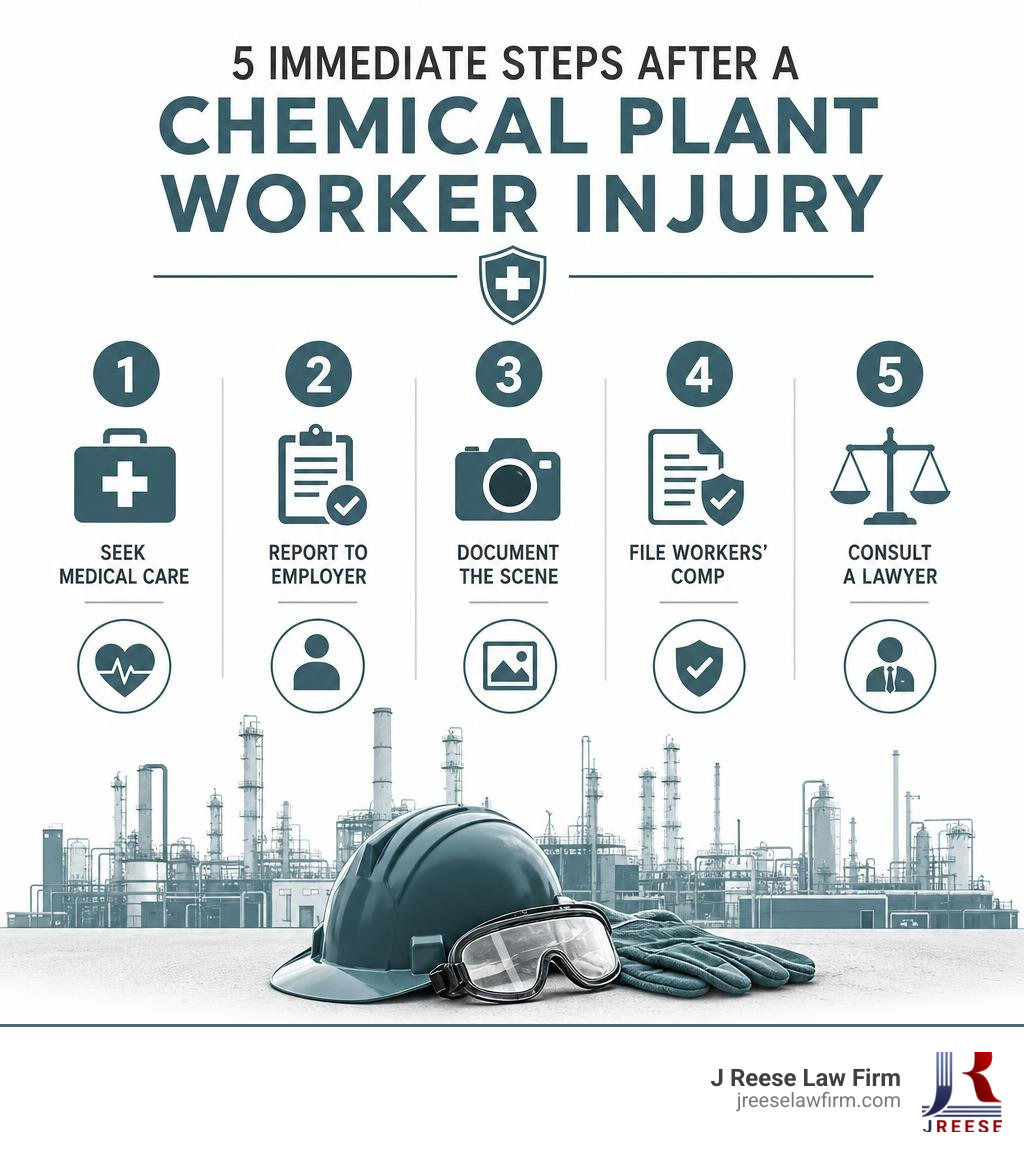
Here’s a quick overview of the most important steps:
- Get medical attention immediately — even if symptoms seem minor at first
- Report the injury to your employer — in Louisiana, you have 90 days, but sooner is always better
- Document everything — photos, witness names, incident details
- File a workers’ compensation claim — covers medical bills and lost wages
- Consult an attorney — you may have additional rights beyond workers’ comp if a third party was at fault
These injuries are more common than most people realize. Serious accidents happen every day at chemical facilities across the country — from toxic gas leaks and chemical burns to catastrophic explosions. In 2023 alone, a single incident at a Dow facility in Louisiana released more than 31,000 pounds of toxic ethylene oxide, affecting hundreds of nearby residents. In 2026, a compressor explosion at a petrochemical plant in Hungary killed one worker and seriously injured several others during a routine plant restart.
The physical, financial, and emotional toll on workers and their families can be enormous. But you don’t have to figure it out alone.
This guide walks you through exactly what to do — step by step.
Understanding the Common Types and Causes of Chemical Plant Accidents
Working in a chemical plant means operating in a high-stakes environment. While these facilities are vital to our modern economy, they house a volatile mix of high pressures, extreme temperatures, and hazardous materials. When safety protocols lapse, the results are often devastating.
Common Injury Types
A chemical plant worker injury can take many forms. Some of the most common physical traumas include:
- Chemical Burns: Unlike thermal burns, chemical burns can continuously destroy living tissue layers below the skin until the substance is completely neutralized or washed away.
- Toxic Inhalation and Respiratory Damage: Breathing in toxic vapors, gases, or dust can cause immediate inflammation of the lungs, chemical pneumonitis, or long-term chronic respiratory diseases.
- Explosion Injuries: Blast waves can cause traumatic brain injuries (TBIs), ruptured eardrums, internal organ damage, severe lacerations from flying debris, and fractures.
- General Industrial Trauma: Slip-and-falls, getting caught in heavy machinery, overexertion, and repetitive motion injuries are also highly prevalent in these busy industrial environments.
Primary Causes of Accidents
Many plant accidents trace back to a few critical failure points:
- Inadequate Equipment Maintenance: Skipped inspections, worn-out valves, or failing compressors are ticking time bombs. For example, a major 2026 MOL petrochemical plant explosion in Hungary occurred when a compressor exploded during the restart of an olefin unit, killing one worker and seriously injuring several others.
- Dust and Pressure Buildup: Fine chemical particles can become highly explosive when suspended in the air. In a tragic 2025 Telangana factory blast in India, a massive explosion killed 14 people and injured 35 others. Investigators discovered the blast was caused by pressure building up inside a spray dryer, accelerated by fine dust chemical particles.
- Shiftwork Fatigue: Human error is closely linked to exhaustion. Studies on chemical plant shiftworkers show that while overall injury rates are comparable to dayworkers, the distribution is highly uneven. Specifically, the average number of injuries is two to three times higher during the first four days of day and night shift rotations. Furthermore, female shiftworkers experience significantly higher injury rates than male shiftworkers and dayworkers of both genders, highlighting how shift rotation tolerance varies across the workforce.
The Danger of Plant Decommissioning and Startup Phases
Statistically, chemical plants are at their most dangerous during transition phases—specifically during plant startups, shutdowns, and decommissioning work. When a plant is running normally, processes are automated and contained. But during transition phases, systems are opened, chemicals are moved, and human intervention is at its peak.
A tragic example occurred during the 2026 Ames Goldsmith WV tragedy, where a plant undergoing decommissioning became the scene of a fatal accident. While workers were cleaning out a chemical storage tank, a violent chemical reaction occurred between nitric acid and another compound.
Instead of a typical fire or explosion, this reaction generated a massive cloud of highly toxic hydrogen sulfide gas. Two workers lost their lives, another was left in critical condition, and dozens of emergency responders and nearby individuals had to be treated for contamination. Nitric acid can coat the lungs and cause severe, life-threatening inflammation, while hydrogen sulfide can instantly overcome a worker, shutting down their respiratory system.
Immediate Steps to Take After a Chemical Plant Worker Injury

When an accident occurs, adrenaline spikes, and chaos can quickly take over. However, the actions you take in the minutes and hours following a chemical plant worker injury are critical for both your physical recovery and your legal rights.
1. Seek Immediate Medical Attention
Your health is the absolute priority. If you suffer a chemical burn, exposure to toxic fumes, or trauma from an explosion, you must be evaluated by a doctor immediately.
- For chemical exposure, locate the nearest safety shower or eyewash station and flush the affected area with cool water for at least 15 to 20 minutes.
- Do not attempt to neutralize the chemical with other substances, as this can cause a secondary chemical reaction and worsen the burn.
- If you have suffered severe trauma, seek emergency medical services. For more complex, long-term conditions, you may need a New Orleans Catastrophic Injuries Attorney to help you secure the specialized medical care required for recovery.
2. Report the Injury to Your Employer
Under Louisiana law, you must report a workplace injury to your employer within 90 days. However, you should never wait that long. Report the incident to your supervisor in writing as soon as practically possible. This creates an official paper trail and prevents the employer or their insurance company from claiming your injury happened outside of work.
3. Document the Scene and Preserve Evidence
If you or a coworker are physically able, gather as much information as possible:
- Take high-quality photos of your injuries, the equipment involved, and the surrounding area.
- Write down the names and contact information of any coworkers who witnessed the accident.
- Keep copies of all medical records, discharge instructions, and receipts for out-of-pocket expenses.
The Long-Term Physical Toll of a Chemical Plant Worker Injury
The initial impact of a chemical plant accident is only the beginning. Many workers face a long, painful road to recovery that extends far beyond their initial hospital stay.
- Chronic Respiratory Damage: Inhaling toxic fumes can lead to reactive airways dysfunction syndrome (RADS), asthma, or pulmonary fibrosis, leaving workers dependent on oxygen or inhalers for the rest of their lives.
- Neurological and Systemic Damage: Exposure to carcinogens and neurotoxins can damage the central nervous system. For instance, the 2023 Dow Plaquemine explosion investigation by the U.S. Chemical Safety Board (CSB) detailed a catastrophic release of over 31,000 pounds of ethylene oxide. Ethylene oxide is not only highly flammable but also a known human carcinogen. Acute exposure can damage the brain and nervous system, while long-term exposure significantly increases cancer risks.
- Psychological Trauma: Surviving a fiery explosion or watching coworkers suffer fatal injuries frequently leads to Severe Post-Traumatic Stress Disorder (PTSD), anxiety, and depression.
Navigating Workers’ Compensation and Third-Party Liability
When you are injured on the job, you generally have two potential avenues for recovering financial compensation. Understanding the differences between these two pathways is essential.
| Feature | Workers’ Compensation Claim | Third-Party Personal Injury Lawsuit |
|---|---|---|
| Fault Required | No-fault system (you do not need to prove the employer was negligent). | Must prove the third party was negligent or at fault. |
| Who You Sue/Claim Against | Your employer’s workers’ comp insurance provider. | A third party (contractor, manufacturer, property owner, etc.). |
| Medical Expenses Covered | 100% of approved, reasonable, and necessary medical care. | Full medical expenses, including future estimated care. |
| Lost Wages Compensation | Typically covers two-thirds (66.67%) of your average weekly wage, subject to state caps. | Covers 100% of lost wages and future loss of earning capacity. |
| Pain and Suffering | Not available. | Fully recoverable (emotional distress, loss of enjoyment of life). |
| Punitive Damages | Not available. | May be available in cases of egregious or willful misconduct. |
Under Louisiana’s workers’ compensation system, you are generally barred from suing your direct employer for negligence. This is known as the “exclusive remedy” rule. However, chemical plants are incredibly complex environments filled with third-party contractors, equipment manufacturers, and delivery drivers.
If your injury was caused by a defective piece of machinery, a negligent contractor working on-site, or an external maintenance crew, you may be able to file a third-party personal injury lawsuit. This is crucial because workers’ comp benefits rarely cover the true, full cost of a catastrophic injury. To learn more about how these complex rules apply to your situation, read about Why Louisiana Personal Injury Cases Are Different.
How Employers Can Prevent Catastrophic Chemical Plant Accidents
Almost every chemical plant disaster is preventable. Employers have a legal and ethical duty under OSHA standards to provide a safe working environment. Key prevention strategies include:
- Strict Process Safety Management (PSM): Employers must implement rigorous PSM programs to manage the hazards associated with highly hazardous chemicals.
- Rigorous Preventive Maintenance: Equipment must be inspected and maintained regularly. The CSB investigation into the 2023 Dow Plaquemine explosion revealed that the blast was caused by metal debris from portable work lights left inside a reflux drum during maintenance. The debris punctured a rupture disc, allowing ethylene oxide to enter air-filled piping and ignite because the nitrogen inerting system had slowly leaked. Proper vessel closure verification practices would have prevented this entire disaster.
- Advanced Air Filtration and Ventilation: Keeping the air clear of combustible dust and toxic vapors prevents the secondary explosions and inhalation hazards that lead to mass casualty events.
- Comprehensive Employee Training: Workers must be thoroughly trained on emergency shutoff procedures, the chemical properties of the materials they handle, and the proper use of Personal Protective Equipment (PPE).
The Role of Legal Representation in Securing Your Recovery
Dealing with insurance companies, corporate lawyers, and workers’ compensation administrators while trying to heal is exhausting. This is where professional legal representation becomes invaluable.
An experienced attorney can handle the administrative burden for you by:
- Investigating the root cause of the accident.
- Identifying all potentially liable third parties.
- Managing communication and negotiations with insurance adjusters.
- Calculating the true lifetime cost of your medical care and lost wages to ensure you do not accept a lowball settlement.
If you have been hurt in an industrial accident, seeking experienced New Orleans Personal Injury Representation is the best way to protect your future. You can also review Our past case results to see how we have successfully fought for injured workers in the past.
How a Lawyer Proves Liability in a Chemical Plant Worker Injury Claim
Proving liability in a chemical plant case requires deep technical knowledge and extensive resources. To build a winning case, a lawyer will:
- Utilize Expert Testimony: Work with chemical engineers, industrial safety experts, and accident reconstructionists to pinpoint exactly what went wrong.
- Review Internal Records: Subpoena the plant’s maintenance logs, safety audit reports, and internal communications to see if management ignored known hazards.
- Analyze OSHA Violations: If federal regulators fined the company following the incident, this evidence can be powerful leverage in your claim.
That time is of the essence. Under Louisiana’s strict one-year statute of limitations, you have exactly one year from the date of your accident to file a personal injury lawsuit. If you miss this deadline, you lose your right to seek compensation forever.
Frequently Asked Questions about Chemical Plant Injuries
When is a chemical burn considered a medical emergency?
A chemical burn is a medical emergency and requires immediate emergency room treatment if:
- It occurs on critical body areas, including the face, eyes, hands, feet, groin, buttocks, or over a major joint.
- It covers an area larger than three inches in diameter.
- It penetrates past the top layer of skin (second- or third-degree burns), causing blistering, severe pain, or white/blackened skin.
- The victim shows signs of shock, such as pale skin, shallow breathing, dizziness, or nausea.
Can I sue my employer directly for a chemical plant injury?
In Louisiana, the “exclusive remedy” rule of workers’ compensation generally prevents you from suing your employer directly for standard negligence. However, there are two major exceptions:
- Intentional Acts: If your employer acted with “substantial certainty” that their actions (or lack thereof) would cause you harm, you may be able to file an intentional tort lawsuit.
- Third-Party Claims: You can sue third-party entities—such as equipment manufacturers, subcontractors, or property owners—whose negligence contributed to your injury.
How does shiftwork affect the risk of chemical plant accidents?
Shiftwork, particularly rotating 8-hour or 12-hour schedules, introduces severe fatigue patterns that compromise worker safety. Studies show that injury incidence rates spike dramatically—up to two to three times higher—during the first four days of a new day or night shift rotation. Fatigue slows reaction times, impairs decision-making, and makes workers far more susceptible to errors when handling highly volatile chemicals.
Conclusion
Suffering a chemical plant worker injury is a life-altering event, but you do not have to navigate the complex road to physical and financial recovery alone. By taking immediate medical action, reporting the incident, and understanding your legal options, you can protect your health and your family’s future.
At J Reese Law Firm, we understand the devastating impact of industrial accidents. If you or a loved one has been injured, let us fight the insurance companies and corporate legal teams on your behalf. Contact our refinery and chemical plant accident lawyers today to schedule a free consultation and learn how we can help you secure the recovery you deserve.