
When a Head Injury Changes Everything: What TBI Victims in Louisiana Need to Know
If you’re looking for a Louisiana traumatic brain injury lawyer, here is what you need to know right away:
Quick answers for TBI victims in Louisiana:
- You have 2 years to file a personal injury claim for accidents on or after July 1, 2024
- You can still recover compensation even if you were partially at fault (up to 50% at fault under 2026 rules)
- TBI symptoms can appear days later — delayed onset does not disqualify your claim
- Insurance companies routinely minimize brain injury claims — legal representation levels the playing field
- Most TBI lawyers work on contingency — you pay nothing unless you win
Any injury to the head is serious. But when that injury is severe enough to be called traumatic, the consequences can ripple through every part of a person’s life — their memory, their personality, their ability to work, and their relationships.
Traumatic brain injuries are more common than most people realize. According to the CDC, TBIs contribute to approximately 190 deaths every single day in the United States. About 5.3 million Americans are currently living with a permanent TBI-related disability. Yet because many brain injuries are invisible on standard scans, victims are often dismissed by insurers — or worse, they dismiss themselves.
In Louisiana, the risks are especially real. Workers in offshore drilling, maritime industries, and agriculture face daily hazards. Multi-vehicle crashes on I-10 and I-20 are a constant reality. And falls — the leading cause of TBIs nationally — happen everywhere from grocery store floors to construction sites.
The financial toll is staggering too. Between lost wages, long-term medical care, and rehabilitation, the economic burden of a single severe TBI can reach into the millions over a lifetime.
I’m Justin Reese, a civil litigation and personal injury attorney with Alexander Shunnarah Trial Attorneys and a native of New Orleans, with years of experience helping Louisiana families pursue justice in catastrophic injury and TBI cases — making me well-positioned to guide you through what a Louisiana traumatic brain injury lawyer can do for your claim. In the sections below, we’ll walk through everything you need to know to protect your rights and pursue full compensation.
Understanding Traumatic Brain Injuries and Common Causes in Louisiana
A traumatic brain injury (TBI) occurs when an external physical force jolts, bumps, or penetrates the head, disrupting normal brain function. It does not always require a direct blow to the skull. For instance, the violent back-and-forth motion of severe whiplash can cause the brain to collide with the interior of the skull, tearing delicate neural pathways.
In Louisiana, our daily environments expose us to unique hazards that frequently result in catastrophic head trauma:
- Motor Vehicle Accidents: Heavy traffic along major corridors like I-10, I-12, and I-20 often leads to high-speed collisions. When passenger cars collide with heavy commercial trucks, the massive force generated routinely results in severe, life-altering brain trauma. If you have been hurt on our local roads, consulting a New Orleans Car Accident Lawyer is a vital step toward protecting your health and your legal rights.
- Maritime and Offshore Drilling Accidents: Our coastal and river economy relies heavily on industrial shipping, dock work, and offshore rigs. Crane failures, slip and falls on wet decks, and heavy equipment malfunctions can cause devastating head injuries.
- Industrial and Construction Site Incidents: Refineries, chemical plants, and construction projects present high-risk environments. Falling tools, scaffolding collapses, and machinery accidents can inflict severe brain damage.
- Slip and Fall Accidents: Uneven sidewalks, wet commercial floors, and poorly maintained staircases are common culprits. A sudden fall can cause a victim’s head to strike a hard surface with incredible force.
When these incidents occur due to another party’s negligence, the law provides a pathway to hold them accountable. Navigating this process requires the support of an advocate who understands both the legal and medical complexities of these claims, which is where a dedicated New Orleans Traumatic Brain Injury Attorney can make a world of difference.
When to Consult a Louisiana Traumatic Brain Injury Lawyer for Delayed Symptoms
One of the most dangerous aspects of a brain injury is that symptoms do not always appear immediately. Immediately after a car crash or a fall, adrenaline masks pain. You might walk away believing you were lucky to escape with only a minor bump.
However, over the following days or weeks, a mild TBI or concussion can evolve into a chronic condition. Delayed symptoms can include:
- Persistent, worsening headaches or migraines
- Unexplained dizziness, vertigo, or loss of physical coordination
- Memory loss, brain fog, and difficulty concentrating
- Sudden mood swings, irritability, anxiety, or depression
- Sensitivity to light and sound, or blurred vision
- Chronic fatigue or disrupted sleep patterns
If these symptoms persist, you may be experiencing post-concussion syndrome. This is where insurance companies often try to take advantage of victims. If standard diagnostic imaging like CT scans or MRIs comes back clear, insurance adjusters may aggressively argue that your injury is non-existent or exaggerated.
Standard imaging is designed to detect structural damage, such as skull fractures or major brain bleeds. They frequently fail to capture microscopic damage, such as diffuse axonal injury (the shearing of brain fibers). To prove these “invisible” injuries, we work alongside medical professionals who utilize advanced neuropsychological evaluations to document cognitive, behavioral, and emotional deficits, building a clear, objective record of your injury.
How Louisiana’s Legal System Handles Brain Injury Claims
Pursuing a legal claim in Louisiana involves navigating a unique set of civil laws. Unlike other states, our legal system operates under a civil code that imposes strict deadlines and specific rules for establishing liability.
Historically, Louisiana was known for having one of the shortest filing windows in the nation. Under Louisiana Civil Code Article 3492, the prescriptive period (statute of limitations) for personal injury claims was strictly one year. However, the legislature enacted a major update: for accidents occurring on or after July 1, 2024, the prescriptive period has been extended to two years.
While this change provides families with more time to understand the long-term impacts of a brain injury, it is still a remarkably tight window. To understand how these timelines impact your specific situation, you can read more about Louisiana’s One Year Statute of Limitations and how the transition to the new two-year rule applies.
For a comprehensive overview of how a lawsuit progresses from the initial filing to a courtroom verdict, our guide on Louisiana Brain Injury Litigation 101: What You Need to Know breaks down the procedural steps. Additionally, our explanation of Why Louisiana Personal Injury Cases Are Different highlights the state-specific procedural rules that can make or break your recovery.
Pure vs. Modified Comparative Fault Rules in 2026
Another critical legal shift in Louisiana involves how fault is shared among parties. For many years, Louisiana operated under a pure comparative fault system, which allowed an injured victim to recover compensation even if they were 90% responsible for the accident (though their payout would be reduced by 90%).
However, as of January 1, 2026, Louisiana has transitioned to a modified comparative fault system. Under these current 2026 rules:
- The 51% Bar Rule: If you are found to be 51% or more at fault for the accident that caused your injury, you are completely barred from recovering any financial compensation.
- The 50% or Less Rule: If your share of fault is determined to be 50% or less, you can still recover damages, but your total compensation will be reduced by your percentage of liability. For example, if your total damages are valued at $500,000 and you are found to be 20% at fault, your final recovery will be $400,000.
Additionally, Louisiana’s “No Pay, No Play” law (updated August 1, 2025) adds another layer of complexity. Under this statute, uninsured drivers are generally barred from recovering the first $100,000 of bodily injury damages and the first $100,000 of property damage, even if another negligent driver was entirely at fault for the crash.
Because insurance defense teams will aggressively attempt to shift blame onto you to push your fault percentage above the 51% threshold, having an advocate who understands these shifting rules is essential. If you are facing these hurdles, consulting a New Orleans Personal Injury Lawyer early is the best way to protect your claim.
Why You Need a Louisiana Traumatic Brain Injury Lawyer to Prove Negligence
Proving negligence in a TBI lawsuit requires establishing four core legal elements:
- Duty of Care: The defendant had a legal obligation to act reasonably and safely (e.g., a driver keeping their eyes on the road, or a business owner keeping floors dry).
- Breach of Duty: The defendant failed to meet that obligation (e.g., texting while driving, or failing to clean up a spill).
- Causation: The defendant’s breach of duty directly caused the accident that resulted in your head injury.
- Damages: You suffered actual physical, cognitive, and financial harm as a result of the injury.
Because brain injuries are often “invisible” to the naked eye, insurance adjusters frequently use bad-faith tactics to minimize payouts. They may offer a quick, lowball settlement immediately after the accident, hoping you will sign away your rights before the true, long-term scope of your cognitive damage is fully diagnosed.
We advise our clients never to accept an early settlement. It is critical to wait until you reach Maximum Medical Improvement (MMI) — the point at which your medical team determines your condition has stabilized as much as it is expected to. Only then can we accurately calculate the lifetime cost of your care. For a deeper look at how we build and defend these cases, read about How a Traumatic Brain Injury Lawyer Evaluates Your Case and Fights.
The Role of Medical Professionals and Life Care Planners
To overcome the skepticism of insurance companies and present a compelling case to a Louisiana jury, we collaborate with a multidisciplinary network of medical and financial professionals:
- Neurologists and Neuropsychologists: These clinicians conduct specialized testing to measure cognitive deficits, memory impairment, and executive dysfunction, establishing a clear link between the accident and your brain damage.
- Life Care Planners: For moderate to severe TBIs, these professionals draft a comprehensive, itemized projection of the victim’s lifetime medical needs. This includes future surgeries, physical therapy, cognitive rehabilitation, home modifications, and in-home care.
- Vocational Professionals and Economists: These witnesses calculate your lost earning capacity, demonstrating how your cognitive or physical limitations prevent you from returning to your previous line of work, especially in labor-intensive Louisiana industries like maritime operations or industrial construction.
Working with these professionals ensures that we do not leave your future financial security to chance. If you or a loved one has suffered a life-altering head injury, reaching out to a New Orleans Catastrophic Injuries Attorney is a critical step toward securing the resources needed for long-term recovery.
Recovering Full Compensation for Catastrophic Brain Damage
In Louisiana, TBI survivors can pursue compensation for both tangible financial losses and intangible human costs. These are categorized into economic and non-economic damages. In the most tragic cases where a severe head injury results in a fatal outcome, surviving family members can seek justice through a wrongful death claim with the help of a New Orleans Wrongful Death Attorney.
| Damage Category | Type of Loss Covered | How It Is Documented and Proven |
|---|---|---|
| Economic Damages | Immediate medical bills, emergency room costs, diagnostic imaging (CT, MRI) | Medical invoices, receipts, and hospital bills |
| Future medical treatment, ongoing surgeries, cognitive therapy, prescription medications | Life care plans developed by medical and rehabilitation professionals | |
| Lost wages from missed work during initial recovery | Pay stubs, tax returns, and employment records | |
| Lost earning capacity (inability to return to your career or work full-time) | Vocational assessments and economic projections | |
| Non-Economic Damages | Physical pain and suffering | Personal journals, medical logs, and testimony |
| Mental anguish, severe anxiety, depression, and post-traumatic stress | Psychological evaluations and therapeutic records | |
| Loss of enjoyment of life (inability to participate in hobbies, sports, or family activities) | Testimony from the victim, family, and close friends | |
| Loss of consortium (the negative impact of the injury on spousal and family relationships) | Interviews and qualitative testimony from loved ones |
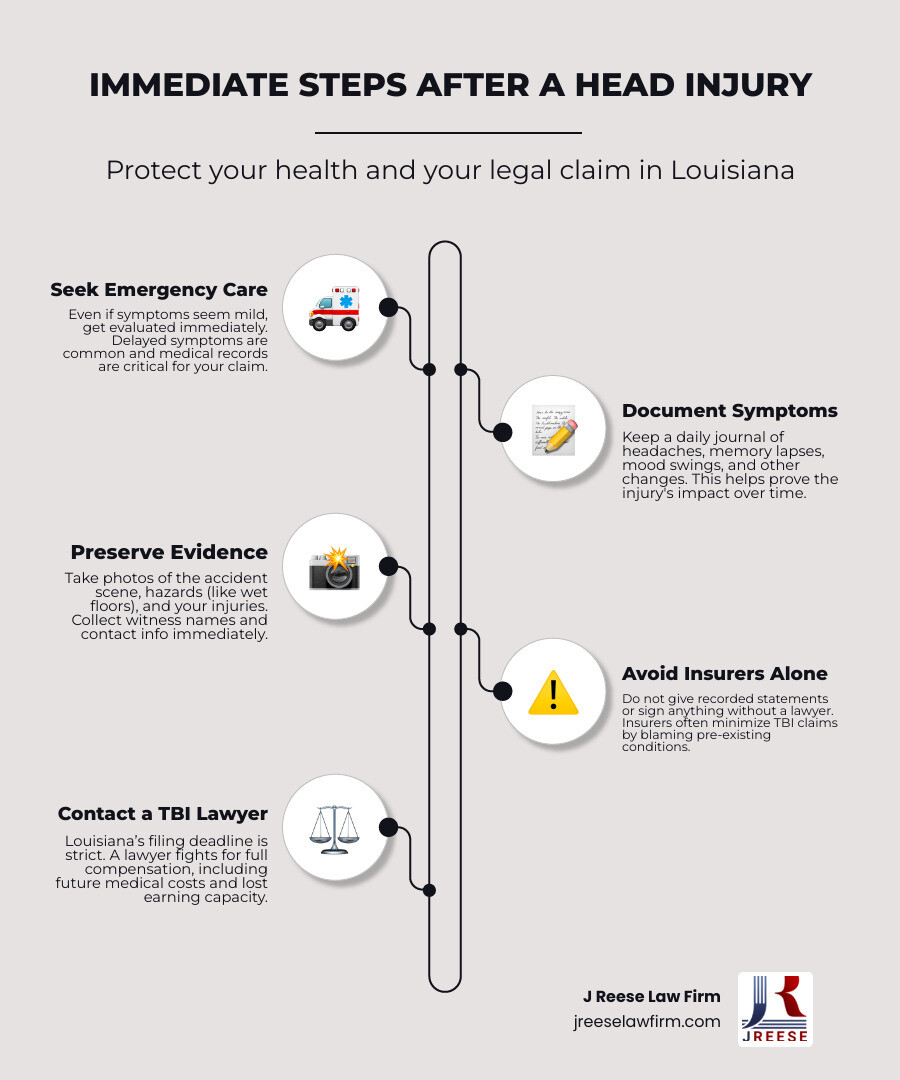
Immediate Steps to Take After a Head Injury in Louisiana
If you or a loved one has suffered a head impact, taking swift, deliberate action can protect both your physical health and your future legal claim:
- Seek Emergency Medical Care Immediately: Never wait to see if symptoms improve. Go to an emergency room or see a primary care physician right away. A doctor must evaluate you for internal bleeding, swelling, or concussive damage.
- Begin a Detailed Symptom Journal: Write down daily changes in physical ability, cognitive function, mood, and sleep patterns. Note any instances of forgetfulness, confusion, or emotional outbursts.
- Preserve Physical Evidence: Keep the clothing, helmet, or protective gear worn during the accident. Do not wash or alter these items, as they can demonstrate the severity of the physical impact.
- Gather Evidence at the Scene (Especially for Slip and Falls): If your injury was caused by a slip and fall, immediate evidence preservation is vital. Take high-quality pictures of the substance or liquid on the floor that caused you to slip. Document the surrounding area to show that there were no wet floor signs or warning barriers posted.
- Collect Witness Contact Information: Obtain the names, phone numbers, and email addresses of anyone who saw the accident occur or observed the immediate aftermath.
- Avoid Giving Statements to Insurance Adjusters: Do not sign any authorizations or provide recorded statements to the other party’s insurance company before consulting an attorney. They can use your words to downplay your injuries or shift fault onto you.
To discuss the specific details of your accident and learn how to safeguard your rights, please reach out to us directly through our Contact page.
Frequently Asked Questions About Brain Injury Claims
How do I choose the right Louisiana traumatic brain injury lawyer?
Choosing a legal advocate for a brain injury claim requires looking beyond basic personal injury advertising. You should seek an attorney with specific experience handling complex, catastrophic injury cases and a deep understanding of neuro-litigation.
Look for a firm that has a proven track record of taking challenging cases to trial rather than rushing to settle for the first low offer. During your initial consultation, ask about their experience working with life care planners and neuropsychologists. To learn more about our background, our approach to client care, and our commitment to Louisiana families, please visit our About Us page.
What if my TBI symptoms did not appear until days after the accident?
Delayed symptom onset is incredibly common with brain injuries. Insurance companies frequently attempt to use this delay to deny claims, arguing that if you did not report head pain at the scene, your cognitive struggles must have been caused by a pre-existing condition or a subsequent, unrelated incident.
To counter this defense, it is essential to seek a comprehensive medical evaluation as soon as you notice any changes in your memory, mood, or physical coordination. A clear medical record linking your delayed symptoms to the date of the initial accident is the most powerful tool we have to protect your claim.
Can I still recover compensation if I was partially at fault under the new 2026 rules?
Yes, but with strict limitations. Under the modified comparative fault rules that went into effect on January 1, 2026, your ability to recover compensation depends entirely on your percentage of fault:
- If you are found to be 50% or less at fault, you can recover damages, but your total payout will be reduced by your percentage of liability.
- If you are found to be 51% or more at fault, you are legally barred from recovering any compensation whatsoever.
Because defense attorneys will fight to push your share of liability over that 51% threshold, securing experienced legal representation is more critical now than ever before.
Protect Your Rights: Secure Your Future with a Dedicated Legal Advocate
A traumatic brain injury does not just affect the survivor; it impacts the entire family support system. Navigating the medical appointments, rehabilitation schedules, and financial stress can feel completely overwhelming. Fortunately, you do not have to walk this path alone.
At the J Reese Law Firm, we are committed to helping local families secure the resources they need to rebuild their lives. Beyond the courtroom, we help our clients connect with vital local resources and support networks, including the Brain Injury Association of Louisiana (BIALA), Touro Rehabilitation Center, and state-funded programs like the Traumatic Brain & Spinal Cord Injury Trust Fund (which can be reached at 888-891-9441).
To explore these support options and read about finding community during your recovery, see our guide on No Survivor Is an Island: Finding the Best Brain Injury Support Groups.
If you are ready to take action, our team is here to listen to your story, evaluate your options, and build a powerful strategy for your recovery. Learn more about our approach by visiting the J Reese Law Firm Catastrophic Injury Practice. We offer a free, confidential, no-obligation consultation to help you understand your rights and take the first step toward a more secure future.