When You Need a New Orleans Car Accident Injury Lawyer: What to Know First
If you’re looking for a New orleans car accident injury lawyer, here’s what matters most right now:
Quick answers for accident victims in Orleans Parish:
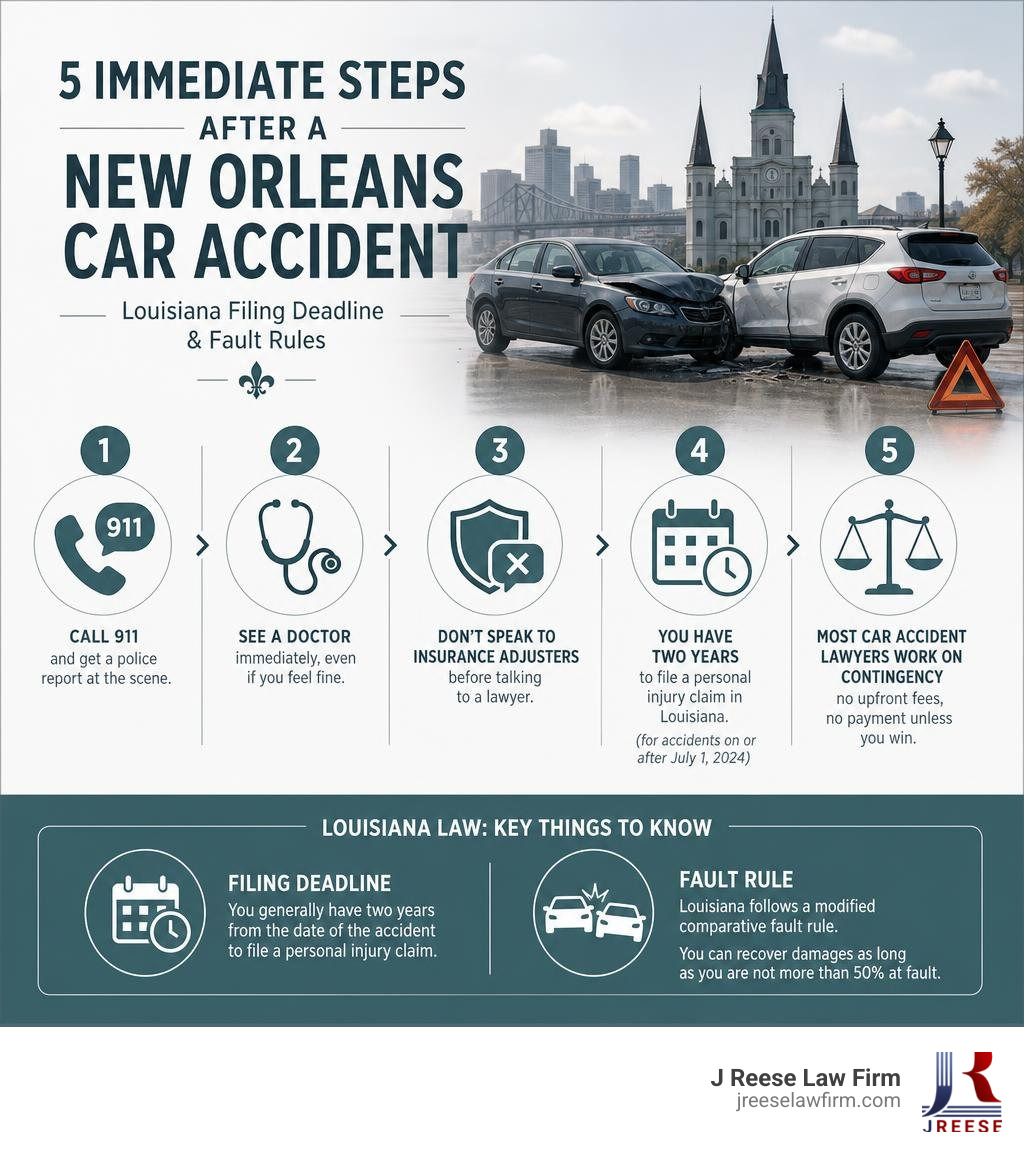
- Call 911 and get a police report at the scene.
- See a doctor immediately, even if you feel fine.
- Don’t speak to insurance adjusters before talking to a lawyer.
- You have two years to file a personal injury claim in Louisiana (for accidents on or after July 1, 2024).
- Most car accident lawyers work on contingency — no upfront fees, no payment unless you win.
New Orleans is one of the most dangerous cities in the country to drive in. Louisiana recorded over 78,000 car crashes in 2023, with New Orleans accounting for roughly 12,000 of those incidents. Orleans Parish reported the highest number of fatal crashes of any Louisiana parish in 2024 — 55 fatal crashes in a single year.
That’s not just a statistic. Behind each number is a real person dealing with medical bills, missed work, and insurance companies that are rarely on their side.
The aftermath of a crash can feel overwhelming fast. Pain, paperwork, and pressure from insurers all hit at once — often before you fully understand your injuries or your rights.
Louisiana’s legal system also works differently from most other states. It follows a modified comparative fault rule, and it’s one of the few states with a direct-action statute that lets you sue an at-fault driver’s insurer directly. These rules can make or break a claim if you don’t know how to use them.
That’s exactly why choosing the right legal help — and moving quickly — matters so much.
Understanding New Orleans Car Accidents: Causes, Hotspots, and Common Injuries
Driving in New Orleans is unlike driving anywhere else. Between the historic charm of our neighborhoods and the constant influx of tourists, our streets are uniquely vibrant—and uniquely hazardous. To build a strong injury claim, it helps to understand the local factors that contribute to collisions on Orleans Parish roads.
The Primary Causes of Local Crashes
Several repeating factors explain why our local crash rates remain so high:
- Distracted Driving: Despite strict state laws prohibiting texting while driving and banning handheld phone use in school zones, distracted driving remains a primary cause of local collisions.
- Impaired Driving: Alcohol and drug use contribute to a massive portion of local wrecks. In fact, impaired driving contributed to 36% of all deadly collisions statewide.
- Speeding and Reckless Behavior: Drivers rushing to make lights or weaving through traffic on congested avenues frequently cause devastating rear-end and T-bone collisions.
- Weather and Road Hazards: New Orleans is famous for sudden, torrential downpours that cause immediate street flooding. When you combine standing water with our city’s notorious potholes and subsidence issues, you get a recipe for hydroplaning and sudden loss of vehicle control.
High-Risk Areas and Local Hotspots
While a crash can happen on any block, certain areas see a disproportionate share of collisions. From the high-speed merges on Interstate 10 and I-610 to the confusing intersections near Gravier Street & South Claiborne Avenue or Poydras Street & Camp Street, navigating the city requires constant vigilance.
Heavy tourist traffic around the French Quarter and the narrow, historic lanes of Uptown further complicate traffic flow. To see where these incidents occur most frequently, you can read our detailed breakdown of New Orleans Accident Hotspots.
Common Injuries Sustained in New Orleans Crashes
When vehicles collide, the physical toll on occupants can be life-altering. We regularly see victims suffering from a wide array of serious physical traumas, including:
- Whiplash and Soft Tissue Damage: The sudden whipping motion of the neck during a rear-end collision frequently stretches or tears muscles and ligaments, causing chronic pain and restricted mobility.
- Traumatic Brain Injuries (TBIs): From mild concussions to severe cognitive impairments, brain injuries occur when a victim’s head strikes the steering wheel, window, or dashboard.
- Spinal Cord Injuries: Herniated discs, fractured vertebrae, and nerve damage can cause permanent pain, numbness, or even paralysis.
- Fractures and Broken Bones: The force of an impact easily crushes limbs, ribs, and collarbones, requiring surgical intervention and months of physical therapy.
- Internal Injuries: Damage to internal organs and internal bleeding are life-threatening conditions that may not show symptoms immediately but require urgent emergency care.
Understanding the relationship between how an accident happened and the medical reality of your recovery is the foundation of any successful injury claim.
What to Do Immediately After a Crash in Orleans Parish
The moments immediately following a car crash are chaotic, stressful, and critical. The steps you take—or fail to take—in the first hour after an accident can heavily influence your physical recovery and your ability to secure fair compensation later.
1. Prioritize Safety first
Stop your vehicle immediately. If possible, move your car to a safe location out of the flow of traffic, such as the shoulder of the highway or a nearby parking lot. Turn on your hazard lights to warn oncoming drivers.
2. Call 911 and Request a Police Report
Always call the police to the scene, even if the other driver begs you not to. A formal police report is a cornerstone of any insurance claim. In Louisiana, police reports are legally required for any accident involving physical injury, death, or property damage exceeding $500. The responding officer will document the scene, interview witnesses, and make an initial determination of fault.
3. Seek a Professional Medical Evaluation
Even if you feel completely fine or believe you only have minor bruises, you must see a doctor as soon as possible. Adrenaline masks pain. Serious conditions like internal bleeding, concussions, and soft tissue damage often have a delayed onset. Delaying medical care gives insurance companies a reason to claim your injuries were not caused by the accident.
4. Collect Comprehensive Evidence
If it is safe to do so, use your phone to gather as much documentation as possible:
- Take photos and videos of all vehicle damage, license plates, skid marks, road hazards, traffic signals, and your visible injuries.
- Exchange names, phone numbers, insurance policy details, and driver’s license numbers with the other motorist.
- Collect contact information from any bystanders who witnessed the crash.
- Keep copies of all medical discharge papers, prescriptions, and towing receipts.
5. Avoid Common Post-Accident Pitfalls
Many well-meaning accident victims accidentally damage their own claims by making simple mistakes. To protect your rights, make sure you avoid these common traps:
- Never apologize or admit fault: Even a casual “I’m so sorry, I didn’t see you” can be twisted by insurance adjusters as an admission of liability.
- Do not post about the crash on social media: Insurance defense teams actively monitor public profiles. A photo of you smiling at a family dinner weeks after a crash can be used to argue that your injuries are not severe.
- Do not accept quick, early settlement offers: Insurers love to offer fast cash payouts before you know the true extent of your medical needs. Accepting these offers requires you to sign away your right to seek further compensation.
For a comprehensive, step-by-step checklist to keep in your glove box, read our guide on What to Do After a Car Accident in Louisiana.
How to Choose the Right New Orleans Car Accident Injury Lawyer
Finding the right legal advocate is the most important decision you will make after a crash. You need an attorney who understands the local legal landscape, has a proven track record of standing up to major insurance companies, and is dedicated to giving your case the personalized attention it deserves. To learn more about how we fight for local victims, visit our dedicated page for a New Orleans Car Accident Lawyer.
The Difference Between a General Personal Injury Attorney and a New Orleans Car Accident Injury Lawyer
While many attorneys advertise themselves as generalists, car accident claims require a highly specialized set of skills. A general attorney might handle a slip-and-fall, a dog bite, and a contract dispute all in the same week under the broad umbrella of Personal Injury.
In contrast, a dedicated car accident lawyer focuses daily on the complexities of auto insurance policies, accident reconstruction, and the specific medical treatments associated with traffic impacts. We understand how to navigate uninsured motorist (UM) policies, how to dissect a commercial trucking logbook, and how to counter the specific tactics used by auto insurance defense lawyers to devalue claims.
What to Look For in a New Orleans Car Accident Injury Lawyer
When evaluating potential attorneys to represent you, keep these key criteria in mind:
- Trial Experience: Insurance companies know which lawyers settle every case for pennies on the dollar and which ones are ready to go to court. Choose a firm with real trial experience that isn’t afraid to present your case to a jury.
- Direct Attorney Access: Many large, high-volume “billboard” law firms assign cases to paralegals or case managers. You may rarely speak to the actual attorney handling your file. Look for a firm that guarantees direct, open communication with your lawyer.
- Transparent Fee Structures: You should never have to pay out-of-pocket to speak with an attorney or launch an investigation. Ensure your lawyer operates on a clear, upfront contingency fee basis.
- Strong Local Roots: A lawyer who is deeply familiar with Orleans Parish courts, local judges, and local medical providers can navigate your claim far more efficiently than an out-of-state firm.
Determining Liability and Proving Negligence Under Louisiana Law
Louisiana’s civil law system is unique, and proving who is responsible for a car accident requires establishing specific legal elements. To successfully recover compensation, your legal team must prove four core pillars of negligence:
- Duty of Care: The other driver owed a legal duty to operate their vehicle safely and follow traffic laws.
- Breach of Duty: The driver breached that duty by acting recklessly, such as speeding, texting, or running a red light.
- Causation: This breach of duty directly caused the collision and your subsequent injuries.
- Damages: You suffered actual, documentable losses (medical bills, lost wages, pain and suffering) as a result.
The Shift to Modified Comparative Fault
A critical legal change went into effect on January 1, 2026. Louisiana transitioned from a pure comparative fault system to a modified comparative fault system with a 51% bar.
Under this current rule, your ability to recover compensation depends on your percentage of fault:
- If you are found to be 50% or less at fault for the accident, you can still recover damages, but your total payout will be reduced by your percentage of blame. For example, if your damages total $100,000 but you are found 20% at fault, you will receive $80,000.
- If you are found to be 51% or more at fault, you are completely barred from recovering any compensation from the other driver.
Because of this strict 51% threshold, insurance companies will work harder than ever to shift blame onto you. Having a skilled attorney who can gather black box data, secure traffic camera footage, and work with accident reconstruction experts is vital to protecting your share of liability.
Handling Multi-Party Liability and Louisiana’s Direct-Action Statute
Many crashes involve more than just two drivers. Multi-car pileups, rideshare accidents, and commercial trucking wrecks often involve multiple potentially liable parties, such as vehicle manufacturers, employers, or government entities responsible for road maintenance.
Additionally, Louisiana’s unique direct-action statute (R.S. 22:1269) provides a major procedural advantage. It allows injury victims to name the at-fault driver’s insurance company directly as a party in the lawsuit. This helps streamline the process and ensures that the financial resources of the insurance provider are brought directly to the negotiating table. To better understand these unique statutory elements, read our detailed analysis on Why Louisiana Personal Injury Cases Are Different.
Compensation, Contingency Fees, and Filing Deadlines
When you are hurt in a crash, the financial consequences mount quickly. A successful legal claim aims to restore your financial security by recovering both economic and non-economic damages.
Types of Recoverable Damages
- Economic Damages: These are objective, quantifiable financial losses. They include your past and future medical bills, emergency room costs, physical therapy expenses, lost wages from missed work, reduced future earning capacity, and the cost of repairing or replacing your vehicle.
- Non-Economic Damages: These represent subjective, non-financial losses. They include physical pain and suffering, emotional distress, mental anguish, loss of enjoyment of life, and loss of consortium (the impact of your injuries on your relationship with your spouse).
| Economic Damages (Quantifiable) | Non-Economic Damages (Subjective) |
|---|---|
| Emergency medical transport & ER bills | Physical pain and chronic discomfort |
| Future surgeries and rehabilitation costs | Emotional distress and anxiety |
| Lost wages and salary from missed work | Loss of enjoyment of daily activities |
| Diminished future earning capacity | Loss of companionship and consortium |
| Vehicle repair or replacement expenses | Mental anguish and PTSD symptoms |
How Contingency Fees Work
Many people hesitate to contact a lawyer because they worry they cannot afford high hourly legal fees. We believe everyone deserves access to high-quality legal representation, regardless of their financial situation.
That is why we operate on a contingency fee structure. Under this arrangement:
- You pay absolutely nothing upfront to hire us.
- We cover all the costs of investigating your crash, hiring experts, and filing court documents.
- We only get paid if we successfully secure a settlement or jury verdict for you. Our fee is a fixed percentage of your final recovery, meaning we are directly incentivized to maximize your compensation.
Understanding Louisiana’s Filing Deadlines
Time is your worst enemy after a car accident. For years, Louisiana maintained an incredibly strict one-year prescriptive period (statute of limitations) for personal injury claims.
However, under recent legislative updates (Act 423), the filing deadline has been extended to two years for personal injury claims resulting from accidents occurring on or after July 1, 2024. If your accident occurred before that date, the older, strict one-year deadline may still apply to your case.
Because missing this deadline permanently bars you from pursuing compensation, it is crucial to consult with an attorney immediately to confirm which timeline applies to your claim. You can read more about how these timelines operate by visiting our guide on Louisiana’s One-Year Statute of Limitations.
Frequently Asked Questions About New Orleans Car Accident Claims
How long does a car accident lawsuit typically take to resolve in New Orleans?
There is no single timeline for a car accident claim. A straightforward case with clear liability and minor injuries might resolve through insurance negotiations in a few months. However, complex cases involving severe injuries, disputed fault, or multiple defendants can take a year or more, especially if court backlogs in Orleans Parish require us to take the case to trial. We focus on moving your case forward as quickly as possible without sacrificing the value you deserve.
Why should I hire an attorney instead of dealing with the insurance company directly?
Insurance companies are businesses focused on protecting their bottom lines, not your health. Adjusters are trained to use tricks—like asking for recorded statements or offering quick, lowball settlements—to minimize what they pay you. Research shows that car accident victims who hire an attorney receive significantly higher settlements than those who represent themselves. An attorney handles all communication, accurately values your claim, and forces the insurer to treat you fairly.
Can I still recover compensation if I was partially at fault for the accident?
Yes, but with limits. Under Louisiana’s modified comparative fault law, you can recover damages as long as you are 50% or less at fault. Your final compensation will simply be reduced by your percentage of blame. However, if you are found to be 51% or more at fault, you cannot recover any damages from the other party. This makes it critical to have an attorney build a strong case to minimize your assigned percentage of fault.
Get Legal Help with J. Reese Law Group
A serious car accident can turn your life upside down in an instant. Dealing with physical pain, missing work, and facing mounting medical bills is stressful enough without having to navigate Louisiana’s complex legal system alone.
By working with an experienced local legal team, you can protect your rights, counter the tactics of greedy insurance companies, and focus entirely on your physical recovery. We are committed to standing up for Orleans Parish families and guiding you through every step of this journey with the personal care, respect, and aggressive advocacy you deserve.
Don’t let an insurance company dictate the value of your recovery. Contact us today to learn how we can help you secure the justice and peace of mind you need to move forward. Get a free consultation with a New Orleans Car Accident Lawyer