

Protecting Offshore and Waterway Workers
Working offshore, along the bustling docks of the Mississippi River, or aboard commercial vessels navigating Louisiana's intricate waterways is vital to our national economy. But the maritime industry is inherently dangerous — heavy machinery, unpredictable waters, tight spaces, and high-pressure demands create a volatile environment where catastrophic accidents occur.
When a serious injury happens on the water, the legal path forward is completely different from a standard land-based personal injury claim. A New Orleans maritime accident lawyer can help protect your rights under federal maritime law, where the stakes couldn't be higher.
At Justin Reese Law Group, we are dedicated to protecting your rights and securing the maximum recovery possible. Our firm stands ready to confront powerful maritime employers and insurance companies to demand justice for injured workers and their families throughout Louisiana and the Gulf Coast.
Why You Need a New Orleans Maritime Accident Lawyer for a Maritime Injury
The Gulf Coast region — specifically the Greater New Orleans area — serves as one of the busiest maritime hubs in the world. From the Port of New Orleans to the constant movement of tugs, barges, and offshore supply vessels, thousands of workers risk their safety daily. Choosing a New Orleans maritime accident lawyer deeply rooted in New Orleans offers distinct advantages.
Deep Local & Regional Knowledge
We understand the unique hazards of the Mississippi River, the Intracoastal Waterway, and the deep waters of the Gulf of Mexico. We are familiar with the specific operations of major regional employers, vessel operators, dock facilities, and fabrication yards that dominate our local economy.
Familiarity with Federal Courts
Maritime claims are often filed in federal courts, such as the United States District Court for the Eastern District of Louisiana in downtown New Orleans. We understand the specific rules, judges, and procedural nuances of these local courts.
Direct, Personalized Attention
A severe injury upends your financial stability and physical well-being. You are never a case number — you are a hard-working member of our community who deserves a voice and a lawyer who picks up the phone.
No Upfront Costs — Ever
We handle all maritime injury cases on a contingency fee basis. There are no upfront costs or hourly fees. We only receive compensation if we successfully secure a financial recovery or settlement for you.
Crucial Steps to Take Immediately After an Offshore or Waterway Accident
The actions you take in the hours and days following a maritime accident can significantly impact both your physical recovery and the strength of your future legal claim. Maritime employers and their insurance adjusters begin protecting their interests immediately — you must protect yours.
Report the Injury Immediately
Notify your captain, supervisor, or safety officer as soon as possible. Ensure a formal written accident report is completed and review every detail carefully before signing — confirming it accurately describes the incident and any equipment failures or unsafe conditions.
Seek Medical Attention
Your health is the highest priority. If offshore, request a medical evacuation if necessary. Once onshore, see a doctor of your own choosing. Under maritime law, you have the absolute right to see your own private physician — you are not required to see a company-selected doctor.
Document the Scene
If physically able, photograph and video the accident scene, the specific equipment involved, and any unsafe conditions — broken guards, oil spills, frayed ropes, missing safety gear. Visual evidence is critical and disappears fast.
Identify Witnesses
Obtain the names and contact information of any crew members, dockworkers, or bystanders who witnessed the incident or the conditions leading up to it. Witness testimony can be the difference in a disputed liability case.
Preserve the Equipment
Request that the vessel owner or employer preserve any tools, lines, or machinery involved in the accident. Do not allow them to alter, repair, or discard evidence before it can be inspected by an independent expert.
Do Not Give Recorded Statements
Insurance adjusters may ask for a recorded statement while you are still shaken or medicated. You are under no legal obligation to give one. Anything you say can and will be used to reduce your claim. Call us first.
Core Statutes & Legal Doctrines Governing Maritime Injuries
Unlike land-based workers restricted to state workers' compensation systems, maritime workers are protected by federal statutes and general maritime law doctrines. Determining which law applies depends heavily on your job description, your connection to a vessel, and where the incident occurred.
The Jones Act
46 U.S.C. § 30104A powerful federal statute protecting crew members — legally known as seamen. If you qualify as a seaman and are injured due to employer negligence, the Jones Act grants you the right to file a personal injury lawsuit. To qualify, your duties must contribute to the function of a vessel, and you must spend at least 30% of your work time aboard a vessel in navigation.
Maintenance and Cure
General Maritime Law — Absolute ObligationIf you qualify as a seaman, vessel owners must provide Maintenance (daily living allowances for food and lodging) and Cure (all necessary medical care) regardless of fault — until you reach Maximum Medical Improvement (MMI). Employers frequently try to underpay or prematurely cut these benefits. We fight to ensure they are fully paid.
Doctrine of Unseaworthiness
General Maritime Law — Strict LiabilityVessel owners have an absolute, non-delegable duty to provide a vessel, equipment, and crew that are reasonably fit for their intended use. If an unseaworthy condition — defective equipment, inadequate crew, unsafe procedures — directly causes your injury, the vessel owner can be held strictly liable regardless of negligence.
Longshore & Harbor Workers' Compensation Act (LHWCA)
Federal Compensation ProgramIf you work on a pier, wharf, dry dock, terminal, or marine railway and don't qualify as a Jones Act seaman, the LHWCA provides medical benefits, vocational rehabilitation, and disability payments. Section 905(b) also allows a separate third-party lawsuit against a vessel owner for negligence — an avenue for additional recovery beyond basic statutory benefits.
Death on the High Seas Act (DOHSA)
Fatal Accidents Beyond 3 Nautical MilesWhen a maritime worker loses their life due to a wrongful act occurring on the high seas beyond three nautical miles from U.S. shores, DOHSA governs the claim. Surviving family members can pursue compensation for lost financial support, loss of services, and funeral expenses. These claims involve highly technical rules requiring precise, experienced handling.
High-Risk Locations & Waterways in Our Region
Maritime accidents can happen anywhere water and commerce meet — but several local sites and corridors see the highest concentration of commercial marine traffic and associated risks. Our firm has firsthand experience handling claims from all of these locations.
Mississippi River (Mile Markers 90–115)
The stretch running past downtown New Orleans, Algiers Point, and Gretna is highly dangerous due to the constant convergence of massive cargo ships, fast-moving tugboats, and local ferries — elevating the risk of collisions and structural impacts.
Inner Harbor Navigation Canal (Industrial Canal)
This tight canal utilizes lock systems and drawbridges to manage heavy industrial barge traffic, creating restricted spaces that make line and barge handling exceptionally hazardous for deckhands.
Gulf Intracoastal Waterway (GIWW)
A critical commercial canal crossing southern Louisiana where tugboats push volatile chemical and fuel barges through narrow channels. Steering issues or bank suction here frequently cause groundings and violent accidents.
Port of New Orleans (Port NOLA)
Spanning miles of riverfront — including the Napoleon Avenue Container Terminal and Louisiana Avenue Wharf — longshoremen face daily hazards from massive container gantry cranes, heavy forklifts, shifting cargo, and unsecured gangways.
Port of South Louisiana
Extending across St. Charles, St. John, and St. James parishes upriver from New Orleans, this port handles massive quantities of grain, oil, and bulk cargo. Workers at grain elevators, oil terminals, and transfer docks face falls from heights, conveyor belt entrapment, and dockside structural failures.
Harvey Canal, Algiers & West Bank Shipyards
Multiple dry docks, fabrication yards, and ship repair facilities line the West Bank. Shipfitters, welders, and blasters here are exposed to scaffolding collapses, confined space toxic gas accumulation, and heavy equipment failures.
Types of Accidents & Injuries We Handle
The maritime working environment involves unstable surfaces, heavy iron equipment, volatile weather, and constant motion. When an accident occurs on the water, the injuries are almost always severe or life-altering.
Line Handling & Winch Snaps
Mooring lines and towing hawsers under tremendous tension can snap and strike a worker with catastrophic force — causing amputations, severe fractures, or immediate fatalities.
Falls Overboard & From Heights
Lack of fall protection, wet or oily decks, or poorly secured gangways can lead to falls onto steel decks or falls overboard into fast-moving currents — often with catastrophic results.
Unsafe Personnel Transfers
Transferring workers from supply vessels to platforms using swing ropes, personnel baskets, or gangplanks is inherently risky — especially in heavy swells or rough seas.
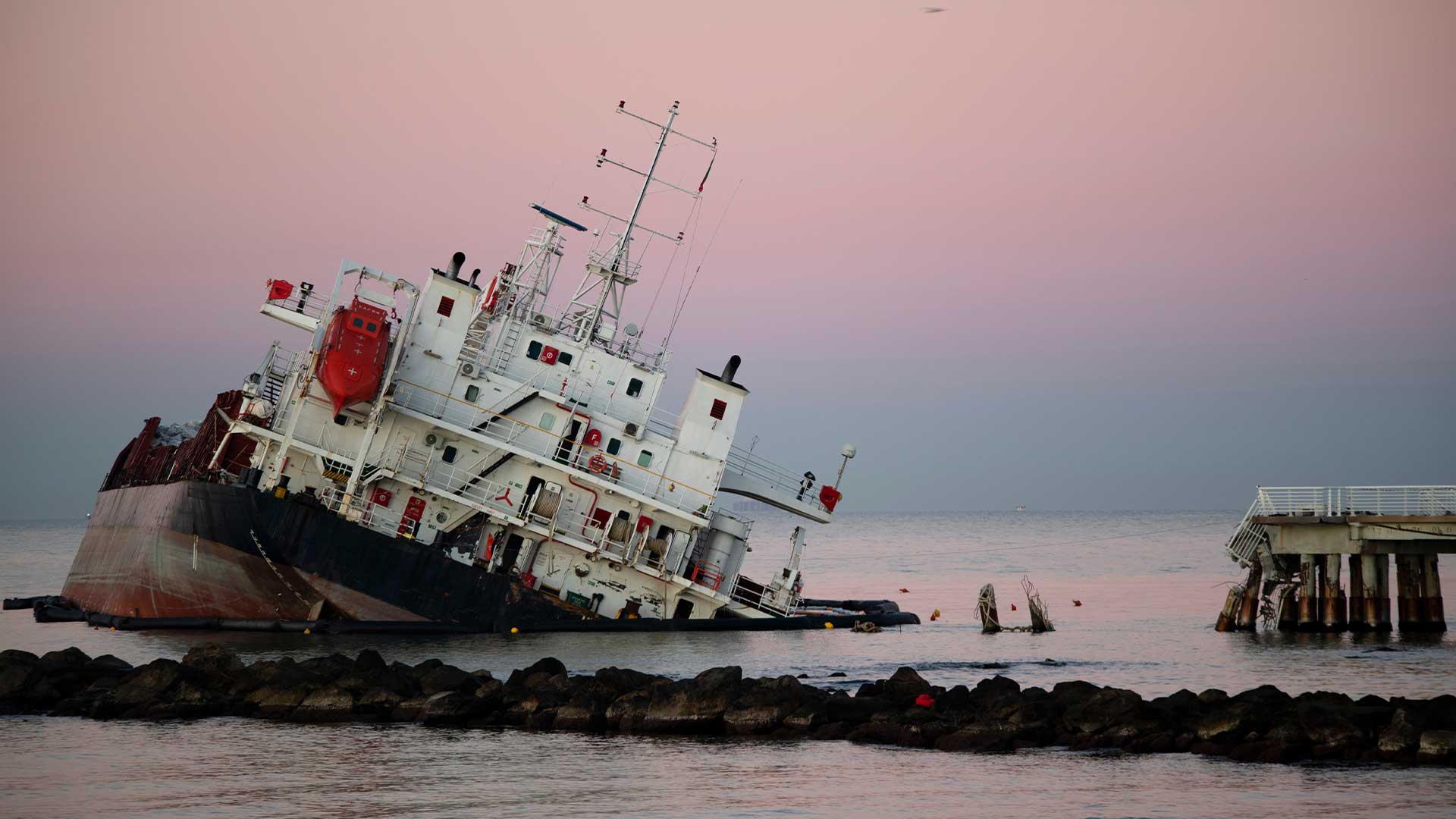
Vessel Collisions, Allisions & Groundings
Navigational errors, mechanical failures, or severe weather can cause a vessel to strike another vessel, run aground, or hit a fixed structure — throwing crew members across compartments or causing structural collapses.
Fires & Explosions
Vessels carrying flammable cargo or fuel present a constant risk of catastrophic fires and explosions. Confined spaces can trap workers, leading to severe thermal burns or fatal smoke inhalation.
Chemical & Toxic Exposure
Many barges and cargo ships transport hazardous chemicals, petroleum products, or crude oil. Workers can suffer long-term systemic damage or acute respiratory injuries from inadequate ventilation or sudden leaks during cargo transfers.
Damages Available in a Maritime Injury Claim
If your maritime injury was caused by negligence or an unseaworthy vessel, you have the legal right to pursue comprehensive compensation to address the full scope of your losses. We calculate every dimension of your claim to ensure nothing is left on the table.
Medical Expenses
Emergency transport, surgeries, hospital stays, medication, medical equipment, and long-term physical therapy or rehabilitation — past and future.
Lost Wages & Earning Capacity
Income lost during recovery, plus future loss of earning capacity if a permanent disability prevents you from returning to maritime work at your previous level.
Pain, Suffering & Mental Anguish
Physical pain, discomfort, sleep deprivation, and psychological impact — including depression, anxiety, and PTSD caused by a traumatic maritime accident.
Maintenance & Cure
Daily living allowances and full medical care coverage owed by vessel owners to injured seamen — a non-negotiable obligation under general maritime law.
Vocational Rehabilitation
If you can no longer work offshore, the cost of retraining, schooling, and job placement services for a land-based career may be recoverable as part of your claim.
Physical Impairment & Disfigurement
Compensation for permanent loss of bodily function, scarring, or loss of a limb that permanently alters your quality of life and physical independence.
Directions to Justin Reese Law Group
Office Address: 320 Huey P Long Ave., Suite 200, Gretna, LA 70053 — conveniently located just across the river from downtown New Orleans, easily accessible from the Westbank, the East, and the CBD. Meet with a New Orleans maritime accident lawyer at our Gretna office.
From Downtown New Orleans (CBD)
- Take the Crescent City Connection (US-90 Business West) across the Mississippi River.
- Take the exit toward Huey P Long Ave / Gretna.
- Continue onto the Westbank Expressway frontage road.
- Turn right onto Huey P Long Ave. Our office is at 320 Huey P Long Ave., Suite 200 on your right.
From Metairie / Kenner
- Take I-10 East toward New Orleans.
- Follow signs for the Westbank / US-90 W.
- Cross the Crescent City Connection.
- Exit toward Huey P Long Ave / Gretna and turn right onto Huey P Long Ave.
From the Lower Westbank
- Take the Westbank Expressway (US-90 Business East) toward Gretna.
- Exit at Huey P Long Ave.
- Turn left onto Huey P Long Ave under the expressway.
- Our office is at 320 Huey P Long Ave., Suite 200 on your left.
New Orleans Maritime Injury FAQ
If your injury occurred while working on or near a navigable waterway — such as the Mississippi River, the Gulf of Mexico, or the Intracoastal Waterway — and your job duties are connected to maritime commerce, shipping, or vessel operations, your case will almost certainly be governed by federal maritime law. Because the boundaries can overlap, a thorough review of your job description and the location of the incident is necessary to determine the exact legal framework that applies.
No. It is entirely illegal for a maritime employer to terminate, demote, or otherwise retaliate against an employee for reporting an injury or pursuing a legitimate Jones Act or LHWCA claim. If your employer attempts to threaten your job or retaliate against you in any way, you may have grounds for an additional, separate legal claim against them.
You should be extremely cautious. Initial quick settlement offers are almost always significantly lower than what your claim is actually worth. These early offers are designed to close your case before the full long-term impact of your injuries is known. Once you sign a settlement agreement or release form, you give up your right to seek any additional compensation — even if your condition worsens or you require future surgeries. Always have an independent attorney review any offer before signing.
Under general maritime law and the Jones Act, there is typically a three-year statute of limitations from the exact date of the injury to file a formal lawsuit. However, LHWCA claims have much shorter deadlines — often within 30 days for reporting the injury to your employer and within one year to file a formal claim. Failing to meet these specific deadlines can permanently bar you from receiving benefits. Act quickly and contact an attorney immediately after your injury.
You can still recover compensation. Maritime law operates under a doctrine known as pure comparative negligence — even if your own actions contributed to the accident, you are not disqualified from pursuing a claim. Your total financial recovery will simply be reduced by your percentage of fault. For example, if your total damages equal $100,000 but you were 20% at fault, you would still be entitled to receive $80,000.
Speak with a Trusted New Orleans Maritime Injury Lawyer
If you have been injured on the water, do not face corporate vessel owners and aggressive insurance adjusters alone. The decisions made in the early days of an injury can dictate your financial stability and physical recovery for years to come. Contact a New Orleans maritime accident lawyer at Justin Reese Law Group today — we stand ready to provide the steadfast, dedicated representation you deserve.
Get Your Free Case Review → No fees unless we win · Available 24/7 · 100% confidential