Every Second Counts After a New Orleans Intersection Crash
If you’ve been hurt in a crash and need an intersection accident lawyer, here’s what matters most:
- Fault is determined by who violated right-of-way rules — but Louisiana’s pure comparative fault law means both drivers can share blame
- You have only one year to file a personal injury claim in Louisiana (the shortest deadline in the country)
- Key evidence — traffic camera footage, signal timing data, dashcam recordings — disappears fast
- Compensation can cover medical bills, lost wages, pain and suffering, and property damage
- Hiring a lawyer early protects your claim before insurance adjusters can minimize it
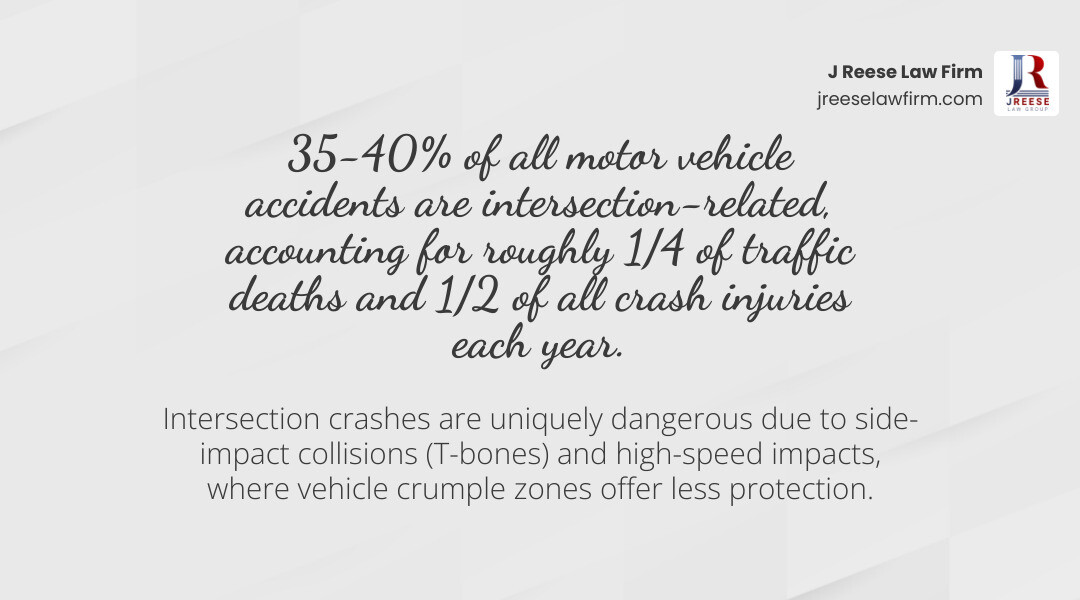
Intersections are among the most dangerous places on any road. According to the National Highway Traffic Safety Administration (NHTSA), between 35 and 40 percent of all motor vehicle accidents are intersection-related — and those crashes account for roughly one-quarter of all traffic deaths and half of all crash injuries every year. In a busy city like New Orleans, where high-traffic corridors and complex road layouts converge daily, the stakes are even higher.
What makes these crashes so legally complicated isn’t just the physical impact. It’s the competing accounts of who had the right of way, the evidence that vanishes within days, and the insurance adjusters who move quickly to protect their bottom line — not yours.
I’m Justin Reese, a New Orleans-born civil litigation attorney who has recovered tens of millions of dollars for injury victims — including clients seriously hurt in intersection and auto collisions across Louisiana. As an intersection accident lawyer, I understand exactly how these cases are built, what evidence wins them, and how Louisiana’s unique fault laws shape your recovery. This guide walks you through everything you need to know to protect your rights and make informed decisions after a crash.
Why Intersection Collisions Are Uniquely Dangerous
When we look at the physics of a car crash, intersections present a perfect storm of hazardous variables. Unlike rear-end collisions—where vehicle crumple zones are designed to absorb a significant portion of the impact force—intersection crashes frequently involve side-impact collisions (commonly known as T-bone crashes) and head-on collisions.
The sides of a vehicle offer the least amount of structural protection for occupants. Doors and side pillars have minimal space to absorb energy compared to the front engine block or the rear trunk. Even with modern side-curtain airbags, a high-speed side-impact collision can easily crush the cabin frame, transferring the violent kinetic energy directly onto the driver and passengers.
Furthermore, because vehicles are often traveling in perpendicular directions at varying speeds, the rotational forces in a T-bone crash can cause vehicles to spin, roll over, or be pushed into secondary collisions with traffic lights, utility poles, or other motorists. According to NHTSA intersection crash data, these complex collision dynamics are the reason why intersection crashes represent such a disproportionate percentage of severe injuries and fatalities on American roads.
Common Causes of Intersection Crashes
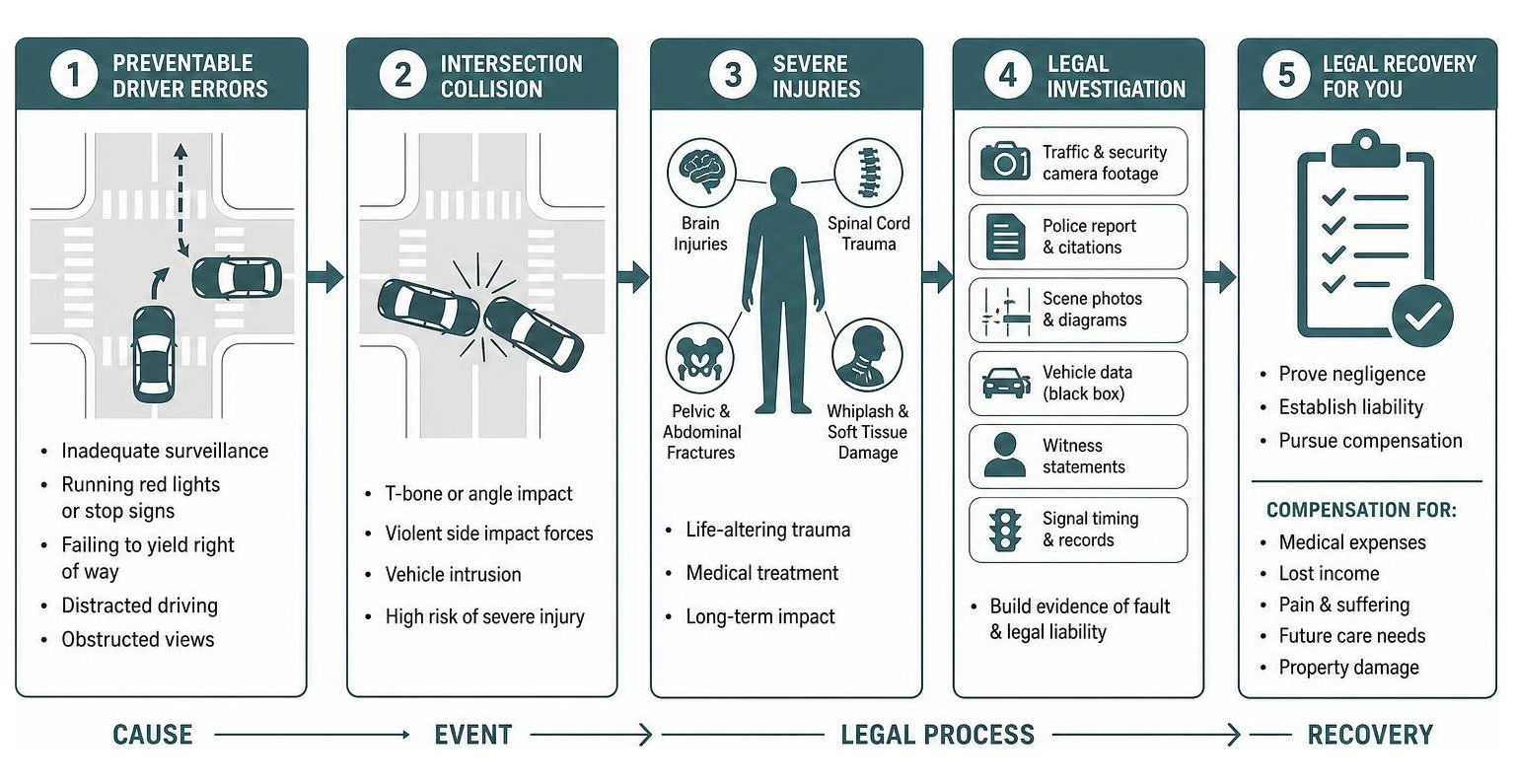
In our experience representing injured motorists, almost every intersection collision can be traced back to a preventable driver error. The most frequent driver behaviors that lead to these devastating events include:
- Inadequate Surveillance: This is the leading cause identified by safety researchers. It occurs when a driver fails to look properly before proceeding, often relying on the false assumption that the intersection is clear.
- Running Red Lights and Stop Signs: Whether caused by aggressive driving, speeding to “beat” a yellow light, or failing to stop entirely, running traffic signals is a primary source of high-speed T-bone collisions.
- Failing to Yield the Right of Way: Drivers making left turns often misjudge the speed or distance of oncoming traffic, turning directly into the path of an approaching vehicle.
- Distracted Driving: Looking down at a navigation app, texting, or adjusting the radio for even a split second prevents a driver from noticing a changing traffic signal or a pedestrian step into a crosswalk.
- Obstructed Views: Parked delivery trucks, overgrown vegetation, or poorly designed road curves can block a driver’s line of sight, leading them to pull out blindly into oncoming traffic.
In New Orleans, these issues are amplified by our unique road layouts, neutral grounds, and high-traffic tourist corridors. You can learn more about the specific areas where these collisions occur most frequently by reviewing our analysis of New Orleans Accident Hotspots.
Severe Injuries Suffered in Crossing Collisions
Because of the lack of side-impact protection and the violent forces involved, the physical trauma resulting from an intersection crash can be life-altering. Some of the most common severe injuries we handle include:
- Traumatic Brain Injuries (TBIs): The rapid lateral violent movement of a T-bone crash can cause the brain to strike the inside of the skull, leading to concussions, cognitive impairments, or permanent brain damage.
- Spinal Cord Trauma: Severe impacts can fracture vertebrae or sever the spinal cord, resulting in chronic nerve damage, herniated discs, or permanent paralysis (paraplegia and quadriplegia).
- Pelvic and Abdominal Fractures: The intrusion of a car door during a side-impact collision frequently causes severe crushing injuries to the hips, pelvis, and internal organs.
- Whiplash and Soft Tissue Damage: The sudden whip-like motion of the neck during an unexpected side or frontal impact tears muscles, ligaments, and tendons, often requiring months of physical therapy.
Proving Liability with an Intersection Accident Lawyer
Establishing who is legally at fault in an intersection crash is rarely straightforward. Unlike a simple rear-end collision where the trailing driver is almost always presumed negligent, intersection cases often involve conflicting stories. One driver may claim they had a green light, while the other insists the light was yellow or that they had already established the right of way.
To secure the compensation you deserve, we must build a rock-solid case demonstrating that the other driver violated Louisiana traffic regulations. This requires an in-depth understanding of Louisiana car accident laws and a systematic approach to gathering evidence before it is lost or destroyed.
Crucial Evidence Your Intersection Accident Lawyer Will Gather
To cut through the “he-said, she-said” disputes that define intersection cases, we rely on objective, technical evidence. When you hire us as your intersection accident lawyer, we immediately launch an investigation to preserve and analyze critical data:
- Traffic Camera Footage: Many New Orleans intersections are equipped with traffic monitoring or red-light cameras. Additionally, nearby commercial businesses or residential security systems may have captured the entire collision on video.
- Dashcam Recordings: We look for dashcam footage from your vehicle, the defendant’s vehicle, or third-party witnesses who were stopped at the light.
- Witness Statements: Eyewitness accounts from neutral bystanders are incredibly persuasive in court. We track down witnesses and secure their statements while their memories are still fresh.
- Police Reports: We analyze the official responding officer’s report, looking for citations issued, diagrammed vehicle positions, and initial determinations of fault.
- Traffic Signal Timing Data: In complex cases, we can request records from municipal transportation departments to analyze the exact timing sequences of the traffic lights at the moment of the crash. This can prove if a light was physically impossible to be green for both lanes.
- Cell Phone Records: If we suspect distracted driving, we can subpoena the other driver’s mobile carrier records to determine if they were actively texting or using data at the exact second of the impact.
By combining this evidence with the expertise of accident reconstruction professionals, we can recreate the physical dynamics of the collision to demonstrate exactly how the negligent driver caused the crash.
How Louisiana Pure Comparative Fault Affects Your Claim
Different states handle shared blame in vastly different ways. For example, some states still use a strict “contributory negligence” rule, where being even 1% at fault completely bars you from recovering any compensation.
Other states use a modified comparative fault rule with a 50% or 51% threshold—meaning if you are found to be 50% or more to blame, you cannot recover damages.
In contrast, Louisiana operates under a “pure” comparative negligence system, which is the same system used in states like California.
Under Louisiana’s pure comparative fault system, your recovery is reduced by your percentage of fault, but you are never barred from seeking compensation—even if you are found to be 90% responsible for the crash. For example, if your total damages equal $100,000, but a court determines you were 20% at fault because you were traveling slightly over the speed limit, you can still recover $80,000 from the other driver.
| State System | Fault Threshold for Recovery | Impact on Your Financial Payout |
|---|---|---|
| Contributory Negligence (e.g., North Carolina) | 0% (Any fault bars recovery) | You receive $0 if you are even 1% at fault. |
| Modified Comparative Fault (e.g., Georgia) | Under 50% or 51% | Payout is reduced by your fault %; you get $0 if you cross the threshold. |
| Pure Comparative Fault (Louisiana & California) | No limit (Can recover at 99% fault) | Payout is reduced by your exact fault % (e.g., 20% fault = 80% payout). |
Because insurance adjusters know how this law works, they will actively search for any excuse to shift even a small percentage of the blame onto you to save their company money. That is why we work relentlessly to build a clean liability case, helping you in recovering maximum compensation by keeping your fault allocation as close to zero as possible.
What to Do Immediately After a New Orleans Intersection Crash
The moments directly following an intersection collision are chaotic, but the actions you take can heavily impact both your physical health and your future legal claim.

If you are physically able to do so safely, follow these essential steps:
- Move to Safety and Call 911: If the vehicles are drivable, carefully move them out of active traffic lanes. Call the police immediately so an official report is generated.
- Seek Immediate Medical Attention: Even if you feel fine, adrenaline can mask serious internal trauma, whiplash, or brain injuries. Go to an emergency room or urgent care to ensure your injuries are diagnosed and documented.
- Document the Scene Thoroughly: Use your phone to take photos and videos of the entire scene. Capture the positions of all vehicles, close-ups of the property damage, any visible skid marks, road hazards, and the status of the traffic signals.
- Exchange Information but Avoid Admitting Fault: Collect contact, driver’s license, and insurance details from the other driver. Speak politely but do not apologize or say things like “I didn’t see you.” These casual remarks will be used against you by insurance adjusters later.
- Gather Eyewitness Contacts: If bystanders stopped to help, ask for their names and phone numbers before they leave the scene.
- Contact an Experienced Lawyer Before Speaking to Insurers: Do not give recorded statements to the other driver’s insurance company. Instead, consult our comprehensive New Orleans car accident guide to understand how to protect your rights from day one.
How to Choose the Right Legal Representation for Your Case
Navigating the aftermath of a serious crash is overwhelming. While you focus on healing and attending medical appointments, an experienced legal team can handle the heavy lifting of dealing with aggressive insurance adjusters, gathering evidence, and filing paperwork.
When looking for the right advocate, you should seek out a firm with deep roots in the local community, a proven track record of securing high-value verdicts, and a willingness to take your case to trial if the insurance company refuses to offer a fair settlement.
At our firm, we operate on a contingency fee basis. This means you pay absolutely nothing upfront, and we only collect a fee if we successfully recover compensation for you. For more tips on finding the right fit for your situation, read our guide on how to choose the best personal injury attorneys in New Orleans LA.
Questions to Ask Your Prospective Intersection Accident Lawyer
Before signing a contract with any law firm, we highly recommend scheduling a free consultation and asking the following key questions:
- Do you have direct experience handling complex intersection and side-impact collision cases?
- How do you handle cases where the other driver claims I was the one who ran the red light?
- Will you handle my case personally, or will it be handed off to a paralegal or junior associate?
- What is your fee structure, and will I have to pay any out-of-pocket costs if we do not win?
- Are you prepared to take my case to a jury trial if the insurance company lowballs our claim?
Asking these questions ensures you partner with a firm that has the resources, dedication, and local insight required to win. Learn more about our approach and how we support our clients by visiting our New Orleans car accident lawyer services page.
Frequently Asked Questions About Intersection Accidents
What is the statute of limitations for an intersection accident in Louisiana?
In Louisiana, the legal deadline to file a lawsuit after a car crash—known as the prescriptive period—is only one year from the exact date of the accident. This is the shortest statute of limitations in the United States.
If you miss this tight deadline, you will lose your right to pursue compensation forever. Because of this incredibly narrow window, it is vital to contact a Louisiana personal injury lawyer guidance professional as soon as possible to ensure your claim is preserved.
Who is at fault if I was hit while making a left turn?
In most situations, traffic laws dictate that a driver making a left turn must yield the right of way to oncoming traffic. Because of this, the left-turning driver is often initially presumed to be at fault.
However, this presumption is not absolute. The other driver may be held liable if we can prove they were speeding excessively, ran a red light, were driving distracted, or if you had a protected left-turn green arrow when they struck your vehicle.
Can I still recover compensation if I was partially at fault?
Yes. Because Louisiana is a pure comparative fault state, you can still seek financial recovery even if your own actions contributed to the crash. Your final compensation package will simply be reduced by your percentage of fault.
For example, if you are awarded $50,000 but are found 10% liable, you will receive $45,000. Our dedicated legal team is focused on fighting back against unfair blame-shifting to keep your recovery as high as possible.
Secure Your Recovery with Trusted New Orleans Legal Advocacy
If you or a loved one has been injured in an intersection crash, you do not have to fight the insurance companies alone. The decisions you make in the days following an accident will shape your physical and financial recovery for years to come.
At the J Reese Law Firm, we combine local New Orleans knowledge with aggressive, strategic advocacy to hold negligent drivers accountable. We know how to secure the technical evidence needed to prove fault, and we refuse to let insurance adjusters devalue your pain and suffering.
Contact us today to schedule your free, no-obligation case evaluation with a dedicated New Orleans Louisiana car accident attorney representation advocate. Let us handle the legal battle so you can focus on your recovery. To learn more about the other types of cases we handle, please explore our full Practice Area offerings.