Gretna, LA Uber Injury Lawsuit Deadline: Your Guide
Under Louisiana law, as of September 2026, you generally have two years from the exact date of the accident to file a personal injury lawsuit against Uber, the rideshare driver, or any other at-fault third party. In Louisiana, this statutory filing deadline is legally termed a “prescriptive period.”
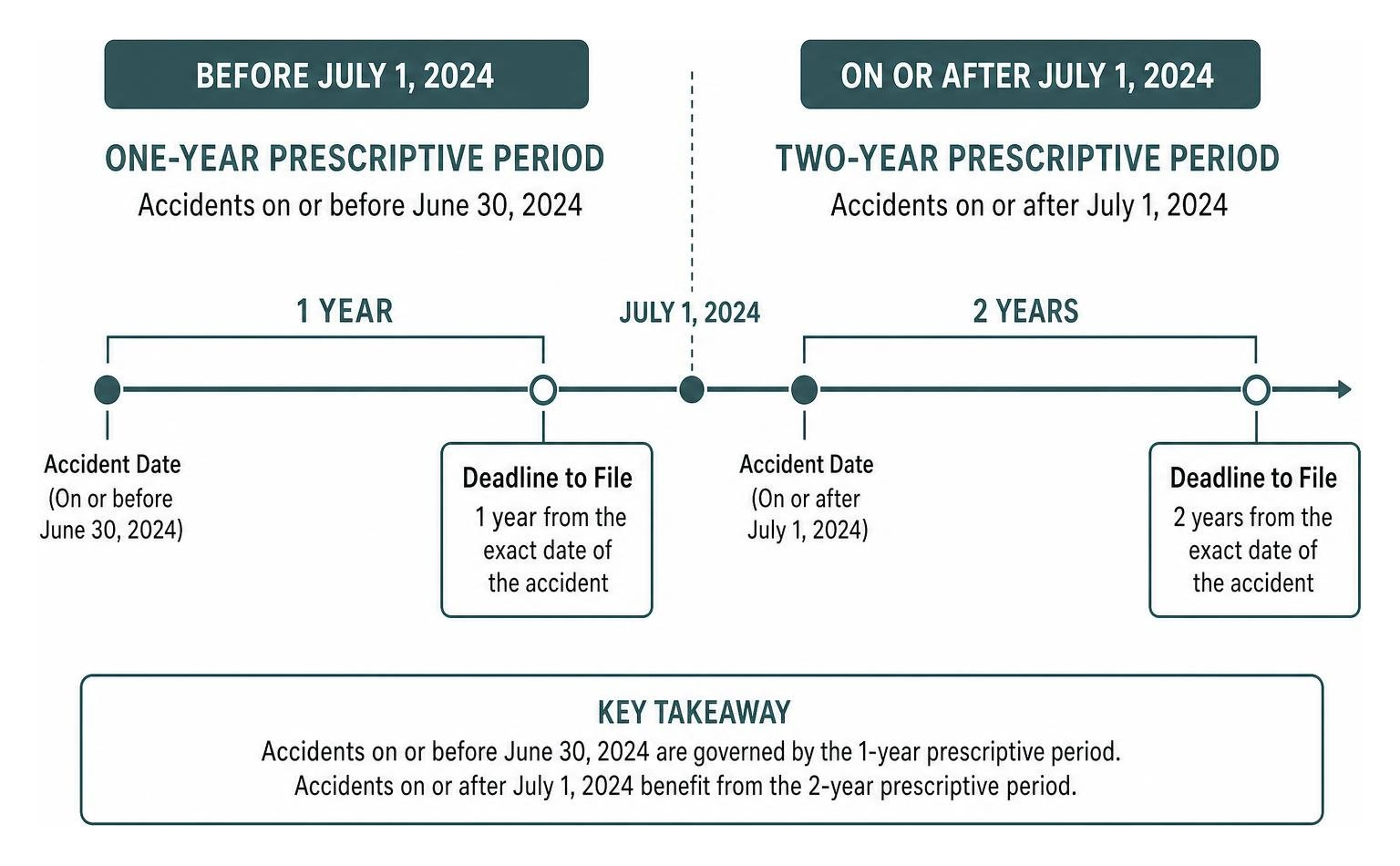
This two-year window was established when the state passed Act No. 423 (HB 315), enacting Louisiana Civil Code Article 3493.11. Effective July 1, 2024, this legislation doubled Louisiana’s standard personal injury prescriptive period from one year to two years.
Understanding your exact accident date is vital:
- Accidents on or after July 1, 2024: You benefit from the two-year prescriptive period under La. C.C. Art. 3493.11.
- Accidents on or before June 30, 2024: These claims were governed by Louisiana’s former one-year statute of limitations. The 2024 amendment was not retroactive, meaning older claims cannot use the extended two-year timeline.
Many injured victims make the mistake of assuming that opening an insurance claim with Uber’s commercial carrier or sending a settlement demand letter protects their legal rights. Under Louisiana’s personal injury statutes of limitations, administrative talks, negotiations, and formal demand letters do not pause, toll, or interrupt prescription. Only drafting and properly filing a formal civil petition for damages in a court of competent jurisdiction stops the legal clock from running out.
How Do Louisiana Fault Rules and Recent Legal Changes Affect Your Uber Claim?
Filing before your prescriptive window closes is only the first step. You must also navigate Louisiana’s evolving liability framework. Louisiana operates as an at-fault (tort) insurance state, meaning the party responsible for causing a collision must pay for the resulting bodily injuries and property damage.
For collisions occurring on or after January 1, 2026, Louisiana transitioned to a modified comparative fault system with a 51% bar under Louisiana Civil Code Article 2323. Under these updated personal injury laws in Louisiana, your ability to recover damages depends directly on your percentage of assigned fault:
- If you are 50% or less at fault: You can recover compensation, but your final financial award is reduced by your exact percentage of liability.
- If you are 51% or more at fault: You are completely barred from recovering any financial compensation from other parties.
Before this 2026 change, Louisiana used a “pure comparative fault” system where a plaintiff could recover a fraction of their damages even if they were 90% responsible. That is no longer the case for newer collisions. Working with a skilled New Orleans car accident injury lawyer ensures your liability is thoroughly analyzed so insurers cannot shift undue blame onto you.
How Does Comparative Fault Reduce or Eliminate Compensation?
In rideshare crashes, your role in the collision dictates how comparative fault applies:
- Uber Passengers: Rideshare passengers almost never share fault for a collision. Unless a passenger actively interfered with the driver’s operation of the vehicle, their fault is zero percent, entitling them to full compensation from whichever driver caused the wreck.
- Third-Party Drivers: If you were driving another vehicle struck by an Uber, insurance defense attorneys will scrutinize your speed, lane position, and reaction time to push your fault over the 51% threshold to avoid paying the claim.
How Does the “No Pay, No Play” Law Apply to Rideshare Collisions?
Louisiana enforces a strict “No Pay, No Play” statute under La. R.S. 32:866. As amended effective August 1, 2025, an uninsured or underinsured motorist who fails to maintain the state-mandated minimum auto liability insurance is barred from recovering the first $100,000 of bodily injury damages and the first $100,000 of property damage, even if the Uber driver was 100% at fault.
This penalty applies strictly to owners and drivers of uninsured vehicles. It does not apply to fare-paying Uber passengers who do not own the vehicle involved in the crash.
Can the Prescriptive Period for an Uber Injury in Gretna Be Extended or Paused?
Louisiana’s prescriptive periods are strictly enforced. While some states offer generous exceptions, Louisiana civil courts apply tolling doctrines in very limited circumstances.
What Is Contra Non Valentem and When Does It Apply?
The primary doctrine used to suspend prescription in Louisiana is contra non valentem agere non currit praescriptio (“prescription does not run against a party unable to act”). Louisiana jurisprudence recognizes four narrow categories:
- Where there was some legal cause which prevented the courts or their officers from taking cognizance of or acting on the plaintiff’s action.
- Where there was some condition or cause of action which prevented the creditor themselves from acting.
- Where the debtor has done some act to effectively prevent the creditor from availing themselves of their cause of action (such as concealment or fraud).
- Where the cause of action is not known or reasonably knowable by the plaintiff, even though their ignorance is not induced by the defendant (the discovery rule).
In rideshare accidents, the discovery rule is rarely accepted as a valid defense for late filing. Because a traffic collision produces immediate, apparent trauma, courts hold that the victim should reasonably know of their injury on the day of the crash. Relying on contra non valentem to save a late filing is an uphill battle.
Why Do Insurance Demand Letters Fail to Stop the Clock?
Insurance adjusters frequently engage in protracted settlement discussions, requesting additional medical records, wage documents, and recorded statements. This back-and-forth often leads victims to believe their claim is progressing toward a fair resolution.
However, an insurer has no legal obligation to remind you of the prescriptive deadline. If the two-year anniversary passes without a formal petition filed in court, the insurance company will close your file and deny payment. Filing a petition for damages in the 24th Judicial District Court stops the prescriptive clock and preserves your right to recover damages against all liable parties.
What Steps and Evidence Are Needed Before Your Filing Window Closes in Jefferson Parish?
Knowing what to do after a car accident in Louisiana is critical for preserving key evidence long before filing your petition. In Gretna, injury claims are typically litigated within the 24th Judicial District Court for the Parish of Jefferson (located in the Thomas F. Donelon Building in Gretna) or the Gretna City Court for smaller disputes within its jurisdictional monetary limits.
What Digital and Physical Evidence Vanishes First?
Critical rideshare crash evidence is subject to strict digital retention limits and commercial overwrite schedules:
- Uber App Telematics and GPS Data: Proves whether the driver was offline, waiting for a fare, or transporting a rider. Must be preserved through a formal legal spoliation letter.
- Commercial Surveillance Footage: Businesses along major Gretna roadways (such as the Westbank Expressway, Belle Chasse Highway, or Gretna Boulevard) often overwrite video within 7 to 30 days.
- Dashcam and Vehicle Black Box Data: Event Data Recorders (EDRs) capture braking speeds, throttle position, and seatbelt usage, but can be erased if the vehicle is repaired or salvaged.
- Witness Recollections: Contact information and formal statements must be secured before memories fade.
How Do You Properly Name and Serve Uber and Its Insurers?
Suing Uber requires identifying the correct corporate entities—such as Uber Technologies, Inc. and its subsidiary Rasier, LLC—and properly serving their registered agents through the Louisiana Long-Arm Statute (La. R.S. 13:3201). Louisiana also permits direct action against the rideshare company’s liability insurers under Louisiana’s Direct Action Statute (La. R.S. 22:1269).
Additionally, if a defective municipal road condition, missing traffic sign, or parish-owned vehicle contributed to the crash, claims involving governmental entities require service of citation within 90 days of filing. Missing these procedural rules can result in case dismissal.
How Does Uber’s Multi-Tier Insurance Coverage Impact Your Lawsuit?
Uber’s insurance liability structure depends directly on the driver’s activity within the mobile application at the exact moment of the crash.
| Driver App Status | Operational Phase | Primary Insurance Coverage | Minimum Coverage Limits |
|---|---|---|---|
| Offline | App turned off | Driver’s Personal Auto Policy | Louisiana state minimums (15/30/25) |
| Period 1 | App on, waiting for ride request | Contingent Commercial Policy | $50,000 bodily injury/person $100,000 bodily injury/accident $25,000 property damage |
| Period 2 | Ride accepted, en route to pickup | Commercial Liability Coverage | $1,000,000 combined single limit third-party liability |
| Period 3 | Passenger in vehicle until drop-off | Commercial Liability + UM/UIM | $1,000,000+ liability and Uninsured/Underinsured Motorist |
What Coverage Exists Across App Periods 1, 2, and 3?
- Period 1: When the driver is logged in but hasn’t accepted a match, their personal auto policy serves as primary coverage. If their personal insurer denies coverage due to a commercial business-use exclusion, Uber’s contingent policy provides up to $50,000 per person and $100,000 per accident.
- Period 2 & 3: The moment a driver accepts a match or carries a passenger, Uber provides $1,000,000 in commercial third-party liability coverage, along with uninsured/underinsured motorist (UM/UIM) protection if another driver causes the crash and lacks sufficient insurance.
What Damages Can You Recover in an Uber Lawsuit?
Louisiana law allows injured victims to pursue both economic and non-economic damages:
- Economic Damages: Past and future medical treatment, physical therapy, prescription medications, lost wages, diminished earning capacity, and property damage repairs.
- Non-Economic Damages: Physical pain and suffering, mental anguish, permanent physical impairment, scarring, and loss of enjoyment of life. Louisiana does not cap non-economic damages in standard auto negligence claims (statutory caps primarily apply to medical malpractice claims).
- Exemplary (Punitive) Damages: Under Louisiana Civil Code Article 2315.4, punitive damages are available if the at-fault driver caused the collision through wanton or reckless disregard while operating a motor vehicle under the influence of alcohol or drugs.
What Are the Most Frequently Asked Questions About Uber Injury Lawsuits in Gretna?
What happens if I miss the two-year deadline to file my Uber injury lawsuit in Gretna?
If you fail to file your lawsuit before the two-year prescriptive period expires, the defendant’s legal team will file a Peremptory Exception of Prescription with the court. A Jefferson Parish judge will grant the motion and dismiss your lawsuit “with prejudice,” permanently extinguishing your right to recover compensation. Once prescription runs, insurance adjusters will immediately deny all pending settlement claims.
Does filing an insurance claim with Uber’s insurer meet the legal filing deadline?
No. Submitting an accident report through the Uber app, communicating with an insurance claims adjuster, or sending a formal settlement demand package does not interrupt prescription. The only action that stops the statutory countdown is filing a formal petition for damages with the clerk of court in an appropriate jurisdiction, such as the 24th Judicial District Court in Jefferson Parish.
What if the Uber driver who hit me was off-duty or not logged into the app?
If the driver was completely offline (not logged into the Uber driver application), Uber’s corporate commercial insurance policy will not provide coverage. You must file your injury claim directly against the driver’s personal automobile insurance policy. If their personal insurer disputes liability or denies the claim under a commercial delivery exclusion, an attorney can review their digital logs to verify their true app status at the exact second of impact.
Protect Your Legal Rights in Jefferson Parish
Rideshare accidents in Gretna involve complex procedural requirements, corporate insurance policies, and strict filing deadlines. The two-year prescriptive period under Louisiana law leaves no room for administrative delays or prolonged insurance negotiations.
Securing your compensation requires moving quickly to subpoena app logs, preserve surveillance footage, and properly name all corporate and insurance defendants. Our team at J Reese Law Firm has extensive experience representing injury victims throughout Gretna and Jefferson Parish.
If you or a loved one suffered injuries in a rideshare crash, contact our office today to schedule a comprehensive, confidential case evaluation with a dedicated New Orleans personal injury lawyer. We will help you protect your rights, establish liability, and file your claim well before your legal window closes.