How a Gretna Personal Injury Lawyer Evaluates and Proves Negligence
When an unexpected injury disrupts your life, determining legal responsibility is the foundation of any financial recovery. In Louisiana civil law, establishing that another party caused your harm requires more than just showing you were hurt. It demands a systematic evaluation of conduct, legal obligations, and demonstrable damages.
At J Reese Law Firm, we approach every injury claim by deconstructing the incident from the ground up to hold reckless individuals and corporate entities accountable.
Establishing the Four Core Elements of Liability
To secure compensation after an accident, your legal team must prove the four fundamental components of tort liability under Louisiana law:
- Duty of Care: We demonstrate that the defendant had a legal obligation to act with reasonable care to avoid causing harm to others. For example, motorists on the Westbank Expressway have a duty to obey traffic signals, and commercial property owners on Manhattan Boulevard must maintain safe walkways.
- Breach of Duty: We prove the responsible party failed to meet that standard of care through reckless, careless, or unlawful behavior—such as texting while driving, speeding, or failing to clean a hazardous spill.
- Causation: There must be a direct link between the breach of duty and the harm suffered. We show that your injuries were the direct result of the defendant’s specific actions rather than a pre-existing condition or an unrelated event.
- Quantifiable Damages: Finally, we establish that the incident produced real, compensable losses, including physical trauma, medical invoices, lost wages, and emotional suffering.
We build this proof using official police reports, video surveillance, eyewitness statements, and detailed medical documentation. In complex claims, such as commercial trucking crashes or catastrophic slip-and-fall incidents, we work with accident reconstruction professionals and medical authorities to illustrate the full mechanics of the injury.
When to Consult a Gretna Personal Injury Lawyer for Case Evaluation
Not every minor scrape requires legal action, but navigating serious harm alone often leads to undervalued settlements. You should seek trusted personal injury representation immediately if you encounter any of the following scenarios:
- Severe or Permanent Injuries: If your recovery involves surgeries, extended physical therapy, or permanent physical limitations, accurately calculating future medical costs is critical.
- Disputed Fault: When the other party or their insurance carrier attempts to blame you for the accident, immediate legal intervention protects your rights.
- Premises Hazards and Slip & Fall Claims: If you slipped on a wet floor in a grocery store or tripped over uneven pavement, evidence disappears fast. It is essential to act quickly to take photos of the exact substance or liquid on the floor, document the absence of wet floor warning signs, and request preservation of security camera footage before it is recorded over.
- Lowball Settlement Offers or Bad Faith Tactics: Insurance adjusters frequently offer fast, inadequate payouts before the true extent of your injuries is known. An attorney shields you from pressure tactics.
Navigating Louisiana’s Two-Year Statute of Limitations and Fault Rules
Understanding state-specific deadlines and liability statutes is essential for protecting your injury claim. A key reason why Louisiana personal injury cases are different from those in many other jurisdictions comes down to our civil code traditions and strict procedural rules.
Meeting Strict Filing Deadlines in Jefferson Parish
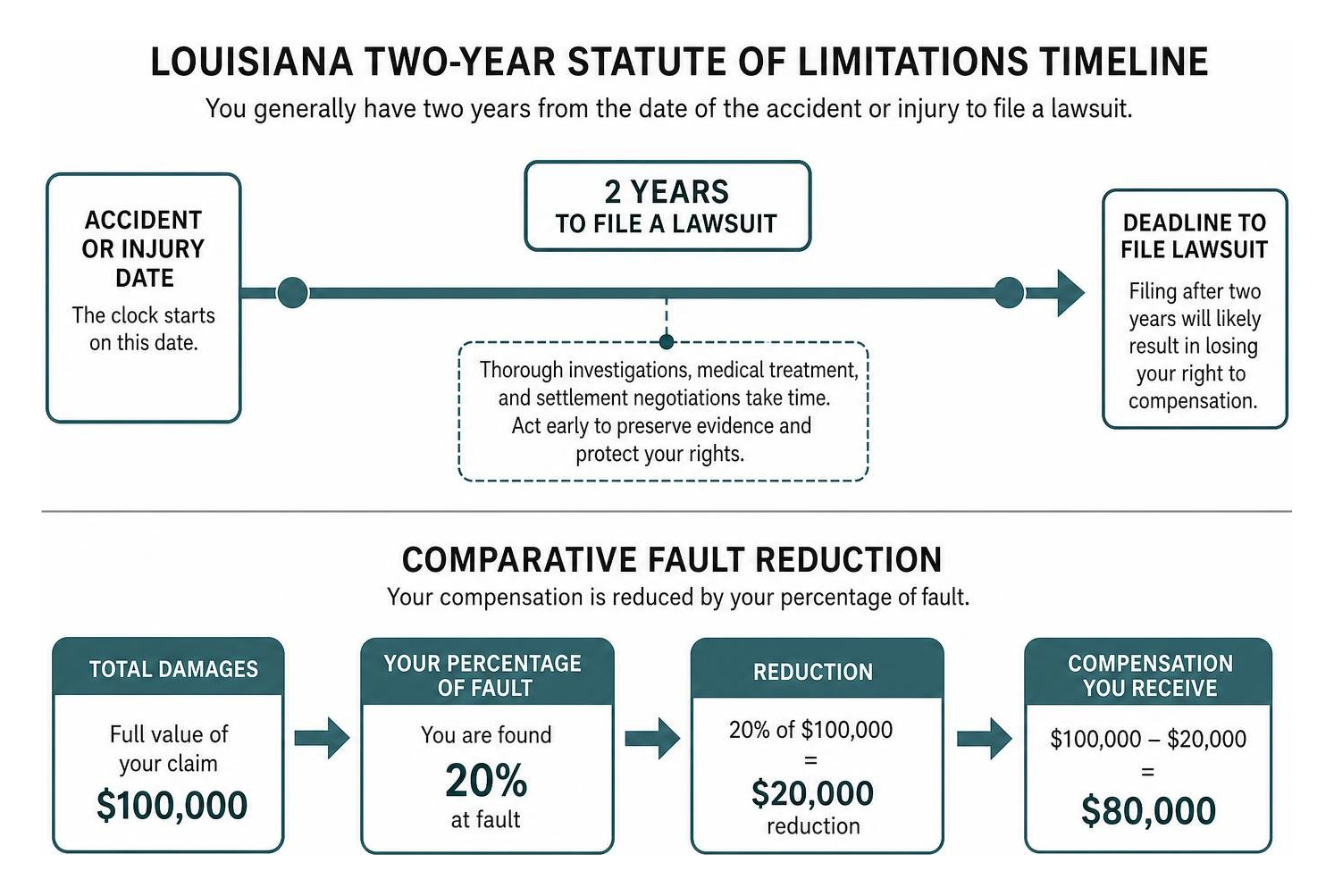
In Louisiana, the deadline to file a personal injury or product liability lawsuit is known as the prescriptive period. Injured victims generally have two years from the date of the accident or injury to file a formal lawsuit in civil court.
Failing to file your claim within this two-year statutory window in the 24th Judicial District Court in Jefferson Parish almost always results in the permanent loss of your right to seek financial recovery. While two years may sound like plenty of time, thorough investigations, medical stabilization, lien reviews, and settlement negotiations require substantial preparation. Contacting legal counsel early ensures that crucial physical evidence is preserved and all legal deadlines are met.
How Comparative Negligence Affects Your Compensation
Louisiana operates under a pure comparative fault doctrine. Under this rule, you are not barred from recovering compensation even if you were partially at fault for the accident. Instead, your total financial award is reduced by your allocated percentage of fault.
For example, if a court determines that your total damages equal $100,000, but finds you were 20% responsible for the collision because you were driving slightly over the speed limit, your final payout is reduced by 20%, leaving you with $80,000.
Because insurance companies aggressively attempt to shift blame to accident victims to lower their payouts, having strong representation ensures your fault is not unfairly exaggerated.
Maximizing Compensation: Economic vs. Non-Economic Damages in Gretna Claims
Securing the compensation you need requires itemizing every way the accident has affected your life. We work tirelessly toward getting every dollar you deserve by dividing your losses into distinct damage categories.
| Damage Category | Description | Key Documentation Required | Common Examples |
|---|---|---|---|
| Economic Damages | Direct, quantifiable financial losses resulting from the accident. | Invoices, receipts, tax forms, payroll records, medical bills. | Emergency room visits, surgery, physical therapy, lost income, vehicle repairs. |
| Non-Economic Damages | Non-monetary, intangible losses related to physical and emotional trauma. | Pain journals, psychiatric evaluations, testimony from friends and family. | Physical pain, emotional distress, loss of enjoyment of life, permanent scarring. |
Calculating Direct Financial Losses and Out-of-Pocket Expenses
Economic damages cover the tangible, out-of-pocket expenses that pile up after an accident. We calculate both your immediate costs and projected future expenses:
- Medical Treatment: Ambulance transport, emergency care, diagnostic imaging (MRIs, CT scans), prescription medications, assistive medical devices, and future corrective procedures.
- Lost Income: Paychecks missed while recovering from your injuries, including lost bonuses, overtime opportunities, and used paid time off (PTO).
- Diminished Earning Capacity: Compensation for long-term limitations if your injury prevents you from returning to your prior trade or working full-time hours.
- Property Damage: Repair or replacement costs for your vehicle, personal items, or electronic devices damaged in the incident.
Valuing Pain, Suffering, and Long-Term Impact
Non-economic damages account for the real, personal disruption caused by severe trauma. While harder to measure than a medical bill, these losses often represent the most significant portion of a recovery:
- Physical Pain and Suffering: The daily discomfort, physical limitations, and chronic pain associated with broken bones, nerve damage, or spinal injuries.
- Mental Anguish and Emotional Distress: Sleep disturbances, anxiety, depression, and post-traumatic stress arising from a frightening wreck or life-altering incident.
- Loss of Enjoyment of Life: The inability to participate in hobbies, recreational activities, family traditions, or sports you once loved.
- Disfigurement and Disability: Compensation for permanent scarring, limb loss, or lasting mobility impairments.
The Legal Process: What to Expect from Investigation to Settlement

Many people hesitate to contact an attorney because they worry the legal process will be overwhelming. In reality, working with a dedicated attorney is designed to lift the legal burden off your shoulders so you can focus entirely on your health.
When you begin searching for counsel through a Gretna legal directory or local recommendations, understanding the standard trajectory of an injury claim provides peace of mind.
Why Retaining a Gretna Personal Injury Lawyer Outperforms Handling Claims Alone
Insurance companies are profit-driven corporations trained to minimize claim payouts. Adjusters often use recorded statements to twist your words or present fast settlement checks before your long-term medical needs are diagnosed.
Knowing how to choose the best personal injury attorneys means finding an advocate who will:
- Thoroughly investigate liability and preserve critical evidence.
- Identify all available insurance policies and liable entities.
- Manage all communication, paperwork, and adversarial negotiations with insurers.
- Prepare your case with the depth required for trial, which gives you maximum leverage during settlement discussions.
Understanding Contingency Fees and Case Timelines
Hiring legal counsel should never add financial stress to an already difficult situation. We handle personal injury claims on a contingency fee basis. This means:
- You pay zero upfront costs or hourly legal fees.
- All investigation, filing, and case expenses are advanced by our firm.
- We only collect an attorney fee if we secure a financial settlement or court verdict on your behalf.
Case timelines vary depending on several factors, including the length of your medical treatment, the willingness of the insurer to negotiate fairly, and court scheduling if a formal lawsuit is required. Straightforward claims may resolve in a few months, while complex or disputed cases involving catastrophic injuries may take a year or more to achieve full value.
Frequently Asked Questions About Gretna Personal Injury Claims
What types of personal injury cases do Gretna lawyers handle?
Personal injury attorneys handle a broad range of civil negligence cases, including:
- Motor vehicle collisions (car, motorcycle, and commercial truck crashes)
- Rideshare accidents involving Uber and Lyft
- Pedestrian and bicycle accidents
- Premises liability incidents (slip-and-fall injuries, poor lighting, negligent security)
- Defective products and product liability claims
- Catastrophic injuries (traumatic brain injuries, spinal damage)
- Wrongful death claims on behalf of surviving family members
Will my personal injury case go to trial or settle out of court?
The vast majority of personal injury cases settle out of court during pre-trial negotiations or formal mediation. Reaching a negotiated settlement allows you to recover compensation without the delays and uncertainties of a courtroom trial. However, if an insurer refuses to offer a fair settlement that covers the full extent of your losses, filing a lawsuit and taking the case to trial before a judge or jury is the most effective way to protect your rights.
How long does it typically take to resolve an injury claim in Louisiana?
The duration of a personal injury case depends largely on your medical recovery. It is critical to reach Maximum Medical Improvement (MMI)—the point where your medical condition has stabilized—before finalizing a settlement so all future care costs are accounted for. Simple claims with clear liability often resolve within 4 to 8 months, whereas complex litigation involving disputed fault or severe injuries may take 12 to 24 months.
Protect Your Future with Dedicated Local Legal Representation
A sudden accident can leave you facing painful injuries, towering medical expenses, and immense stress about how you will provide for your family. You do not have to confront aggressive insurance companies alone.
At J Reese Law Firm, we are committed to standing up for injured individuals across Gretna and the greater New Orleans area. We take the time to listen to your story, evaluate your damages, and build an uncompromising case designed to secure the full financial recovery you need to rebuild your life.
If you or someone you love was injured due to someone else’s carelessness, reach out today to schedule a consultation with a dedicated car accident lawyer and take the first step toward getting the justice and compensation you deserve.