What Are Typical Wrongful Death Settlement Amounts?

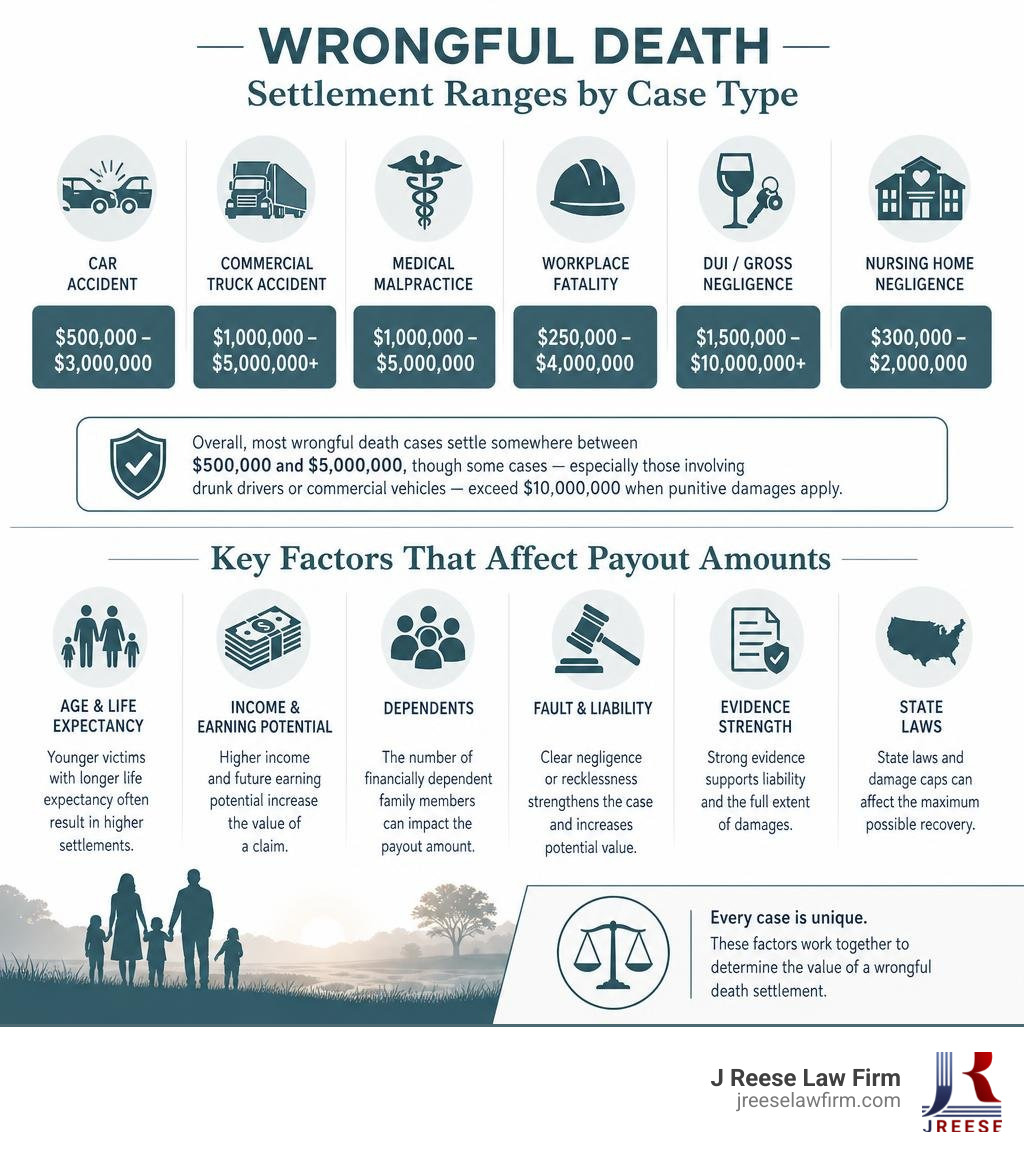
Wrongful death settlement amounts vary widely — but here is a quick look at typical ranges to help you understand what families generally recover:
| Case Type | Typical Settlement Range |
|---|---|
| Car accident | $500,000 – $3,000,000 |
| Commercial truck accident | $1,000,000 – $5,000,000+ |
| Medical malpractice | $1,000,000 – $5,000,000 |
| Workplace fatality | $250,000 – $4,000,000 |
| DUI / gross negligence | $1,500,000 – $10,000,000+ |
| Nursing home negligence | $300,000 – $2,000,000 |
Overall, most wrongful death cases settle somewhere between $500,000 and $5,000,000, though some cases — especially those involving drunk drivers or commercial vehicles — exceed $10,000,000 when punitive damages apply.
Losing someone you love is devastating. When that loss is caused by someone else’s negligence, the grief is compounded by a very real financial burden — funeral costs, lost income, and a future that looks completely different than it should.
A wrongful death claim won’t undo that loss. But it can help your family recover financially and hold the responsible party accountable.
The challenge is that no two cases are alike. A settlement for a young parent with three children and a high income will look very different from one involving an older adult with no dependents. The cause of death, the state where the claim is filed, and the strength of the evidence all shape the final number.
This guide breaks down how settlements are calculated, what factors push values up or down, and what families in Louisiana and beyond can realistically expect from the legal process.
What Is a Wrongful Death Claim?

At its core, a wrongful death claim is a civil action brought against a person or entity whose negligent, reckless, or intentional actions caused someone’s death. Think of it as a personal injury lawsuit that the deceased person would have been entitled to file had they survived the incident. Because they cannot file it themselves, the law permits certain surviving family members or the estate representative to step in and seek justice on their behalf.
To establish liability in a wrongful death lawsuit, we must prove three fundamental elements:
- Duty of Care: The defendant owed the deceased a legal duty to act reasonably (for example, a driver must follow traffic laws, or a doctor must meet medical standards).
- Breach of Duty: The defendant breached that duty through action or inaction (such as speeding, driving drunk, or misdiagnosing a treatable condition).
- Causation and Damages: This breach directly caused the death of your loved one, resulting in the financial and emotional damages your family is now facing.
Unlike criminal cases, where the goal is punishment (like jail time), a civil wrongful death claim focuses entirely on financial compensation to ease the heavy burdens placed on surviving family members.
Civil Lawsuits vs. Criminal Charges
It is common for a single tragic event to trigger both criminal charges and a civil lawsuit. For instance, if a driver kills a pedestrian while driving under the influence, the state will likely prosecute them for vehicular homicide. At the same time, the victim’s family can file a civil wrongful death lawsuit.
These two tracks operate independently, and they differ in several key ways:
- The Goal: Criminal prosecution seeks to punish the wrongdoer with jail time, probation, or fines paid to the government. Civil lawsuits seek financial restitution paid directly to the surviving family to cover their losses.
- The Burden of Proof: In a criminal trial, the prosecutor must prove the defendant’s guilt “beyond a reasonable doubt” (essentially 99% certainty). In a civil wrongful death lawsuit, we only need to prove liability by a “preponderance of the evidence” (meaning it is more likely than not—or 51% certain—that the defendant was at fault).
- The Outcome: A criminal court can find someone “not guilty,” but that does not block a civil lawsuit. A famous historical example of this is O.J. Simpson, who was acquitted in criminal court but later found liable for wrongful death in civil court.
Understanding these differences is crucial, especially because Why Louisiana Personal Injury Cases Are Different can impact how evidence from a criminal investigation is used to support your civil recovery.
How Are Wrongful Death Settlement Amounts Calculated?
Calculating wrongful death settlement amounts is not as simple as plugging numbers into an online calculator. Insurance adjusters and defense attorneys do not use a single, magic formula. Instead, they evaluate a complex mix of tangible financial losses and intangible emotional trauma.
To give you an idea of how these factors are weighed, we look at damages in three distinct categories:
| Category | What It Covers | Examples |
|---|---|---|
| Economic Damages | Direct, quantifiable financial losses resulting from the death. | Medical bills prior to death, funeral and burial costs ($10,000–$25,000+), lost future income, and lost retirement benefits. |
| Non-Economic Damages | Intangible, emotional losses that do not have a direct price tag. | Loss of companionship, loss of guidance, mental anguish, and loss of household services (like childcare or maintenance). |
| Punitive Damages | Extra compensation designed to punish the defendant for extreme misconduct. | Awarded in cases of gross negligence, such as repeat DUI offenses or severe safety violations by commercial trucking companies. |
To accurately calculate economic damages, we frequently collaborate with forensic economists. These financial experts look at the deceased person’s age, career path, education, and inflation rates to project exactly what they would have earned over their remaining working years. This ensures that your family does not accept a lowball offer that fails to cover your long-term financial needs.
Key Factors Influencing Wrongful Death Settlement Amounts
When insurance companies or juries evaluate wrongful death settlement amounts, several unique variables dictate whether a payout lands on the lower or higher end of the spectrum:
- Age and Health: A tragic loss of a young breadwinner in their 30s with decades of earning potential ahead of them will naturally command a higher economic valuation than the loss of an elderly retiree. However, non-economic damages for the loss of a parent or grandparent remain profoundly significant.
- Earning Capacity and Dependents: If the deceased was the sole financial provider for a spouse and multiple young children, the projected loss of financial support is immense.
- Comparative Fault: Louisiana follows a pure comparative fault system. This means if your loved one was partially to blame for the accident, your final settlement will be reduced by their percentage of fault. For example, if a jury determines the total damages are $1,000,000 but finds the deceased was 20% at fault for the crash, the final payout is reduced to $800,000.
- Damage Caps: While some states place strict caps on non-economic damages, Louisiana generally does not cap these damages in standard personal injury or wrongful death cases. However, there is a strict statutory cap of $500,000 on medical malpractice claims, which heavily limits recovery in cases involving healthcare errors.
How Insurance Policy Limits Impact Wrongful Death Settlement Amounts
Even if a forensic economist proves your family has suffered $5 million in economic damages, the physical reality of recovering that money often depends on the available insurance coverage.
If an individual with a standard auto insurance policy causing a fatal accident carries only the state-minimum liability limits, recovering a multi-million-dollar sum directly from them can be incredibly difficult unless they have significant personal assets.
Conversely, commercial entities—such as interstate trucking companies—are required by federal law to carry much larger policies, typically ranging from $1,000,000 to $5,000,000 or more. In these cases, or when a defendant has an umbrella policy, there is a much higher likelihood of securing a settlement that matches the true, full value of your family’s losses.
Typical Payout Ranges by Case Type
The circumstances surrounding the tragedy play a massive role in determining the final recovery. Let’s look at how different types of accidents shape typical payouts:
- Car Accidents ($500,000 – $3,000,000): Car crashes are the most common source of wrongful death claims. Payouts are highly dependent on the at-fault driver’s insurance policy limits and whether the deceased had uninsured/underinsured motorist (UM) coverage.
- Commercial Truck Accidents ($1,000,000 – $5,000,000+): Due to the massive size of commercial rigs, truck accidents are often fatal. Because trucking companies must carry high-limit commercial policies, and because multiple parties (driver, loading company, manufacturer) can be held liable, these settlements are frequently in the multi-million-dollar range.
- Medical Malpractice ($1,000,000 – $5,000,000): While medical errors often result in high valuations due to the victim’s pain and suffering, Louisiana’s $500,000 cap on medical malpractice damages represents a significant hurdle that requires strategic legal navigation.
- Workplace Fatalities ($250,000 – $4,000,000): If a loved one dies on the job, workers’ compensation death benefits may provide immediate, but limited, relief. However, if a negligent third party (such as an equipment manufacturer or subcontractor) caused the death, your family can bypass workers’ comp limits and file a third-party wrongful death lawsuit for full civil damages.
- Aviation Disasters: High-profile aviation cases can yield historic verdicts. For example, a federal jury recently awarded a $49.5M verdict over an Ethiopian Air passenger’s death to the family of a global health professional, illustrating how courts value life when corporate negligence is proven on a massive scale.
In some instances, rejecting a low settlement offer and taking a case to trial can yield dramatic results. For instance, a Georgia jury delivered a 70M verdict after a 1M settlement offer was rejected in a case involving a motorist who struck an improperly stopped tractor-trailer. While trials carry risks, having a legal team willing to go all the way is essential to forcing insurance companies to negotiate fairly.
To get a sense of how local cases are resolved, you can review historical settlements, judgments, and verdicts across the region.
Eligibility, Distribution, and Legal Timelines
Who gets to file a claim, how the money is split, and how long you have to act are all strictly governed by state law. In Louisiana, these rules are highly specific and differ significantly from other states.
Who Can File a Claim?
In Louisiana, the civil code establishes a strict hierarchy of relatives who are eligible to recover compensation through a wrongful death action. If a relative in a higher tier exists, they have the exclusive right to file, which excludes those in the lower tiers:
- First Tier: The surviving spouse and/or children of the deceased.
- Second Tier: The surviving parents of the deceased (if there is no spouse or child).
- Third Tier: The surviving siblings of the deceased (if there are no parents, spouse, or children).
- Fourth Tier: The surviving grandparents of the deceased (if no closer relatives survive).
If none of these relatives exist, the estate’s personal representative may file a survival action to recover damages for the deceased’s pre-death pain and suffering. To understand where you stand in this legal hierarchy, it is best to consult an experienced Wrongful Death Claims Attorney who can guide you through the process.
Statutes of Limitations and Deadlines
Time is of the essence when pursuing a claim. Every state has a legal clock known as the statute of limitations.
While states like California allow up to two years to file, Louisiana is far stricter. Under state law, you must deal with Louisiana’s One Year Statute of Limitations (referred to locally as the “prescriptive period”).
This means you have exactly one year from the date of your loved one’s death to file a lawsuit in court. If you miss this deadline, your family will almost certainly lose the right to seek compensation forever. This incredibly short window makes it vital to secure legal representation as soon as possible so that evidence can be preserved, witnesses can be interviewed, and your claim can be filed correctly.
Frequently Asked Questions About Wrongful Death Settlements
Are wrongful death settlements taxable?
Fortunately, the IRS and state tax authorities generally treat compensatory wrongful death settlements as non-taxable. Under federal law, damages received on account of personal physical injuries or physical sickness are excluded from gross income. This means the money you receive for funeral costs, lost future income, and loss of companionship is typically tax-free.
However, there are a few exceptions:
- Punitive Damages: If the court awards punitive damages to punish the defendant, this portion of the payout is taxable.
- Interest: Any interest that accumulates on your settlement during a prolonged legal battle is considered taxable income.
How long does it take to receive a wrongful death settlement?
Most straightforward wrongful death claims resolve within 6 to 24 months. However, the timeline depends heavily on the complexity of the case. If liability is clear and the insurance company offers a fair settlement early on, the process can move quickly. If the case involves complex medical malpractice, multiple liable parties, or goes to a full jury trial, it can take several years to reach a final resolution.
What is the average wrongful death settlement?
Because every life, career, and family structure is entirely unique, there is no single, meaningful “average” wrongful death settlement. While national databases point to a broad range of $500,000 to $5,000,000, your family’s recovery will depend entirely on the specific facts of your case. Avoid relying on generic online calculators, as they cannot account for crucial local factors like Louisiana’s comparative fault rules or insurance policy caps.
Conclusion
No amount of money can replace the warmth, guidance, and presence of a loved one who was taken too soon. But your family should not have to carry the heavy weight of medical bills, funeral expenses, and lost financial security alone.
At J Reese Law Firm, we provide compassionate, dedicated legal guidance to help families navigate these incredibly difficult times. We understand the local legal landscape, and we fight tirelessly to secure the maximum compensation your family deserves.
If you have lost a family member due to someone else’s negligence in New Orleans or the surrounding areas, please explore our resources under the Category: Wrongful Death section, or contact a dedicated New Orleans Personal Injury Lawyer today.
Let us carry the legal burden so you can focus on healing. Reach out to a New Orleans Wrongful Death Attorney at J Reese Law Firm today for a free, confidential, and compassionate consultation.