What to Do After a Leased Vehicle Accident in Gretna
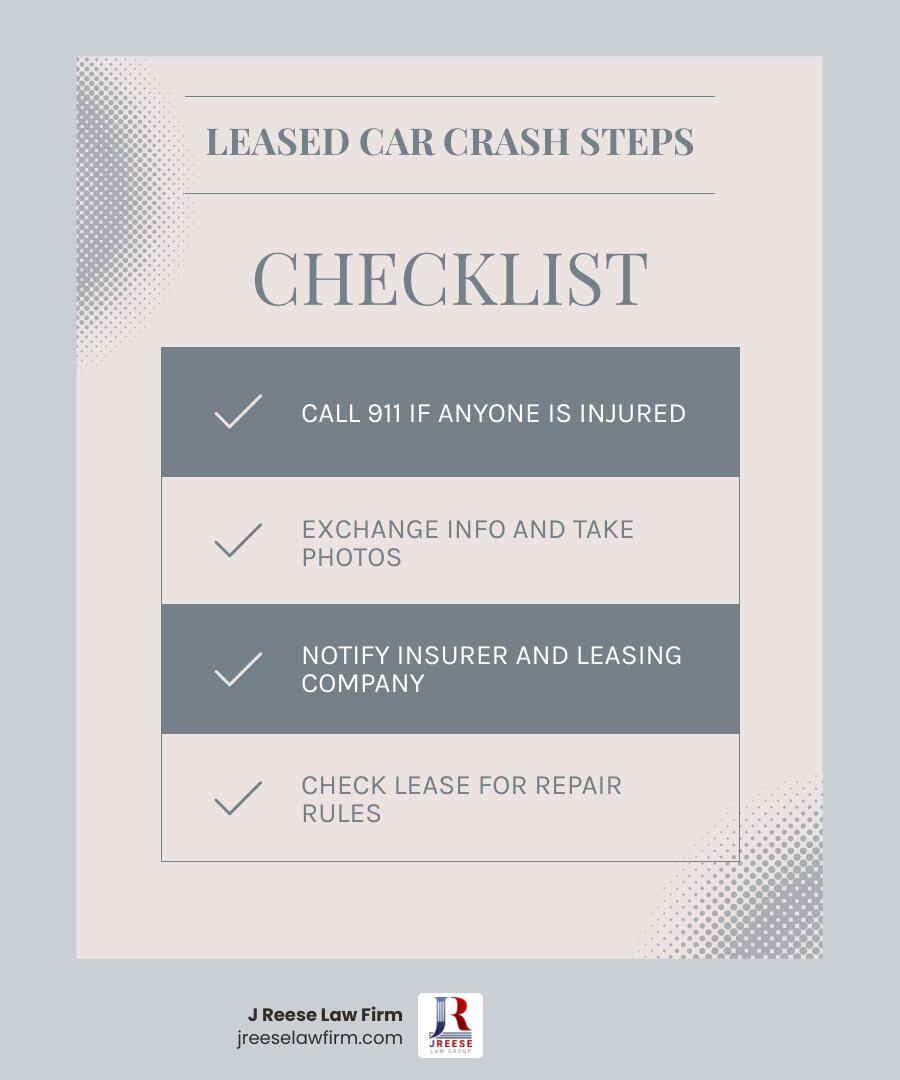
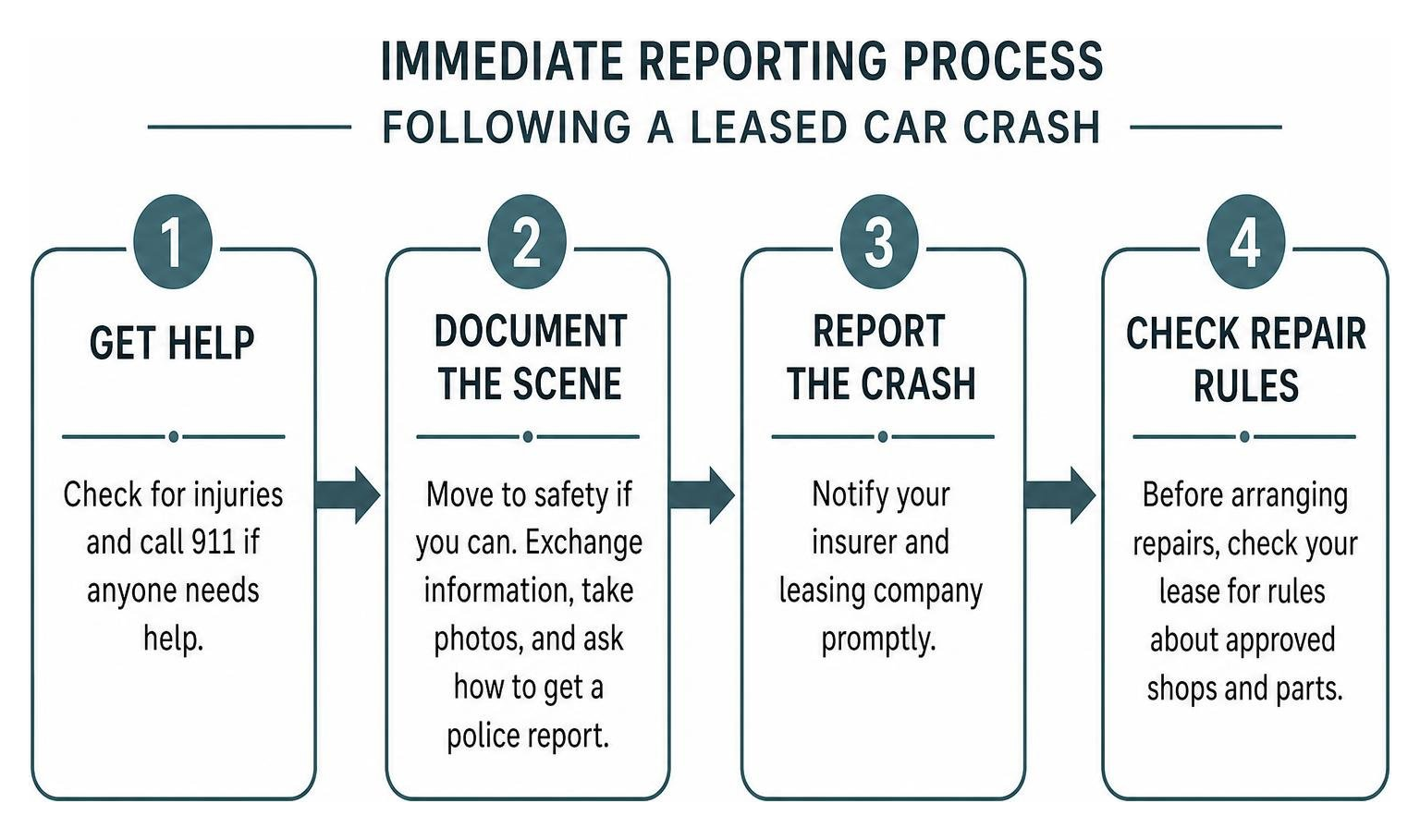
Check for injuries and call 911 if anyone needs help. Move to safety if you can, exchange information with the other driver, and take photos of the vehicles and scene. Ask how to get a police report. Then notify your insurer and leasing company promptly. Before arranging repairs, check your lease for rules about approved shops and parts.
A crash does not pause your lease payments. If the car is totaled, the insurance payment generally goes to the leasing company, and you may owe a balance. Your lease and any GAP coverage will help determine what happens next.
I’m Justin Reese, and I’ve handled auto collision and personal injury cases since 2011. That experience helps me explain the insurance and lease issues that can follow a leased vehicle accident.
Basic leased vehicle accident vocab:
Immediate Steps and Reporting Requirements in a Leased Vehicle Accident
When you are involved in a collision while driving a leased vehicle, the legal and financial stakes are uniquely complicated. Unlike an accident in a car you own outright, a crash in a leased car introduces a third party into the equation: the leasing company that holds the title. Managing this situation properly requires prompt action, careful documentation, and a thorough understanding of your contractual obligations.
Essential On-Scene Actions and Safety Protocols
Your top priority at the scene is physical safety and securing medical treatment for anyone injured. After checking yourself and your passengers:
- Call 911 Immediately: Request emergency medical personnel and local law enforcement. A Gretna police officer or state trooper will complete an official crash report detailing the crash scene, statements, and initial fault indicators.
- Move to a Safe Area: If the vehicle is drivable and you are in the flow of traffic on the Westbank Expressway or Belle Chasse Highway, move safely to the shoulder and turn on your hazard lights.
- Capture Comprehensive Photographic Evidence: Take wide-angle and close-up photographs of vehicle damage, license plates, skid marks, street signage, and environmental factors like weather or lighting.
- Exchange Crucial Details: Collect the full name, contact information, insurance carrier, policy number, and driver’s license details of all motorists involved.
- Gather Witness Statements: If bystanders saw what happened, obtain their names and phone numbers before they leave the scene.
- Seek a Complete Medical Evaluation: Even if you feel fine initially, adrenaline often masks soft-tissue injuries, concussions, or spinal trauma. Seeking immediate medical care establishes a clear record linking your injuries to the collision. Reviewing our checklist on what to do after a car accident in Louisiana can help protect your personal injury claim.
Never apologize or admit fault at the scene. Statements made in the heat of the moment can be taken out of context by insurance adjusters looking for reasons to reduce your settlement payout.
Mandatory Notifications: Insurer, Dealership, and GSA Fleet Contacts
Lease contracts contain strict reporting clauses. Failing to notify the required parties within designated timeframes can jeopardize your coverage or trigger penalty fees:
- Your Auto Insurance Provider: Report the accident right away to start the claims process. Your policy will dictate collision coverage and medical payment options.
- The Leasing Finance Company: You must alert the lessor (the entity financing your lease) about any significant accident. They hold the legal title and need to document vehicle condition and oversee major repairs.
- Government Fleet Management (If Applicable): If your incident involves a federal government lease, the General Services Administration (GSA) requires drivers to report crashes within five business days through GSAFleet.gov and submit Standard Form 95 when public claims arise.
Navigating these requirements is essential, especially when determining how liability protections apply under federal standards, such as those discussed in a Federal appellate decision on lessor liability. We guide clients through each required notification so that insurers and lessors cannot exploit technical reporting errors.
Managing Vehicle Repairs and Leasing Company Contract Rules
Getting a leased vehicle repaired after a collision is not as simple as dropping it off at the neighborhood garage. Lease contracts mandate specific repair protocols to preserve the vehicle’s market value and warranty coverage.
Adhering to Manufacturer Parts Mandates and Authorized Shop Networks
Most financing companies require that all repairs be completed using original equipment manufacturer (OEM) parts rather than aftermarket or salvaged alternatives. Furthermore, the work must often be performed by an authorized dealership or a factory-certified collision center.
If you authorize non-OEM parts or take your vehicle to an unapproved body shop to save on out-of-pocket costs, you risk severe financial penalties when you turn the vehicle in at the end of your term. The leasing company’s inspectors will identify substandard parts or mismatched paint and bill you for the cost of re-repairing the car to factory standards.
Resolving Unrepaired Damage Penalties at Lease Return
At the conclusion of your lease, the vehicle undergoes a formal end-of-term inspection based on strict wear-and-tear guidelines. While minor stone chips or minimal tire wear may be excused, collision damage, compromised frame components, or poorly aligned body panels are not considered normal wear.
The leasing company will issue surcharges for:
- Unrepaired body dents, frame distortion, and mechanical faults
- Paint work that fails manufacturer standards
- Non-OEM replacement windshields or body panels
- Diminished market value resulting from improper collision repairs
When another driver causes the crash, we demand that their liability carrier covers all repair costs, OEM part differentials, and associated rental vehicle expenses. Utilizing 7 proven ways a Gretna car accident lawyer maximizes your injury settlement, our team works to ensure you do not face unexpected out-of-pocket lease penalties.
Total Loss Settlements, ACV Payouts, and GAP Insurance Protection
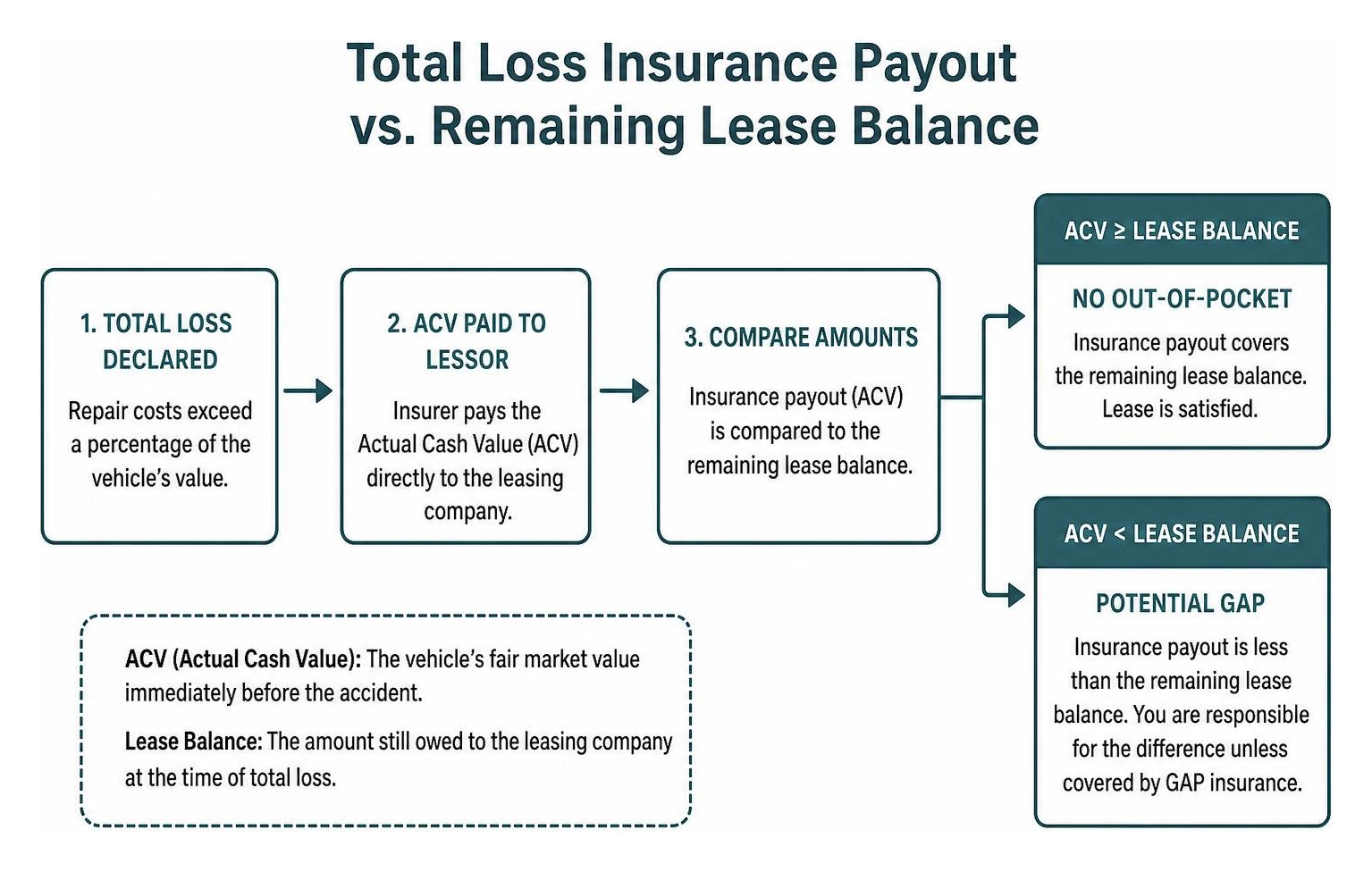
When vehicle repair estimates exceed a specific percentage of the car’s current value (often 70% to 80% under Louisiana standards), the insurer will declare the leased car a total loss. This scenario triggers distinct financial rules that differ dramatically from an owned vehicle settlement.
Handling Total Loss Claims Following a Leased Vehicle Accident
In a total loss scenario, the auto insurer calculates the vehicle’s actual cash value (ACV) immediately prior to the crash. Because the leasing institution is the registered titleholder, the insurance payout goes directly to the leasing company, not to you.
This dynamic creates a major financial risk:
- Cars depreciate rapidly during the early months of a lease.
- Your remaining lease balance—which includes remaining monthly payments, financing fees, and the predetermined residual purchase price—is frequently higher than the car’s current market value.
- If the ACV insurance check is less than your outstanding lease payoff balance, the leasing company will demand that you pay the remaining shortfall out of pocket.
Financial Recovery and GAP Insurance After a Leased Vehicle Accident
Guaranteed Auto Protection (GAP) insurance is specifically designed to bridge the difference between the actual cash value paid by the auto insurer and the remaining balance on your lease agreement. Many modern lease contracts include GAP coverage automatically, but others require lessees to purchase it as an add-on policy.
Without GAP protection, you could find yourself paying thousands of dollars for a vehicle you can no longer drive. If another motorist caused the wreck, our legal team pursues all available damages—including medical expenses, lost wages, and out-of-pocket vehicle expenses—to help you get maximum financial recovery with a trusted car accident attorney in Gretna.
Understanding Legal Liability: Leased Cars vs. Rentals and Owned Vehicles
Sorting out legal responsibility in a leased car crash involves examining specific federal and state laws. A central question clients ask is whether the leasing company itself can be sued for damages caused by the vehicle.

Under federal law (the Graves Amendment, 49 U.S.C. § 30106), commercial leasing and rental companies cannot be held vicariously liable for crashes caused by drivers leasing their vehicles, provided the company was not guilty of direct negligence or criminal wrongdoing (such as leasing a vehicle known to have defective brakes). In short, you cannot collect damages from a leasing company simply because they own the car driven by an at-fault motorist.
| Vehicle Type | Titleholder / Owner | Primary Insurance Source | Graves Amendment Shield? | Who Gets Total Loss Check? |
|---|---|---|---|---|
| Leased Vehicle | Leasing / Finance Bank | Lessee’s Policy (Comprehensive/Collision) | Yes (Protects Lessor) | Leasing Company |
| Rental Car | Rental Agency | Renter’s Policy, Credit Card, or LDW | Yes (Protects Rental Co.) | Rental Agency |
| Personally Owned | Driver / Personal Bank | Driver’s Personal Policy | Not Applicable | Vehicle Owner / Lienholder |
State laws also shape insurance obligations. For example, in an Appellate ruling on statutory uninsured motorist coverage for leased vehicles, courts have held that statutory mandates can require broad uninsured motorist protections for leased fleet operations regardless of restrictive policy exclusions.
When seeking recovery after a crash in Louisiana, timing is critical. Under Louisiana’s one-year statute of limitations (Civil Code Article 3492), you generally have only one year from the date of the collision to file a personal injury or property damage lawsuit. Missing this deadline permanently forfeits your right to compensation.
Rental Car Waivers, GSA Protocols, and Government Leases
Collisions involving rental vehicles or government-leased units feature their own unique legal procedures:
- Loss Damage Waivers (LDW): If you purchase an optional LDW when renting, the rental company waives its right to collect repair costs from you, provided you complied with the rental agreement. However, if an unauthorized driver was behind the wheel, the waiver is voided.
- GSA Fleet Protocols: When an accident involves a vehicle leased through the federal General Services Administration, public claims must be brought under the Federal Tort Claims Act (FTCA). You must submit an administrative claim using Standard Form 95 within two years of the incident before any federal lawsuit can be initiated.
Frequently Asked Questions About Leased Vehicle Accidents
Am I still responsible for monthly payments while my leased vehicle is being repaired?
Yes. Your lease contract remains an active financial agreement regardless of vehicle condition. You must continue making your scheduled monthly payments on time while the vehicle is at the repair shop. If the at-fault driver’s insurance provides rental car reimbursement or loss-of-use coverage, those funds can offset your temporary transportation costs while repairs are underway.
Who receives the insurance settlement check if the leased car is written off?
The leasing finance company receives the settlement payment directly because they hold the title. If the insurance payment equals or exceeds the lease payoff balance, your lease obligation is satisfied, and any excess equity (though rare) may be credited to you. If a shortfall remains, your GAP coverage pays the difference; otherwise, you are billed for the balance.
Can I continue driving or extend my lease after an accident?
If the vehicle sustains only minor, cosmetic damage and remains fully roadworthy, you can continue driving it until your scheduled repair appointment. Once repairs are completed to manufacturer specifications by an approved shop, your lease agreement continues as normal until your scheduled maturity date.
Take Decisive Action to Protect Your Rights After a Collision
Navigating the aftermath of a collision is stressful enough without the added burdens of lease agreements, total loss shortfalls, and pushy insurance adjusters. Lessors want their investment protected, while insurers want to minimize what they pay out. You need an advocate focused solely on your financial and physical recovery.
At J Reese Law Firm, we stand up to insurance carriers and finance companies to protect your rights, recover your lost wages and medical expenses, and resolve complex property damage disputes. If you or a loved one has been injured, consult an experienced New Orleans car accident injury lawyer today to secure the dedicated legal guidance you deserve.