How to Start a Big Rig Accident Claim in Gretna
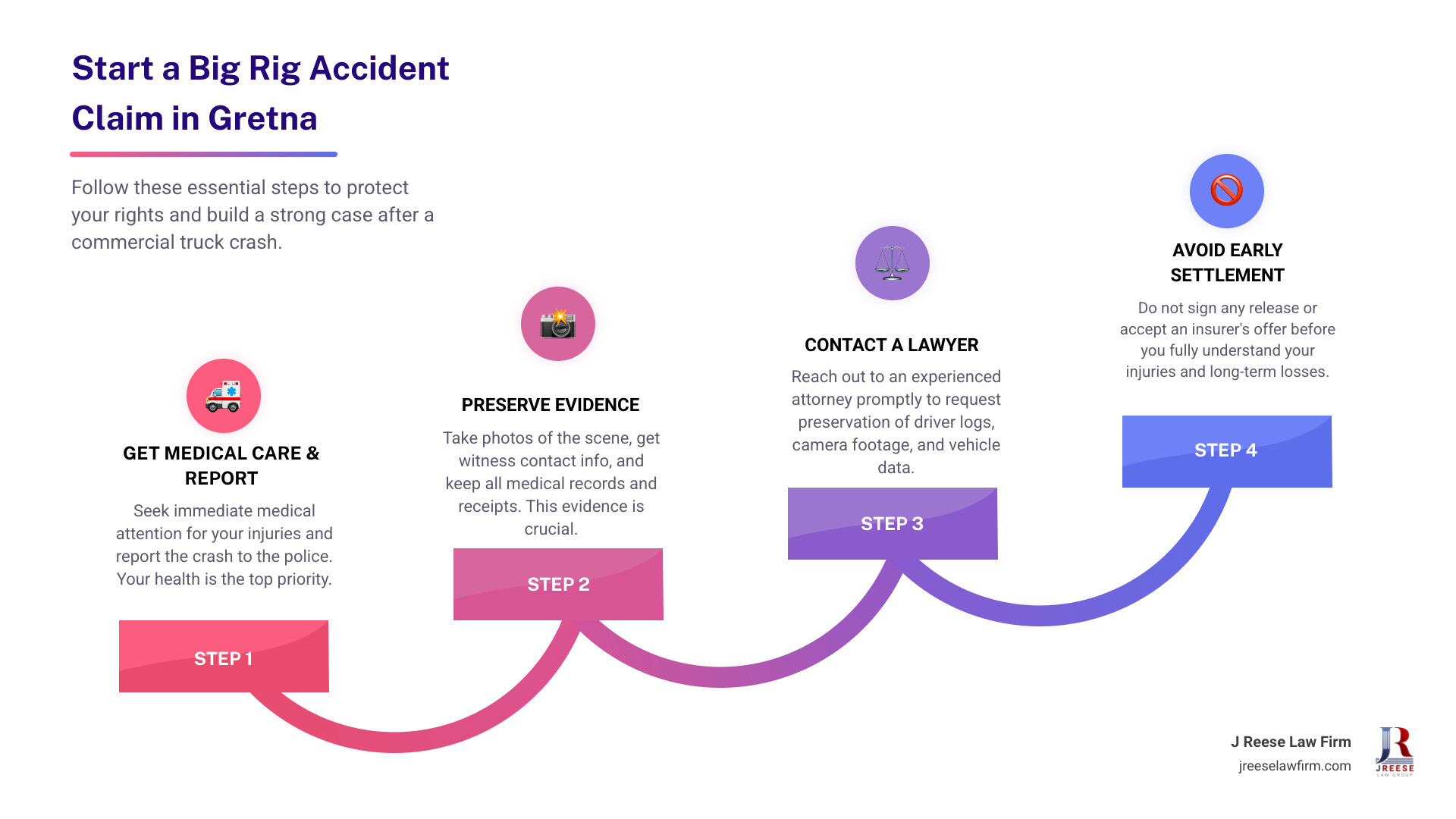
Get medical care, report the crash, and save what you can. Take photos if it is safe, get witness names, and keep your medical records and receipts. Then contact a lawyer promptly to request that the trucking company preserve its driver logs, camera footage, and vehicle data. Do not sign an insurer’s release before you understand your injuries and losses.
A big rig accident claim can involve more than the driver. The trucking company, cargo loader, or maintenance provider may also bear responsibility. Finding out who was at fault takes time, but some crash evidence may not last.
I’m Justin Reese. I’ve handled personal injury and civil litigation since 2011, including auto collisions and catastrophic injury cases, and this guide explains the first steps in a big rig accident claim.
Big rig accident claim word roundup:
Why Commercial Truck Crashes Differ from Typical Car Accidents
When a passenger vehicle collides with an 80,000-pound tractor-trailer on the Westbank Expressway or crossing the Crescent City Connection, the physical consequences are devastating. The sheer difference in gross vehicle weight makes these wrecks fundamentally distinct from standard two-car fender benders. In fact, data from the Federal Motor Carrier Safety Administration (FMCSA) reveals that approximately 70% of people killed in large commercial truck crashes are occupants of passenger vehicles, not the truck drivers.
Beyond the physical trauma, the legal and financial dynamics operate on a completely different level. Passenger car claims typically involve single insurance policies with state-mandated minimums as low as $15,000 to $25,000. In contrast, interstate commercial carriers hauling nonhazardous freight must carry at least $750,000 in federal public liability coverage, while those transporting hazardous materials must carry up to $5,000,000.
These high policy limits mean that motor carriers and their commercial insurers dispatch rapid-response defense teams to the scene of a crash within hours. They are not investigating to uncover the objective truth; they are working to insulate their company from financial liability.
| Claim Factor | Standard Passenger Car Accident | Commercial Big Rig Accident |
|---|---|---|
| Typical Policy Limits | $15,000 to $100,000 per person | $750,000 to $5,000,000+ per incident |
| Regulatory Oversight | Basic state traffic codes | Federal Motor Carrier Safety Regulations (49 CFR) |
| Potentially Liable Parties | Individual driver, vehicle owner | Driver, motor carrier, broker, shipper, mechanic |
| Critical Electronic Evidence | Minimal (basic onboard diagnostics) | Black box (EDR), ELD, telematics, inward/outward dashcams |
| Corporate Defense Response | Routine claim adjuster assigned days later | Immediate rapid-response investigators deployed to scene |
Identifying Multiple Liable Parties Beyond the Driver
In a standard collision, fault usually begins and ends with the motorists behind the wheel. A commercial crash is rarely that simple. Multiple corporate entities contribute to putting an 18-wheeler on the road, and each entity owes a legal duty of care to the motoring public. Understanding everything you must know about a big rig accident lawsuit in Gretna requires looking at every party in the supply chain:
- The Motor Carrier (Trucking Company): Under the doctrine of vicarious liability (respondeat superior), carriers are liable for the negligent actions of their drivers performed within the scope of employment. They can also face direct liability claims for negligent hiring, negligent supervision, or forcing drivers to exceed statutory hours behind the wheel.
- Freight Brokers and Shippers: Third-party logistics brokers who select carriers with poor safety records or failing safety ratings can be held liable for negligent carrier selection.
- Cargo Loading Companies: When freight shifts inside a trailer due to improper tie-downs, uneven weight distribution, or exceeding axle weight limits, it can cause catastrophic rollovers or jackknife collisions.
- Third-Party Maintenance Contractors: Fleets frequently outsource brake jobs, tire replacements, and steering inspections. If a third-party mechanic returns an unsafe rig to service with defective air brakes, that repair shop shares liability.
- Vehicle and Parts Manufacturers: When a blowout stems from a tread separation defect or a steering linkage snaps due to a manufacturing flaw, strict product liability claims come into play.
Federal Safety Regulations and Negligence Per Se
Commercial trucking operations must comply with the Federal Motor Carrier Safety Regulations codified under Title 49 of the Code of Federal Regulations (49 CFR Parts 300–399). These rules dictate everything from how many consecutive hours a driver can steer a truck to mandatory pre-trip brake inspections and random drug and alcohol screenings.
When a motor carrier or driver violates these federal mandates, that infraction can serve as evidence of negligence per se. Under this legal doctrine, if a safety rule designed to protect the public is broken and causes the exact type of harm the rule intended to prevent, the defendant is presumed negligent as a matter of law. Reviewing an established guide to federal trucking liability and damages demonstrates how hours-of-service violations directly simplify the burden of proving fault during litigation.
Step-by-Step Process to File a Big Rig Accident Claim

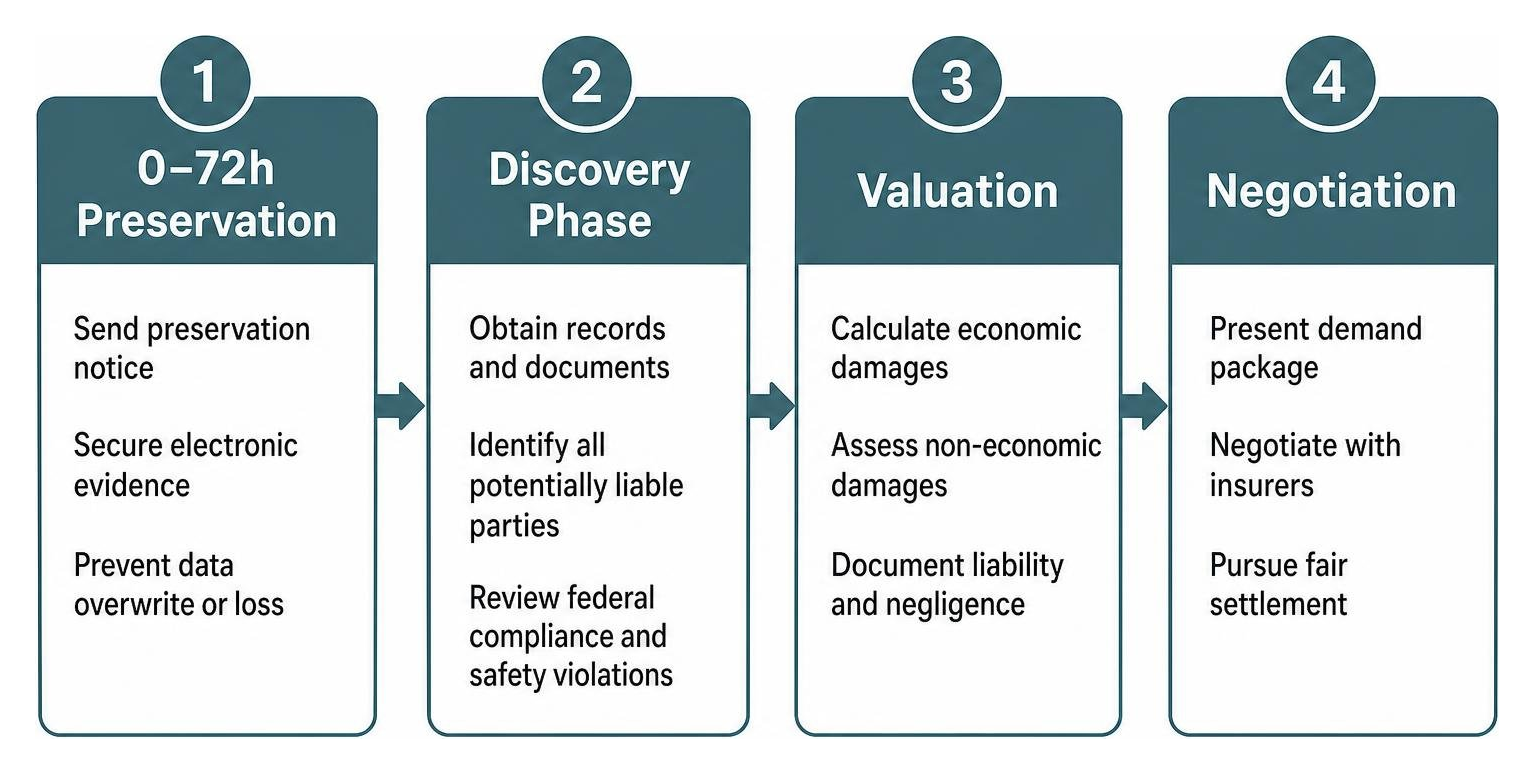
Successfully filing a claim against a trucking company requires following a structured, methodical process to avoid delays and maximize your compensation.
Immediate Evidence Preservation for Your Big Rig Accident Claim
The single greatest threat to your case is the loss of electronic evidence. Commercial tractor-trailers are equipped with sophisticated Electronic Data Recorders (EDRs, commonly known as “black boxes”) and Electronic Logging Devices (ELDs) that record vehicle speed, braking application, engine RPM, steering inputs, and exact driving hours before an impact.
However, EDR data can be overwritten in as few as 7 to 30 days during normal vehicle operation, and routine dashcam footage can disappear in days. Furthermore, federal rules only require motor carriers to retain certain ELD logs for six months.
To prevent the destruction of this vital data, you must send formal spoliation letters within 48 to 72 hours of the crash. A spoliation letter is a binding legal demand that puts the carrier, driver, insurer, and maintenance vendors on notice to preserve every byte of physical and digital records relating to the vehicle, driver, and trip. Winning an 18-wheeler accident lawsuit in Gretna requires fast action because once data is erased or vehicles are repaired and placed back on the road, proving key liability facts becomes exponentially harder.
Investigating Driver Logs, Telematics, and Maintenance Records
Once evidence is legally secured, the discovery and investigation phase begins. Our team pulls and analyzes complex data points to reconstruct what happened in the cab leading up to the collision:
- ELD and Hours-of-Service (HOS) Records: Analyzing whether the driver was on hour 13 of an illegal shift, fighting severe fatigue, or falsifying status updates.
- Telematics and GPS Tracking: Comparing timestamped GPS location data with official log entries to uncover route deviations or speeding violations.
- Driver Qualification Files (DQF): Reviewing background checks, commercial driver’s license (CDL) endorsements, prior crash histories, and medical examiner certificates to evaluate whether the driver should have been behind the wheel in the first place.
- Maintenance Logs and Out-of-Service Orders: Inspecting past roadside inspection citations, annual mechanical audits, and repair work orders to reveal systemic vehicle neglect.
Negotiating with Commercial Insurers and Avoiding Lowball Offers
Commercial insurance adjusters are skilled corporate negotiators trained to minimize claim payouts. Within days of a crash, they may contact you under the guise of “checking in,” asking you to provide a recorded statement or offering a fast initial settlement check.
Signing an early release agreement or giving a recorded statement without legal representation is one of the costliest mistakes you can make. Early settlement offers rarely account for future surgeries, long-term physical therapy, or permanent loss of earning capacity. Consulting a commercial truck lawyer in New Orleans allows you to protect your rights, shield yourself from aggressive adjuster tactics, and ensure your injuries are completely diagnosed before entering settlement talks. When local drivers need dedicated legal guidance, they turn to J Reese Law Firm to handle insurance negotiations directly.
Damages and Valuation: What Is Your Case Worth?
Commercial truck accident damages fall into three distinct legal categories: economic, non-economic, and punitive damages.
- Economic Damages (Tangible Losses): These cover all objective financial costs, such as past and future medical bills, emergency room fees, surgical interventions, prescription medications, lost wages, and lost future earning capacity.
- Non-Economic Damages (Intangible Losses): These compensate for the subjective human toll of the crash, including physical pain and suffering, mental anguish, permanent disfigurement, physical impairment, and loss of enjoyment of life.
- Punitive Damages: In situations involving egregious conduct—such as a carrier intentionally forcing drivers to operate on dangerous drugs or knowingly sending a truck onto the highway with failing brakes—punitive damages may be awarded to punish the wrongdoer and deter similar corporate behavior.
When evaluating severe injury values, using an online trucking accident settlement calculator helps illustrate how medical costs, lifetime lost wages, and venue rules shape the financial baseline of a commercial claim.
Calculating Full Value in a Big Rig Accident Claim
For victims suffering catastrophic injuries such as traumatic brain injuries (TBIs), spinal cord damage, or compound orthopedic fractures, calculating total case value requires projecting long-term needs over decades. We retain vocational counselors, economists, and certified life-care planners to develop a comprehensive roadmap of every medical expense you will face for the rest of your life.
Nationwide, commercial claims for severe injuries frequently reach into multi-million-dollar territory. The average verdict in commercial trucking lawsuits over $1 million grew from $2.3 million to $22.3 million over a nine-year period ending in 2018—an increase of nearly 967%. Juries across the country continue to return substantial awards against negligent motor carriers, such as an $85 million Los Angeles verdict in 2025 and a $16.6 million Georgia TBI verdict in 2023. Gaining a clear perspective on big rig accident settlement in New Orleans values helps ensure that injury victims do not settle for a fraction of what their recovery truly requires.
How Comparative Negligence and State Laws Impact Recovery
The state where your accident occurs plays a massive role in how much money you take home. States adhere to different fault systems:
- Pure Comparative Negligence (e.g., California, Louisiana): You can recover damages even if you are partially at fault for the crash. Your final recovery is simply reduced by your percentage of fault. For example, if your damages total $1,000,000 and a jury finds you 10% responsible because of lane positioning, you still recover $900,000.
- Modified Comparative Negligence: You are barred from recovering any compensation if your share of fault reaches 50% or 51%, depending on the state statute.
- Contributory Negligence: In a small handful of jurisdictions, being even 1% at fault completely destroys your right to collect damages.
Having an experienced semi truck accident attorney in New Orleans review your case ensures that insurance defense adjusters cannot unfairly shift blame onto you to devalue your payout.
Frequently Asked Questions About Commercial Truck Claims
What is the time limit for filing a truck crash claim in Louisiana?
In Louisiana, the legal deadline to file a personal injury lawsuit—known as the prescriptive period—is generally two years from the date of the collision for accidents occurring on or after July 1, 2024. If your crash occurred prior to that statutory change, an earlier one-year prescriptive period applied. Missing this strict filing deadline forever bars you from seeking financial recovery in court, making early legal consultation essential.
Why do trucking companies try to settle quickly after a crash?
Trucking companies and their corporate insurers move fast because they know that early in the process, you likely do not yet know the full extent of your physical injuries. By offering an immediate cash payout before you undergo diagnostic MRIs or consult orthopedic surgeons, they attempt to secure a signed liability waiver. Once you sign that document, you forfeit all rights to demand further compensation, even if you require spine surgery months down the road.
Can I recover compensation if the truck driver was an independent contractor?
Yes. Commercial motor carriers frequently classify their drivers as independent contractors or owner-operators to evade legal responsibility. However, under federal regulations and state employment laws, motor carriers exercise statutory operational control over commercial vehicles displaying their DOT operating numbers. If the carrier controls dispatch, routes, or vehicle standards, they generally cannot hide behind independent contractor labels to escape liability for a serious wreck.
Protecting Your Right to Full Compensation
A collision with an 18-wheeler can alter your physical and financial well-being in an instant. Because commercial carriers back their operations with dedicated defense teams and high-stakes legal strategies, you should never attempt to navigate a complex trucking claim on your own.
To hold negligent trucking companies accountable and secure the compensation you need to rebuild your life, speak with our truck accident attorney at J Reese Law Firm today. We will move quickly to preserve vital black box data, identify all responsible parties, and fight for the recovery you deserve.