When a New Orleans Personal Injury Turns Your Life Upside Down
New Orleans personal injury cases are more common than most people realize — and the stakes are high. Louisiana has the 3rd highest rate of traffic fatalities per 100,000 residents in the U.S., and New Orleans ranks among the top 10 U.S. cities for pedestrian fatalities per capita. If you’ve been hurt because of someone else’s negligence, here’s what you need to know right now:
- You have only one year to file a personal injury claim in Louisiana (Louisiana Civil Code §3492)
- You can still recover compensation even if you were partly at fault, under Louisiana’s comparative fault system
- Insurance companies will try to pay you as little as possible — often with a quick, lowball offer
- You pay nothing upfront — most personal injury attorneys work on a contingency fee basis
- The sooner you act, the stronger your case — evidence disappears and witnesses forget
Whether you were hurt in a car crash on Canal Street, slipped and fell at a French Quarter business, or lost a loved one due to someone’s recklessness, the law gives you the right to fight back.
I’m Justin Reese, a New Orleans-born civil litigation attorney who has spent over a decade recovering tens of millions of dollars for victims in New Orleans personal injury cases — including catastrophic injuries, wrongful death, maritime accidents, and auto collisions. In this guide, I’ll walk you through exactly what to do, what to avoid, and how to get every dollar you deserve.
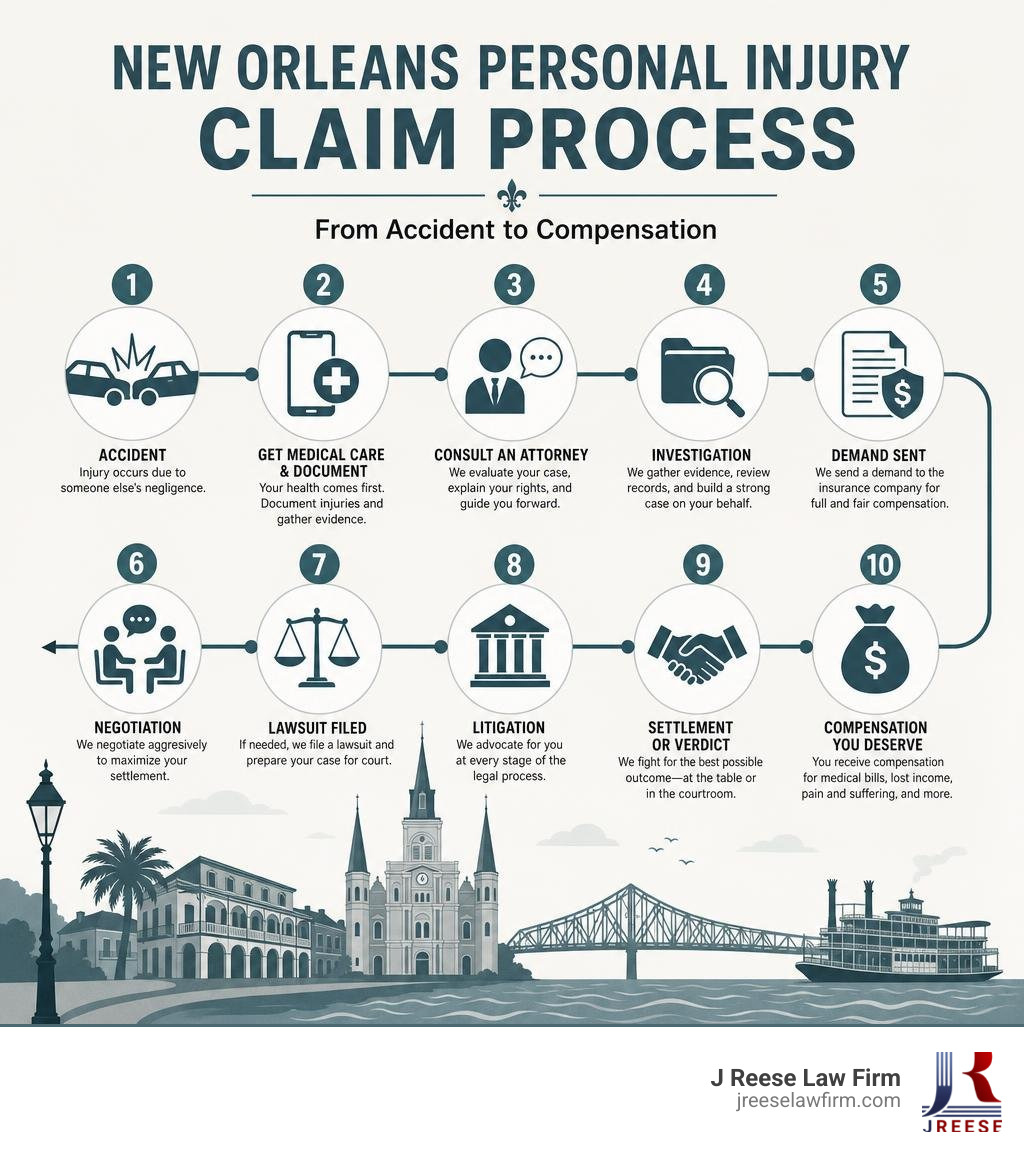
Understanding Your Rights After a New Orleans Personal Injury
When you suffer a New Orleans personal injury, the physical pain is often only the beginning. Suddenly, you are facing a mountain of medical bills, missed time at work, and the stress of dealing with insurance adjusters who do not have your best interests at heart. Understanding your legal rights is the first step toward taking back control of your life.
At its core, personal injury law is designed to make an injured person “whole” again after an accident caused by someone else’s carelessness or recklessness. In legal terms, this is known as proving negligence. To build a successful case, we must establish four key elements:
- Duty of Care: The other party had a legal obligation to act reasonably and safely (for example, a driver must follow traffic laws, or a shop owner must keep floors dry).
- Breach of Duty: They failed to meet that obligation (running a red light or ignoring a known roof leak).
- Causation: Their failure directly caused your accident and subsequent injuries.
- Damages: You suffered actual physical, emotional, or financial harm as a result.
If you have been hurt because someone else failed to act responsibly, you have the legal right to pursue financial compensation. However, securing that compensation is rarely straightforward. That is why working with a dedicated New Orleans Personal Injury Lawyer is essential. We step in to handle the legal heavy lifting, allowing you to focus entirely on your physical recovery.
Traffic and Tourism Factors in New Orleans Personal Injury Claims
New Orleans is a city unlike any other, and our unique local culture directly influences the types of accidents that happen here. From the historic, narrow streets of the French Quarter to the constant influx of millions of tourists who may be unfamiliar with our roads, the risk of a serious collision is always present.
Distracted driving, rideshare vehicles stopping abruptly to drop off passengers, and poorly maintained streets contribute to our high accident rates. If you have been involved in a collision, consulting a New Orleans Car Accident Lawyer is crucial to navigating the unique local dynamics of your claim.
Our city also features several notorious transit corridors where accidents occur with alarming frequency. Areas like the I-10 and I-610 interchange, South Claiborne Avenue, and Canal Street are well-known hazard zones. For a detailed breakdown of these high-risk areas, you can explore our guide on New Orleans Accident Hotspots. Additionally, national data from the NHTSA Traffic Safety Facts highlights how local infrastructure and driver behavior contribute to Louisiana’s elevated traffic fatality statistics.
Complex Cases: Truck Accidents, Wrongful Death, and Maritime Injuries
Not all personal injury cases are simple two-car fender benders. Many of the claims we handle involve complex legal frameworks, massive corporations, or devastating, life-altering losses.
- Commercial Truck Accidents: Collisions involving 18-wheelers and commercial delivery vehicles are incredibly dangerous due to the sheer size and weight of the trucks. These cases require an experienced New Orleans Truck Accident Attorney who understands federal trucking regulations and knows how to preserve critical black box data. Determining the potential value of these claims involves looking at insurance policies and corporate assets, which we detail in our resource on Big Rig Accident Settlement New Orleans.
- Wrongful Death Claims: Losing a loved one due to someone else’s negligence is the ultimate tragedy. While no amount of money can replace a family member, a wrongful death claim can provide essential financial security for surviving spouses and children. If you find yourself in this heartbreaking position, a New Orleans Wrongful Death Attorney can guide you through the process. To understand how these claims are valued, you can read about Wrongful Death Settlement Amounts.
- Maritime and Offshore Injuries: Because New Orleans is a major port hub, many local workers are employed on the Mississippi River, in the Gulf of Mexico, or on offshore rigs. These workers are protected by unique federal laws rather than standard workers’ compensation. If you are an offshore worker who has been injured on the job, you need an Offshore Worker Injury Attorney who understands the Jones Act and general maritime law to ensure your rights are protected.
Louisiana Liability Laws: Comparative Fault and Deadlines
Louisiana’s legal system is built on a unique civil code tradition, which means the laws governing your personal injury claim can be very different from those in neighboring states. To learn more about these unique legal structures, read our article on Why Louisiana Personal Injury Cases Are Different.

How Louisiana’s 2026 Comparative Fault System Impacts Your Compensation
One of the most critical legal developments in Louisiana is the transition to a modified comparative fault system, effective January 1, 2026. Prior to this change, Louisiana followed a pure comparative fault rule. Under the new 2026 standards, your ability to recover compensation depends heavily on your percentage of fault.
Under Louisiana Civil Code Article 2323, the law uses a “50 percent rule”:
- 50% or Less At Fault: You can still recover compensation for your injuries, but your total payout will be reduced by your exact percentage of fault. For example, if you are awarded $100,000 but are found to be 20% at fault for the accident, you will receive $80,000.
- 51% or More At Fault: If you are determined to be the primary cause of the accident (51% or more at fault), you are completely barred from recovering any damages from the other party.
Because of this threshold, insurance companies will fight aggressively to push your share of the blame past the 50% mark to avoid paying you a single cent. This makes having experienced legal representation more important than ever.
Act Quickly: Louisiana’s One-Year Statute of Limitations
In Louisiana, time is your greatest enemy after an accident. Under state law, you generally have only one year from the date of the injury to file a personal injury lawsuit. This is one of the shortest filing windows in the entire country.
Failing to file your lawsuit before this strict deadline means you will permanently lose your right to seek compensation, no matter how severe your injuries are or how obvious the other party’s fault is. Acting quickly is not just about meeting a legal deadline; it is also about preserving critical evidence, securing witness statements before memories fade, and obtaining immediate medical documentation. You can read more about why this timeline is so vital in our guide to Louisiana’s One Year Statute of Limitations.
Maximizing Your Recovery: Damages and Insurance Tactics
To get every dollar you deserve, we must carefully calculate the full scope of your losses. Insurance companies want you to focus only on your immediate bills, but a comprehensive claim looks at the long-term impact of your injuries.
Types of Damages You Can Recover in a New Orleans Personal Injury Case
A successful personal injury claim can secure compensation for both financial losses and the personal toll the accident has taken on your life. These are categorized into economic and non-economic damages:
- Economic Damages (Financial Losses):
- Medical Expenses: This includes ambulance fees, emergency room visits, surgeries, hospital stays, prescription medications, physical therapy, and any estimated future medical care you will need.
- Lost Income: Compensation for the wages you missed while recovering from your injuries.
- Reduced Earning Capacity: If your injuries prevent you from returning to your previous line of work or limit the hours you can work in the future, you can recover damages for this long-term financial loss.
- Non-Economic Damages (Personal Impact):
- Pain and Suffering: Compensation for the physical pain and discomfort caused by your injuries.
- Emotional Distress: Coverage for anxiety, depression, post-traumatic stress, and loss of sleep following a traumatic accident.
- Loss of Enjoyment of Life: If your injuries prevent you from participating in hobbies, sports, or family activities you once loved.
How Insurance Companies Minimize Payouts and How to Fight Back
Insurance companies are profit-driven corporations. Their primary goal is to settle your claim for as little money as possible. To do this, insurance adjusters use a variety of tactics designed to catch injured victims off guard:
- The Fast, Lowball Offer: Shortly after your accident, an adjuster may offer you a quick cash settlement. While this money can be tempting when bills are piling up, accepting it requires you to sign a release waiving your right to pursue any future compensation. If your injuries require surgery months down the road, you will have to pay for it out of pocket.
- The Recorded Statement Trap: Adjusters will often ask you to give a recorded statement describing the accident. They may phrase questions in ways designed to get you to admit partial fault or minimize the severity of your pain.
- Delaying the Process: By dragging out the claims process, insurers hope you will become desperate enough to accept a fraction of what your case is actually worth.
We know these tactics inside and out. When we represent you, we handle all communications with the insurance companies, shielding you from their high-pressure strategies and fighting for a settlement that reflects the true value of your claim.
Immediate Steps to Protect Your Legal Rights After an Accident
What you do in the minutes, hours, and days following an accident can make or break your personal injury claim. Taking the right steps immediately helps preserve crucial evidence and establishes a clear link between the accident and your injuries.
What to Do at the Scene and in the Days Following an Injury
If you are involved in an accident, try to remain calm and follow these essential steps:
- Prioritize Safety: Move to a safe area if possible and check yourself and others for injuries.
- Call 911: Request medical personnel and the New Orleans Police Department (NOPD). A formal police report is a vital piece of evidence.
- Document the Scene: Use your smartphone to take high-quality photos and videos of the vehicles, property damage, skid marks, road conditions, and any visible injuries.
- Gather Witness Information: Collect names, phone numbers, and addresses of anyone who saw the incident occur.
- Seek Immediate Medical Attention: Even if you feel fine, go to an urgent care clinic or emergency room. Adrenaline can mask serious injuries, such as internal bleeding or concussions. Having a medical record dated the day of the accident is critical. For more detailed advice, review our guide on What to Do After a Car Accident in Louisiana.
Special Instructions for Slip and Fall Injuries: If you are injured in a slip and fall accident at a local business, property owners will often try to clean up the hazard immediately to avoid liability. It is absolutely critical that you:
- Take immediate pictures of the substance: Photograph the exact liquid, debris, or hazard on the floor that caused you to slip.
- Check for wet floor signs: Take photos showing the entire area to document that there were no wet floor signs or warning barriers in place.
- Contact a legal advocate: Reach out to a New Orleans Slip and Fall Attorney as soon as possible to help secure security camera footage before it is recorded over.
Critical Mistakes That Can Ruin Your Claim
Just as there are things you should do, there are several common mistakes that can severely damage your chances of recovering compensation:
- Posting on Social Media: Avoid posting anything about your accident, your physical activities, or your recovery on platforms like Facebook, Instagram, or TikTok. Insurance defense attorneys actively monitor these accounts and will use any photo of you smiling or out with friends to argue that your injuries are not as severe as you claim.
- Missing Medical Appointments: Skipping doctor visits or physical therapy sessions creates a gap in your medical treatment. Insurers will use this to argue that you are either fully recovered or failing to mitigate your damages.
- Accepting an Early Settlement: Never sign any insurance paperwork or accept a check without having an attorney review your case first.
Frequently Asked Questions About New Orleans Personal Injury Claims
How do contingency fees work for personal injury cases?
We believe that everyone deserves access to high-quality legal representation, regardless of their financial situation. That is why we work on a contingency fee basis. This means you pay absolutely nothing upfront. Our legal fees are paid as a percentage of the final settlement or jury verdict we win for you. If we do not recover money for your claim, you do not owe us a dime.
What if I was a passenger in a car accident?
As a passenger, you are almost never at fault for a collision. You have the legal right to recover compensation for your medical bills and lost wages, regardless of whether the driver of your vehicle or the driver of the other vehicle caused the crash. Your claim will typically be filed against the insurance policies of the at-fault drivers.
Can I still recover compensation if I was partially at fault?
Yes, but under Louisiana’s 2026 modified comparative fault rules, you must be 50% or less at fault to recover any damages. If your share of the blame is determined to be 50% or less, your total compensation payout will be reduced by your percentage of fault. If you are found to be 51% or more at fault, you cannot recover any compensation.
Take Back Control: Let Us Fight for Your Recovery
Dealing with a serious injury is exhausting, but you do not have to go through this challenging time alone. At the J Reese Law Firm, we are dedicated to standing up to big insurance companies and demanding the full, fair compensation you need to rebuild your life.
We understand the local courts, the local roads, and the tactics that insurers use to minimize your pain. We will handle the investigations, the paperwork, and the aggressive negotiations so you can focus on healing.
If you or a loved one has suffered a New Orleans personal injury, do not wait until the strict one-year deadline passes. Contact an experienced New Orleans Personal Injury Lawyer today to schedule your free, no-obligation case evaluation. Let us help you get every dollar you deserve.