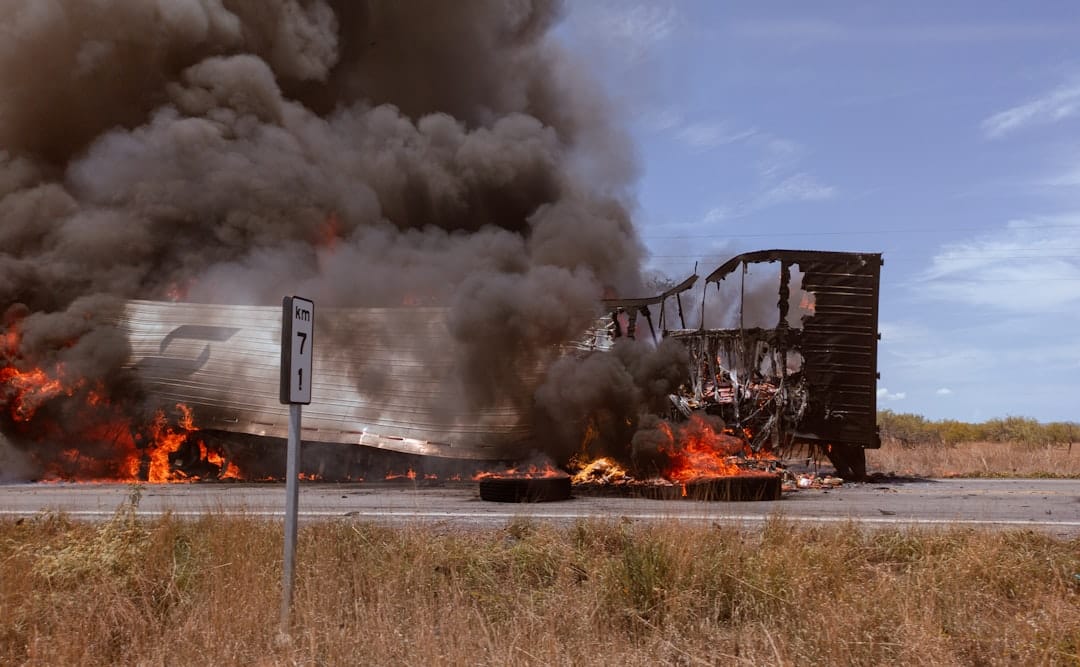
Understanding the Legal Grounds for a Big Rig Accident Lawsuit
Pursuing a legal claim after a semi-truck collision requires showing that one or more parties failed to uphold safety obligations. Commercial truck operators are held to distinct legal standards beyond those required of standard motorists. Because tractor-trailers operate on shared public highways, commercial carriers and their drivers must follow rigorous Federal Motor Carrier Safety Regulations (FMCSR) established to protect the public.
When a driver or trucking firm violates these federal directives—such as ignoring mandatory rest breaks, exceeding weight limits, or failing to perform pre-trip inspections—it creates grounds for establishing negligence per se. Under this legal doctrine, demonstrating a clear violation of a safety regulation designed to prevent highway collisions directly supports your claim of liability. Reviewing established commercial truck litigation insights can help clarify how these safety mandates shape commercial injury claims.
Violations of Federal Regulations in a Big Rig Accident Lawsuit
Under Title 49 of the Code of Federal Regulations (CFR), particularly Part 395, commercial drivers face strict limits on their operational hours. Known as the Hours of Service (HOS) rules, these laws dictate that property-carrying drivers may drive no more than 11 hours following 10 consecutive hours off duty, and cannot drive beyond the 14th consecutive hour after coming on duty.
When motor carriers impose tight delivery deadlines, operators may push past fatigue limits or falsify duty logs. A catastrophic crash can occur in seconds when an exhausted driver loses focus or falls asleep behind the wheel. The real-world consequences of corporate oversight failures and hours-of-service non-compliance were demonstrated when a Texas jury rendered a massive decision where a nuclear verdict pins C.H. Robinson, carrier, and driver for $604 million following a fatal collision tied to safety metric failures and falsified logs.
Manufacturer Defects and Collision Mitigation Systems
Liability in a tractor-trailer collision is not always limited to the person behind the wheel. When mechanical failures or design oversights cause or worsen a crash, vehicle manufacturers may face product liability claims. Modern commercial rigs rely heavily on advanced safety equipment, including automatic emergency braking (AEB), forward collision warning systems, and roll stability controls.
When an advanced safety system malfunctions, unexpectedly disengages, or fails to detect stopped traffic, the manufacturer can be held responsible under design or manufacturing defect claims. The legal responsibilities surrounding these automated safety tools continue to evolve in the courts, as highlighted in ARIEL DE JESUS ORTIZ v. DAIMLER TRUCK NORTH AMERICA LLC (2025), where appellate judges evaluated whether the omission or configuration of collision-mitigation technology can support design defect claims.
Identifying Liable Parties in Commercial Truck Collisions
Tractor-trailer claims involve multi-layered corporate structures. Identifying every responsible entity requires looking into employment contracts, maintenance agreements, and logistics arrangements.
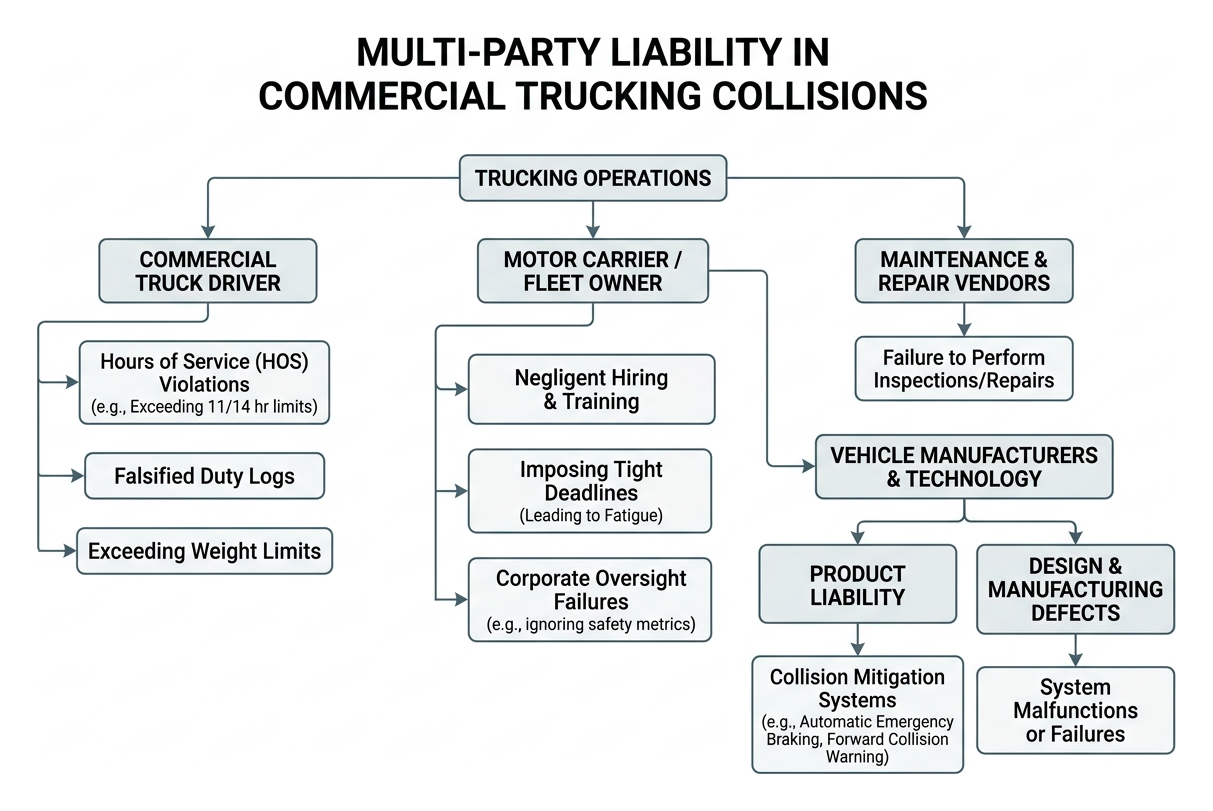
Seeking skilled commercial truck lawyer guidance allows injured individuals to identify all potential sources of financial recovery, which may include:
- The commercial truck driver
- The motor carrier or fleet owner
- Third-party maintenance and repair vendors
- Freight brokers and dispatchers
- Cargo loaders and logistics facilities
- Commercial vehicle and parts manufacturers
Direct vs. Vicarious Carrier Liability
Under the doctrine of respondeat superior, trucking companies are vicariously liable for the negligent actions of their employees committed within the scope of employment. However, motor carriers often face direct liability claims as well.
Direct corporate negligence occurs when a carrier cuts corners on driver safety. This includes negligent hiring (failing to check a driver’s commercial driving record), negligent retention (keeping a driver with multiple safety violations), and failing to provide safety training. The Federal Motor Carrier Safety Administration (FMCSA) tracks carrier violations using the Safety Measurement System (SMS). If a carrier continues dispatching drivers despite failing SMS safety scores, it demonstrates a conscious disregard for motorist safety.
Third-Party Brokers and Freight Handlers
Freight brokers serve as intermediaries connecting shippers with motor carriers. While brokers historically claimed immunity from accident liability, recent legal precedents hold them accountable when they fail to vet the safety history of the carriers they hire.
Similarly, third-party cargo loaders bear significant responsibility. An improperly distributed or unsecured load can shift during transit, causing the trailer to swing, jackknife, or overturn. Cargo loaders who exceed federal gross vehicle weight ratings (typically 80,000 pounds without special permits) increase braking distances and mechanical wear, directly elevating collision risks.
Essential Steps and Evidence in Filing Your Claim
Litigating an 18-wheeler claim requires different steps than resolving a standard passenger vehicle crash:
| Key Element | Passenger Car Accident Claim | Commercial Big Rig Lawsuit |
|---|---|---|
| Typical Weight Impact | 3,000 to 4,000 lbs | Up to 80,000+ lbs |
| Minimum Insurance | State minimums ($15,000+) | Federal minimums ($750,000 to $5,000,000) |
| Governing Rules | State motor vehicle traffic codes | FMCSR, federal safety rules & state codes |
| Liable Parties | Individual driver / vehicle owner | Driver, carrier, broker, loader, manufacturer |
| Critical Evidence | Police report, photos, witness statements | EDR/ECM telemetry, ELD logs, maintenance records |
Preserving evidence quickly is vital. Motor carriers are not required to keep all operational data indefinitely, and critical telematics can be overwritten within 30 days. Partnering with a dedicated semi truck accident attorney ensures that formal spoliation letters are immediately dispatched to the carrier, requiring them to preserve all electronic and physical evidence.
Securing Black Box Data and Electronic Logging Devices
Every modern commercial tractor contains an Engine Control Module (ECM) and Event Data Recorder (EDR), commonly referred to as the truck’s “black box.” This onboard computer continuously records vehicle performance metrics.

Crucial data extracted during a forensic download includes:
- Vehicle travel speed immediately before impact
- Throttle percentage and engine RPM
- Exact timing of brake application
- Steering angles and lateral acceleration
- Seatbelt usage and cruise control settings
- Electronic Logging Device (ELD) hours-of-service records
This unalterable data prevents carriers and drivers from misrepresenting their driving behavior or duty hours in the moments leading up to a crash.
Calculating Damages in a Big Rig Accident Lawsuit
Because of the massive kinetic forces involved, collisions with commercial trucks often cause severe, permanent injuries. Evaluating your big rig accident settlement options involves calculating all current and future losses.
Compensable damages typically fall into three categories:
- Economic Damages: Tangible out-of-pocket costs, including emergency room care, surgeries, physical therapy, assistive medical devices, lost wages, and diminished future earning capacity.
- Non-Economic Damages: Intangible losses, such as physical pain and suffering, mental anguish, permanent disfigurement, disability, and loss of enjoyment of life.
- Wrongful Death Damages: In fatal accidents, surviving family members may pursue compensation for funeral costs, loss of financial support, and the loss of companionship and guidance.
In cases involving gross negligence—such as a carrier intentionally bypassing brake maintenance or a driver operating under the influence—courts may also award punitive damages to penalize the wrongdoer and deter similar conduct.
Navigating Louisiana Comparative Fault and Filing Deadlines
If you are pursuing a claim in Gretna or the greater New Orleans area, state law governs how fault is allocated and how much time you have to file. Working with J Reese Law Firm ensures your case complies with all local court rules and state deadlines.
Under Louisiana Civil Code Article 2323, claims are handled using a pure comparative fault system. If you are found partially responsible for a collision, your financial recovery is reduced in direct proportion to your percentage of fault. For example, if your damages equal $500,000 but a jury determines you were 10% responsible because of a minor traffic infraction, your final recovery would be $450,000.
Securing comprehensive big rig accident representation early helps protect you from trucking defense lawyers who try to shift undue blame onto injured drivers.
Regarding timing, Louisiana applies strict prescriptive periods (statutes of limitations). Following recent legislative updates, most personal injury and delictual claims are subject to a two-year prescriptive period from the date of the accident. Missing this filing deadline permanently revokes your legal right to seek compensation.
Frequently Asked Questions About Commercial Truck Claims
How long do I have to file a commercial truck accident lawsuit in Louisiana?
Under Louisiana law, you generally have two years from the exact date of the collision to file a personal injury lawsuit in court. If the collision resulted in a fatality, family members generally have two years from the date of death to bring a wrongful death action. Because critical evidence like electronic logging data can be lost or overwritten within weeks, beginning the legal process as soon as possible is critical.
What makes commercial truck crash claims more complex than car accidents?
Truck claims involve distinct federal regulations, higher commercial insurance policy limits (ranging from $750,000 to over $5,000,000), and multiple corporate defendants. Proving liability requires examining complex evidence, such as black box downloads, driver qualification files, maintenance histories, and freight brokerage contracts, which are not present in standard car accident claims.
Can freight brokers be held liable for an 18-wheeler wreck?
Yes. If a freight broker fails to properly vet a motor carrier’s safety history, hires a carrier with known severe safety violations, or exerts direct control over the driver’s schedule in a way that forces regulatory violations, the broker can be named as a defendant for negligent hiring and selection.
Take Decisive Action to Protect Your Recovery
A serious collision with a tractor-trailer can alter your life in an instant, leaving you with heavy medical expenses, lost income, and a long road to recovery. Trucking corporations and their commercial insurers move quickly to limit their exposure and protect their bottom lines.
You do not have to confront these corporate carriers and legal teams by yourself. At J Reese Law Firm, we focus on identifying every liable entity, securing time-sensitive electronic records, and pursuing full financial recovery for our clients. Reach out to our New Orleans truck accident attorney team today for a free case evaluation, and let us handle the legal process while you focus on your physical recovery.