
Benchmarks for a Head Injury Settlement by Severity Level
When evaluating a head injury case, settlements generally align with the medical severity of the trauma, the permanence of cognitive deficits, and the degree of financial disruption to your life. While every brain injury affects an individual differently, legal benchmarks provide a starting framework for understanding potential value.
| Severity Level | Typical Settlement Range | Key Characteristics & Prognosis |
|---|---|---|
| Mild TBI / Concussion | $100,000 – $150,000+ | Concussions, brief loss of consciousness, headaches, post-concussion syndrome lasting months. |
| Moderate Brain Trauma | $150,000 – $500,000 | Extended loss of consciousness, visible imaging deficits, cognitive impairment, memory loss, vocational disruption. |
| Severe / Catastrophic TBI | $1,000,000 – $5,000,000+ | Coma, skull fractures, permanent physical or cognitive disability, need for lifelong medical or residential care. |
Actual results can vary significantly from these benchmarks based on specific facts, liability clarity, and policy limits. For example, a courtroom outcome highlighted in this Georgia Jury Awards $1.59M in TBI, Crash Trial report demonstrated how a jury delivered an award more than three times the defense insurer’s pre-trial offer of $500,000, demonstrating that documented ongoing deficits often push compensation far beyond initial insurer assessments.
Mild Traumatic Brain Injuries and Concussions
The term “mild” can be misleading. In medical terminology, a mild traumatic brain injury (mTBI) refers to the initial presentation of trauma—such as a brief alteration in mental state or a short loss of consciousness—rather than the permanence of its long-term impact.
Between 10% and 30% of individuals who suffer concussions develop post-concussion syndrome (PCS). This condition can bring months or years of debilitating migraines, vertigo, light sensitivity, mood changes, sleep disruption, and memory lapses. Even when standard CT scans or structural MRIs appear clear, these invisible functional injuries interfere heavily with daily life and work performance. As reported where a motor vehicle collision leads to $355,000 settlement, securing fair compensation for persistent concussive injuries and associated fractures often requires stacking available liability, underinsured motorist, and medical payment coverages to reach six-figure resolutions.
Moderate to Severe Traumatic Brain Injuries
Moderate and severe brain injuries often leave survivors with profound, permanent cognitive and physical challenges. Survivors may experience speech impairments, executive function deficits, personality alterations, and partial or complete loss of independence.
These cases require substantial financial resources to cover acute emergency interventions, intensive care unit (ICU) stays, extensive neuro-rehabilitation, and potentially decades of in-home support or assisted living. When navigating brain damage claims in New Orleans and beyond, our focus remains on ensuring that long-term care plans accurately capture every projected cost across a survivor’s entire life span.
Core Components Used to Calculate TBI Damages
Determining the true value of a brain injury claim requires a meticulous calculation of both tangible economic costs and intangible non-economic losses.
When we work to maximize your financial compensation for car crash losses across New Orleans, we build an evidentiary foundation that accounts for both current expenses and future life adjustments.
Calculating Economic and Non-Economic Losses in a Head Injury Settlement
Economic damages cover direct, quantifiable financial outlays and future financial requirements caused by the injury:
- Past emergency room bills, hospital stays, surgical procedures, and physician visits.
- Future physical, occupational, vestibular, and speech therapy.
- Prescription medications and cognitive rehabilitation programs.
- In-home nursing assistance, home modifications, and specialized mobility equipment.
Non-economic damages compensate for subjective, personal harms that do not come with an itemized invoice:
- Physical pain and chronic suffering.
- Mental anguish, anxiety, depression, and loss of enjoyment of life.
- Emotional distress and loss of consortium or companionship with a spouse.
A clear demonstration of this dynamic occurred in a case where a woman who lost job after head injury in crash wins seven-figure settlement, securing a $1.383 million verdict focused on loss of earnings and post-concussion syndrome after a rear-end collision, despite initial insurer settlement offers that were far lower.
Vocational Loss and Diminished Earning Capacity
A serious head injury often derails professional careers, reduces work endurance, or removes a victim from the workforce altogether. Diminished earning capacity calculations evaluate what you reasonably would have earned over your working life versus what you are now capable of earning post-injury.
Forensic economic calculations examine career trajectories, statistical likelihood of promotions, loss of bonuses, and retirement contributions. For instance, in a notable case where a Kamloops lawyer awarded $3.2M after car crash diminished her career, the court awarded $3.2 million after a crash caused chronic migraines and cognitive fatigue that forced her to cut her working hours to 60%, drastically impairing her long-term partnership potential.
Key Factors Influencing Total Claim Payouts
Every claim involves specific legal and factual elements that influence total recovery. Understanding how a traumatic brain injury lawyer evaluates your case and fights helps ensure no critical leverage is overlooked during negotiations.
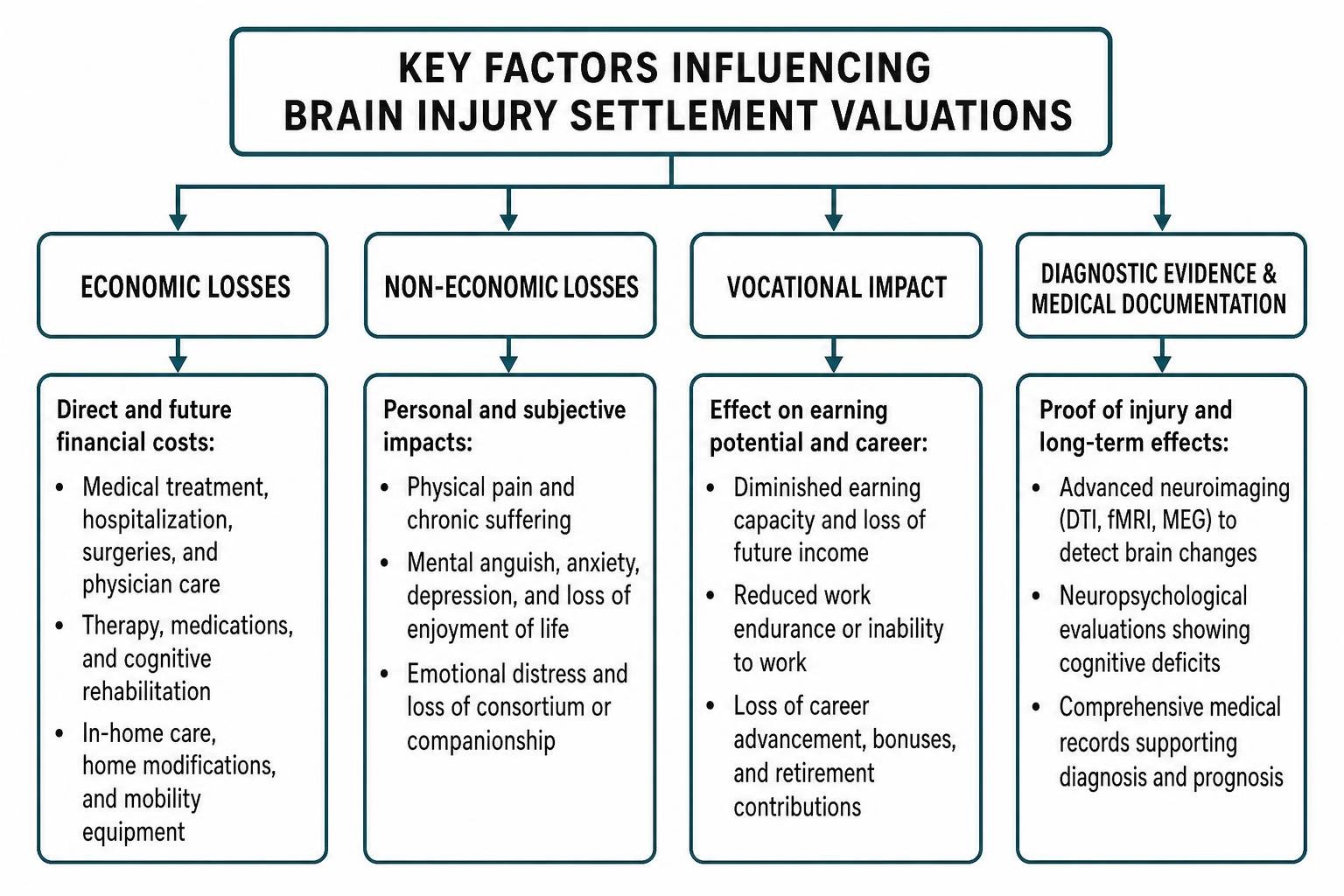
Diagnostic Evidence and Medical Documentation
Because brain injuries are often subtle, insurers routinely argue that symptoms are exaggerated or caused by pre-existing conditions. Overcoming these defenses requires comprehensive diagnostic evidence.
Advanced neuroimaging—such as high-field diffusion tensor imaging (DTI), functional MRI (fMRI), and magnetoencephalography (MEG)—can reveal microstructural white-matter tract disruptions and functional abnormalities that traditional CT scans miss entirely. Neuropsychological evaluations provide standardized, objective metrics demonstrating deficits in processing speed, memory retention, and executive functioning.
Age and Long-Term Life Care Needs
A survivor’s age directly influences lifetime economic damages. A younger person facing 40 or 50 years of diminished earning capacity and ongoing therapy needs will naturally require a substantially larger life care plan than an older individual closer to retirement. Understanding the 5 ways a New Orleans brain injury lawyer protects your long-term care ensures your settlement covers projected inflation, evolving therapy needs, and assistive care over your entire actuarial life expectancy.
The Risks of Accepting an Early Insurance Offer
Insurance adjusters often move quickly following an accident, offering what might seem like a substantial upfront sum before the true extent of a brain injury becomes apparent.
Knowing what to do after a car accident in Louisiana includes understanding why an immediate check from an insurance carrier rarely serves your long-term health and financial interests.
Why You Should Never Rush a Head Injury Settlement
Brain injuries take time to stabilize. Settling a claim before reaching Maximum Medical Improvement (MMI)—the point where your medical condition has stabilized and your doctors can clearly forecast future limitations—is exceptionally risky.
Settlement agreements contain comprehensive releases of liability. Once you sign the release and deposit the check, your claim is closed forever. If you discover six months later that your post-concussion symptoms are permanent and you cannot return to your prior job, you cannot reopen the claim to demand additional funds.
What to Do When an Insurer Makes an Initial Offer
- Request the offer in writing: Obtain the full written terms, including any proposed release language, rather than agreeing to verbal summaries.
- Preserve every medical and financial record: Maintain a complete file of all diagnostic imaging, physician notes, therapy invoices, and wage-loss records.
- Decline to provide recorded statements: Insurance adjusters often ask leading questions designed to downplay cognitive symptoms or extract statements that hurt your claim.
- Consult legal counsel before signing: Have an attorney review the offer against a comprehensive calculation of your long-term care and vocational losses.
For premises liability cases, such as a slip and fall that resulted in a head injury, it is also important to preserve physical evidence right away by taking pictures of the liquid or substance on the floor and taking note of missing wet floor signs at the scene.
Frequently Asked Questions About Brain Injury Claims
What is the average payout for a concussion or mild TBI?
Settlements for mild traumatic brain injuries and concussions typically range from $100,000 to $150,000, but cases involving persistent post-concussion syndrome, prolonged time off work, or clear liability frequently exceed these numbers and reach into the mid-six-figure range.
How long does it take to settle a head injury lawsuit?
Resolving a brain injury claim usually takes anywhere from several months to two years or more. The timeline depends on how long it takes to reach Maximum Medical Improvement, complete comprehensive neuropsychological testing, quantify lifetime economic damages, and navigate formal litigation if the insurer disputes liability or damages.
Can I seek compensation if my head injury symptoms appeared weeks later?
Yes. It is common for traumatic brain injury symptoms—such as memory difficulties, personality shifts, vestibular problems, and cognitive fatigue—to manifest or worsen weeks after an accident. As long as qualified medical providers connect your neurological symptoms back to the traumatic event, you can pursue full compensation.
Securing Your Financial Future After a Head Injury
A serious head injury affects your physical health, cognitive clarity, career, and family stability. Accepting an early settlement without knowing the full scope of your medical prognosis can leave you without the resources needed for future care.
At J Reese Law Firm, we focus on uncovering the true, long-term costs of brain injuries and holding negligent parties fully accountable. If you or a family member is dealing with the aftermath of head trauma, speak with a dedicated New Orleans Traumatic Brain Injury Attorney to evaluate your claim and protect the compensation you need to recover.