How to Start an 18-Wheeler Accident Lawsuit in Gretna
Get medical care, report the crash, and save what you can. Keep photos, witness names, medical records, and bills. Then ask a lawyer to send a preservation request to the trucking company before truck data, driver logs, or other records are lost. An 18-wheeler accident lawsuit may involve the driver, the trucking company, and other parties, so do not assume the first insurance offer covers your full loss.
I’m Justin Reese, a civil litigation attorney who has handled catastrophic injury and wrongful death cases since 2011. I bring that experience to evaluating an 18-wheeler accident lawsuit, starting with the evidence that needs attention now.
Related content about 18-wheeler accident lawsuit:
How to Build a Strong 18-Wheeler Accident Lawsuit from Day One
A collision with a commercial semi-truck is fundamentally different from a typical passenger car wreck. A fully loaded tractor-trailer can weigh up to 80,000 pounds, whereas the average passenger car weighs around 4,000 pounds. This severe weight disparity creates immense kinetic force during impact, leaving car occupants vulnerable to life-altering harm. In fact, research indicates that passenger vehicle occupants account for roughly 67 percent of deaths in fatal large truck crashes.
When you or someone you love suffers harm in a major collision, establishing accountability demands an immediate, systematic approach. Commercial carriers and their insurance companies dispatch rapid-response defense teams to the collision scene within hours. These investigators work quickly to minimize financial exposure, control physical evidence, and begin building an aggressive defense.
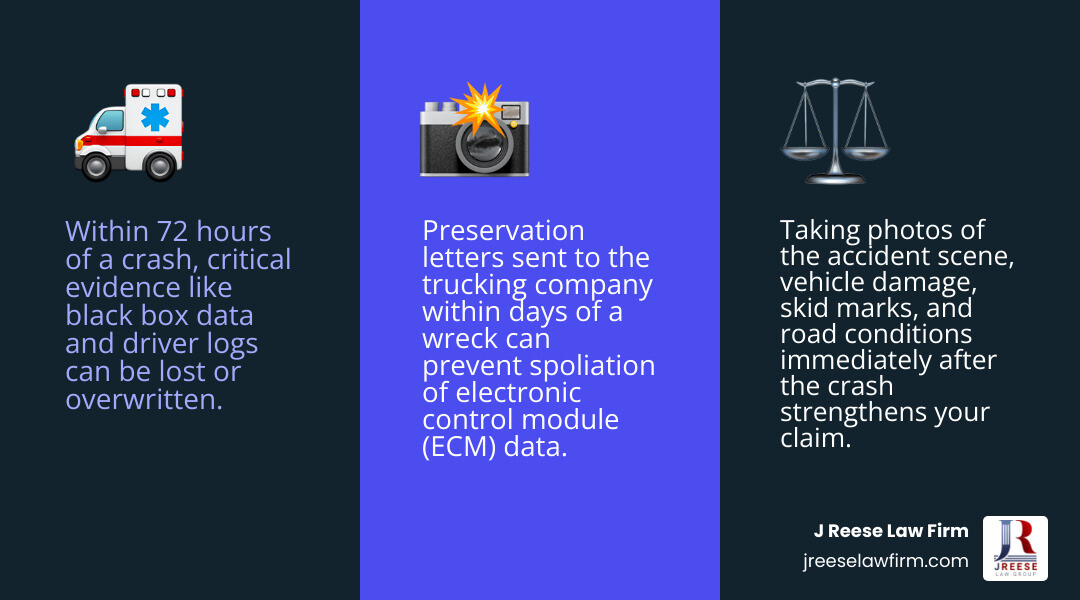
To counter these tactics, our team acts immediately by issuing formal spoliation letters. A spoliation letter is a formal legal demand putting the motor carrier, maintenance providers, and insurance companies on notice to preserve all tangible and digital records connected to the wreck. Without this formal demand, vital electronic data and physical truck parts may be repaired, altered, or overwritten in the ordinary course of business.
Understanding why a semi truck crash attorney in Gretna is essential for commercial collision claims starts with knowing how complex state and federal trucking regulations intersect with local injury laws. We immediately secure the physical and digital trail to uncover regulatory breaches under Title 49 of the Code of Federal Regulations (49 CFR Parts 390–399), ensuring no critical detail is overlooked.
Securing Critical Black Box and ELD Data Before It Disappears
Modern commercial rigs are equipped with complex onboard computers, including Electronic Control Modules (ECMs) and Electronic Logging Devices (ELDs). These systems record real-time operational data that can definitively demonstrate how the collision occurred.

This onboard technology captures a wide array of objective vehicle telemetry:
- Speed and throttle position prior to and at the precise moment of impact.
- Brake sensor logs showing whether and when the trucker applied the brakes.
- Steering angles, engine RPM, and clutch status.
- Hours-of-Service (HOS) data, tracking whether the operator exceeded daily driving limits.
Time is of the essence when retrieving this telemetry. Many ELD systems record on rolling memory cycles—sometimes overwriting raw device data in as few as eight days if not properly preserved. Likewise, ECM systems may overwrite “hard-braking” event logs when the truck is turned back on, moved, or put back into service.
Reviewing everything you must know about a big rig accident lawsuit in Gretna helps clarify why downloading this data with qualified forensic download technicians forms the backbone of a successful legal claim.
Investigating Safety Records, SMS Scores, and Driver Qualification Files
Beyond the physical vehicle, an effective legal strategy requires scrutinizing the motor carrier’s corporate safety infrastructure. We thoroughly evaluate records maintained by the Federal Motor Carrier Safety Administration (FMCSA), particularly the carrier’s Safety Measurement System (SMS) scores. These public and carrier-specific metrics highlight historical safety violations in crucial areas such as:
- Unsafe driving patterns and chronic speeding citations.
- Hours-of-Service compliance and log falsification.
- Vehicle maintenance defects and out-of-service violations.
- Controlled substance and alcohol compliance.
We also subpoena the complete Driver Qualification File (DQF). Federal law requires motor carriers to maintain detailed records for every commercial driver, including commercial driver’s license (CDL) endorsements, driving history background checks, medical examiner certifications, and prior crash histories. Carriers that cut corners by hiring unqualified drivers or overlooking failed medical exams can be held directly liable for negligent hiring and retention.
Corporate safety rules are non-negotiable. For example, appellate court rulings, such as the Texas Fourteenth Court of Appeals opinion on corporate negligence involving Werner Enterprises, confirm that trucking companies owe an independent legal duty to maintain proper winter-weather driving policies and ensure dispatchers do not push drivers to operate at unsafe speeds during hazardous road conditions. We uncover training manual deficiencies, dispatcher communication transcripts, and mandatory post-fatal drug testing records to show when corporate management chose delivery speed over public safety.
Identifying Liable Parties in Commercial Trucking Collisions
Establishing fault after an 18-wheeler crash often involves unraveling complex corporate relationships. Unlike standard auto accidents where only the individual driver is typically named, commercial trucking operations involve several corporate entities whose overlapping negligence can cause a catastrophe.

Under the legal doctrine of respondeat superior (vicarious liability), employers are generally responsible for the negligent acts performed by their employees within the scope of their employment. However, many trucking companies attempt to shield themselves from financial accountability by classifying their operators as independent contractors or utilizing complex leasing arrangements.
Our investigation pierces these corporate layers by evaluating dispatch control, equipment ownership, and operating authority to hold the motor carrier directly and vicariously responsible.
Why Multi-Party Liability Shapes an 18-Wheeler Accident Lawsuit
Identifying every responsible entity is essential to securing full financial compensation, especially when catastrophic injuries exceed basic insurance minimums.
A thorough investigation routinely reveals liability across multiple entities:
- The Commercial Driver: For speeding, driving while fatigued, distracted driving, impaired operation, or failing to yield right-of-way.
- The Motor Carrier (Trucking Company): For negligent hiring, failing to train drivers, pushing unlawful delivery schedules that force HOS violations, and neglecting fleet maintenance.
- Third-Party Freight Brokers and Logistics Providers: When brokers fail to vet a motor carrier’s safety history and hire unsafe carriers with alarming SMS violation scores. Landmark industry litigation—such as the FleetOwner report on broker liability detailing a $604 million verdict against C.H. Robinson and partner carriers—demonstrates that brokers can face substantial liability when they fail to exercise reasonable care in carrier selection.
- Cargo Loading Companies: When improperly secured, unbalanced, or overloaded freight shifts during transit, causing jackknife crashes or vehicle rollovers.
- Third-Party Maintenance Contractors: When mechanics perform substandard brake repairs, overlook worn tires, or sign off on defective safety equipment.
- Vehicle and Component Manufacturers: When defective tires, faulty steering components, or malfunctioning brake assemblies fail on the highway.
Reviewing these 7 critical reasons to hire a truck accident attorney in Gretna shows why identifying all potential defendants early helps prevent corporate entities from passing the blame to an empty chair at trial.
Apportioning Fault and Managing Comparative Negligence
When commercial claims go to trial, defense lawyers frequently attempt to shift blame onto passenger car drivers to reduce their financial exposure. Under comparative negligence principles, financial recovery is adjusted based on each party’s percentage of fault. In proportionate responsibility jurisdictions like Texas, an injured victim can recover compensation as long as their share of fault does not exceed 50 percent; if a plaintiff is found 51 percent or more at fault, they are barred from recovery.
Corporate defense teams often assert that a passenger vehicle was speeding, lingering in a truck’s blind spot, or following too closely. To defeat these offset tactics, we present objective ECM data, accident reconstruction analysis, and physical road markings to prove that systemic corporate failures were the true cause of the crash.
| Liability Element | Standard Passenger Auto Claim | Commercial 18-Wheeler Claim |
|---|---|---|
| Primary Defendants | Individual driver | Driver, carrier, freight broker, cargo loader, maintenance shop |
| Regulatory Framework | State traffic statutes | Federal Motor Carrier Safety Regulations (49 CFR) + State laws |
| Key Evidentiary Data | Police report, basic photos | ECM/black box data, ELD logs, telematics, DQF files, SMS scores |
| Insurance Coverage | Typical personal limits ($15k–$100k) | Commercial policies ($750k–$5M+) plus excess/umbrella coverage |
| Corporate Negligence | Rarely applicable | Negligent hiring, training, scheduling, and systemic safety failures |
Calculating Damages and Settlement Values for Truck Crash Victims
Quantifying the value of a catastrophic truck collision claim requires an exhaustive assessment of both current financial losses and projected lifetime care needs. Because commercial collisions often cause severe head trauma, spinal cord damage, internal organ injuries, or traumatic amputations, settlement values must be calculated with rigorous precision.
Maximizing Financial Recovery in Your 18-Wheeler Accident Lawsuit
Securing an adequate financial recovery requires calculating all economic and non-economic losses. Our legal team collaborates with medical providers, vocational rehabilitation economists, and life-care planners to document the full scope of your harm.

A comprehensive claim includes:
- Past and Future Medical Expenses: Emergency room care, trauma surgery, hospitalization, physical therapy, home modifications, assistive equipment, and round-the-clock nursing care.
- Lost Wages and Diminished Earning Capacity: Actual income lost during recovery, alongside projected lifetime earnings lost if you are unable to return to your prior trade or profession.
- Non-Economic Damages: Physical pain and suffering, emotional anguish, loss of enjoyment of life, physical impairment, and permanent disfigurement.
- Wrongful Death Damages: In fatal wrecks, surviving family members can recover compensation for the loss of financial support, loss of companionship, household services, and mental anguish.
- Punitive Damages: When a carrier or driver exhibits gross negligence, malice, or a conscious indifference to the safety of others—such as driving under the influence or destroying log records—punitive damages may be awarded to punish the wrongdoer. For instance, a Midland family secured a landmark $49 million wrongful death verdict that included substantial punitive damages after an 18-wheeler made an unsafe turn across an active highway.
To learn more about how comprehensive valuations are handled, explore our guide on securing a big rig accident settlement in New Orleans.
Navigating Insurance Policy Limits, MCS-90 Endorsements, and Stowers Demands
Federal regulations require interstate motor carriers to maintain minimum public liability insurance coverage, starting at $750,000 for general freight and reaching $5 million or more for hazardous materials. Most established fleets carry layered commercial insurance policies, including multi-million-dollar excess and umbrella layers.
When insurance disputes arise, several key legal mechanisms come into play:
- The MCS-90 Endorsement: This federally mandated endorsement guarantees that injured members of the public can receive compensation from the carrier’s insurer even if the carrier breached a specific policy exclusion or condition.
- Stowers Demands: In Texas and similar legal frameworks, plaintiffs can utilize formal settlement demands to hold an insurer accountable. Under the Stowers doctrine, if a claimant makes a reasonable pre-trial demand within policy limits that a prudent insurer should accept, and the insurer unreasonably refuses, the insurer can be held liable for the entire final verdict—even if it far exceeds the written policy limits.
Understanding these insurance mechanisms is essential when confronting multi-million-dollar losses, such as the Dallas News coverage of multi-vehicle crash verdict where a jury awarded $604 million against a trucking enterprise and its logistics partners following a tragic chain-reaction pileup.
Step-by-Step Action Plan Immediately After a Serious Truck Wreck
The steps you take immediately following a collision are critical to protecting your health and preserving your legal rights. Knowing what actions to prioritize ensures that vital evidence remains intact while you focus on recovery.
The Crucial First 72 Hours After a Collision
- Obtain Immediate Emergency Medical Care: Even if your adrenaline masks symptoms, seek a comprehensive hospital trauma evaluation immediately. Internal bleeding, concussions, and soft-tissue injuries may worsen rapidly without medical attention.
- Contact Law Enforcement: Ensure a formal state police or municipal crash report is filed. Make sure the responding officer documents commercial vehicle details, DOT license numbers, driver logbook entries, and visible mechanical conditions.
- Preserve Scene Documentation: If you or a family member can safely do so, photograph skid marks, debris fields, vehicle resting positions, weather conditions, and commercial carrier logos. Collect contact information from all eyewitnesses.
- Never Give a Recorded Statement to the Truck Insurer: Adjusters often contact victims within hours of a crash offering friendly conversation or quick settlement checks. These calls are designed to lock you into statements that minimize your injuries. Politely decline and direct all inquiries to your legal team.
- Engage an Attorney to Inspect the Vehicles: Your legal counsel must arrange an immediate forensic inspection of the tractor-trailer, the passenger car, and all physical debris before repairs or disposal occur.
Filing Deadlines and the Statute of Limitations
Every state enforces strict legal timeframes, known as the statute of limitations, governing how long you have to file a personal injury or wrongful death lawsuit. In Louisiana, personal injury claims are governed by strict prescriptive periods. Missing this statutory deadline forever forfeits your legal right to seek financial compensation from the at-fault parties.
Furthermore, relying on the statutory deadline alone can be a mistake because commercial trucking evidence disappears long before the filing clock runs out. ECM data overwrites, physical equipment is repaired, and witness memories fade within weeks. Working with a dedicated commercial truck lawyer in New Orleans ensures that formal legal proceedings and evidence preservation protocols begin immediately.
Frequently Asked Questions About Truck Accident Claims
How long do I have to file an injury or wrongful death claim after a truck wreck?
The legal deadline to file an injury or wrongful death claim depends entirely on state law. While formal statutory deadlines provide the outside window to file in court, you should never delay. Critical digital evidence—including onboard black-box data, GPS tracking, and ELD driver logs—can be legally deleted or overwritten within days or weeks. Contacting an attorney immediately ensures spoliation letters are served right away to safeguard vital proof.
What makes commercial truck crash verdicts reach nuclear levels?
Large verdicts—often exceeding tens or hundreds of millions of dollars—typically occur when juries uncover systemic corporate misconduct rather than simple human error. When evidence demonstrates that a motor carrier knowingly forced drivers to falsify logbooks, ignored dangerous SMS safety scores, failed to implement basic safety manuals, or dispatched unqualified drivers into hazardous weather conditions, juries use substantial compensatory and punitive damages to punish gross corporate negligence and protect public safety.
Can I recover compensation if I was partially at fault for the accident?
Yes, under comparative negligence and proportionate responsibility laws, you can still recover financial compensation as long as your share of fault does not exceed the legal threshold. Your total compensation award will be reduced in proportion to your percentage of fault. For example, if your total damages are $1,000,000 and you are found to be 10 percent at fault, you would still receive $900,000. Our role is to challenge improper defense accusations and prove the carrier’s primary responsibility.
Taking Decisive Action to Protect Your Future
Winning an 18-wheeler accident lawsuit requires rapid investigation, an in-depth understanding of federal safety regulations, and the resources to stand up to commercial carriers and their insurance companies. Corporate trucking operations have teams of defense lawyers working immediately to limit your recovery. You deserve an equally determined legal team fighting to hold every negligent party accountable and secure the full compensation you need to rebuild your life.
If you or a loved one has been injured in a commercial collision, do not face the insurance companies alone. Schedule a free consultation with the team at J Reese Law Firm, or consult with a dedicated New Orleans truck accident attorney today to preserve your evidence and protect your legal rights from day one.