Injured on Public Transit in Gretna? You May Not Need to Pay Upfront
A no-win, no-fee attorney can help you pursue a claim after an injury involving a JeT or RTA bus without charging an upfront attorney fee. The attorney is paid from a recovery if the case succeeds. Ask how case expenses are handled before you sign an agreement.
Get medical care, report the incident, and save the bus number, photos, and witness details. Louisiana filing deadlines apply, and a claim involving a public transit agency may have added requirements. Do not wait to ask about them.
I’m Justin Reese, a Louisiana trial lawyer who has handled personal injury cases since 2011. If you need a no-win no-fee attorney for public transit injuries in Gretna, LA, I can help you review your legal options and take the next steps toward recovering full compensation.
Understanding Contingency Representation in Jefferson Parish Transit Cases
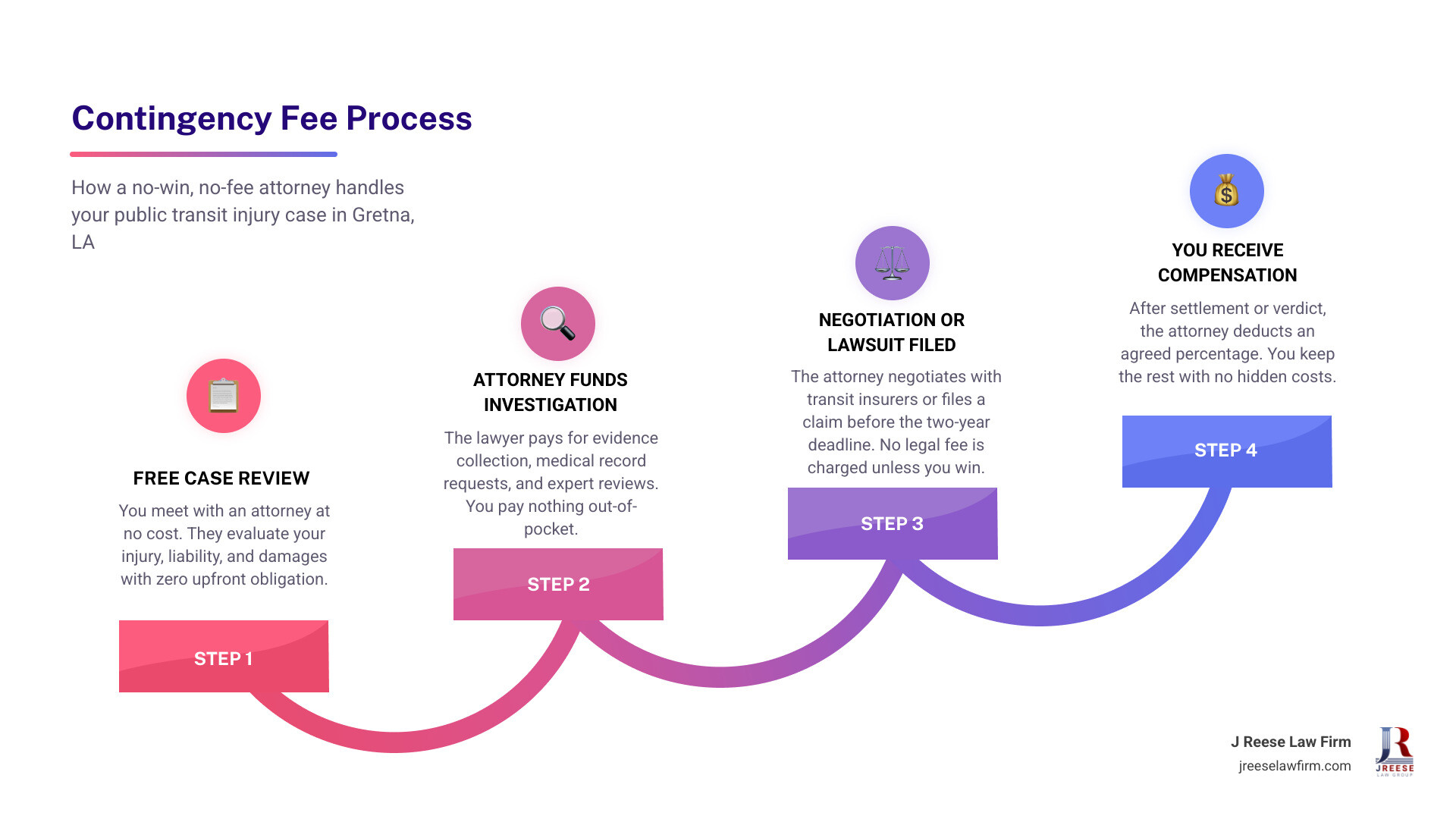
Navigating the aftermath of a public transit collision can be physically exhausting and financially overwhelming. When you are dealing with mounting hospital bills, prescription costs, and missed work, the thought of paying a lawyer by the hour sounds impossible. This is why we handle injury cases on a contingency fee basis.
Under a contingency fee agreement, you pay nothing upfront for legal representation. We fund the upfront investigation, court filings, depositions, and technical analyses required to build a solid claim. If we do not recover financial compensation on your behalf through a negotiated settlement or courtroom verdict, you do not owe us any attorney fees.
This model levels the playing field against municipal transit agencies, corporate bus contractors, and aggressive commercial insurance carriers. It ensures that every injured passenger, pedestrian, or driver has access to high-quality legal advocacy, regardless of their current financial standing. When you are looking into finding trusted personal injury representation, understanding how contingency fees work helps you make an informed decision without adding to your immediate financial stress.
| Feature | Contingency Fee Representation | Hourly Legal Billing |
|---|---|---|
| Upfront Retainer | $0 required to begin representation | Thousands of dollars required upfront |
| Ongoing Hourly Bills | None; no bills for phone calls, emails, or drafting | Invoiced bi-weekly or monthly regardless of outcome |
| Litigation Funding | Law firm advances all case and filing costs | Client typically pays court fees and expenses as they occur |
| Fee Due Date | Only collected when a settlement or verdict is won | Billed continuously, win or lose |
| Financial Risk | Borne primarily by the law firm | Borne entirely by the injured client |
How Contingency Agreements Protect Injured Transit Passengers
Public transit vehicles like buses and streetcars are legally classified as “common carriers” under Louisiana law. This classification means transit authorities owe their fare-paying passengers the highest degree of care. Despite this heightened standard, transit agencies often fight injury claims aggressively to shield public funds and maintain corporate safety records.
A contingency agreement provides essential protection for injured riders. Rather than draining your family’s savings to battle a municipality or private charter service, your legal team takes on the financial weight of the dispute. When the case successfully concludes, the attorney fees and advanced litigation costs are simply deducted directly from the final settlement or jury award.
This structure keeps your legal team’s incentives completely aligned with yours: we work diligently to maximize every category of damages available under Louisiana law, ensuring you receive the resources needed for your physical and financial recovery.
Evaluating Your Case with a No-Win No-Fee Attorney for Public Transit Injuries Gretna, LA
When you consult a no-win no-fee attorney for public transit injuries in Gretna, LA, the first objective is to perform a thorough, realistic evaluation of your claim. This assessment involves several key elements:
- Establishing Liability: Reviewing traffic collision reports, onboard surveillance video, black-box telematics, and maintenance records to pinpoint who was at fault.
- Assessing Injury Severity: Examining emergency room charts, MRI results, surgical recommendations, and rehabilitation projections to understand the true impact of the injury.
- Calculating Economic and Non-Economic Damages: Tallying current medical debt, projecting future treatment needs, calculating lost wages, and quantifying physical pain and emotional disruption.
- Addressing Comparative Fault: Analyzing whether Louisiana’s pure comparative fault rules apply, ensuring that any allegations of shared fault are strongly countered.
With over 15 years of dedicated courtroom experience and more than $10 million recovered for our injured clients across Greater New Orleans and the Westbank, we examine these factors from day one to build an airtight strategy.
Types of Public Transit Accidents and Liable Parties in Gretna
Public transit on the Westbank encompasses a range of municipal and regional systems. Gretna commuters frequently rely on the Jefferson Transit (JeT) system—such as the Gretna Local or Wilshire routes—as well as the New Orleans Regional Transit Authority (RTA) lines crossing over the Crescent City Connection.
Whether you were a passenger inside a bus, an occupant of another vehicle, or a pedestrian navigating busy streets, our firm helps clients pursue full personal injury compensation after transit accidents happen.
Common Transit Injury Scenarios: Sudden Stops, Collisions, and Pedestrian Strikes
Public transit vehicles operate in dense traffic, often creating dangerous scenarios:
- Sudden and Violent Braking: Bus drivers who follow too closely or fail to anticipate traffic patterns often slam on the brakes unexpectedly. Because public buses generally lack seatbelts, unrestrained passengers are violently tossed into metal handrails, bulkheads, or the floor, resulting in severe whiplash, fractured limbs, and head trauma.
- High-Impact Collisions on Major Arterials: High-density corridors like the Westbank Expressway (US-90 BUS), Stumpf Boulevard, and Belle Chasse Highway see frequent side-swipes, rear-end impacts, and T-bone collisions involving buses and smaller motor vehicles.
- Crosswalk and Bus Stop Pedestrian Strikes: Poor sightlines, distracted driving, or wide turns at busy Gretna intersections can lead to catastrophic pedestrian strikes at designated bus stops and marked crosswalks.
- Boarding and Alighting Incidents: Faulty pneumatic steps, broken handrails, oil-slicked entryways, and drivers pulling away before passengers are securely seated lead to painful falls. When slip and fall conditions occur, capturing pictures of the slippery substance or liquid on the floor and documenting the total absence of warning signs is critical to proving fault.
Identifying Liable Parties: Transit Authorities, Drivers, and Third Parties
Determining fault in a public transit accident requires looking beyond just the driver at the wheel. Multiple entities often share legal responsibility:
- Public Transit Authorities (JeT / RTA): As municipal or regional entities, they can be held liable for negligent hiring, improper operator training, and the negligent driving of their employees under Louisiana Civil Code Article 2320.
- Private Fleet and Maintenance Contractors: Municipalities frequently contract with private vendors to service brakes, tires, steering linkages, and onboard safety systems. Inadequate maintenance creates independent third-party liability.
- Negligent Third-Party Drivers: Often, a bus collision occurs because an impatient motorist cut off the bus or blew through a red light. In these situations, claims may involve private auto insurers, commercial truck carriers, or even rideshare collision policies if an Uber or Lyft driver caused the crash.
- Vehicle and Parts Manufacturers: Defective steering gears, failing airbrakes, or malfunctioning door sensors can result in product liability claims against equipment manufacturers.
Louisiana Laws, Prescriptive Periods, and Government Notice Requirements
Pursuing a claim against a public entity in Louisiana involves specific statutory rules. Unlike a standard car accident between two private motorists, transit cases involve municipal codes, common carrier statutes, and tight administrative prerequisites.
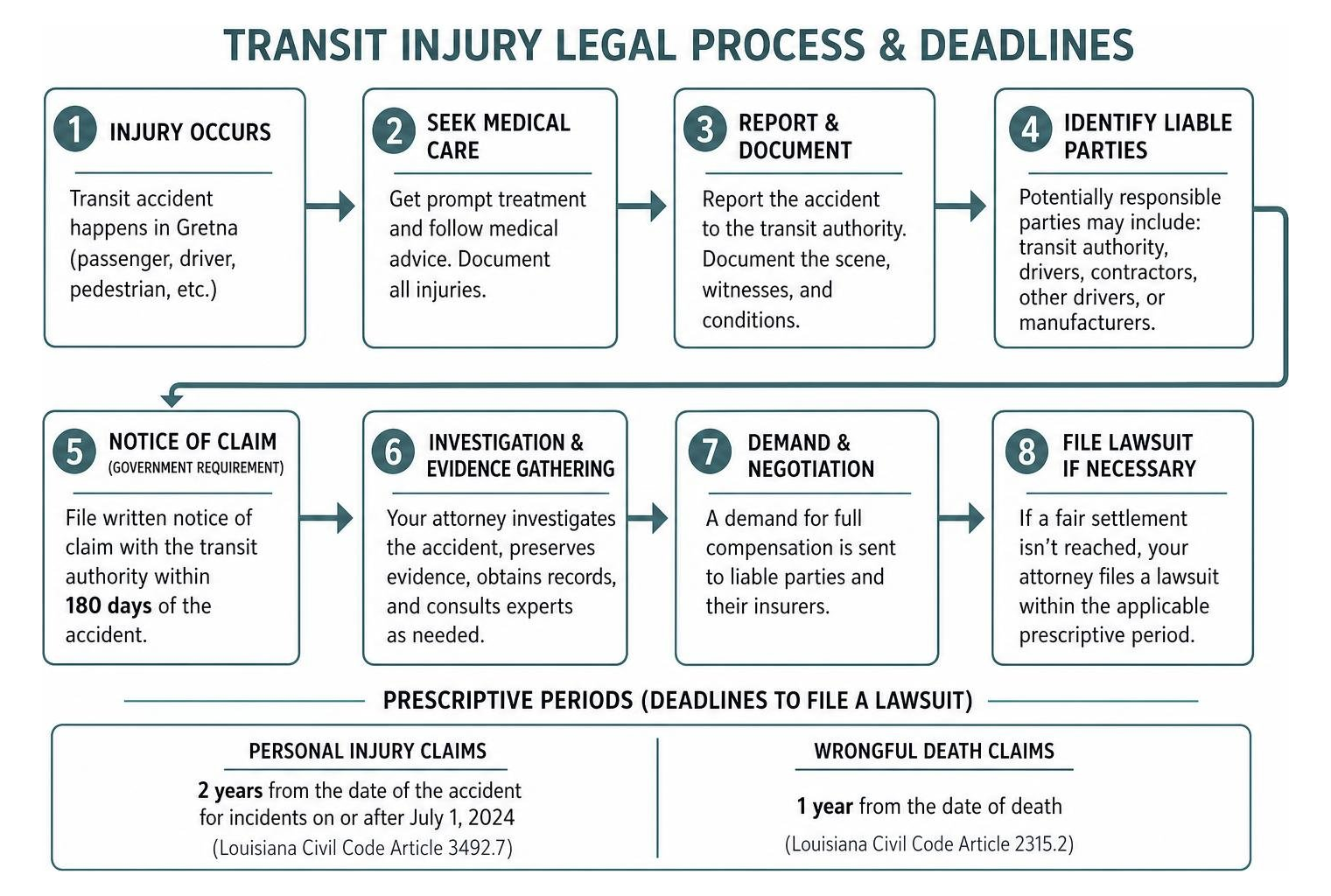
Louisiana Statutory Deadlines for Transit Injury and Wrongful Death Claims
Understanding statutory deadlines—known as “prescriptive periods” in Louisiana—is vital. If you miss the applicable deadline, your right to seek financial compensation in court is permanently lost:
- Personal Injury Claims: Under Louisiana law, a two-year prescriptive period applies to standard personal injury claims arising from accidents that occurred on or after July 1, 2024 (Louisiana Civil Code Article 3492.7).
- Wrongful Death Claims: If an accident tragically results in a fatality, the family’s prescriptive period to file a wrongful death lawsuit is strictly one year from the date of the person’s death under Louisiana Civil Code Article 2315.2.
- Survival Actions: Surviving family members also have one year from the date of death to seek recovery for the victim’s pre-death pain, suffering, and medical costs.
For more details on how timelines can shift across different transportation claims, review our guide on statutory filing deadlines in Gretna.
Navigating Strict Procedural Hurdles When Suing Government Entities
While the general prescriptive period gives two years to file a lawsuit in court, bringing a claim against municipal bodies such as Jefferson Parish, the City of Gretna, or the RTA requires clearing unique procedural hurdles.
Many public entities have administrative notice provisions requiring formal written notice of an injury claim within a few months of the incident. These notices must typically detail the exact date, time, location, nature of injuries, and circumstances of the incident before any formal lawsuit can be filed. Failing to serve this administrative notice properly can result in the swift dismissal of your claim. An experienced legal team ensures all statutory notices are drafted accurately and delivered on time.
Why Hire a No-Win No-Fee Attorney for Public Transit Injuries Gretna, LA
Public transit claims are heavily contested. Municipal risk management departments and private insurance carriers are backed by seasoned defense teams whose primary goal is to minimize payouts.

When you choose a contingency fee lawyer, you gain an advocate dedicated to building your case. We manage all communication with insurance adjusters, gather critical evidence before it can be deleted or lost, work with forensic reconstructionists, and prepare your case for trial. If you are researching how to move forward, review our advice on selecting an experienced personal injury attorney to ensure your legal team has the trial experience needed for complex transit claims.
When to Contact a No-Win No-Fee Attorney for Public Transit Injuries Gretna, LA
You should contact an attorney immediately following the collision. Public transit vehicles generate a vast amount of digital and physical evidence that must be formally preserved before routine system resets or maintenance repairs take place.
Contacting counsel right away allows for:
- Issuing immediate formal spoliation letters to preserve onboard multi-angle digital video footage.
- Securing bus Electronic Control Module (ECM) data, including speed, throttle position, and brake activation timing.
- Subpoenaing driver logbooks, shift logs, training records, and post-accident drug and alcohol screening results.
- Interviewing fellow transit passengers and witnesses before their memories fade or contact details change.
Recoverable Damages in Public Transit Injury Claims
A successful public transit injury claim can recover both economic and non-economic losses. Depending on the specifics of your accident, recoverable damages include:
- Past, Present, and Future Medical Expenses: Emergency room visits, diagnostic imaging (MRIs, CT scans), surgeries, physical therapy, and prescription medications.
- Lost Wages and Diminished Earning Capacity: Compensation for time missed from work, as well as the loss of future earning potential if you suffer permanent functional limitations.
- Physical Pain and Suffering: Compensation for the physical pain, chronic discomfort, and bodily trauma caused by the accident.
- Emotional Distress and Mental Anguish: Recovery for anxiety, depression, sleep disorders, and post-traumatic stress related to the collision.
- Loss of Enjoyment of Life: Damages awarded for your inability to participate in hobbies, family activities, and daily routines that you enjoyed prior to the incident.
- Property Damage: Repair or replacement costs for personal items damaged during the crash, such as cell phones, laptops, or personal vehicles.
Immediate Steps to Take After a Gretna Transit Accident
Taking the right steps immediately following a transit crash protects both your health and your legal claim. Follow these essential actions:
- Call 911 and Request Emergency Assistance: Ensure that local law enforcement (such as the Gretna Police Department or Jefferson Parish Sheriff’s Office) arrives to create an official accident report.
- Document the Bus and Route Information: Note the bus vehicle number, license plate, route name (e.g., JeT Westbank Express or RTA line), and the driver’s name or badge number.
- Photograph the Entire Scene: Take clear photos and videos of the transit vehicle, point of impact, vehicle positions, street conditions, traffic signals, and your visible injuries. If you slipped inside the bus, photograph the liquid or substance on the floor and capture the absence of any warning signs.
- Collect Witness Contact Information: Ask fellow passengers, motorists, and bystanders for their full names, phone numbers, and email addresses before they disperse.
- Seek Immediate Medical Attention: Go to an emergency medical facility, such as West Jefferson Medical Center or Ochsner Medical Center – West Bank, for a comprehensive physical evaluation. Some severe injuries, like internal bleeding or concussions, do not present immediate symptoms.
- Decline to Give Recorded Statements: Do not provide recorded statements or sign settlement releases for transit adjusters until you have spoken with your own lawyer.
Frequently Asked Questions About Transit Injury Claims in Gretna
How does a no-win no-fee structure work for a Gretna public transit injury claim?
Under a no-win no-fee (contingency) structure, you do not pay any upfront retainers or out-of-pocket legal fees. Your attorney advances the costs of investigating the crash, gathering medical records, hiring technical resources, and filing court pleadings. Legal fees and case expenses are only collected as an agreed-upon percentage of the final settlement or jury award if your case is successful. If no recovery is made, you owe zero attorney fees.
What is the deadline to file a lawsuit against JeT or RTA in Louisiana?
For injuries occurring on or after July 1, 2024, Louisiana provides a two-year prescriptive period to file a standard personal injury lawsuit in civil court. However, claims against municipal transit agencies like JeT or the RTA often require a formal administrative notice of claim within a much shorter timeframe (often within several months). For fatal collisions, wrongful death claims must be filed within one year from the date of the victim’s passing.
Can I recover compensation if I fell due to a sudden bus stop in Gretna?
Yes. Under Louisiana common carrier law, public transit operators owe passengers a high standard of care. If a bus driver accelerates aggressively, brakes unnecessarily hard, or drives distractedly—causing an unrestrained passenger to fall and suffer injuries—the transit authority can be held legally accountable for the resulting damages, subject to Louisiana’s comparative fault rules.
Partner with J Reese Law Firm for Your Transit Injury Claim
When a routine trip on public transit turns into a painful injury, you should not have to carry the financial burden alone. At J Reese Law Firm, we have spent over 15 years standing up for injured individuals across Gretna, New Orleans, and surrounding Southeast Louisiana communities.
Our team understands the specific operational rules, common carrier duties, and municipal regulations governing JeT and RTA transit operations. We advance all litigation costs and only get paid when we recover compensation for you. If you or a family member was injured on a public bus or struck by a transit vehicle, learn more about our work as a dedicated New Orleans personal injury lawyer and contact our team today for a free, confidential case review.