
When You Need a Nursing Home Sexual Abuse Lawyer
A nursing home sexual abuse lawyer can help protect a resident, preserve evidence, and pursue a civil claim against the person or facility responsible. If you suspect abuse, treat it as urgent: move your loved one out of immediate danger, seek medical care, report the concern to law enforcement and the proper state agencies, and document what you observe.
More than 1.5 million Americans live in nursing homes and assisted living facilities. Many residents depend on staff for daily care and may have dementia, communication limits, or physical disabilities that make it harder to report harm. Sexual abuse can leave physical injuries, deep emotional trauma, and lasting fear – and it can occur when a facility fails to screen, supervise, or respond to warning signs.
A lawyer can investigate records the facility controls, including staffing schedules, incident reports, surveillance footage, medical charts, and prior complaints. They can also help identify every party that may be legally responsible, not only the individual who caused harm.
I am Justin Reese, a Louisiana civil litigation and personal injury attorney who has represented people and families facing catastrophic harm and wrongful death since 2011. As a nursing home sexual abuse lawyer advocate, I bring trial experience, a background in felony prosecution, and a commitment to holding powerful institutions accountable.
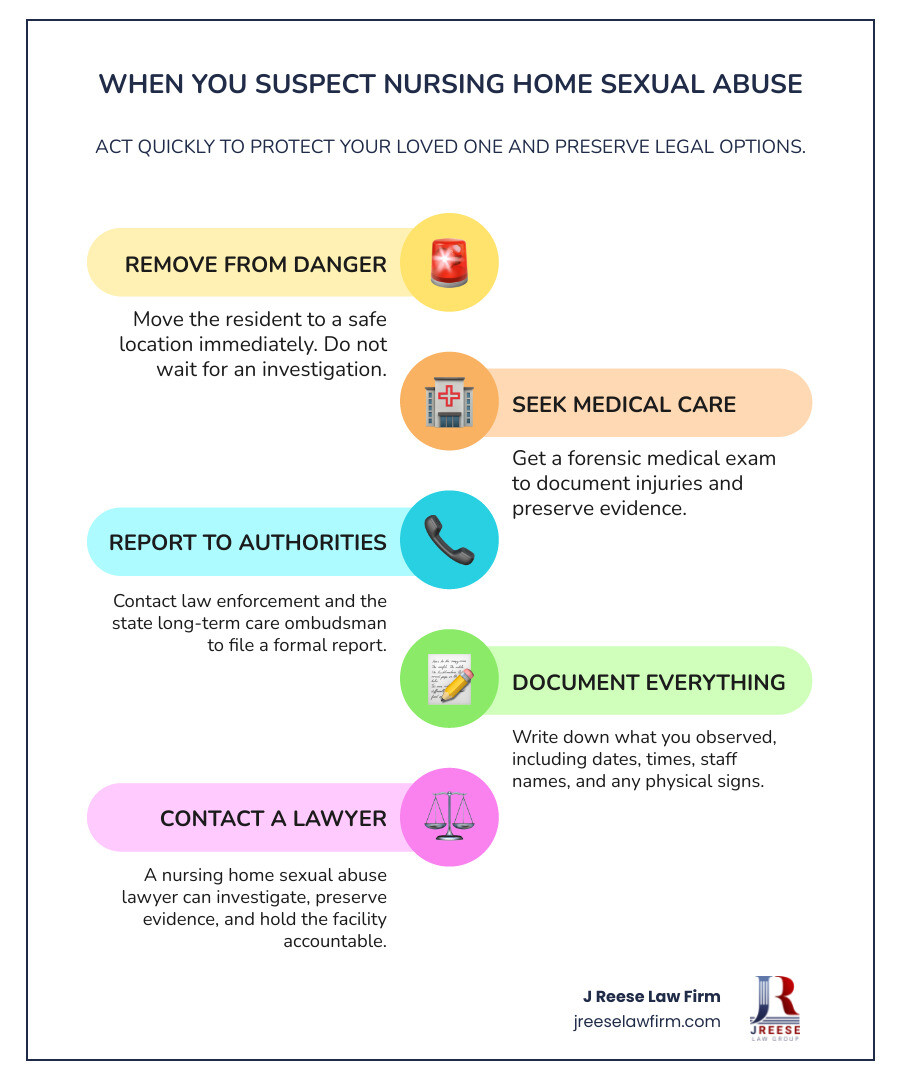
Must-know nursing home sexual abuse lawyer terms:
Understanding Nursing Home Sexual Abuse: Warning Signs and Liability

Placing a family member in a long-term care facility requires immense trust. We count on administrators, nurses, and certified nursing assistants (CNAs) to create a safe, supportive environment. Unfortunately, national data paints a sobering picture of systemic vulnerability across care facilities. Surveys show that one in three nursing homes has been cited for health and safety violations. Even more concerning, studies reveal that up to 50 percent of nursing home staff members have admitted to engaging in resident abuse or mistreatment, while 51 percent of CNAs admitted to yelling at residents.
When staffing shortages intersect with poor management, residents become targets for misconduct. Nursing home sexual abuse encompasses any non-consensual sexual contact, behavior, or exploitation directed at a resident. Because many residents live with cognitive decline, physical frailty, or speech impediments, perpetrators often operate under the cruel assumption that their actions will go unnoticed or unpunished.
Every resident retains strict fundamental rights to dignity, bodily autonomy, and freedom from mistreatment. Recognizing how assault manifests and identifying who should be held accountable are the first steps toward stopping ongoing harm.
Defining Sexual Assault in Long-Term Care Facilities
In long-term care settings, sexual assault and abuse cover a broad spectrum of non-consensual acts. These range from forced nudity and unwanted physical touching to explicit sexual assault, photography without consent, and verbal coercion.
Consent requires voluntary, uncoerced agreement from someone who possesses full cognitive capacity to understand the situation. A significant portion of nursing home residents live with Alzheimer’s disease, vascular dementia, or severe stroke-related deficits. Under the law, an individual who lacks cognitive capacity cannot legally consent to any sexual activity. Any sexual encounter between a caregiver and a cognitively impaired resident is strictly unlawful and constitutes severe abuse.
Furthermore, because of the profound power imbalance between care workers and vulnerable residents, sexual contact initiated by facility staff is prohibited under all circumstances. When facilities allow these boundaries to be broken, pursuing long-term care misconduct claims becomes necessary to secure justice.
Physical and Behavioral Red Flags Families Must Watch For
Victims of institutional abuse often feel deeply ashamed, afraid of retaliation, or physically incapable of communicating what happened. Consequently, family members are usually the first line of defense. Knowing what to look for can prevent prolonged suffering.
When visiting your loved one, pay close attention to the following physical indicators:
- Unexplained bruising around the inner thighs, hips, pelvic area, or upper arms
- Blood stains on clothing, undergarments, or bed linens
- Genital or anal bleeding, irritation, swelling, or unexplained torn tissue
- Newly diagnosed sexually transmitted diseases (STDs) or recurrent urinary tract infections
- Torn, stained, or missing clothing and undergarments
Behavioral shifts are equally critical to observe:
- Sudden emotional withdrawal, severe depression, or uncharacteristic silence
- Panic attacks, heightened anxiety, or extreme agitation around specific staff members or caregivers
- Frequent nightmares or night terrors
- Excessive fear during routine physical assistance, such as bathing, dressing, or repositioning
- Hesitancy or refusal to speak freely in front of facility workers
If you notice any of these signs, trust your instincts. Documenting these symptoms right away builds vital foundation work for any legal action.
Identifying Liable Parties in Nursing Home Misconduct
When an assault occurs inside a long-term care facility, liability rarely begins and ends with the individual perpetrator. While the abuser faces criminal prosecution and direct personal liability, the facility itself is frequently negligent in its duty of care.
Nursing home corporate owners and management companies owe residents a legal duty to maintain safe premises and protect them from foreseeable harm. Facilities can be held directly or vicariously liable for:
- Improper Background Checks: Hiring employees without thoroughly checking criminal registries, prior employment histories, or state disciplinary databases.
- Inadequate Staffing Ratios: Overworking employees or leaving units understaffed, which eliminates oversight and gives potential abusers unmonitored access to vulnerable residents.
- Negligent Supervision: Failing to monitor staff interactions, inspect living areas, or maintain functioning security systems.
- Failure to Report: Ignoring or covering up prior resident complaints, failure to report emergency room visits for abuse, or failing to notify law enforcement. State inspections repeatedly reveal cases where residents require emergency room care for assault, yet management fails to file required police reports.
By retaining comprehensive nursing home abuse representation, families can hold both the individual abuser and the corporate institution accountable.
How a Nursing Home Sexual Abuse Lawyer Can Help Your Case

Navigating an institutional sexual assault claim involves complex state health codes, medical evidence, and corporate defense strategies. Nursing homes and their insurance carriers move quickly to protect their reputations and minimize legal payouts. Retaining a dedicated legal representative levels the playing field.
Our legal team acts immediately to protect the resident’s rights, preserve critical evidence before it disappears, and conduct a thorough independent investigation. We work alongside medical practitioners, forensic investigators, and law enforcement to piece together what happened.
By partnering with a skilled legal team, you gain a fierce advocate who understands how facilities handle internal logs and regulatory audits. Learn more about hiring a nursing home abuse attorney to understand how professional legal representation transforms your position from defensive to proactive.
Key Qualities of an Effective Nursing Home Sexual Abuse Lawyer
Selecting the right legal advocate is one of the most important decisions a family can make following an institutional assault. Not all personal injury attorneys possess the experience required to handle sensitive institutional abuse claims.
When evaluating legal representation, look for these vital qualities:
- Trauma-Informed Compassion: Your legal team must approach every interaction with deep empathy, prioritizing the victim’s emotional comfort and dignity to prevent re-traumatization.
- Strong Investigative Capabilities: The ability to subpoena shift logs, personnel files, background checks, internal emails, and state survey reports is essential for uncovering corporate cover-ups.
- Trial Readiness: Insurance companies offer fair settlements only when they know a law firm is prepared to take a case all the way to a jury verdict.
- Clear Communication: Families deserve direct, honest updates regarding case milestones, legal strategies, and expected timelines.
Reviewing the key qualities of an elder neglect lawyer will help you select a team built to challenge powerful corporate nursing home networks.
Steps to Take Before Contacting a Nursing Home Sexual Abuse Lawyer
If you suspect your loved one has suffered sexual assault inside a long-term care facility, taking organized action right away protects their physical health and preserves vital legal evidence.
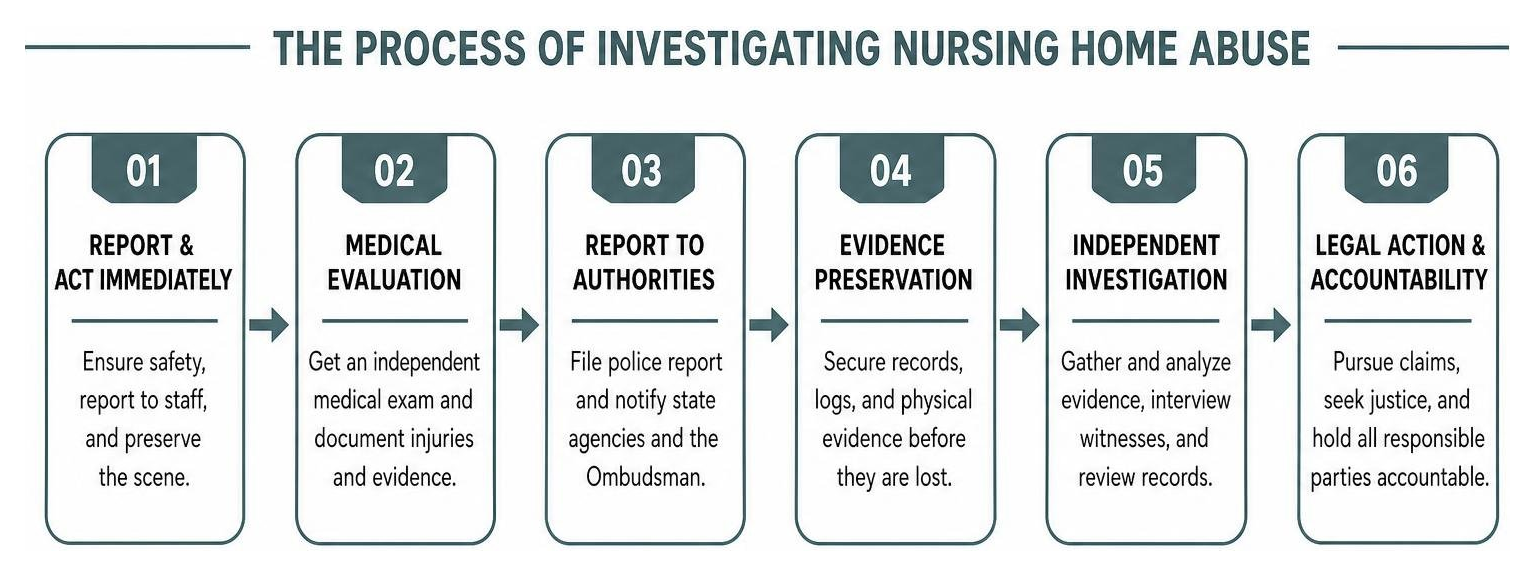
Follow these critical steps before and during your initial legal consultation:
- Ensure Immediate Safety: If your family member is in active danger, call 911 immediately. Request an urgent transfer to an independent hospital or safe facility.
- Obtain an Independent Medical Examination: Ensure the resident is evaluated by hospital staff or a certified forensic nurse examiner. A detailed medical exam documents physical injuries, collects DNA evidence, and tests for infections or STDs.
- Report to Law Enforcement and State Agencies: File an official police report. Report the incident to state regulatory health departments and the local Long-Term Care Ombudsman.
- Preserve Physical Evidence: Do not wash soiled clothing, bedding, or personal items. Store them safely in clean paper bags to preserve physical or biological evidence.
- Document Everything: Record dates, times, names of staff on duty, physical symptoms, behavioral changes, and statements made by your loved one or facility workers.
- Avoid Detailed Statements to Facility Insurers: Corporate risk managers may attempt to record statements or offer quick settlements. Do not give recorded statements or sign release forms until you consult legal counsel.
Legal Process: Evidence, Compensation, and Deadlines
Pursuing a civil claim for nursing home sexual abuse involves a structured legal framework aimed at proving liability and recovering full compensation for damages. While criminal proceedings focus on punishing the perpetrator with jail time, a civil lawsuit focuses on securing financial resources for the victim’s recovery, relocation, and ongoing care.
Civil claims operate independently from criminal charges. Even if prosecutors decline to file criminal charges due to a lack of proof beyond a reasonable doubt, a civil lawsuit can still succeed under the lower burden of proof known as the “preponderance of the evidence.”
Essential Evidence Needed to Prove Assault Claims
Proving institutional liability requires gathering documentary, physical, and testimonial evidence. Nursing home defense teams often argue that physical injuries resulted from routine falls or that behavioral shifts are natural symptoms of dementia progression. Overcoming these defense tactics requires objective proof.
Key evidence includes:
- Medical and Psychological Records: Clinical charts, emergency room evaluation records, forensic nursing exam results, photos of injuries, and notes from mental health counselors.
- Facility Staffing and Shift Schedules: Electronic timecards and shift logs that establish which employees were assigned to the resident’s room or unit when the incident occurred.
- Employee Personnel Files: Background check records, prior disciplinary actions, complaints from former staff or residents, and employee training verification records.
- State Inspection and Violation Surveys: Department of health survey reports citing the facility for safety infractions, understaffing, or past failures to report abuse.
- Surveillance and Visitor Logs: Hallway security video footage and visitor sign-in registries.
- Witness Statements: Depositions and written statements from co-residents, family members, whistleblowing staff members, or responding officers.
In complex claims, statements from nursing home administration consultants and medical professionals help demonstrate how the facility breached basic standards of care.
Recoverable Compensation and Settlement Valuations
The financial value of a civil claim depends on the severity of physical harm, the extent of psychological trauma, and the degree of corporate negligence involved. Compensation generally falls into two primary categories: economic damages and non-economic damages. In cases involving gross negligence or intentional cover-ups, punitive damages may also be awarded.
| Category of Compensation | Specific Expense / Harm Covered | Purpose of Legal Recovery |
|---|---|---|
| Economic Damages | Emergency room visits, forensic exams, ongoing therapy, specialized medical care, and relocation costs to a secure facility. | Reimburses direct, out-of-pocket financial losses resulting from the abuse. |
| Non-Economic Damages | Physical pain, severe mental anguish, loss of enjoyment of life, anxiety, post-traumatic stress, and emotional distress. | Provides financial recovery for non-monetary, personal suffering. |
| Punitive Damages | Awarded in court cases involving deliberate misconduct, malice, or gross institutional cover-ups. | Punishes the wrongdoer and deters other facilities from committing similar violations. |
Every case is unique, but looking at data on average nursing home settlement trends shows how comprehensive evidence directly influences financial recovery.
Frequently Asked Questions About Nursing Home Sexual Abuse
When families uncover sexual mistreatment inside a care facility, they face urgent questions about legal timelines, facility responsibility, and victim protection. Below are answers to common questions about filing an abuse claim.
What is the statute of limitations for filing a nursing home sexual abuse claim?
A statute of limitations is a strict legal deadline established by state law that governs how long a victim or family has to file a civil lawsuit. In Louisiana, personal injury claims, including long-term care abuse lawsuits, are subject to a strict one-year prescriptive period from the date of the injury or discovery of the harm.
Because legal deadlines vary significantly across states and depend on specific discovery rules, contacting legal counsel right away is critical. Failing to file before the deadline expires permanently forfeits your right to seek legal compensation in court.
Can a facility be held responsible if an individual staff member committed the assault?
Yes. Care facilities are legally responsible for harm caused by their employees through legal principles such as vicarious liability and direct corporate negligence.
A facility can be held directly liable if it failed to conduct mandatory criminal background checks, ignored prior complaints about an employee’s inappropriate behavior, failed to provide adequate staff supervision, or left facilities understaffed. Furthermore, if facility management attempted to conceal the incident or failed to report ER visits for abuse to local law enforcement, the facility faces serious institutional liability.
What should families do if they suspect immediate danger in a facility?
If you believe your loved one is in immediate physical danger, take these actions right away:
- Call 911 immediately to request law enforcement intervention and emergency medical transport.
- Contact the state department of health hotline and the local Long-Term Care Ombudsman to file an urgent institutional complaint.
- Arrange for immediate emergency transfer to a hospital or alternative care facility.
- Contact our legal team at J Reese Law Firm to initiate an independent investigation and safeguard your family member’s legal rights.
Taking a Stand for Your Loved One: How We Fight for Justice
Discovering that a vulnerable parent or family member has suffered sexual abuse in a care facility is heartbreaking. You placed your faith in an institution to keep them safe, only to have that trust shattered. You do not have to carry this heavy burden alone.
At J Reese Law Firm, we are committed to standing up for long-term care residents and holding negligent facilities accountable for their actions. We investigate corporate practices, expose security breakdowns, and pursue maximum financial compensation for victims and their families.
If you suspect your loved one has experienced harm, take immediate action. Contact our office today for a free, confidential case review. We will listen to your story, evaluate your legal options, and guide you through every step of the legal process.
For additional information on protecting your family and exploring your options, review our resources on working with a nursing home neglect attorney. Reach out to our team today—we are here to help you demand accountability and bring peace of mind back to your family.