
Why Is the Insurance Company Demanding Access to Your Entire Medical History?
When an insurance adjuster contacts you after a motor vehicle collision, they often sound polite, helpful, and accommodating. They might say, “We just need you to sign this standard medical authorization so we can gather your accident bills and process your settlement quickly.”
It sounds routine. But that document is almost never a standard, limited billing request. In most cases, it is a blanket medical authorization form granting the insurer unfettered access to your entire medical history—from your childhood vaccinations and psychological evaluations to gynecological exams and old athletic sprains.
You are under no legal obligation to hand over your lifetime medical records to an at-fault driver’s insurance company.
To understand why adjusters make these demands, you must understand the critical legal distinction between two types of insurance claims:
- Third-Party Liability Claims (e.g., Car Crashes, Slip and Falls): You are filing against another person’s insurance company because their negligence caused you harm. You have no contract with this insurer, owe them no contractual duties, and are not bound by policy cooperation clauses.
- First-Party Insurance Applications (e.g., Life, Disability, Health Policies): You are applying for coverage or filing a claim against your own policy. In underwriting scenarios, you enter a contractual agreement where the insurer evaluates actuarial risk before issuing a policy.
In a third-party personal injury claim, the claims adjuster does not demand your complete medical file to help you. They are conducting a fishing expedition.
Adjusters look for three specific vulnerabilities in your health background:
- Pre-Existing Conditions: If you suffered a lumbar herniation in a collision, the adjuster searches your records for any mention of lower back discomfort from five or ten years ago. They will use that note to argue your pain was already there and that the crash caused no new damage.
- Credibility Levers: Adjusters compare statements you made to your emergency room doctor against what you told the police officer or what you noted on intake forms. Any discrepancy becomes ammunition to question your honesty.
- Gaps in Treatment or Alternative Causes: If you missed a physical therapy visit due to work or mentioned feeling stressed about personal matters, the insurer uses that note to argue your pain stems from life stress rather than physical trauma.
Insurance companies train their adjusters to build defense files as early as possible. By securing an all-inclusive medical release before you retain legal representation, they capture sensitive information that can devalue or destroy your case.
Can an Insurance Company Legally Force You to Hand Over All Medical Records?
Under federal privacy statutes, specifically the federal health privacy standards under HIPAA, your healthcare providers cannot disclose your protected health information (PHI) to a third party without your express, voluntary, written consent.
An at-fault driver’s insurance carrier has no legal authority to subpoena your doctors, call your pharmacy for records, or demand your private chart without a signed release or a formal court order.
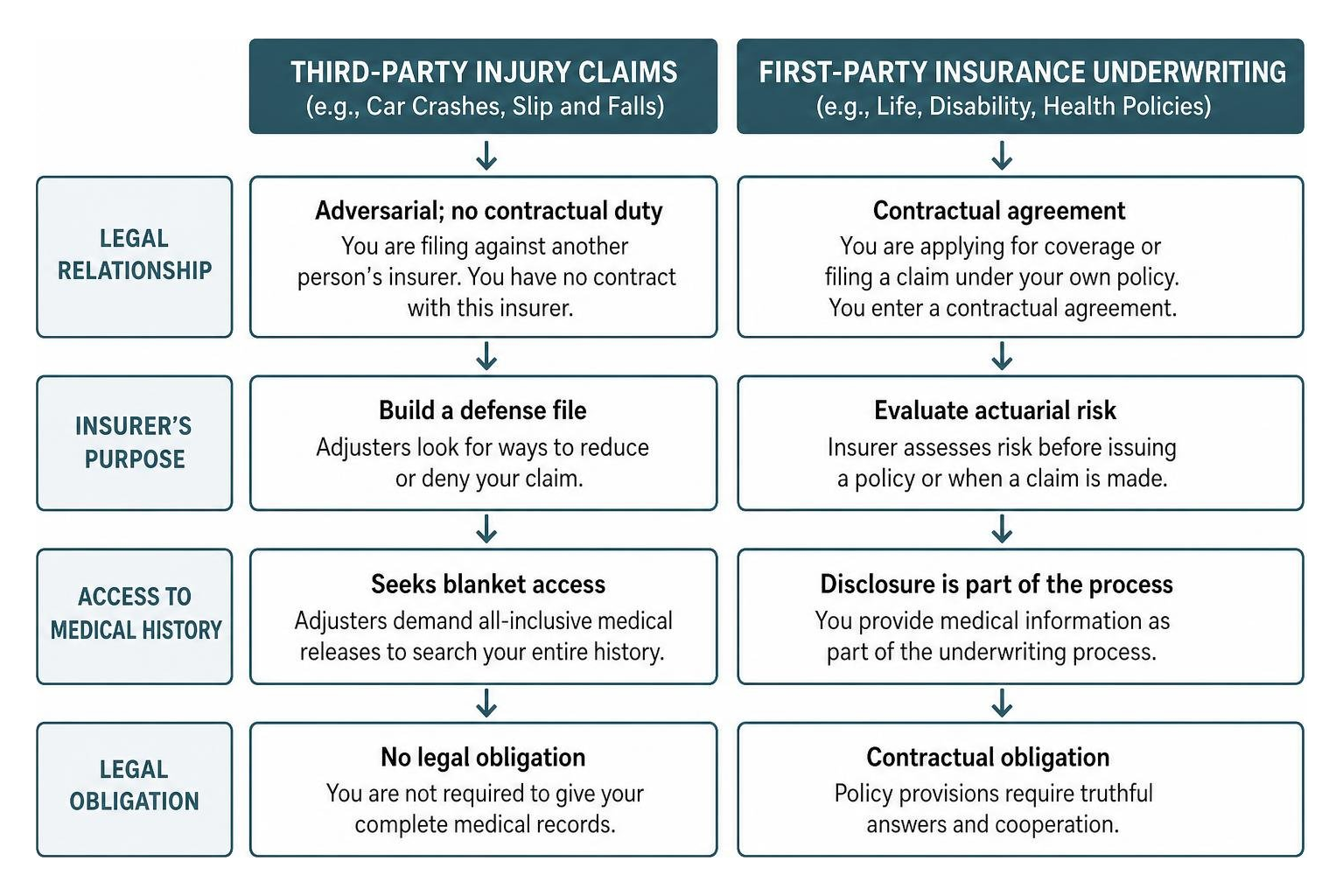
The legal dynamics change depending on whether you are negotiating an insurance claim pre-lawsuit or navigating formal court litigation:
| Request Category | Third-Party Auto Accident Claim | First-Party Life / Disability Underwriting |
|---|---|---|
| Legal Relationship | Adversarial; no contractual duty | Contractual agreement between insurer and applicant |
| Authority to Demand Records | None without written authorization or court subpoena | Condition of underwriting approval under application terms |
| Permissible Scope | Records directly relevant to crash-related injuries | Broad historical health profile (typically 5–10 years) |
| Consequence of Refusal | Insurer cannot search unrelated files; claim proceeds on submitted evidence | Insurer may decline policy coverage or deny application |
| Protected Health Data Access | Strictly limited to relevant body parts and dates | Broad underwriting review with signed consent |
When you file a personal injury lawsuit under Louisiana personal injury and litigation procedures, your health condition is put “at issue” regarding the specific injuries you claim. This allows defense counsel to request relevant medical records through formal discovery.
However, placing your physical injuries at issue does not waive your right to medical privacy regarding unrelated body parts, psychiatric treatment, or historical conditions that have no bearing on the collision. If a defense attorney issues an overly broad subpoena for your lifetime records, we file formal motions for protective orders to quash the request and keep irrelevant history out of the courtroom.
What Medical Information Are Insurers Actually Entitled to Review?
To settle an injury claim, an insurer is entitled to verify that you were injured and that your medical treatment was necessary and reasonably priced. That legitimate scope includes:
- Post-Accident Treatment Records: Emergency room reports, ambulance run sheets, physician notes, physical therapy charts, and surgical records generated from the date of the accident forward.
- Objective Diagnostic Imaging: X-rays, CT scans, and MRIs showing the acute trauma caused by the collision.
- Itemized Medical Bills and Billing Summaries: Proof of the financial expenses incurred for your crash-related care.
- Narrowly Tailored Prior Records: Historical records strictly limited to the specific body parts injured in the accident, typically covering a reasonable lookback window of 3 to 5 years.
If you suffered a broken wrist and a concussion in a t-bone crash, the insurer has no right to examine your reproductive healthcare records, your childhood medical history, dermatological visits, or unrelated surgeries. As personal injury attorneys, we curate and submit only the medical documentation necessary to prove liability and damages while shielding your private life.
What Are the Hidden Dangers of Signing a Blanket Medical Authorization Form?
Adjusters frequently send release forms containing sweeping language such as:
“The undersigned authorizes the release of any and all medical records, hospital records, pharmacy records, mental health records, and billing statements from any provider, for any condition, without limitation as to date or specialty.”
Signing a document with this type of language gives the insurance company a master key to your entire life story.
Here is what happens behind the scenes when an insurer receives an unrestricted authorization:
- They Request Records from Every Provider You Have Ever Seen: The insurer sends requests to regional hospital systems, family doctors, physical therapists, and diagnostic labs, accumulating hundreds of pages of irrelevant history.
- They Query Electronic Databases and Prescription Clearinghouses: Insurers use automated databases to run your name and Social Security number, pulling historical prescription fill records going back a decade or more.
- They Search the MIB Group Underwriting Database: If you ever applied for individual life, health, or disability coverage, the insurer cross-references codes maintained by the MIB Group to see what conditions were previously flagged.
- They Weaponize Minor Health Complaints: If you visited a doctor four years ago for temporary muscle soreness after yard work, the adjuster highlights that note to claim your current herniated disc was an existing degenerative issue.
- They Target Inconsistencies to Attack Your Integrity: If an intake note from seven years ago mentions occasional alcohol use or personal stress, adjusters attempt to use that information during settlement talks to discredit your pain and suffering claims.
Unrepresented claimants routinely forfeit thousands of dollars in compensation because they unknowingly signed these documents. Understanding these insurance practices is one of the key reasons insurance companies fear your soft tissue injury lawyer, as dedicated legal representation immediately blocks adjusters from accessing unrelated records.
What Extra Protections Apply to Sensitive Health Records?
Federal and state laws establish strict confidentiality firewalls for certain categories of health information:
- Psychotherapy Notes: Under HIPAA (45 CFR § 164.508(a)(2)), notes recorded by a mental health professional documenting private counseling sessions receive elevated protection. They cannot be released through a general medical authorization and require a distinct, standalone authorization form.
- Substance Use Disorder Treatment Records: Federal regulations under 42 CFR Part 2 strictly protect records created by federally assisted substance abuse treatment programs. A standard medical release cannot authorize the disclosure of these records; the release must explicitly reference 42 CFR Part 2 compliance.
- Genetic Information and Sensitive Diagnoses: The Genetic Information Nondiscrimination Act (GINA) and state privacy statutes prohibit the misuse of genetic test results, and many jurisdictions maintain heightened statutory protections for HIV/AIDS diagnosis and treatment documentation.
When an adjuster sends a blanket authorization, they hope you will sign away these statutory protections without realizing you have the legal right to withhold sensitive, unrelated care.
How Does the Eggshell Plaintiff Rule Protect You If You Have Pre-Existing Conditions?
One of the most common reasons insurers demand full medical histories is to locate pre-existing conditions and argue that the crash did not cause your pain. However, personal injury law protects victims through a longstanding legal doctrine known as the Eggshell Plaintiff Rule (or the “eggshell skull” doctrine).
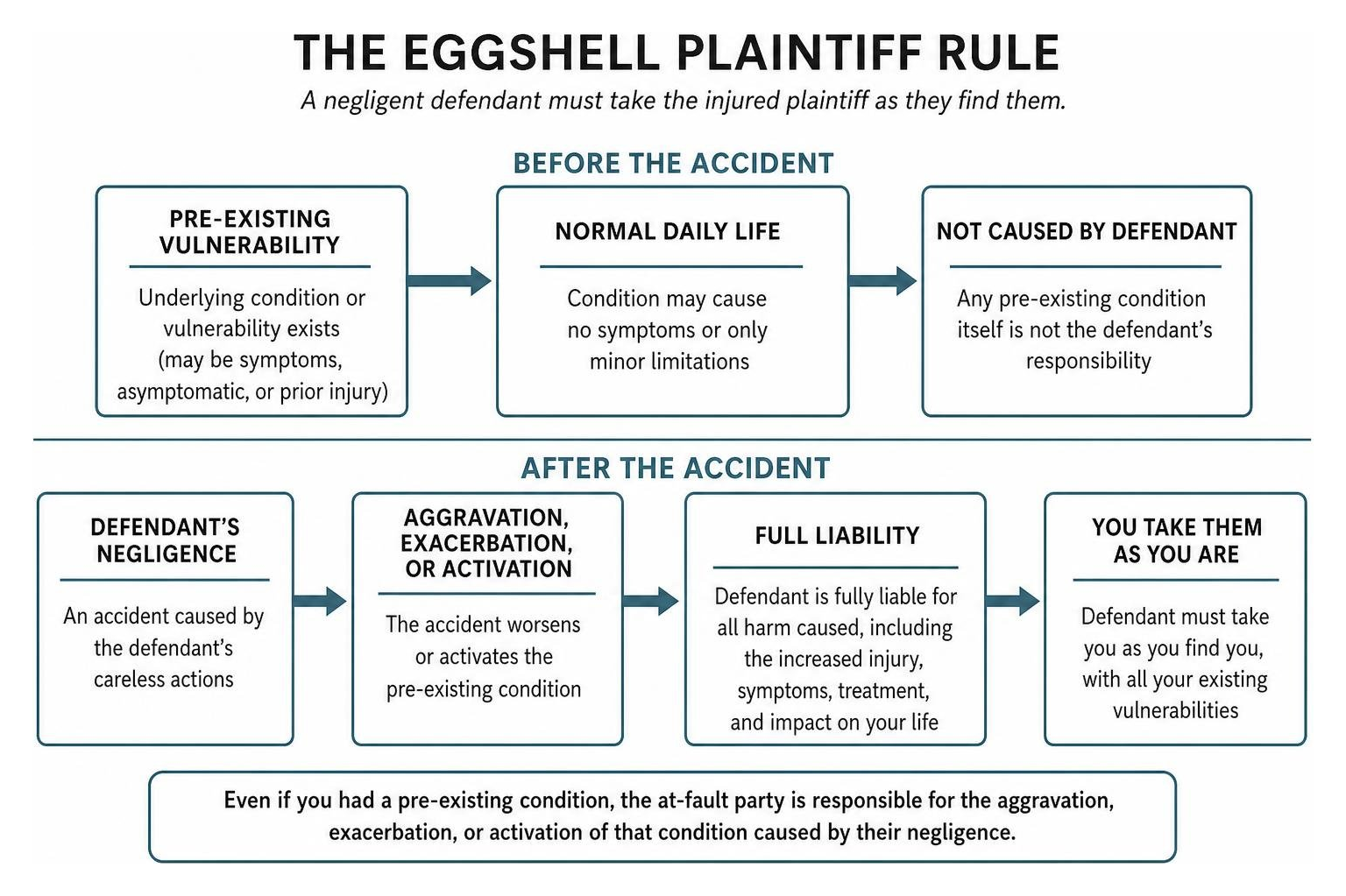
Under Louisiana law and general tort principles:
A negligent defendant must take the injured plaintiff as they find them.
This means that if you had an underlying vulnerability—such as asymptomatic degenerative disc disease, prior joint stiffness, or an old spinal injury—the at-fault party is fully liable for the aggravation, exacerbation, or activation of that condition caused by their careless actions.
Consider the practical difference between two scenarios:
- Scenario A (Unrepresented): A driver with mild, pain-free spinal degeneration is rear-ended. The collision ruptures the disc, causing severe nerve pain. The driver signs a blanket medical release. The adjuster finds a routine chiropractic visit from five years prior, labels the injury “pre-existing,” and offers a nominal settlement that barely covers the emergency room bill.
- Scenario B (Legally Protected): The same driver retains an attorney. We present objective baseline imaging, prior symptom-free records, and treating physician testimony demonstrating that while degeneration existed, the violent crash caused an acute, painful exacerbation. We hold the insurer legally accountable for the full extent of the aggravated injury.
Having a prior condition does not disqualify you from recovering substantial damages. By presenting curated, comparative medical evidence, we demonstrate the stark contrast between your pre-accident health and your post-accident limitations, allowing us to maximize financial compensation for car crash losses across New Orleans.
How Can You Limit and Control What Medical Records Are Disclosed to an Insurer?
You do not have to accept an insurance company’s release form as written. You have the right to modify, restrict, and tailor any authorization before signing—or provide your records directly through your attorney.
To understand the boundaries of what adjusters are permitted to see under federal standards, reviewing What Medical Records Do Insurance Companies Have Access To? provides helpful perspective on baseline privacy rights. Additionally, analyzing the legal boundaries outlined in Should I Release Medical Records to an Insurance Company? reinforces why uncontrolled disclosures harm claims.
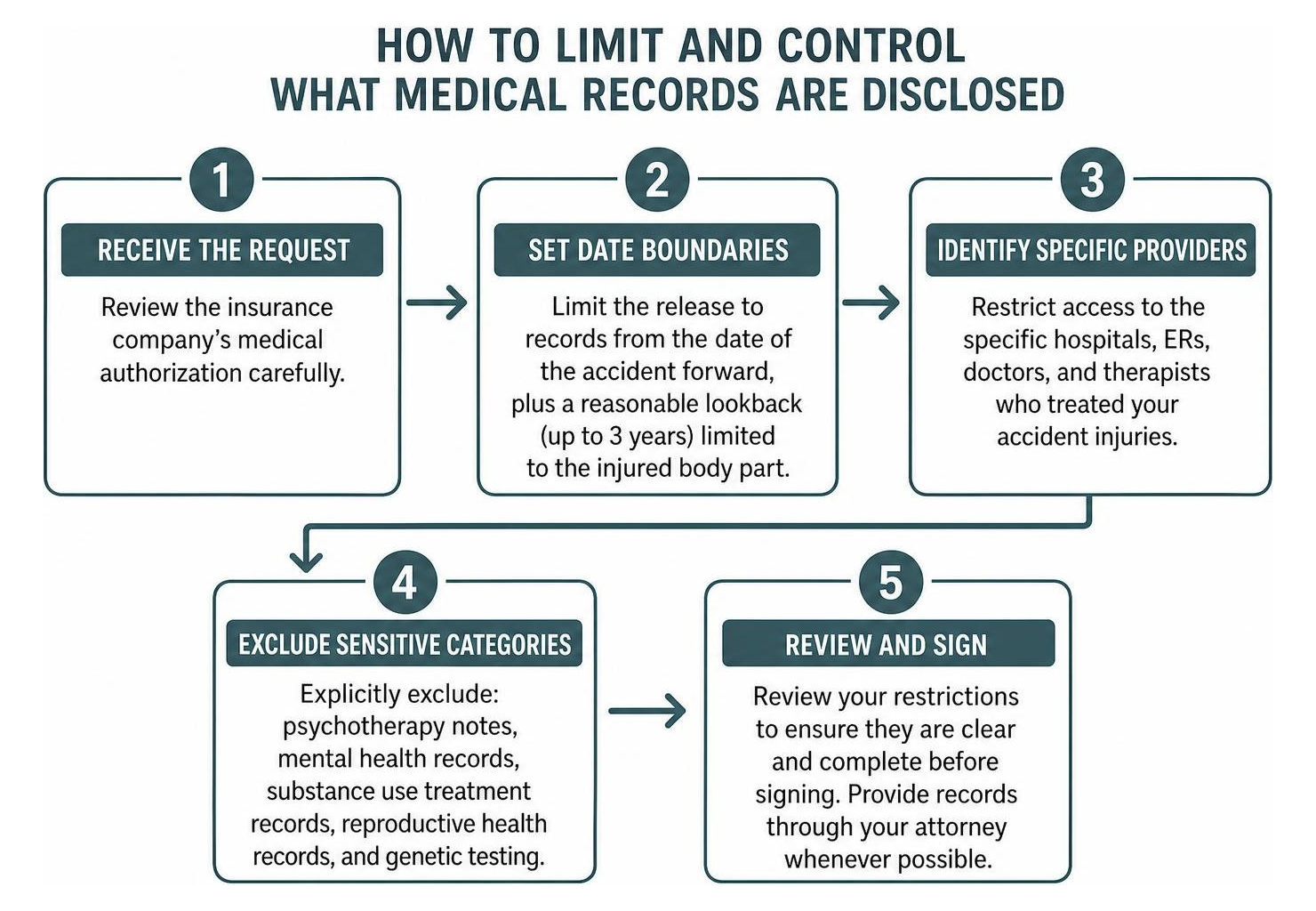
If you are evaluating a medical authorization request, apply these specific restrictions:
- Enforce Strict Date Boundaries: Cross out open-ended date language. Limit the release to records generated from the date of the accident forward, along with a reasonable lookback period (typically 3 years maximum) limited strictly to the injured body part.
- Identify Specific Healthcare Providers: Never permit access to “any and all healthcare providers.” Write in the specific names of the hospitals, emergency rooms, orthopedic doctors, or physical therapists who treated your accident injuries.
- Explicitly Exclude Sensitive Health Categories: Write clear exclusions directly on the form: “This authorization explicitly excludes psychotherapy notes, mental health records, substance use treatment records, reproductive health records, and genetic testing.”
- Set an Automatic Expiration Date: Standard forms often remain valid for one to two years. Limit the validity of the authorization to 60 or 90 days so the insurer cannot quietly retrieve updated charts months down the road.
- Exercise Your Right to Inspect Your Records First: Under HIPAA, you have the right to request, inspect, and review your complete medical records from your providers before anyone else sees them. If you spot administrative errors, mistaken diagnoses, or outdated entries, you can submit formal amendment requests under 45 CFR § 164.526 to correct the chart before release.
When we handle your case, we bypass the insurer’s release forms entirely. We collect your records directly, redact non-pertinent entries, organize the diagnostic proof, and submit a complete, airtight evidence package that proves your damages without exposing your personal life.
What Should You Do If You Have Already Signed a Broad Authorization Form?
If you already signed a blanket medical authorization form and sent it to the insurance company, do not panic. You have clear statutory rights to stop the insurer from continuing to pull your records.
Under the HIPAA Privacy Rule (45 CFR § 164.508(b)(5)), you have the legal right to revoke your medical authorization in writing at any time.
Take the following steps immediately to protect your remaining privacy:
- Draft a Formal Revocation Notice: Write a clear letter stating: “I hereby revoke, effective immediately, any and all medical record authorizations, HIPAA release forms, and disclosure permissions previously executed by me in connection with claim number [Your Claim Number]. No further disclosures of my protected health information are authorized.”
- Send via Certified Mail with Return Receipt Requested: Mail the revocation notice to the claims adjuster, the insurance carrier’s legal department, and every healthcare provider, hospital system, and pharmacy you have visited.
- Understand the Revocation Scope: A written revocation stops all future disclosures immediately. However, it does not legally force the insurer to return or destroy records they already retrieved while the authorization was active.
- Conduct a Records Audit: Demand an itemized list from the adjuster showing every medical provider they contacted and every record they obtained prior to the revocation.
- Retain Legal Representation: An experienced New Orleans car accident lawyer can file formal motions in court to exclude improperly obtained or irrelevant records from settlement negotiations and trial proceedings, refocusing the dispute where it belongs: on the at-fault party’s negligence and your crash-related injuries.
What Are the Most Frequently Asked Questions About Medical Record Requests?
Will My Claim Be Denied If I Refuse to Sign the Adjuster’s Medical Release?
Refusing to sign an at-fault driver’s blanket medical release form will not result in a valid denial of your personal injury claim. Because you have no contract with the third-party insurer, you are not bound by cooperation clauses that compel you to use their forms.
While you must provide credible medical evidence to prove your injuries and financial losses, you have the right to submit that evidence on your own terms through a tailored record submission. However, refusing to provide any medical documentation whatsoever would stall your claim, as insurers cannot evaluate damages without proof of injury.
How Far Back Can an Insurance Company Look into My Past Medical History?
In third-party personal injury claims, insurers are generally limited to reviewing prior records that are directly relevant to the body parts injured in the accident, typically covering a reasonable historical window of 3 to 5 years.
In contrast, if you are applying for a first-party life or disability insurance policy, underwriting questionnaires may lawfully ask for a 5- to 10-year health history based on contractual disclosure requirements. In personal injury cases, demands for lifetime medical records are overbroad and legally objectionable.
What Is the MIB Group and How Does It Affect My Medical Privacy?
The MIB Group (formerly known as the Medical Information Bureau) is a consumer reporting agency governed by the Fair Credit Reporting Act (FCRA). It maintains a secure, shared database of coded medical and underwriting information accessible by hundreds of life, health, and disability insurance companies.
When you apply for individually underwritten insurance, the company may query MIB to verify that your medical disclosures match prior applications. Under federal law, you are entitled to request one free copy of your MIB consumer file annually and submit formal disputes to correct any inaccurate medical codes in your file.
Take Control of Your Medical Privacy and Protect Your New Orleans Injury Claim
Navigating an insurance claim after a serious injury is challenging enough without adjusters prying into your confidential health history. Insurance companies use blanket medical record requests as a tool to shift blame, exaggerate pre-existing conditions, and minimize what they pay you.
When you work with J Reese Law Firm, we handle all communication with insurance adjusters. We immediately revoke overbroad authorizations, establish strict firewalls around your private health data, and curate comprehensive medical evidence that demonstrates the true physical and financial toll of your crash.
Knowing how to handle medical disclosures is an essential part of choosing the best personal injury attorney in New Orleans to represent your interests. We ensure that insurance companies treat you fairly, respect your statutory privacy rights, and pay every dollar you deserve for your injuries.
If an insurance adjuster is demanding your medical history or pressuring you to sign release forms, do not sign away your rights. Contact our team today for a free, confidential case review. We will examine the adjuster’s requests, protect your private medical records, and fight to secure the maximum compensation for your recovery.