
How a Soft Tissue Injury Lawyer Can Help Protect Your Claim
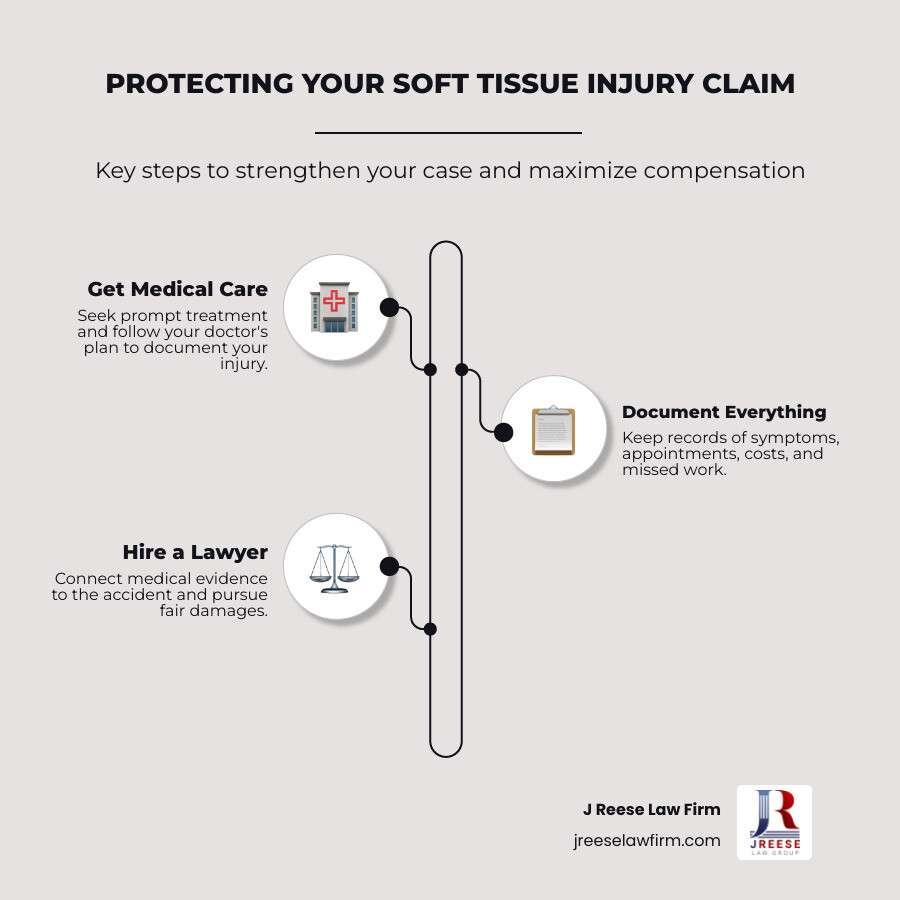
After a crash, fall, or other accident, hire a soft tissue injury lawyer if pain, limited movement, missed work, or ongoing treatment is affecting your life. To protect your claim:
- Get medical care promptly and follow the treatment plan.
- Keep records of symptoms, appointments, costs, and time missed from work.
- Do not accept a quick insurance offer before you know the full extent of your injury.
- Speak with a lawyer who can connect the medical evidence to the accident and pursue fair damages.
Soft tissue injuries include whiplash, sprains, strains, ligament damage, and muscle tears. They may not appear on an X-ray, but they can still cause serious pain and limit daily activities. Insurers often challenge these claims by pointing to a lack of fractures, delayed symptoms, treatment gaps, or a prior injury.
A well-documented claim can seek payment for medical bills, lost income, and pain and suffering. The rules and deadlines depend on where the accident happened, so early legal advice matters.
I am Justin Reese, a Louisiana and Texas attorney who has handled civil litigation and personal injury cases since 2011, including auto collisions and serious injury matters. As a soft tissue injury lawyer, I use clear medical records, careful case preparation, and trial-focused advocacy to help injured people make informed decisions about their claims.
Simple guide to soft tissue injury lawyer terms:
Understanding Soft Tissue Damage and Why Insurers Undervalue Claims
Soft tissue injuries involve damage to muscles, ligaments, tendons, and myofascial structures. Unlike broken bones, these injuries do not show up on routine X-ray imaging. Common conditions include cervical sprains, lumbar strains, whiplash, rotator cuff tears, and disc herniations pressing against spinal nerves.

Because ligaments and muscles are pliable, violent forces stretch them beyond their normal limits. Micro-tears, severe inflammation, and chronic spasms follow. For trusted guidance, turning to a seasoned car accident lawyer New Orleans residents trust helps ensure that these invisible injuries are properly evaluated and documented from day one.
Common Accidents Causing Soft Tissue Trauma
Soft tissue trauma happens across a wide variety of unexpected incidents:
- Rear-End Collisions: The sudden transfer of momentum whips the neck back and forth, resulting in cervical strain, torn ligaments, and disc herniations.
- Slip and Fall Incidents: Falls on slick surfaces create abrupt, twisting impacts. When dealing with injuries from dangerous property conditions, filing a premises liability claim requires clear documentation. For any fall, gather photographic proof immediately: take clear photos of the substance or liquid on the floor, note whether any warning cones or “wet floor” signs were missing, and record the exact lighting conditions.
- Commercial Vehicle Crashes: Due to the sheer weight and force of 18-wheelers, working with an experienced New Orleans truck accident attorney is critical for documenting severe spinal damage.
- Pedestrian and Bicycle Accidents: Direct impact with a vehicle throws victims to the ground, tearing shoulder tendons and knee ligaments.
The Challenge of Undervalued Soft Tissue Damages
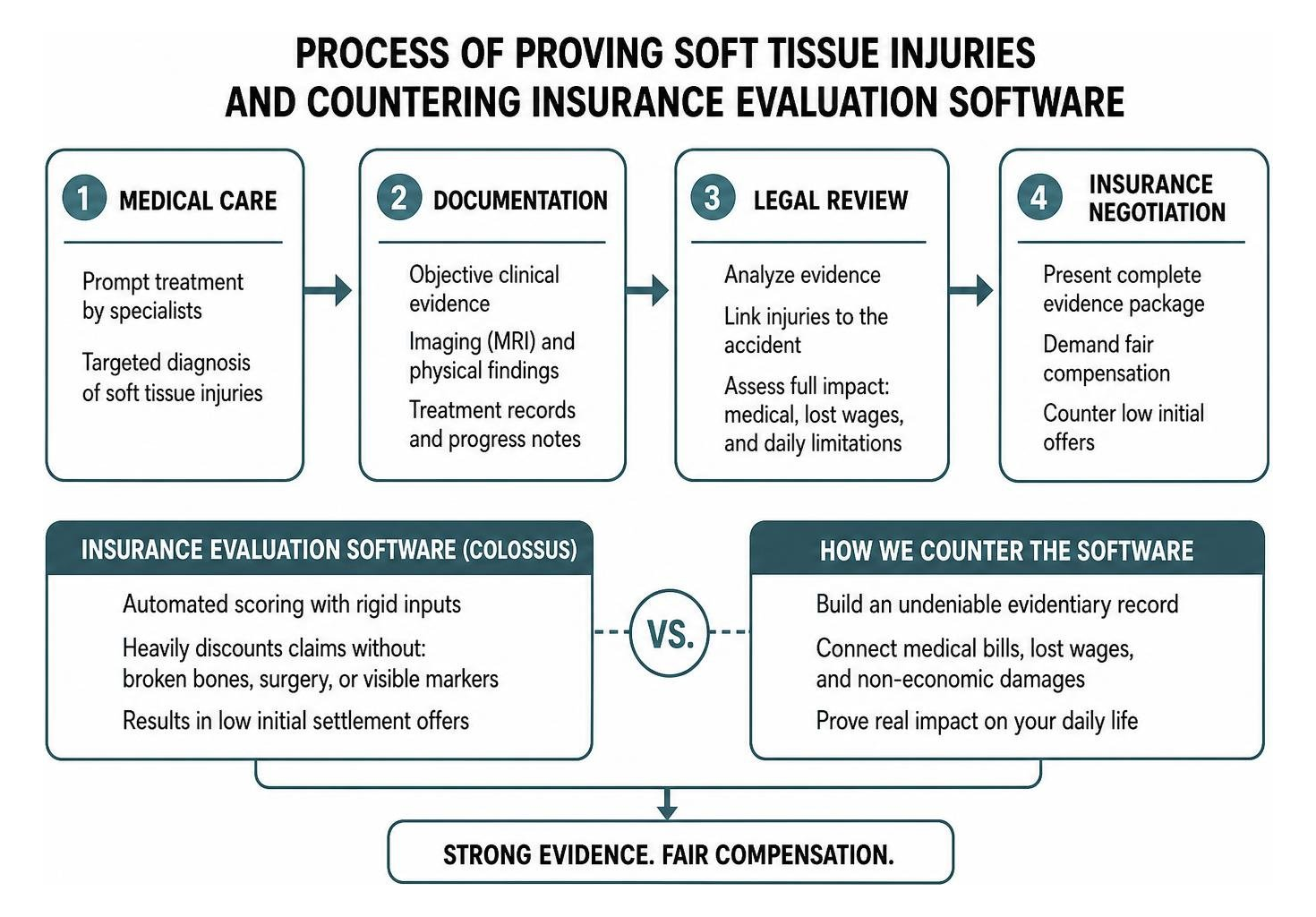
Insurance companies routinely rely on claims evaluation software like Colossus to calculate initial settlement offers. These automated systems score claims based on rigid inputs, heavily discounting any case lacking broken bones, emergency room surgery, or visible physical markers.
To maximize your financial compensation for car crash losses across New Orleans, we build an undeniable evidentiary record. We connect medical bills, lost wages, and non-economic damages directly to your daily physical limitations.
Essential Medical Evidence and Legal Thresholds Across Jurisdictions
Proving soft tissue injuries requires objective clinical evidence that translates your subjective pain into legally undeniable facts. The following evidence types establish the severity of your injuries:
| Medical Evidence Type | Diagnostic Purpose | Legal Impact on Claim |
|---|---|---|
| Goniometric ROM Testing | Measures precise degrees of joint and spinal restriction | Provides objective, quantifiable proof of physical limitation |
| Magnetic Resonance Imaging (MRI) | Visualizes soft tissues, disc bulges, and tendon tears | Disproves claims that the injury is merely a temporary strain |
| Electromyography (EMG/NCV) | Evaluates nerve conduction and identifies radiculopathy | Proves radiating nerve damage caused by spinal disc compression |
| Physical Therapy Logs | Tracks functional progress, strength deficits, and pain | Demonstrates consistent treatment and validates recovery time |
State Legal Thresholds and Fault Systems
Legal systems treat soft tissue claims differently depending on jurisdiction. In no-fault states like New York, victims must satisfy a “serious injury threshold” under statutory categories (such as significant limitation, permanent consequential limitation, or the 90/180-day category) to pursue non-economic damages.
In states governed by tort law and comparative fault principles:
- Comparative Fault: In Texas, modified comparative fault bars recovery if you are 51% or more at fault, while Louisiana applies pure comparative fault principles.
- Filing Deadlines: Adhering to strict statutory deadlines is essential; review Louisiana’s one year statute of limitations to avoid losing your right to recovery.
Managing Pre-Existing Conditions and Aggravations
Insurers frequently argue that soft tissue symptoms stem from age-related wear, prior accidents, or pre-existing degenerative disc disease. Under the established “eggshell plaintiff” doctrine, a defendant must take the victim as they find them. A negligent driver or property owner remains fully responsible for aggravating a dormant or stable condition. We obtain your baseline medical records and work with treating physicians to isolate the new trauma caused by the crash.
Step-by-Step Guide: How a Soft Tissue Injury Lawyer Protects Your Claim

Navigating a contested injury claim requires a methodical approach to prevent insurers from minimizing your losses. Utilizing proven 5 ways New Orleans car accident attorneys maximize your payout, we handle every step of the legal process.
How a Soft Tissue Injury Lawyer Counters Lowball Insurance Tactics
Insurance companies employ well-rehearsed strategies to deny or devalue soft tissue claims:
- Defense Medical Examinations (IMEs): Insurers hire third-party doctors who spend minutes evaluating you before drafting reports that minimize your injuries. We cross-examine these examiners, expose their financial ties to the defense, and highlight contradictory treating records.
- Exploiting Treatment Gaps: If you delay seeing a doctor due to busy schedules or family obligations, adjusters claim you were not truly hurt. Understanding why Louisiana personal injury cases are different enables us to explain treatment pauses using contemporaneous physician notes.
- Recorded Statements: Adjusters often call shortly after an accident hoping you will make casual remarks like “I’m doing okay.” We manage all communications so you avoid costly misstatements.
Critical Steps When Hiring a Soft Tissue Injury Lawyer for Your Case
When selecting legal representation, take the following actions:
- Evaluate Track Record and Experience: Review past verdicts and client satisfaction ratings. Learn how to choose the best personal injury attorneys in New Orleans LA to find an attorney equipped for courtroom litigation.
- Verify Contingency Fee Representation: Ensure your legal team operates on contingency, meaning you owe nothing unless compensation is recovered on your behalf.
- Schedule a Free Case Evaluation: Meet with J Reese Law Firm to review your medical reports, insurance policies, and legal options.
Frequently Asked Questions About Soft Tissue Claims
How long do I have to file a soft tissue injury lawsuit?
Statutory deadlines vary by state. In Texas, you generally have two years from the accident date, whereas Louisiana civil claims are subject to strict prescriptive periods. Missing the deadline permanently bars you from seeking financial recovery.
Can I recover compensation if my symptoms appeared days after the crash?
Yes. Adrenaline surges immediately after an accident frequently mask pain, stiffness, and inflammation. Symptoms from soft tissue damage often emerge 48 to 72 hours later. The key is seeking professional medical evaluation as soon as symptoms arise so the diagnosis connects directly to the event.
What is the 90/180-day rule in soft tissue injury cases?
In threshold jurisdictions, the 90/180-day rule allows victims without permanent disabilities to recover pain and suffering damages if they can prove their injury prevented them from performing substantially all daily activities for at least 90 out of the 180 days following the accident.
Secure Full Value for Your Soft Tissue Injury Claim
Soft tissue injuries can disrupt your daily routine, impact your career, and cause long-term physical discomfort. Insurance carriers rely on computer algorithms and quick settlement offers to minimize these claims, but you do not have to fight them alone.
At J Reese Law Firm, we provide attentive legal advocacy to ensure your medical bills, lost income, and pain are fully recognized. If you were injured in a collision or fall, contact a dedicated New Orleans car accident injury lawyer today for a free, comprehensive case review.