Immediate Steps to Protect Your Commercial Truck Accident Claim
When an 80,000-pound commercial vehicle collides with a standard passenger car, the immediate aftermath is chaotic and disorienting. Taking calculated actions in the minutes, hours, and days following an incident protects both your physical recovery and your legal standing.
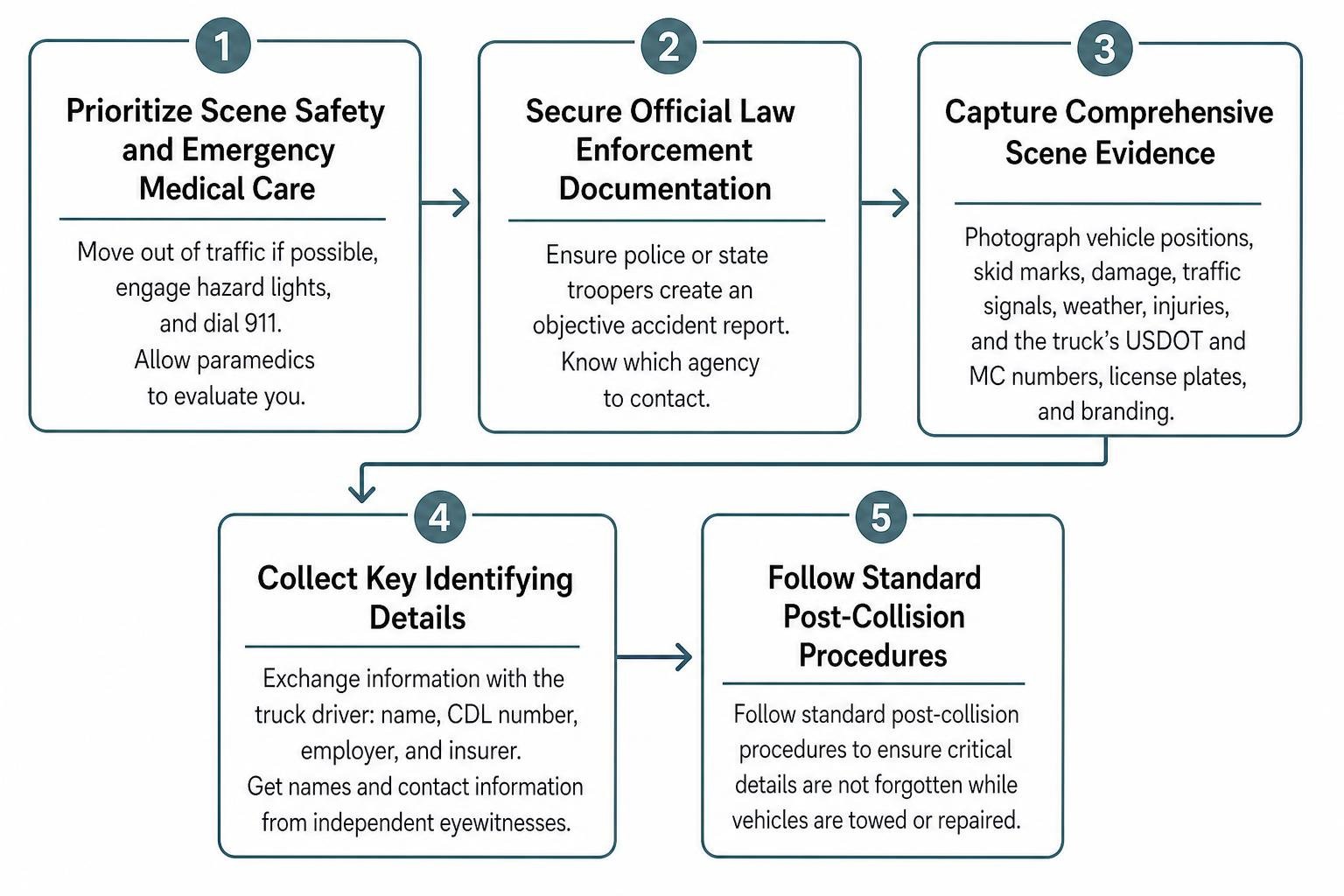
- Prioritize Scene Safety and Emergency Medical Care: Your health is the absolute priority. Move out of active traffic lanes if possible, engage hazard lights, and dial 911 immediately. Even if your injuries seem minor at first, allow paramedics to evaluate you. High-impact collisions frequently produce hidden injuries, such as internal bleeding, herniated discs, or concussions, that manifest hours or days after the adrenaline fades.
- Secure Official Law Enforcement Documentation: Ensure local police or state troopers dispatch to the crash site to create an objective accident report. In Jefferson Parish, understanding who investigates an 18 wheeler crash on Westbank Expressway or local roadways ensures you know precisely which agency to contact for the completed collision report.
- Capture Comprehensive Scene Evidence: If you can safely move around, photograph vehicle positions, skid marks, broken vehicle components, traffic signals, weather conditions, and visible injuries. Pay close attention to the truck itself: photograph its USDOT and MC registration numbers, license plates on both the cab and trailer, and any corporate branding.
- Collect Key Identifying Details: Exchange information with the truck driver, noting their full name, commercial driver’s license (CDL) number, employer name, and commercial liability insurer. Gather names, phone numbers, and addresses from any independent eyewitnesses before they leave the scene.
- Follow Standard Post-Collision Procedures: Following these crucial steps for your big rig accident claim ensures critical details are not forgotten while vehicles are towed or repaired.
Critical Evidence Required for a Commercial Truck Accident Claim
Unlike standard passenger car wrecks where fault is proven primarily through police reports and driver statements, trucking litigation relies heavily on specialized digital and corporate records. Much of this evidence resides exclusively in the possession of the motor carrier and is governed by strict document retention cycles.
- Electronic Logging Device (ELD) Data: Under Federal Motor Carrier Safety Administration (FMCSA) rules, commercial carriers must track driver duty status electronically. However, under 49 CFR 395.8(k), drivers are only required to retain the current day plus the preceding seven days of logs in the cab. Carriers maintain backup logs for only six months under 49 CFR 395.22(i) unless formally ordered to preserve them.
- Event Data Recorder (Black Box) Telematics: Modern semi-trucks contain electronic control modules that record speed, braking application, steering angles, throttle position, and engine RPMs in the seconds immediately preceding a collision.
- Driver Qualification Files (DQFs): Federal regulations mandate that trucking companies maintain detailed records for every driver, including initial background checks, CDL verifications, annual driving record reviews, and medical examiner certifications.
- Pre-Trip and Post-Trip Inspection Reports: Inspection logs reveal whether the driver conducted mandatory safety checks on brakes, tires, lighting, and coupling devices prior to getting on the road.
- Maintenance and Repair Invoices: Comprehensive maintenance histories expose deferred repairs, worn brake pads, uneven tire wear, or skipped diagnostic checks.
- In-Cab and Forward-Facing Dashcam Footage: Video recordings offer undeniable objective proof of driver behavior, lane discipline, and road conditions leading up to impact. Many systems overwrite footage within days or weeks.
To prevent the destruction or routine digital overwriting of these critical materials, a lawyer must issue a formal spoliation of evidence letter to the motor carrier, their insurance underwriters, and all third-party maintenance contractors immediately.
Costly Mistakes That Can Weaken Your Case
Commercial trucking insurers frequently dispatch rapid-response defense teams to crash sites to gather evidence and build arguments that limit their financial exposure. Injured claimants often make unintended missteps that severely damage their position:
- Giving Recorded Statements to the Trucking Insurer: Adjusters are trained to ask leading questions designed to elicit statements minimizing your injuries or admitting partial fault. Politely decline to provide recorded statements until you have consulted legal counsel.
- Accepting Premature Settlement Offers: Insurance carriers often present quick check offers before the injured party has reached Maximum Medical Improvement (MMI). Accepting an early settlement permanently waives your right to seek additional compensation if you later require unexpected surgery or prolonged physical therapy.
- Delaying or Discontinuing Medical Treatment: Gaps in treatment provide defense attorneys with ammunition to argue that your injuries were caused by an unrelated event or were not severe enough to warrant ongoing care.
- Posting on Social Media Platforms: Defense investigators routinely monitor social media accounts. Even an innocent photograph of you attending a family gathering can be used out of context to argue you are not genuinely in pain.
- Admitting Fault or Apologizing at the Scene: Simple polite remarks like “I’m sorry, I didn’t see you” can be recorded in police notes as an admission of legal liability.
How Commercial Truck Collisions Differ From Standard Car Accidents

Commercial vehicle collisions cannot be handled like typical passenger car claims. A loaded commercial tractor-trailer can weigh twenty to thirty times more than a standard passenger vehicle, generating tremendous kinetic energy upon impact and often causing severe, life-altering trauma.
| Comparison Factor | Standard Passenger Car Claim | Commercial Truck Accident Claim |
|---|---|---|
| Vehicle Mass & Weight | ~3,000 to 4,500 lbs | Up to 80,000 lbs (20–30x passenger car) |
| Governing Regulations | Basic state motor vehicle laws | Extensive federal rules (FMCSA, 49 CFR) & state laws |
| Potentially Liable Parties | Individual negligent driver | Driver, carrier, cargo loader, broker, maintenance shop, manufacturer |
| Minimum Insurance Mandate | State minimums ($15k–$25k typical) | $750,000 to $5,000,000+ federal statutory minimums |
| Available Digital Evidence | Basic physical damage, cell records | ELD logs, black box data, telematics, DQF files, maintenance logs |
| Defense Strategy | Single insurance adjuster review | Corporate rapid-response teams, corporate defense counsel |
The financial stakes in commercial collisions are substantial. According to data from the American Transportation Research Institute (ATRI), average trucking verdicts increased by 967% between 2010 and 2018, with the median nuclear verdict against motor carriers reaching $36 million in 2022. Because insurance carriers face massive exposure, they defend these claims with significant resources. For a complete procedural breakdown of civil claims, review this resource on Truck Accidents: Who to Sue and How to File.
Identifying Liable Parties Across the Freight Chain
In a standard collision, liability generally falls on the at-fault driver. In commercial transportation, however, liability often extends across multiple corporate entities within the shipping and logistics chain:
- The Commercial Driver: Directly liable for operational negligence, such as distracted driving, speeding, tailgating, or impaired driving.
- The Motor Carrier (Trucking Company): Held vicariously liable under the doctrine of respondeat superior for the negligent acts of employee drivers. Carriers are also directly liable for corporate negligence, including negligent hiring, inadequate driver training, and pressuring drivers to violate federal regulations when a truck driver was over his hours before a crash.
- Third-Party Cargo Loading Contractors: If cargo shifts during transit due to improper blocking, bracing, or overweight loading, the third-party facility that packed or sealed the trailer may share direct liability.
- Maintenance and Repair Vendors: Independent mechanic shops contracted to service steering, brakes, and tires are liable when mechanical failure stems from shoddy repair work.
- Freight Brokers and Logistics Companies: When a freight broker hires an unsafe or unvetted motor carrier with a history of safety violations, they can be sued under theories of negligent selection.
- Vehicle and Component Manufacturers: If a catastrophic tire blowout or air brake failure results from a manufacturing or design defect, the parts manufacturer is subject to product liability claims.
Even when corporate entities are based outside Louisiana, state long-arm statutes allow victims to sue an out of state trucking company in Gretna if the company operates within interstate commerce and causes injury on local roadways.
Federal Insurance Mandates and Multi-Layered Coverage
To ensure adequate financial recovery for severe injuries, federal law establishes mandatory minimum liability insurance limits for commercial motor vehicles operating in interstate commerce:
- Non-Hazardous Freight Carriers: Must carry at least $750,000 in public liability and property damage coverage.
- Oil and Petroleum Carriers: Must maintain at least $1,000,000 in primary liability coverage.
- Hazardous Materials and Toxic Cargo Carriers: Required to maintain at least $5,000,000 in financial responsibility.
Large motor carriers frequently operate with layered insurance structures, utilizing a primary auto liability policy, secondary excess liability layers, and commercial umbrella policies reaching $10 million to $25 million in total coverage. Navigating these layered policies requires identifying every applicable policy to ensure full recovery for catastrophic losses.
Step-by-Step Gretna Road Map to Securing Compensation
Recovering full financial compensation requires building a comprehensive, fact-based claim that accounts for every economic and personal loss you have suffered. The National Safety Council estimates that the average work injury needing medical care cost $48,000 in 2024, counting wage losses, medical bills, and administrative costs across all industries—and catastrophic highway collision expenses often reach far higher figures.
Understanding the mechanics of a Gretna big rig accident settlement involves calculating both current and future damages:
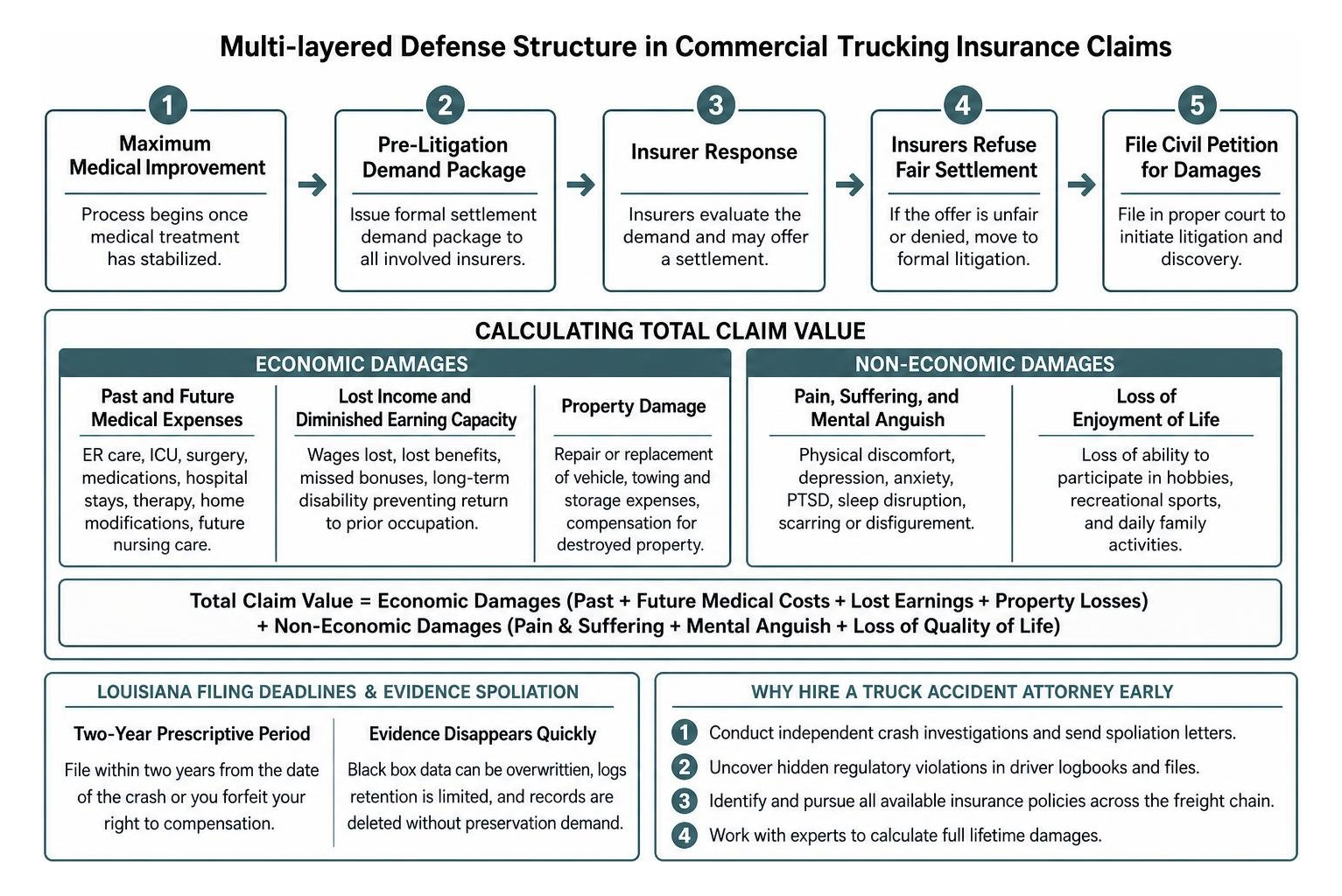
- Past and Future Medical Expenses: Emergency room care, intensive care, surgical interventions, prescription medications, hospital stays, physical therapy, home modifications, and future specialized nursing care.
- Lost Income and Diminished Earning Capacity: Base wages lost while out of work, lost benefits, missed bonuses, and compensation for long-term disability that prevents you from returning to your prior occupation.
- Property Damage: Repair or replacement of your vehicle, towing and storage expenses, and compensation for destroyed personal property.
- Pain, Suffering, and Mental Anguish: Physical discomfort, depression, anxiety, post-traumatic stress, sleep disruption, and permanent physical scarring or disfigurement.
- Loss of Enjoyment of Life: The loss of your ability to participate in hobbies, recreational sports, and daily family activities.
The process begins with issuing a formal pre-litigation settlement demand package to all involved insurers once you have reached Maximum Medical Improvement. If the insurers refuse to offer a fair settlement, your lawyer will file a formal civil petition for damages in court, initiating the formal litigation and discovery phase. For step-by-step guidance on establishing proper claim value, consult this resource on How to Get a Fair Settlement in Your Truck Accident Case.
Louisiana Filing Deadlines and Evidence Spoliation
Time is a critical factor in truck accident claims. In Louisiana, personal injury lawsuits are governed by a strict legal prescriptive period (statute of limitations). Historically set at one year, recent legislative revisions have established a two-year prescriptive period from the date of the crash for personal injury claims arising on or after July 1, 2024. If you fail to file a formal petition in the proper court before this deadline expires, you permanently forfeit your right to pursue compensation.
However, waiting until the deadline approaches is dangerous. Commercial trucking evidence disappears quickly:
- Black box event data can be overwritten the next time the truck is driven.
- Drivers are only required to retain logs for limited periods.
- Dispatch records, sensor telematics, and video footage are frequently deleted under routine document destruction policies unless a formal preservation demand is in place.
Reviewing these Legal Steps After A Truck Accident (2026) underscores why securing critical records immediately after a wreck is essential.
When to Hire an Attorney for a Commercial Truck Accident Claim
Managing a high-stakes truck collision claim against experienced corporate claims adjusters without legal representation places injured victims at an extreme disadvantage. Commercial claims require in-depth knowledge of both state tort law and federal motor carrier safety standards. To better understand how the commercial claims process unfolds from the insurance perspective, see How Trucking Insurance Claims Work: Step-by-Step From Accident to Settlement | RMS Truck Insurance and this Commercial Trucking Insurance Claims Guide: What to Do After an Accident or Loss | Anvo Insurance.
There are 7 critical reasons to hire a truck accident attorney in Gretna early in your case:
- Conducting independent crash investigations and sending formal spoliation letters.
- Uncovering hidden regulatory violations in driver logbooks and qualification files.
- Identifying and pursuing all available insurance policies across the freight chain.
- Working with independent collision analysts, medical professionals, and economists to calculate full lifetime damages.
- Handling all correspondence with aggressive insurance defense teams to protect you from damaging mistakes.
- Managing court filing deadlines, legal pleadings, and formal discovery depositions.
- Operating on a contingency fee basis, meaning you pay no upfront legal fees, and attorney fees are deducted only as an agreed-upon percentage of the final recovery.
Frequently Asked Questions About Commercial Truck Claims
How long does a commercial truck accident case take to resolve?
Simple property damage claims with undisputed liability can occasionally resolve within two to six weeks. However, claims involving severe bodily injuries typically require anywhere from six months to over two years to conclude. The timeline depends on:
- The duration of your medical treatment and the time required to reach Maximum Medical Improvement.
- The number of corporate defendants and insurance policies involved.
- Whether liability or the extent of your injuries is disputed.
- Whether the case settles through pre-litigation negotiations or proceeds through formal court discovery and trial.
What should I do if the trucking insurer blames me for the crash?
It is common for commercial adjusters to attempt to shift blame onto passenger vehicle drivers. Louisiana operates under a pure comparative fault system (La. Civ. Code art. 2323). Under this rule, your total financial recovery is reduced by your assigned percentage of fault, but you are not barred from recovering damages even if you share partial responsibility.
If an insurer claims you caused or contributed to the crash, do not accept their determination. An attorney can subpoena black box data, gather traffic camera footage, and consult independent collision analysts to refute the insurer’s claims.
How is pain and suffering calculated in heavy truck collisions?
Non-economic damages do not come with receipts, so insurance adjusters and courts typically use one of two calculation methods:
- The Multiplier Method: Total economic losses (medical bills and lost wages) are multiplied by a number typically ranging from 1.5 to 5, depending on injury severity, pain level, permanent impairment, and overall disruption to your life.
- The Per Diem Method: A daily monetary rate is assigned and multiplied by the number of days you are expected to suffer from the physical and emotional effects of your injuries.
Severe injuries such as traumatic brain injury, spinal cord damage, compound fractures, or chronic nerve pain justify higher calculation rates because they alter your daily living permanently.
Secure Proven Advocacy for Your Commercial Truck Injury Claim
Commercial truck accident claims require swift, methodical action to preserve electronic evidence, navigate complex federal transportation regulations, and hold well-funded motor carriers accountable. When you are dealing with painful injuries, mounting medical bills, and lost wages, you should not have to face aggressive corporate insurance teams alone.
At J Reese Law Firm, we have extensive experience standing up to national freight carriers and their insurers to protect the rights of injured victims throughout Gretna, Jefferson Parish, and the greater New Orleans region. We conduct thorough independent investigations, preserve critical fleet telematics before they are deleted, and build compelling claims designed to secure the full compensation you deserve.
If you or a loved one has suffered injuries in a collision with an 18-wheeler, semi-truck, or commercial delivery vehicle, do not wait for the trucking company’s evidence to disappear. Contact an experienced New Orleans truck accident attorney today to schedule a confidential, no-obligation case evaluation and start building your claim.