When to Call a Louisiana Bicycle Accident Lawyer in New Orleans — and Why It Matters
If you need a Louisiana bicycle accident lawyer, here is what you should know right now:
| What You Need to Know | Quick Answer |
|---|---|
| Who can help you? | A personal injury lawyer who handles bicycle accident cases in Louisiana |
| When to contact one | As soon as possible after the crash — before speaking to any insurance company |
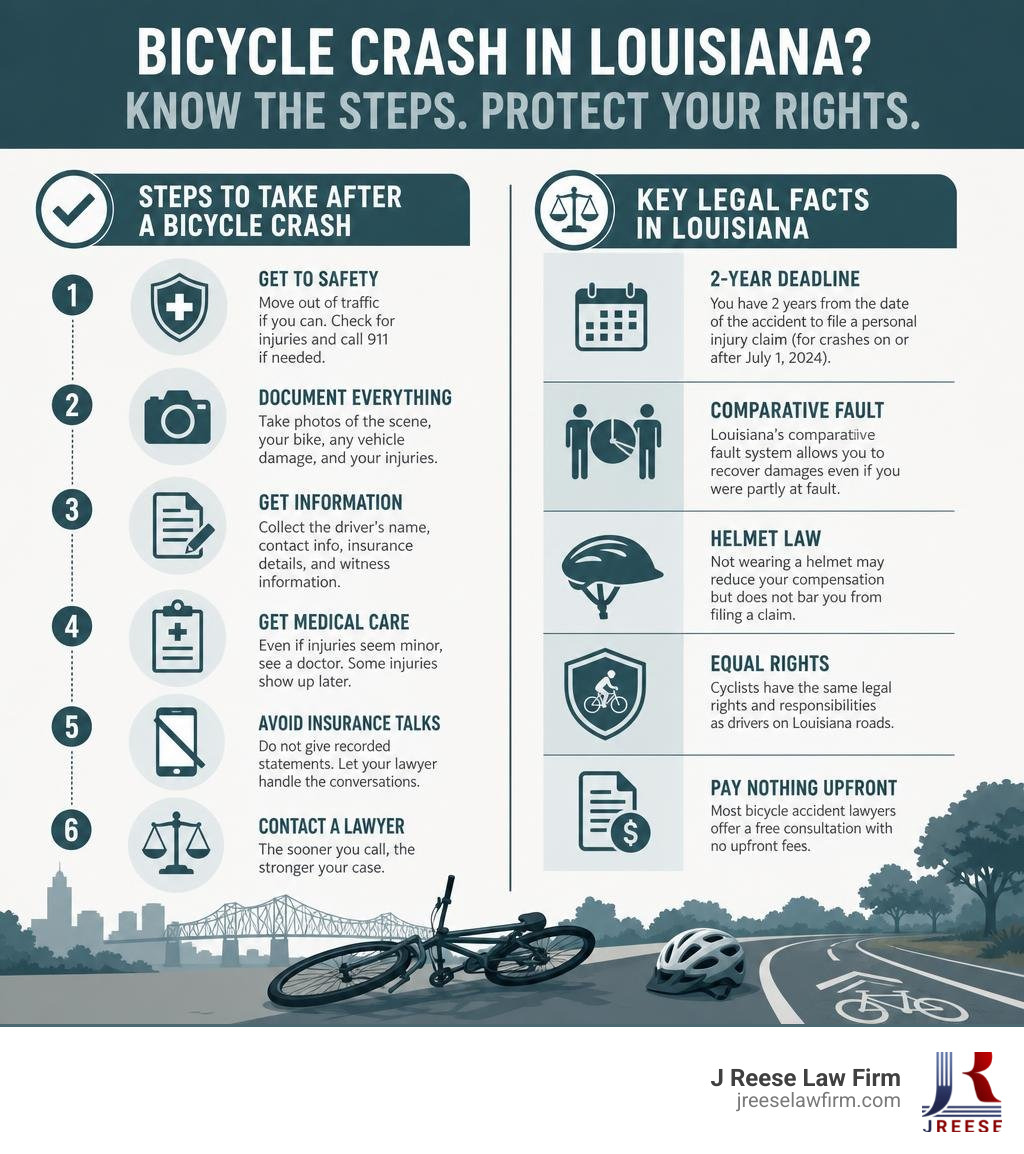
| How long do you have to file? | 2 years from the date of the accident (for crashes on or after July 1, 2024) |
| Can you recover damages if partly at fault? | Yes — Louisiana’s comparative fault system allows partial recovery |
| Does not wearing a helmet hurt your case? | It may reduce your compensation but does not bar you from filing a claim |
| Cost to get started | Most bicycle accident lawyers offer a free consultation with no upfront fees |
Louisiana is one of the most dangerous states in the country for cyclists. In 2023 alone, 35 cyclists were killed on Louisiana roads — and hundreds more were seriously injured. Behind every one of those numbers is a real person dealing with medical bills, lost income, and a long road to recovery.
Cyclists have the same legal right to the road as drivers in Louisiana. But when a crash happens, insurance companies rarely treat them that way.
That gap between your legal rights and what insurers actually offer you is exactly where a bicycle accident lawyer makes the difference.
I’m Justin Reese, a New Orleans-based civil litigation and personal injury attorney with over a decade of experience recovering tens of millions of dollars for injury victims across Louisiana — including those harmed in bicycle crashes where a Louisiana bicycle accident lawyer was the difference between a denied claim and full compensation. If you or someone you love has been hurt on a bike, this guide will walk you through everything you need to know to protect your rights and pursue the recovery you deserve.
Louisiana Bicycle Accident Lawyer: Understanding Your Rights on the Road
When you pedal through the vibrant streets of New Orleans or travel the scenic routes of southern Louisiana, you are not just a pedestrian on wheels. Under state law, a bicycle is legally recognized as a vehicle. This means you have the exact same rights—and the exact same responsibilities—as the driver of any car, truck, or SUV sharing the asphalt.

Unfortunately, many motorists fail to respect these rights. To combat this, state legislation has introduced specific vulnerable road user protections. The most notable of these is the three-foot passing rule, which legally requires motorists to maintain a minimum of three feet of clearance when passing a cyclist. If a driver squeezes past you too closely and causes you to crash, they have broken the law and can be held fully liable for your injuries.
Understanding how these rules apply to your specific situation is the first step toward securing justice. To explore how state-level rules protect your physical and financial recovery, you can read our comprehensive guide on finding a Bicycle Accident Lawyer Louisiana.
Why You Need a Louisiana Bicycle Accident Lawyer After a Crash
You might wonder if you can handle a bicycle accident insurance claim on your own. Technically, you can—but doing so often puts you at a severe disadvantage.
Insurance companies are notorious for harboring a deep-seated bias against cyclists. Adjusters frequently rely on outdated stereotypes, painting riders as reckless daredevils who weave through traffic and ignore stop signs. They will use any excuse to shift the blame onto you so they can protect their bottom line.
Furthermore, bicycle accidents rarely result in minor bumps and bruises. Without the protective steel cage of a motor vehicle, cyclists absorb the direct force of the impact. This leads to catastrophic, life-altering injuries, such as:
- Traumatic brain injuries (TBIs) and severe concussions
- Spinal cord damage and paralysis
- Multiple bone fractures and joint dislocations
- Severe road rash requiring skin grafts
- Internal organ damage and internal bleeding
When you are dealing with intense physical pain and a mountain of medical bills, the last thing you need is the stress of fighting an aggressive insurance adjuster. By securing a dedicated New Orleans Bike Accident Lawyer, you gain an advocate who understands the legal landscape, handles all communications on your behalf, and fights to protect your rights while you focus on healing.
Key Louisiana Traffic Laws for Cyclists and Motorists
To build a rock-solid injury claim, it helps to understand the specific laws governing both cyclists and motorists in Louisiana. Here are the key regulations you should know:
- Helmet Requirements: Louisiana law only mandates helmet use for riders under the age of 12. If you are an adult, wearing a helmet is highly recommended for safety, but you cannot be ticketed for riding without one.
- Sidewalk Riding: Riding a bicycle on a sidewalk is generally regulated by local municipal ordinances. In New Orleans, sidewalk riding is discouraged and, in many commercial districts, strictly prohibited. Cyclists are expected to use designated bike lanes or ride on the street.
- Lane Positioning: Cyclists are required to ride as close to the right-hand edge of the roadway as is safely practicable. However, you are legally permitted to take the center of the lane when preparing for a left turn, avoiding road hazards (like potholes, glass, or debris), or riding in a lane that is too narrow for a car and a bike to share safely.
- Hand Signals: You must use standard hand signals to communicate your intentions to other drivers. Louisiana law requires you to signal continuously during the last 100 feet before making a turn, provided you can do so while safely maintaining control of your bike.
- Lighting and Equipment: If you ride at night, your bicycle must be equipped with a front white light visible from at least 500 feet and a red rear reflector or red light visible from 100 to 600 feet. Additionally, your bike must have functioning brakes capable of making the tires skid on dry, level pavement.
Critical Steps and Evidence to Secure Your Compensation
What you do in the minutes, days, and weeks following a bicycle crash can make or break your personal injury claim. To help you through this high-stress period, we have compiled a detailed roadmap in our Getting Your Cash After a Crash Louisiana Bicycle Injury Compensation Guide.
Immediately after a crash, you should take the following actions to protect both your health and your legal rights:
- Seek Medical Attention Immediately: Even if you think your injuries are minor, go to an emergency room or urgent care clinic. Adrenaline can mask severe pain, and internal injuries or brain trauma may not show symptoms until hours later. Having a formal medical record links your injuries directly to the accident.
- Call the Police: Always report the crash to law enforcement (such as the NOPD). The responding officer will file an official police report, which serves as a vital, unbiased piece of evidence in your claim.
- Document the Scene: If you are physically able, take photos and videos of your bicycle, the driver’s vehicle, your injuries, the road conditions, and any nearby traffic signs or camera systems.
- Gather Witness Statements: Speak to anyone who saw the crash. Collect their names, phone numbers, and brief statements of what they witnessed.
- Keep Everything: Preserve your damaged bicycle, torn clothing, and helmet. Do not repair or clean anything, as these items are powerful physical evidence of the impact’s force.
How a Louisiana Bicycle Accident Lawyer Proves Driver Negligence
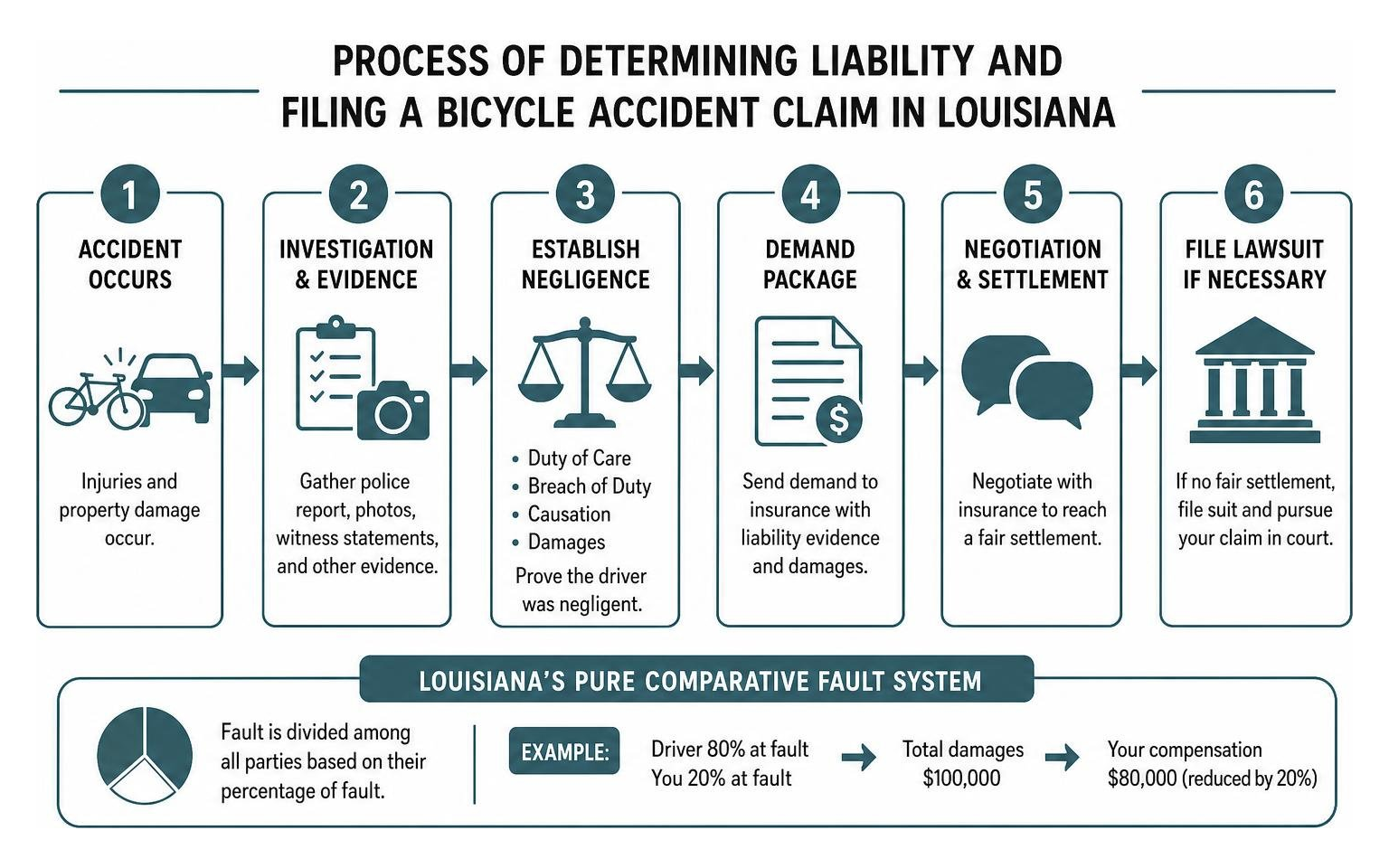
To secure a fair settlement, we must prove that the driver who hit you acted negligently. Proving negligence requires establishing four key legal elements:
- Duty of Care: The driver had a legal obligation to operate their vehicle safely and share the road responsibly with you.
- Breach of Duty: The driver failed to uphold that obligation. Common examples include distracted driving (texting behind the wheel), speeding, tailgating, failing to yield at intersections, or “dooring” (opening a parked car door directly into your path).
- Causation: The driver’s breach of duty directly caused your accident.
- Damages: You suffered actual physical, emotional, or financial harm as a result of the crash.
We utilize accident reconstruction professionals, analyze traffic camera footage, subpoena cell phone records to prove distracted driving, and review police reports to build an undeniable case of driver liability.
Types of Damages Recoverable in a Bicycle Injury Claim
If you have been injured in a bicycle accident, you are entitled to pursue compensation for all the ways the crash has disrupted your life. These damages are generally divided into economic and non-economic categories:
- Medical Expenses: This covers your past, present, and future medical care, including ambulance rides, emergency room visits, surgeries, physical therapy, prescription medications, and long-term rehabilitation.
- Lost Income: If your injuries prevent you from working, you can recover the wages you lost. If you suffer a permanent disability that limits your future earnings, you can pursue compensation for lost earning capacity.
- Pain and Suffering: This compensates you for the physical pain, emotional distress, anxiety, and post-traumatic stress caused by the crash.
- Property Damage: You can recover the cost to repair or replace your bicycle, helmet, riding gear, and any electronic devices damaged in the accident.
To learn more about how we calculate these damages to ensure you do not leave money on the table, check out our resource on New Orleans Personal Injury: Your Guide to Getting Every Dollar You Deserve.
Determining Fault and the Statute of Limitations in Louisiana
Louisiana’s legal system has unique rules that directly impact how personal injury cases are handled. If you want to understand why our local courts operate differently than those in other states, we invite you to read our detailed analysis on Why Louisiana Personal Injury Cases Are Different.
Louisiana’s Comparative Fault System
One of the most important legal concepts in Louisiana personal injury law is the system of “pure comparative fault.” Under this system, liability for an accident is allocated among all parties involved based on their percentage of fault.
What does this mean for you? It means that even if you were partially to blame for the accident, you are not barred from recovering compensation. For example, if a court finds that a distracted driver was 80% responsible for hitting you, but you were 20% at fault because you failed to use a hand signal, your final compensation will simply be reduced by 20%. If your total damages were $100,000, you would still receive $80,000.
Insurance companies love to abuse this system by trying to shift as much blame onto the cyclist as possible. We know how to counter these tactics with clear, evidence-backed arguments to keep your percentage of fault as close to zero as possible.
The Two-Year Statute of Limitations for Personal Injury Claims
Time is of the essence when filing a personal injury lawsuit in Louisiana. For decades, our state had one of the shortest deadlines in the nation, which you can read about in our article on Louisiana’s One Year Statute of Limitations.
However, the legal landscape has recently shifted. For all personal injury claims arising from accidents that occur on or after July 1, 2024, Louisiana has established a two-year statute of limitations.
This means you generally have exactly two years from the date of your bicycle accident to file a formal lawsuit in court. If you miss this deadline, the court will almost certainly dismiss your case, and you will lose your right to pursue compensation forever. While two years may sound like a long time, gathering evidence, negotiating with insurers, and building a strong case takes time. It is always best to consult with an attorney as soon as possible.
Frequently Asked Questions About Louisiana Bicycle Accidents
The days following a bicycle crash can bring up a lot of questions. Here are clear answers to some of the most common legal questions we hear from injured cyclists:
Can I recover damages if I wasn’t wearing a helmet?
Yes. Because Louisiana law does not require adults (anyone aged 12 and older) to wear a helmet, you cannot be penalized by the state for riding without one.
However, the insurance company may try to use your lack of a helmet against you. They might argue that your head injuries would have been less severe if you had been wearing one, attempting to reduce your payout under the comparative negligence rule. We are skilled at fighting back against these arguments by showing that the driver’s negligence was the primary cause of the crash and your resulting injuries.
What if the driver fled the scene of the accident?
Hit-and-run accidents are unfortunately common, but you still have legal options. Under Louisiana law (La. R.S. § 14:100), leaving the scene of an accident is a serious criminal offense.
If the police are unable to identify the driver, we can help you explore recovery through your own auto insurance policy. If you carry Uninsured/Underinsured Motorist (UM) coverage under La. R.S. § 22:1295, this policy often covers bicycle accidents, stepping in to pay for your medical bills, lost wages, and pain and suffering just as if the fleeing driver had stayed at the scene.
Can I sue the city for poor road conditions?
Yes, you can sue a municipality or government entity if a hazardous road condition—such as a massive pothole, collapsed shoulder, or unmarked construction zone—caused your bicycle crash.
However, bringing a claim against a government entity is highly complex. You must prove that the city had actual or constructive notice of the hazard and failed to repair it within a reasonable timeframe. Furthermore, claims against government bodies are subject to strict administrative deadlines and procedural rules that differ from standard personal injury lawsuits.
Let’s Get You Back on Two Wheels: Partner with J Reese Law Firm
Riding a bicycle is a wonderful way to experience the beauty and culture of New Orleans, but a single moment of driver inattention can change your life in an instant. If you have been injured, you do not have to fight the insurance companies alone.
At the J Reese Law Firm, we provide compassionate, aggressive, and highly personalized legal advocacy for injured cyclists. We understand the physical, emotional, and financial toll of a serious crash, and we are committed to helping you recover every dollar you deserve.
Whether you need a dedicated New Orleans Personal Injury Lawyer or a New Orleans Car Accident Lawyer to handle a complex multi-vehicle collision, we are here to stand by your side.
Don’t wait to protect your future. Contact us today to schedule a free, no-obligation consultation, and let us help you secure the justice and financial peace of mind you need to move forward.