
Who Qualifies as a Seaman Under the Jones Act in Louisiana?
Who qualifies as a seaman under the Jones Act in Louisiana? A worker generally qualifies when their job contributes to a vessel’s work and their connection to that vessel, or a commonly controlled fleet, is substantial in duration and nature. The job title alone does not decide the issue.
The federal Jones Act allows a qualifying seaman to bring an employer-negligence claim. The statute is available at the Legal Information Institute’s Jones Act text. The controlling analysis comes from the Supreme Court’s two-part Chandris test.
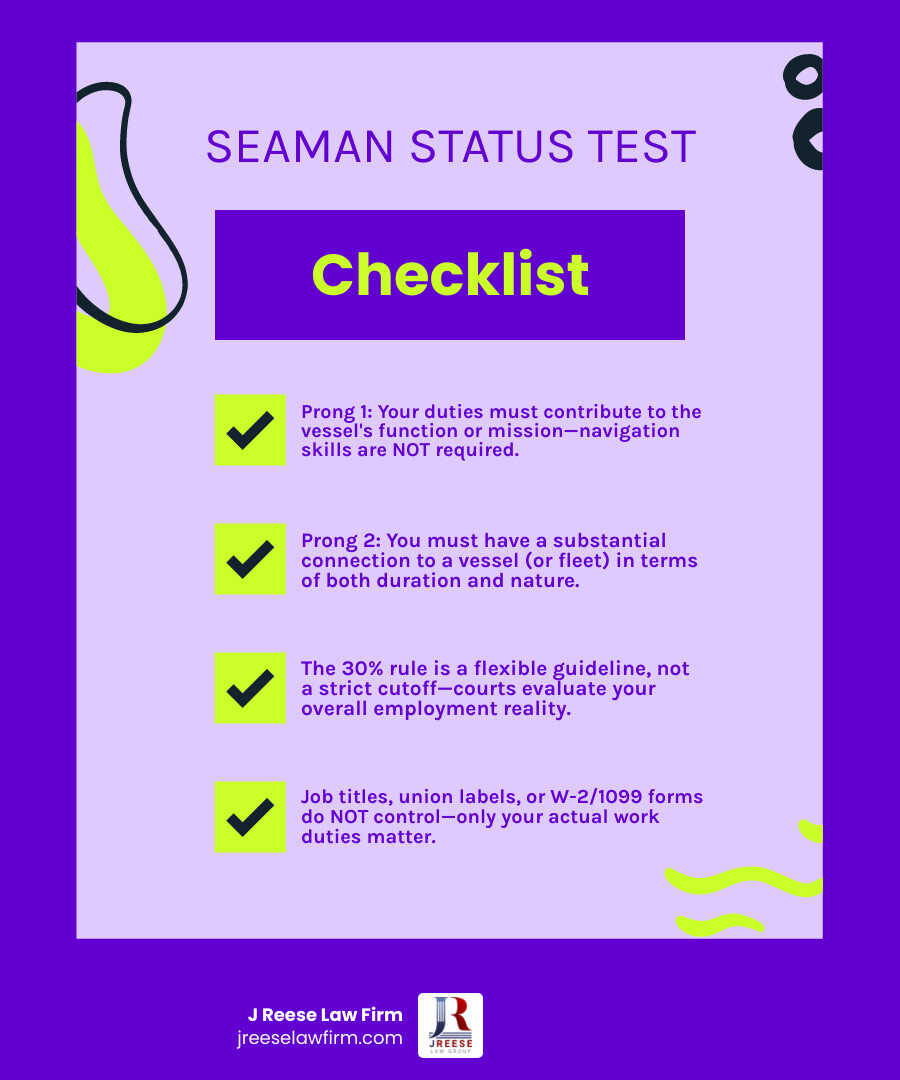
First, the worker must contribute to the vessel’s function or mission. Deckhands, welders, cooks, mechanics, crane operators, and offshore crew members may satisfy this part when their work supports the vessel’s operations.
Second, the worker must have a substantial relationship with a vessel in navigation or an identifiable fleet. This is the part that often drives disputes after an offshore, river, or barge injury near New Orleans, Gretna, and the Louisiana coast.
The legal hook is practical: seaman status turns on the vessel connection and the time-at-sea record. Preserve that evidence before payroll records, crew lists, and vessel logs become harder to obtain.
How Does the Time-at-Sea Test Affect Seaman Status?
A worker’s time at sea matters because courts look for a substantial connection to a vessel or fleet. The Supreme Court has described roughly 30 percent of work time in vessel service as a useful rule of thumb, not a rigid cutoff. The actual assignment and work pattern remain critical.
A worker whose regular duties move from a shoreside yard to a vessel-based assignment may qualify before a long work history has accumulated. Conversely, occasional work aboard a boat may not be enough when the employee’s real job remains land-based.
Keep daily time records, dispatch tickets, crew manifests, work schedules, and payroll records. Those documents can show where the work happened and whether the worker faced the maritime risks that distinguish a vessel-based job from a brief visit aboard a craft.
Louisiana cases illustrate the point. In Guidry v. ABC Insurance Co., the Louisiana Third Circuit discussed a welder whose work pattern included about 90 percent of his time on barges and floating mats. That documented vessel connection was important to the seaman-status analysis.

For a worker injured on the Mississippi River, in a Louisiana bayou, or offshore from New Orleans, the central question is not simply whether the accident happened on water. It is whether the worker’s overall employment tied them substantially to a vessel or a commonly controlled fleet.
What Counts as a Vessel or Fleet Under the Jones Act?
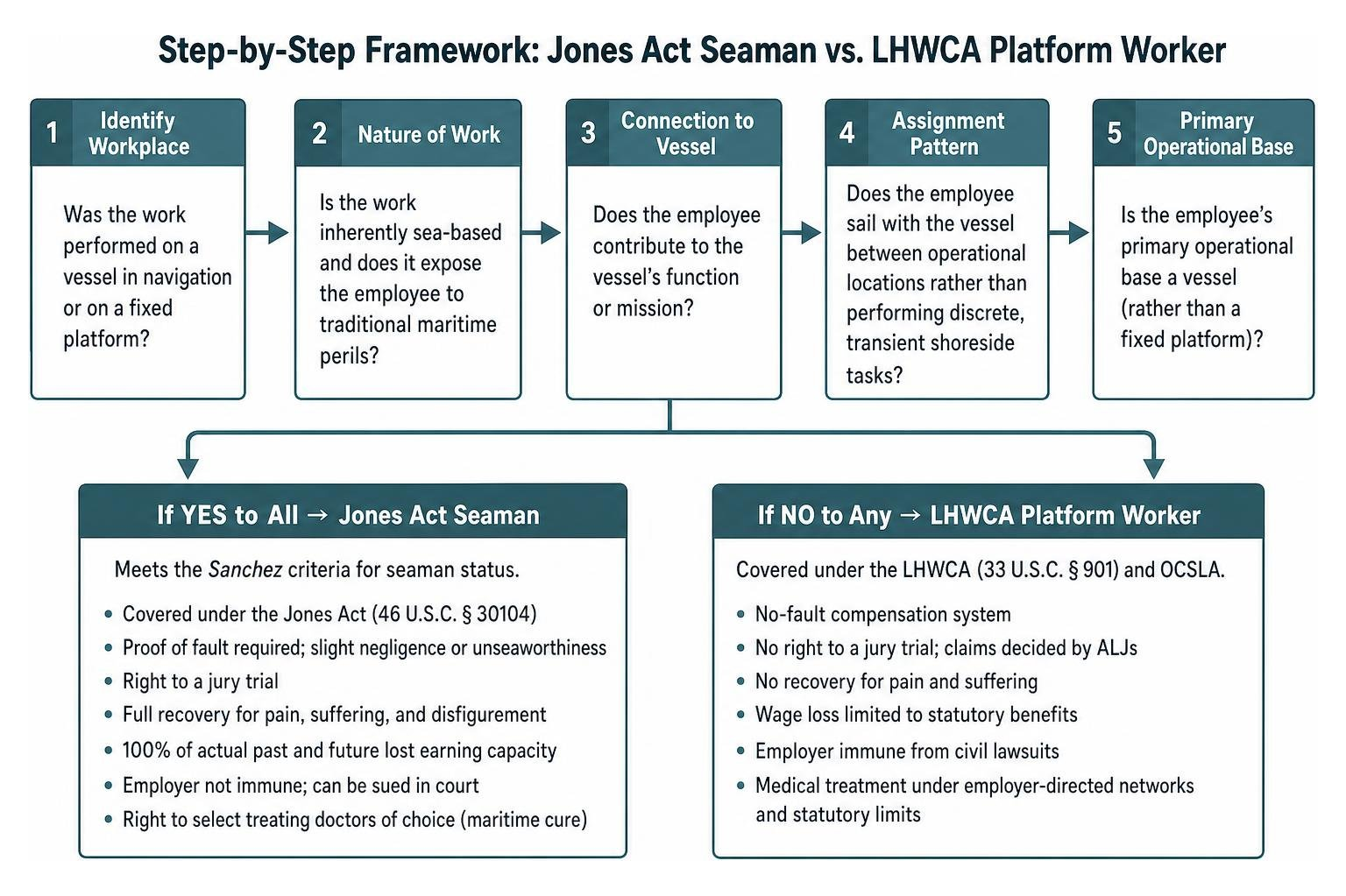
A Jones Act claim requires a connection to a vessel in navigation or to an identifiable fleet. A vessel can include a tug, supply boat, barge, drillship, or mobile offshore unit when it is used or practically capable of transportation on water. Fixed platforms are generally treated differently.
The fleet doctrine may allow a worker to combine time on several vessels, but only when they are under common ownership or operational control. Time on unrelated vessels cannot simply be added together to reach the time-at-sea benchmark.
This distinction matters for Louisiana offshore workers. A person assigned to a fixed production platform may fall under a different compensation system, while a worker assigned to a fleet of vessels may have a Jones Act claim. The federal Longshore and Harbor Workers’ Compensation Act excludes a “master or member of a crew of any vessel.” See the official U.S. Code text for 33 U.S.C. § 902.
The facts must be reviewed closely. Vessel logs, charter agreements, daily assignments, and who directed the work can help show whether a fleet relationship existed.
What Evidence Helps Prove Seaman Status After a Louisiana Injury?
The strongest seaman-status cases are built with records, not job labels. A worker should preserve documents showing the vessel assignment, the percentage of work performed aboard vessels, and the employer’s operational control. Prompt action can also protect evidence before it is overwritten or lost.
Useful records include vessel logs, crew manifests, time sheets, dispatch tickets, job safety analyses, photos of the work location, maintenance records, and charter or master-service agreements. Ask for copies of incident reports and identify coworkers who can describe regular duties.
Attorney insight from J Reese Law Firm: the time-at-sea question is often answered by documents created before the injury claim begins. A crew list or daily assignment can be more persuasive than a payroll title that calls a worker a contractor or laborer.
There may also be deadlines for a maritime injury claim. The applicable deadline depends on the claim and facts, so an injured worker should seek legal advice promptly rather than assume a workers’ compensation filing protects every possible Jones Act remedy.
For a focused review of liability, evidence preservation, and available compensation, speak with a maritime accident attorney.
When Should an Injured Maritime Worker Contact a Lawyer?
An injured maritime worker should seek legal guidance as soon as there is a dispute about vessel status, fault, medical treatment, maintenance and cure, or the proper benefits system. Early review helps preserve records and prevents an employer’s job classification from becoming the only version of the facts.
This is especially important after an injury on a barge, tug, crew boat, drillship, or offshore support vessel. A lawyer can compare the actual work pattern with the time-at-sea test and determine whether the worker may have a Jones Act claim, an LHWCA claim, or another maritime remedy.
Workers in Gretna, New Orleans, Jefferson Parish, and along the Louisiana coast should document their assignments immediately. Keep texts, schedules, pay records, and photographs of the vessel or platform. Do not assume a temporary shoreside task automatically ends a long-standing vessel connection.
For related guidance, see Can I Sue Under the Jones Act if I Was Hurt on a Boat Near Gretna?.
What Are Common Questions About Jones Act Seaman Status in Louisiana?
Jones Act seaman status depends on the worker’s actual relationship to a vessel, not a single shift or payroll label. The questions below address common concerns after an injury, but every case depends on its records, work history, vessel assignment, and the circumstances of the accident.

Does a worker have to steer or navigate a vessel to qualify?
No. A worker does not need to steer, pilot, or hold a captain’s license. The first part of the test asks whether the person’s duties contributed to the vessel’s function or mission. Work such as maintenance, cooking, welding, rigging, and deck operations may qualify when it supports vessel operations.
Can a worker qualify after an injury on a dock or ashore?
Possibly. The location of the accident matters, but courts also examine the worker’s overall employment relationship. A crew member may remain a seaman while completing temporary shoreside duties that are connected to vessel work. The complete work history and assignment records remain important.
Does sleeping on a support vessel make a platform worker a seaman?
Usually not by itself. Lodging, meals, or transportation aboard a support vessel may be temporary and incidental when the person’s real work is tied to a fixed platform. The analysis turns on the nature and duration of the worker’s vessel connection.
Contact J Reese Law Firm About a Maritime Injury
If a vessel, barge, or offshore injury raises questions about seaman status, J Reese Law Firm can review the work history, time-at-sea records, and available evidence. For another practical resource, read 5 Ways a New Orleans Maritime Injury Attorney Protects Injured Seamen.