
How Long Does a Nursing Home Lawsuit Take? A Quick Estimate
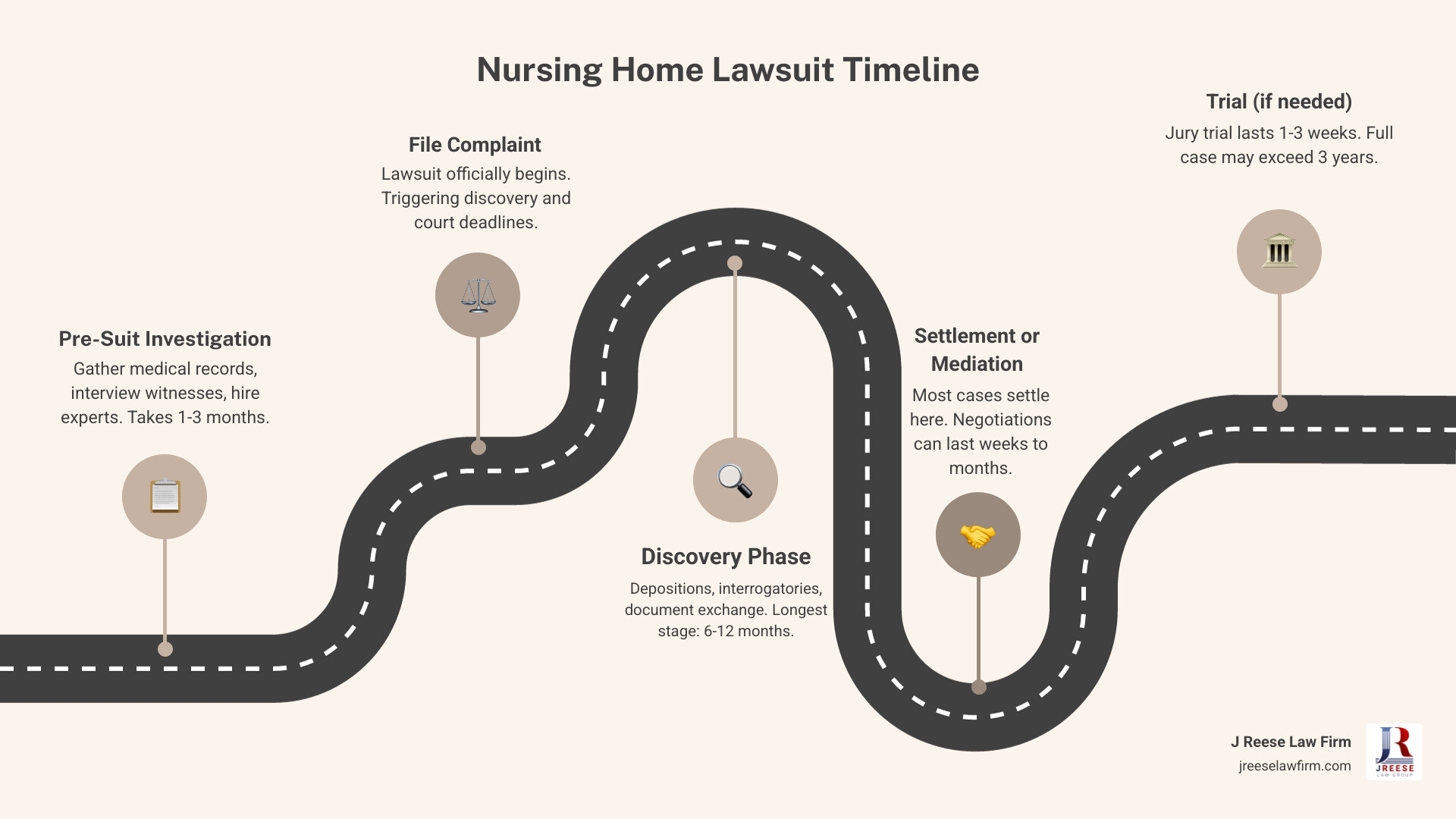
How long does a nursing home lawsuit take? Most cases resolve in about one to three years. A clear case that settles early may finish in six to twelve months, while a disputed case that goes to trial can take more than three years.
| Case stage or outcome | Common time range |
|---|---|
| Pre-suit review and evidence collection | 1 to 3 months or longer |
| Early settlement | 6 to 12 months |
| Typical lawsuit from filing to resolution | 1 to 3 years |
| Discovery, including records and depositions | 6 to 12 months in many cases |
| Trial, once it begins | 1 to 3 weeks |
| Trial or appeal case | 3 years or longer |
The timeline depends on the injury, available records, the number of people or companies involved, arbitration issues, insurance negotiations, and the court’s schedule. Wrongful death claims can take longer because the family may first need to open an estate and appoint a legal representative.
I am Justin Reese, a civil litigation and personal injury attorney who has represented families in catastrophic injury and wrongful death matters since 2011. I understand that the answer to how long does a nursing home lawsuit take depends on both the legal process and the facts that must be uncovered before a case can fairly resolve.
How long does a nursing home lawsuit take further reading:
- average nursing home neglect settlement
- nursing home neglect resulting in death
- nursing home neglect attorney
Breakdown: How Long Does a Nursing Home Lawsuit Take?
When families first reach out to our team at J Reese Law Firm, one of their top concerns is timing. Their loved one may have suffered severe bedsores, malnutrition, an unassisted fall, or a life-threatening infection due to facility neglect. Understandably, families want justice and closure as quickly as possible.
On average, a nursing home lawsuit takes 18 to 24 months from the initial legal consultation to the final disbursement of funds. However, litigation is not a single quick event—it is a structured, multi-step process designed to gather proof, establish direct liability, and hold neglectful care providers accountable.
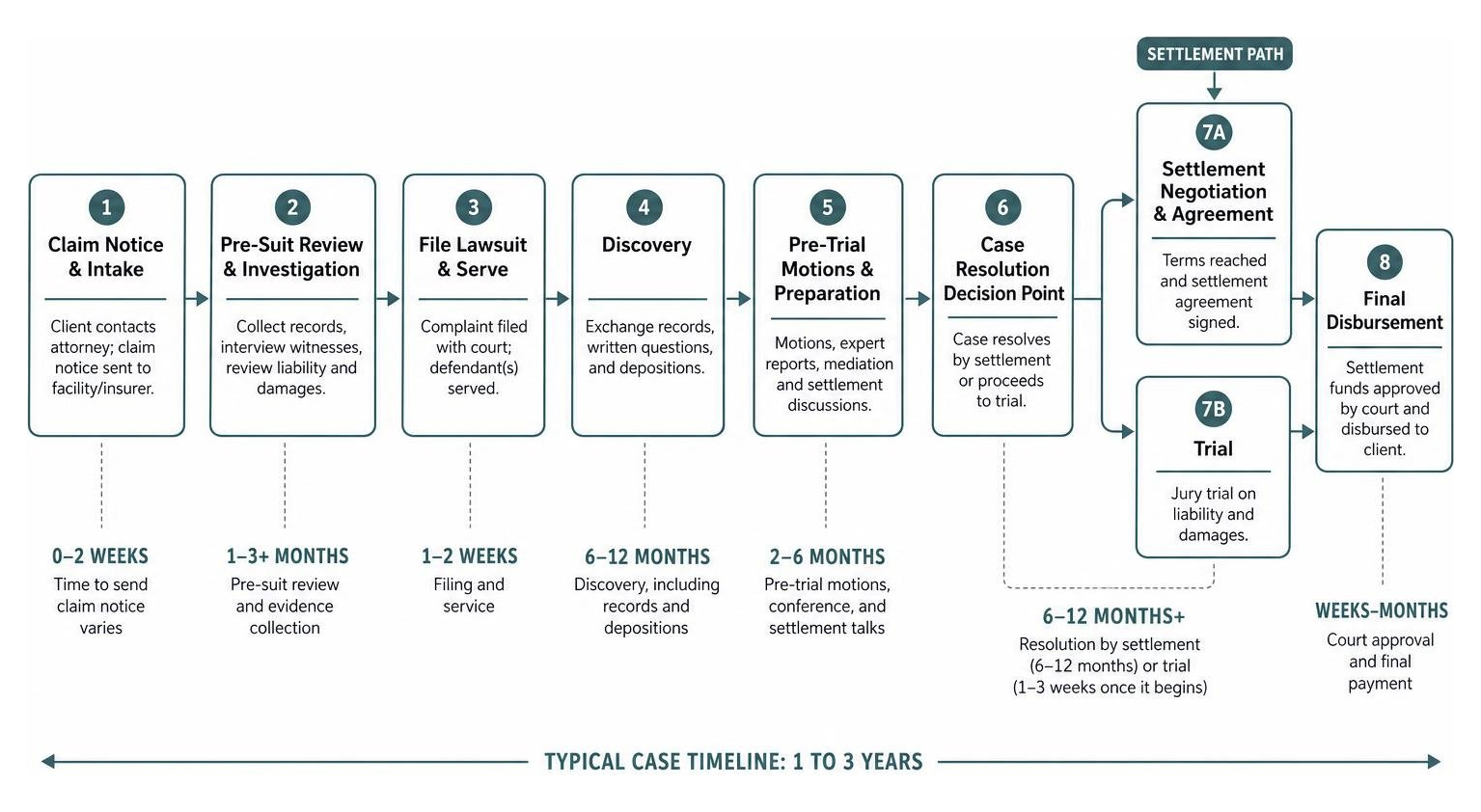
Roughly 95% of nursing home cases end up settling out of court before a jury trial takes place. Cases with clear proof of neglect—such as photographic evidence of untreated stage 4 pressure ulcers or documented staffing violations—may settle in as little as 6 to 12 months. When liability is disputed or multiple corporate entities share responsibility, the timeline routinely expands to 2 or 3 years.
Pre-Suit Phase: How Long Does a Nursing Home Lawsuit Take to File?
Before a formal lawsuit can even be filed with the court, we conduct a pre-suit investigation. This crucial setup phase typically lasts 1 to 3 months, though it can stretch longer depending on how fast medical records are provided.
During this window, our primary objective is assembling rock-solid evidence that connects the facility’s failure to meet accepted care standards directly to the resident’s harm. Standard documents and proof collected during the pre-suit investigation include:
- Complete Nursing Home Records: Shift logs, care plans, medication administration records (MARs), and incident reports.
- Hospital and Medical Treatment Records: Records tracking emergency room admissions, surgical procedures, wound care notes, and physical therapy assessments.
- State Regulatory Complaints and Findings: Incident investigations or deficiency citations issued by state health departments or regulatory bodies.
- Photographic Evidence: Time-stamped photographs of injuries, pressure ulcers, unsanitary living conditions, or hazards.
- Billing Records: Invoices detailing emergency treatment, prolonged hospitalizations, and specialized medical equipment costs.
Because elder abuse claims require detailed medical backing, we consult qualified medical professionals to review the charts. Their analysis ensures that the resident’s injuries stem directly from actionable neglect rather than pre-existing conditions. For more detailed timeline insights across jurisdictions, you can review this nursing home lawsuit duration guide.
Discovery Phase: Evidence Gathering and Depositions
Once we file the initial legal complaint in court, the case enters the discovery phase. Discovery is usually the longest single portion of any civil lawsuit, typically taking 6 to 12 months in straightforward claims and up to 18 months in complex multi-party cases.
During discovery, both sides exchange information under court supervision. This procedural phase centers on three core mechanisms:
- Written Interrogatories: Formal written questions that each party must answer truthfully under penalty of perjury.
- Requests for Production: Demands for internal emails, shift scheduling rosters, employee background checks, and corporate administrative policies.
- Depositions: Sworn, out-of-court oral testimonies recorded by a court reporter. We depose certified nursing assistants (CNAs), registered nurses, facility administrators, and corporate officers. In turn, defense attorneys depose family members and treating physicians.
Discovery routinely uncovers whether shift shortages or improper training led directly to systemic neglect. To explore the broader legal process in depth, see this resource on nursing home legal resolution steps.
Settlement Negotiations, Mediation, and Trial
After discovery wraps up, both sides have a clear view of the evidence. This is when earnest settlement negotiations take place.
Many judges require parties to attend formal pre-trial mediation—a structured, full-day session led by a neutral third-party mediator. Mediation aims to help both sides reach an agreed financial resolution without the expense and delay of trial. Negotiations and mediation typically occur over 1 to 3 months.

If an out-of-court settlement cannot be reached, the case moves to trial. While the actual trial proceedings usually last 1 to 3 weeks, waiting for an open trial date on the court calendar can easily take 6 to 12 months. Understanding these mechanics is essential when evaluating our guide to average nursing home neglect settlement values.
Key Factors Influencing How Long Does a Nursing Home Lawsuit Take
Why do some nursing home cases wrap up in nine months while others drag on for three years? The overall timeline depends on several intersecting factors:
- Injury Severity and Medical Nuance: Cases involving complex medical histories take longer to analyze than straightforward injury claims.
- Number of Defendants: Claims naming individual nurses, facility administrators, operating companies, and parent corporate entities require extra procedural steps.
- Insurance Coverage Limits: Facilities carrying standard $1 million to $5 million liability policies may negotiate differently than underinsured facilities.
- Court Docket Schedules: Local court backlog directly impacts how quickly hearings, status conferences, and trial dates are placed on the calendar.
Defense Delay Tactics and Corporate Ownership Structures
A significant reason nursing home cases take time is intentional defense stalling. Large nursing home chains and their insurance carriers often use legal maneuvers to delay proceedings. Their hope is that delay will wear down the family emotionally or that key witnesses’ memories will fade over time.

Complex corporate ownership structures make this issue worse. Modern nursing homes are rarely simple single-building operations. Private equity firms and parent corporations frequently divide operations across separate holding companies, property management firms, and staffing agencies to insulate themselves from liability.
Identifying these corporate layers and serving proper legal paperwork can add 2 to 4 months to the pre-trial timeline. Furthermore, gathering evidence like federal staffing data—such as mandatory Federal Payroll-Based Journal (PBJ) reports—takes persistent legal action. Knowing why hiring a nursing home lawyer helps ensures your family has dedicated advocates pushing back against these stalling tactics.
Arbitration Clauses and Legal Challenges
Many nursing home admission packets contain mandatory pre-dispute arbitration clauses hidden deep within fine print paperwork. These clauses ask residents to waive their constitutional right to a jury trial in favor of private arbitration.
Defense lawyers routinely file motions to compel arbitration early in a case. Litigating whether an arbitration clause is enforceable can add 3 to 6 months of court hearings and briefing schedules.
However, arbitration clauses are not always binding. Under federal regulations, residents or their authorized legal representatives have a strict 30-day window to rescind signed arbitration agreements following admission. Furthermore, if a resident had severe cognitive impairment or lacked legal authority when signing, court rules often invalidate the agreement. Navigating these roadblocks is critical when holding facilities accountable for systemic negligence.
Timeline Differences: Wrongful Death vs. Standard Negligence Claims
There are distinct procedural differences between a personal injury lawsuit filed by a living resident and a wrongful death lawsuit filed by surviving family members.
| Claim Factor | Standard Personal Injury Claim | Wrongful Death Claim |
|---|---|---|
| Plaintiff | Living resident (or legal representative) | Successor representative or appointed estate administrator |
| Typical Duration | 12 to 24 months | 2 to 4 years |
| Estate Filings Required? | No | Yes (must establish formal succession/estate first) |
| Primary Damages | Medical bills, pain, suffering, personal disability | Medical expenses, funeral costs, loss of companionship |
| Resolution Method | Settlement or civil jury trial | Mediated agreement, court-approved distribution, or trial |
When neglect results in a resident’s death, the legal timeline automatically lengthens. Before filing a lawsuit, surviving family members must open an estate through court proceedings to appoint an official representative. Opening an estate and receiving legal authorization adds 2 to 6 months to the front end of the process. For local guidance on fatal neglect cases, consult a New Orleans wrongful death attorney.
Statute of Limitations and Post-Settlement Payout Timelines
Every state establishes strict deadlines, known as statutes of limitations, for filing nursing home neglect claims. Missing this strict statutory window permanently bars a family from pursuing financial recovery.
- Filing Deadlines: Depending on the specific state and legal claim type, filing deadlines typically range from 1 to 3 years from the date the neglect occurred or was reasonably discovered. Acting promptly preserves essential physical evidence, care records, and witness testimonies before details fade.
- Post-Settlement Disbursement: Once a financial settlement is signed, families do not receive a check immediately. Resolving final disbursements usually takes 30 to 90 days.
- Medical Liens: Payout delays stem primarily from calculating and clearing mandatory health insurance liens. By federal and state law, Medicare, Medicaid, and private health plans must be reimbursed for care expenses paid on the victim’s behalf before final funds reach the family. Negotiating these statutory liens down ensures the family retains the largest possible net payout.
Frequently Asked Questions About Nursing Home Lawsuits
How long does a nursing home trial take if a settlement isn’t reached?
While the actual courtroom proceedings of a nursing home trial usually take 1 to 3 weeks, getting to the trial stage requires considerable time. Due to court calendar backlogs and motion filings, waiting for an available trial date typically takes 6 to 12 months after discovery concludes.
How quickly will we receive the payout after settling a claim?
Final payout disbursement typically takes 30 to 90 days after both parties sign the formal settlement agreement. This timeframe allows insurance providers to issue settlement checks, while our team works to resolve Medicare or Medicaid reimbursement liens, pay court costs, and disburse net funds directly to you.
Can an arbitration clause double the time it takes to resolve a lawsuit?
While an arbitration clause rarely doubles the total timeline, it can easily add 3 to 6 months of preliminary legal briefing and court hearings. If the court upholds the arbitration agreement, the dispute transitions to a private arbitrator. Private arbitration can occasionally proceed faster than a congested public court trial, but challenging unfair arbitration clauses requires initial time and effort.
Partnering with J Reese Law Firm to Protect Your Family’s Legal Timeline
When a loved one suffers preventable harm or tragic death due to facility neglect, navigating complex legal timelines should not fall on your shoulders alone. Understanding how long does a nursing home lawsuit take allows your family to move forward with realistic expectations, clear milestones, and absolute confidence.
At J Reese Law Firm, we aggressively manage every phase of litigation—from securing vital medical charts to countering corporate delay tactics—so your case moves forward as swiftly as possible. If you suspect your family member experienced abuse or neglect, review our nursing home abuse claim options or contact us today to schedule a free, confidential consultation.