When Limb Loss Happens in Louisiana, a Louisiana Amputation Lawyer Is Your First Call
If you or someone you love has suffered a traumatic amputation, a Louisiana amputation lawyer can help you understand your legal rights and pursue the full compensation you deserve. Here is a quick overview of what you need to know:
Who can file an amputation injury claim in Louisiana?
- Victims of workplace accidents, car crashes, maritime incidents, or medical malpractice
- Family members acting on behalf of a victim who cannot file on their own
What compensation can you recover?
- Medical bills and future treatment costs
- Prosthetic limb expenses and rehabilitation
- Lost wages and reduced earning capacity
- Pain, suffering, and loss of quality of life
Key facts to know right now:
- Louisiana’s statute of limitations is only one year from the date of injury — one of the shortest deadlines in the country
- Louisiana has one of the highest workplace amputation rates in the U.S. — 3.2 per 10,000 full-time workers, versus the national average of 1.9
- Non-economic damages in medical malpractice cases are capped at $500,000 under Louisiana law
Losing a limb changes everything — your career, your independence, your daily life. Yet many amputation victims in Louisiana don’t realize how quickly their legal window to act can close, or how much compensation they may actually be entitled to. Louisiana’s civil law system, its industrial economy, and its strict one-year filing deadline make these cases unlike almost any other in the country. Understanding your rights early is not just helpful — it is critical.
I’m Justin Reese, a trial attorney with J Reese Law Firm and a New Orleans native who has spent more than a decade recovering tens of millions of dollars for clients facing catastrophic injuries, including amputation cases tied to Louisiana’s oil and gas, maritime, and industrial sectors — making me a Louisiana amputation lawyer with the courtroom experience and local knowledge your case demands. In the sections ahead, I’ll walk you through exactly what to expect, what your claim may be worth, and how to protect your future.
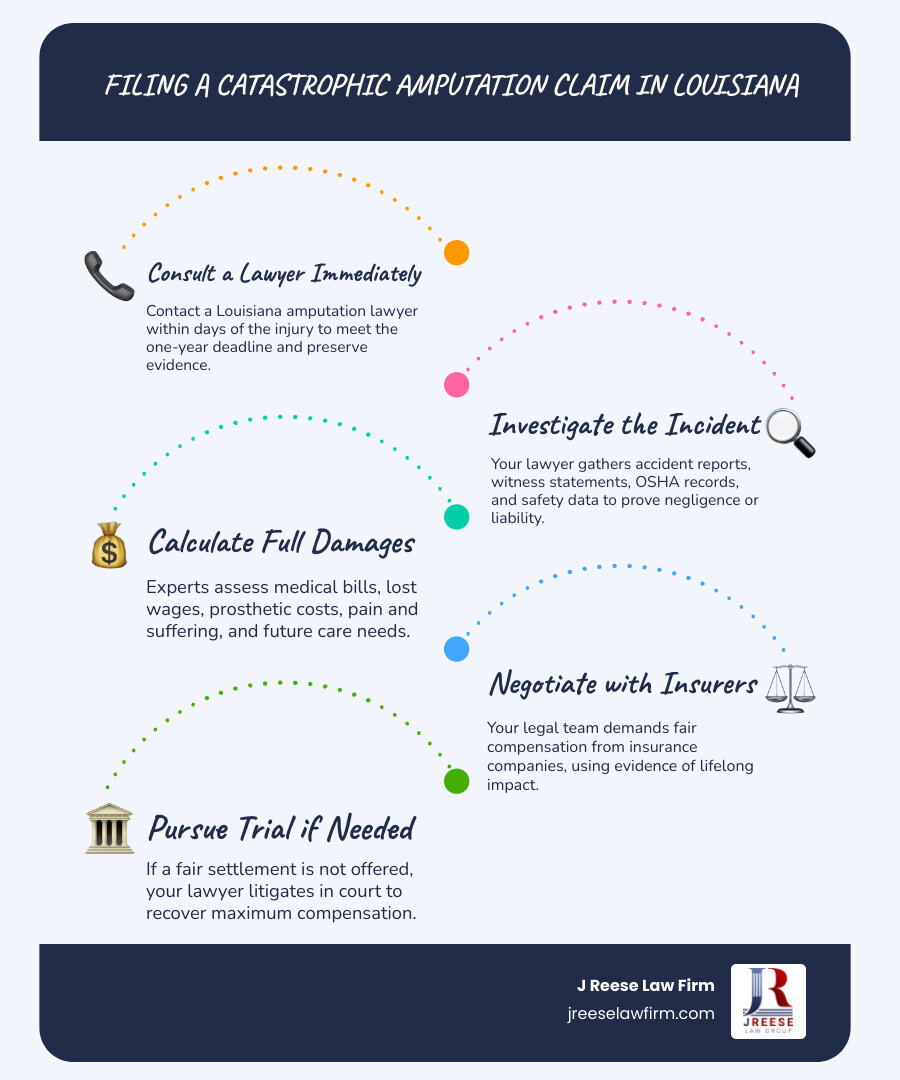
Common louisiana amputation lawyer vocab:
Common Causes of Limb Loss in Louisiana Industries

Louisiana is a powerhouse of heavy industry, but this economic strength comes with inherent dangers. Every day, thousands of Louisianians work in high-risk environments where a single equipment failure or safety oversight can lead to life-altering consequences. Statistics reveal that approximately 60% of amputation-related lawsuits in Louisiana involve industrial accidents. The oil and gas, construction, and manufacturing sectors account for the vast majority of these claims.
Furthermore, our state has one of the highest rates of workplace amputations in the United States, with a rate of 3.2 per 10,000 full-time workers. This is significantly higher than the national average of 1.9 per 10,000. When industrial operations prioritize speed and profit over safety, workers pay the ultimate price.
Whether an injury occurs on an offshore oil rig in the Gulf, at a bustling manufacturing plant in New Orleans, or on a local agricultural farm, federal and state safety regulations are in place for a reason. Under OSHA workplace safety standards, employers are legally required to maintain safe working conditions, provide adequate training, and equip machinery with proper safety guards. When these standards are ignored, catastrophic injuries occur, and seeking help from an experienced amputation attorney louisiana help is the most effective way to protect your future.
How a Louisiana Amputation Lawyer Evaluates Industrial Accidents
When we take on an industrial amputation case, our first step is to conduct a comprehensive investigation to determine exactly what went wrong. Proving liability in these complex environments requires looking beyond the immediate accident to identify systemic negligence, equipment maintenance failures, or clear safety violations.
We meticulously review the details of your accident to pinpoint:
- Negligence: Did supervisors pressure workers to bypass safety protocols to meet deadlines?
- Safety Violations: Did the company fail to adhere to OSHA guidelines or internal safety manuals?
- Equipment Failure: Was the machinery poorly maintained, or were safety guards intentionally removed?
By analyzing these elements, we build a robust foundation for your personal injury claim. We help you manage the complex intersection of workers’ compensation and third-party personal injury liability within our dedicated practice area specialties.
High-Risk Sectors and Equipment Failures
Certain industries in Louisiana carry a much higher risk of catastrophic limb loss due to the nature of their daily operations:
- Oil and Gas Sector: Offshore drilling rigs, refineries, and extraction sites utilize heavy, high-pressure equipment. Pipe-handling systems, rotating machinery, and winch accidents can easily crush or sever limbs.
- Maritime Industry: Tugboats, barges, and cargo ships feature heavy mooring lines, cranes, and winches. A snapped line or a cargo shifting accident can lead to traumatic, immediate amputations.
- Manufacturing and Construction: Conveyor belts, forklifts, hydraulic presses, and heavy power tools represent constant hazards. When manufacturing plants fail to implement proper lockout/tagout procedures during machine maintenance, workers are exposed to severe crushing injuries.
- Defective Products: In some cases, the equipment itself is inherently dangerous due to design or manufacturing defects. If a machine lacks an essential emergency shut-off switch or has a faulty safety guard, the manufacturer can be held strictly liable for the resulting injuries.
Louisiana’s Unique Legal System and Amputation Damages
Louisiana’s legal framework is distinct from any other state in the country. Our civil law heritage, rooted in the Napoleonic Code, heavily influences how personal injury claims are handled, negotiated, and litigated. If you are pursuing a claim for limb loss, understanding why louisiana personal injury cases are different is essential to maximizing your financial recovery.
One of the most critical aspects of Louisiana injury law is the doctrine of pure comparative fault. Under this rule, liability is apportioned among all parties involved in an accident based on their percentage of fault. This means that even if you were partially responsible for the incident that led to your injury, you can still recover damages. However, your total compensation will be reduced by your percentage of fault. For example, if a jury determines your total damages are $1,000,000 but finds you were 20% at fault for the accident, your final recovery will be $800,000. Insurance companies frequently use comparative fault to minimize their payouts, which is why having a skilled louisiana amputation lawyer representing you is so vital.
Why Louisiana’s One-Year Statute of Limitations Demands Urgent Action
If there is one rule that every injury victim in Louisiana must know, it is the state’s incredibly strict filing deadline. Louisiana has a one-year prescriptive period (statute of limitations) for personal injury claims. This is one of the shortest legal deadlines in the entire United States.
Under louisianas one year statute of limitations, you have exactly one year from the date of the accident to file a lawsuit in court. If you miss this deadline, you will almost certainly lose your right to seek compensation forever.
One year may seem like a long time, but when you are dealing with surgeries, physical therapy, prosthetic fittings, and the emotional toll of limb loss, twelve months fly by. Building a strong case requires securing physical evidence, obtaining maintenance records, interviewing witnesses, and consulting medical professionals. Waiting until the last minute can severely compromise your case, making immediate action absolutely necessary.
Calculating Economic and Non-Economic Damages
To secure the financial resources you need to rebuild your life, your legal team must carefully calculate and document both your economic and non-economic damages.
| Damage Type | Description | Key Components Included |
|---|---|---|
| Economic Damages | Tangible, verifiable financial losses resulting from the injury. | Immediate medical bills, future surgeries, prosthetic devices, physical therapy, home modifications, and lost wages/loss of earning capacity. |
| Non-Economic Damages | Intangible, subjective losses that affect your quality of life. | Physical pain and suffering, mental anguish, loss of enjoyment of life, disfigurement, and loss of consortium. |
While economic damages are calculated using bills, receipts, and economic projections, non-economic damages are highly subjective. In Louisiana, there is generally no cap on non-economic damages in standard personal injury or industrial accident cases. However, if your amputation was the result of medical malpractice (such as a surgical error or a misdiagnosed infection that led to gangrene), Louisiana law imposes a strict $500,000 cap on all non-economic damages. This cap makes it even more critical to work with a legal team that knows how to maximize every available avenue of recovery.
Why You Need a Dedicated Louisiana Amputation Lawyer for Your Case

Amputation claims are among the most complex personal injury cases to litigate. They require substantial financial resources, deep legal knowledge, and access to a network of medical and financial professionals. Insurance companies know exactly how expensive a lifetime of prosthetic care and medical treatment is, and they will fight aggressively to limit their financial exposure. Attempting to negotiate with these corporate giants on your own is a recipe for an undervalued settlement.
By partnering with a dedicated louisiana amputation lawyer, you level the playing field. We handle the stressful legal details, manage communication with the insurance adjusters, and prepare your case as if it is going to trial. Our extensive results speak to our commitment to securing maximum compensation for our clients. Knowing how to choose the best personal injury attorneys in new orleans la means looking for a firm with a proven track record, local trial experience, and the resources necessary to take a catastrophic injury case all the way to a jury verdict.
How a Louisiana Amputation Lawyer Proves the Full Value of Your Claim
To win a catastrophic injury claim, we must present a compelling, evidence-backed narrative that clearly demonstrates the lifelong impact of your injury. We don’t just ask for a number; we prove exactly why that compensation is required.
To do this, we collaborate with a team of respected professional witnesses:
- Life Care Planners: These professionals create a comprehensive, customized plan detailing every medical, rehabilitative, and assistive need you will have for the rest of your life, along with the projected costs.
- Prosthetic Professionals: Modern prosthetics are highly advanced, but they are also incredibly expensive and must be replaced every few years. We ensure the lifetime cost of purchasing, maintaining, and upgrading your prosthetic limbs is fully covered.
- Vocational and Financial Analysts: If you can no longer return to your previous line of work, we calculate the exact difference in your lifetime earning capacity to ensure your family’s financial security.
This meticulous approach is a core part of our strategy, as detailed in our comprehensive guide, new orleans personal injury your guide to getting every dollar you deserve.
Choosing the Right Legal Representation for Catastrophic Injuries
When choosing an attorney for an amputation case, look for a firm that offers:
- Trial-Ready Advocacy: Many personal injury firms prefer quick, easy settlements. You need a firm that is fully prepared to take your case to court if the insurance company refuses to offer a fair settlement.
- Deep Financial Resources: Litigating an amputation case requires spending tens of thousands of dollars on professional witnesses, accident reconstruction, and medical animations. Your law firm must have the financial strength to fund these upfront costs.
- Compassionate, Client-First Service: You are going through one of the most challenging periods of your life. You deserve a legal team that communicates clearly, answers your questions promptly, and treats you with the respect and empathy you deserve.
Frequently Asked Questions About Louisiana Amputation Claims
What is the average settlement for an amputation in Louisiana?
There is no single “average” settlement, as every case depends on the specific circumstances of the accident, the clear determination of liability, and the insurance coverage available. However, historical data shows distinct trends:
- Workers’ Compensation: In Louisiana, workers’ comp settlements for a single-finger amputation typically range from $15,000 to $40,000. In contrast, a hand or arm amputation can result in settlements exceeding $250,000.
- Personal Injury Lawsuits: When a third party (not your employer) is negligent, a personal injury lawsuit can recover full pain and suffering, lost earning capacity, and complete medical costs. These settlements or jury verdicts regularly reach the high six-figure or seven-figure range due to the lifetime costs associated with severe limb loss.
Can I still recover compensation if I was partially at fault for the accident?
Yes. Because Louisiana follows a system of pure comparative negligence, you can recover compensation even if you were partially responsible for the accident. Your final compensation award will simply be reduced by your exact percentage of fault. For example, if a court determines that a defective machine was 70% responsible for your injury and your own actions were 30% responsible, you can still recover 70% of the total calculated damages.
How long do I have to file an amputation lawsuit in Louisiana?
In almost all cases, you have exactly one year from the date of the accident to file a personal injury lawsuit in Louisiana. This strict deadline is known as the prescriptive period. While there are a few exceedingly rare exceptions (such as injuries to minors or cases where the injury could not have been discovered immediately), you should always assume you have only one year to act. Contacting a lawyer as soon as possible after your injury is the best way to avoid missing this critical deadline.
Secure Your Future with Dedicated Legal Advocacy
Losing a limb is a traumatic, life-altering event, but you do not have to navigate the legal aftermath alone. At the J Reese Law Firm, we are committed to helping catastrophic injury victims secure the financial resources, medical care, and peace of mind they need to move forward.
We understand the complex industrial landscapes of New Orleans and the surrounding Louisiana communities. Our team is prepared to investigate your accident, challenge the insurance companies, and fight for every dollar you are entitled to.
If you or a loved one is dealing with the devastating impact of limb loss, do not let Louisiana’s strict one-year deadline pass you by. Reach out to us today to schedule a free, confidential consultation. Let us handle the legal burden so you can focus on your recovery.
- Learn more about our dedicated catastrophic injury support
- Ready to take action? Please contact our team today to discuss your case.