How a Gretna 18-Wheeler Injury Attorney Can Help After a Crash
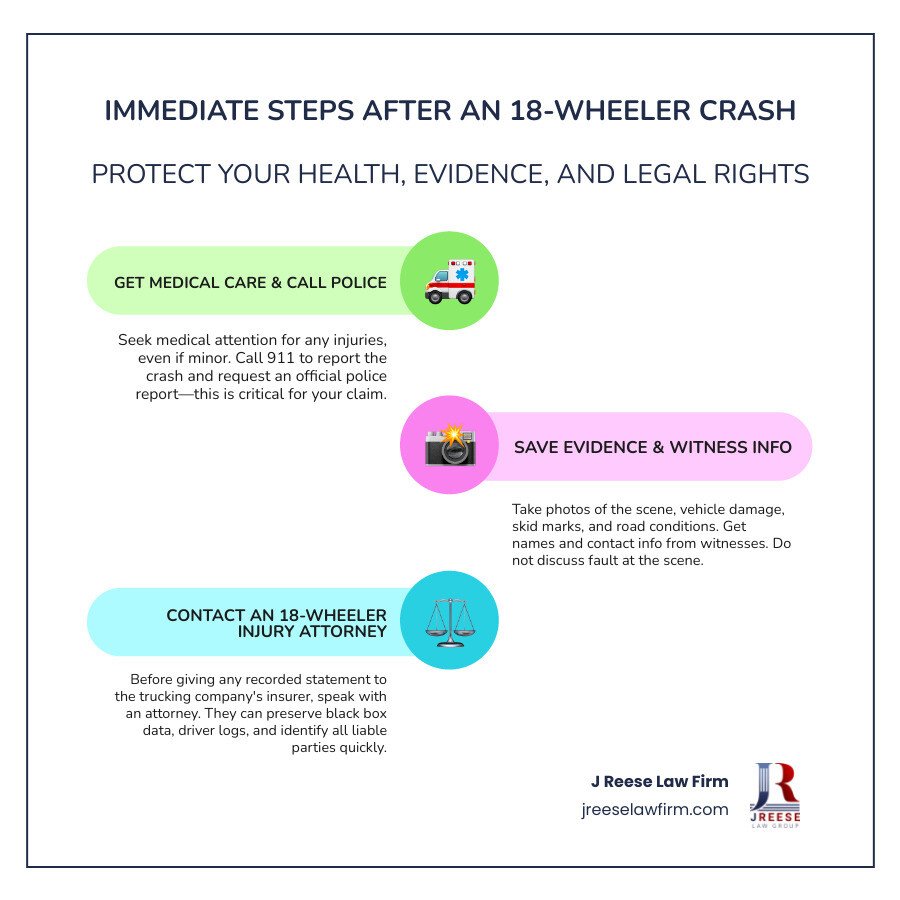
Get medical care, call the police, and save any photos or witness details you can. Then speak with an 18-wheeler injury attorney before giving a recorded statement to the trucking company’s insurer. An attorney can help preserve truck data and driver records, identify who may be at fault, and seek payment for your injuries and other losses.
Truck claims can involve more than the driver. The trucking company, a maintenance contractor, or another party may share responsibility. Evidence can also disappear quickly, so it helps to act early.
I’m Justin Reese. Since 2011, I’ve handled personal injury cases involving auto collisions and catastrophic injuries; as an 18-wheeler injury attorney, I know how important it is to investigate the crash and protect your claim from the start.
18-wheeler injury attorney word guide:
When an eighty-thousand-pound semi-truck collides with a standard passenger car, the physical laws of momentum leave little room for error. Commercial trucks outweigh typical passenger cars by up to twenty to one. In recent federal crash reporting, large truck involvements in fatal crashes reached 5,788 nationwide in a single year, with approximately 71% of fatalities occurring among occupants of other vehicles rather than the truck drivers themselves. These collisions cause devastating harm. Securing immediate legal representation levels the playing field against corporate motor carriers and their defense teams.
Common Causes and Catastrophic Injuries in Commercial Truck Crashes
Commercial tractor-trailers operate under tight shipping deadlines across busy Louisiana interstates and local roadways. When safety standards slip in favor of faster delivery times, catastrophic accidents occur. In passenger car collisions, both drivers usually share similar insurance policy limits and vehicle sizes. By contrast, an 18-wheeler collision involves massive corporate insurance policies, severe vehicle damage, and life-altering physical trauma.
| Feature | Standard Passenger Vehicle Collision | Commercial 18-Wheeler Collision |
|---|---|---|
| Vehicle Weight | 3,000 to 5,000 lbs | Up to 80,000 lbs (or more with permits) |
| Governing Regulations | Louisiana Highway Regulatory Act | Federal Motor Carrier Safety Regulations (FMCSA) & State Law |
| Liable Parties | Usually individual negligent driver | Driver, motor carrier, cargo loader, freight broker, maintenance vendor |
| Insurance Policy Limits | Often minimum state limits ($15,000/$30,000) | $750,000 to $5,000,000+ commercial policies |
| Evidence Available | Basic police report, personal photos | Black box data (ECM), telematics, ELDs, driver qualification files |
| Severity of Harm | Mild to moderate injuries common | High rate of catastrophic harm, permanent disability, or fatality |
Driver Fatigue, Equipment Failure, and Federal Safety Violations
Commercial drivers face immense pressure to keep freight moving. Despite strict Hours of Service (HOS) mandates enforced by the Federal Motor Carrier Safety Administration (FMCSA), driver fatigue remains one of the leading causes of semi-truck crashes. Fatigued driving impairs reaction times similarly to driving under the influence of alcohol. When motor carriers demand unrealistic delivery windows, drivers may push beyond their legal driving limits or falsify electronic logging records.
Mechanical neglect poses another significant threat on our roads. Worn brake pads, bald tires, steering mechanism failures, and broken cargo securement straps transform a massive rig into an uncontrollable hazard. Semi-trucks also have extensive blind spots—known as “No-Zones”—around all four sides of the trailer. When truckers fail to check mirrors or properly signal lane transitions, smaller vehicles can be crushed or forced off the road. Understanding who investigates an 18-wheeler crash on Westbank Expressway is critical for uncovering local police findings and state enforcement documentation.
Severe Injuries and Life-Altering Damages Sustained by Victims
The violent forces generated in a commercial truck crash frequently cause severe, irreversible bodily trauma. We see crash victims forced to cope with life-changing conditions that demand lifelong medical intervention, including:
- Traumatic Brain Injuries (TBIs): Concussions, skull fractures, and diffuse axonal injuries that alter cognitive function, speech, memory, and emotional stability.
- Spinal Cord Trauma and Paralysis: Complete or incomplete spinal cord damage resulting in quadriplegia, paraplegia, chronic nerve pain, or loss of mobility.
- Crush Injuries and Amputations: Severe extremity damage requiring surgical amputation or leading to chronic circulatory complications.
- Severe Burns and Disfigurement: Fuel fires and chemical cargo spills causing third-degree burns that necessitate extensive skin grafting and plastic surgery.
- Internal Organ Lacerations: Blunt-force impact leading to ruptured spleens, punctured lungs, internal bleeding, and kidney damage.
Establishing Liability in Complex Big Rig Collisions

Proving who is at fault for an 18-wheeler collision requires looking beyond the person behind the wheel. Commercial trucking operations rely on a chain of distinct corporate entities, any of which may have contributed directly to the crash.
Identifying Multiple At-Fault Parties Beyond the Driver
Under the legal doctrine of respondeat superior, trucking companies are vicariously liable for the negligent actions of their employed drivers performed within the scope of employment. Motor carriers can also be held independently negligent for their own reckless operational decisions, including:
- Negligent Hiring and Retention: Failing to run background checks, ignoring previous moving violations, or hiring drivers without valid Commercial Driver’s Licenses (CDL).
- Inadequate Driver Training: Putting unqualified drivers on complex urban routes or failing to train them on bad weather handling.
- Third-Party Cargo Loaders: Shifting freight caused by uneven distribution or improper tie-downs can easily destabilize a trailer and trigger a rollover.
- Maintenance Contractors: Third-party shops that perform shoddy repairs, sign off on inadequate inspections, or use substandard replacement parts.
- Freight Brokers: Logistics companies that contract with trucking companies known to have terrible safety records or active federal out-of-service orders.
When commercial carriers operate across state lines, jurisdictional questions often arise. Victims frequently ask if they can sue an out-of-state trucking company in Gretna, and Louisiana long-arm statutes allow us to pursue out-of-state corporations when their commercial vehicles cause injuries on local roads.
Federal Motor Carrier Regulations vs. Louisiana Traffic Laws
18-wheeler cases require an understanding of both federal safety rules and Louisiana state traffic statutes. While the Louisiana Highway Regulatory Act governs speed limits, right-of-way, and basic driving conduct, the FMCSA establishes nationwide safety mandates covering:
- Part 391: Qualifications of drivers and medical certifications.
- Part 392: Driving rules, including strict prohibitions on handheld mobile devices and driving while fatigued.
- Part 393: Vehicle parts, emergency equipment, and cargo securement requirements.
- Part 395: Hours of Service rules limiting drive time to 11 hours within a 14-hour workday following 10 consecutive hours off-duty.
- Part 396: Mandatory vehicle inspection, repair, and maintenance record-keeping.
Proving a motor carrier violated these federal safety mandates provides strong evidence of negligence in your personal injury claim.
Why You Need an Experienced 18-Wheeler Injury Attorney After a Crash
Trucking companies and their corporate insurers move quickly. Within hours of a serious collision, they often dispatch emergency response teams—including private investigators, accident reconstruction analysts, and insurance defense lawyers—to the crash site. Their objective is clear: control the narrative, shield their insured driver, and minimize potential financial payouts.
We level this imbalance. As detailed in our guide on why hiring a Gretna truck accident lawyer matters after a commercial crash, early legal intervention ensures your rights are protected before critical proof disappears.
How an 18-Wheeler Injury Attorney Uncovers Black Box and Driver Log Evidence
Commercial trucks are equipped with electronic control modules (ECMs)—commonly known as “black boxes”—and telematics units that record real-time operational data. This digital evidence is invaluable for showing exactly how the crash occurred. However, black box data can be overwritten in weeks or days if the truck returns to active service.
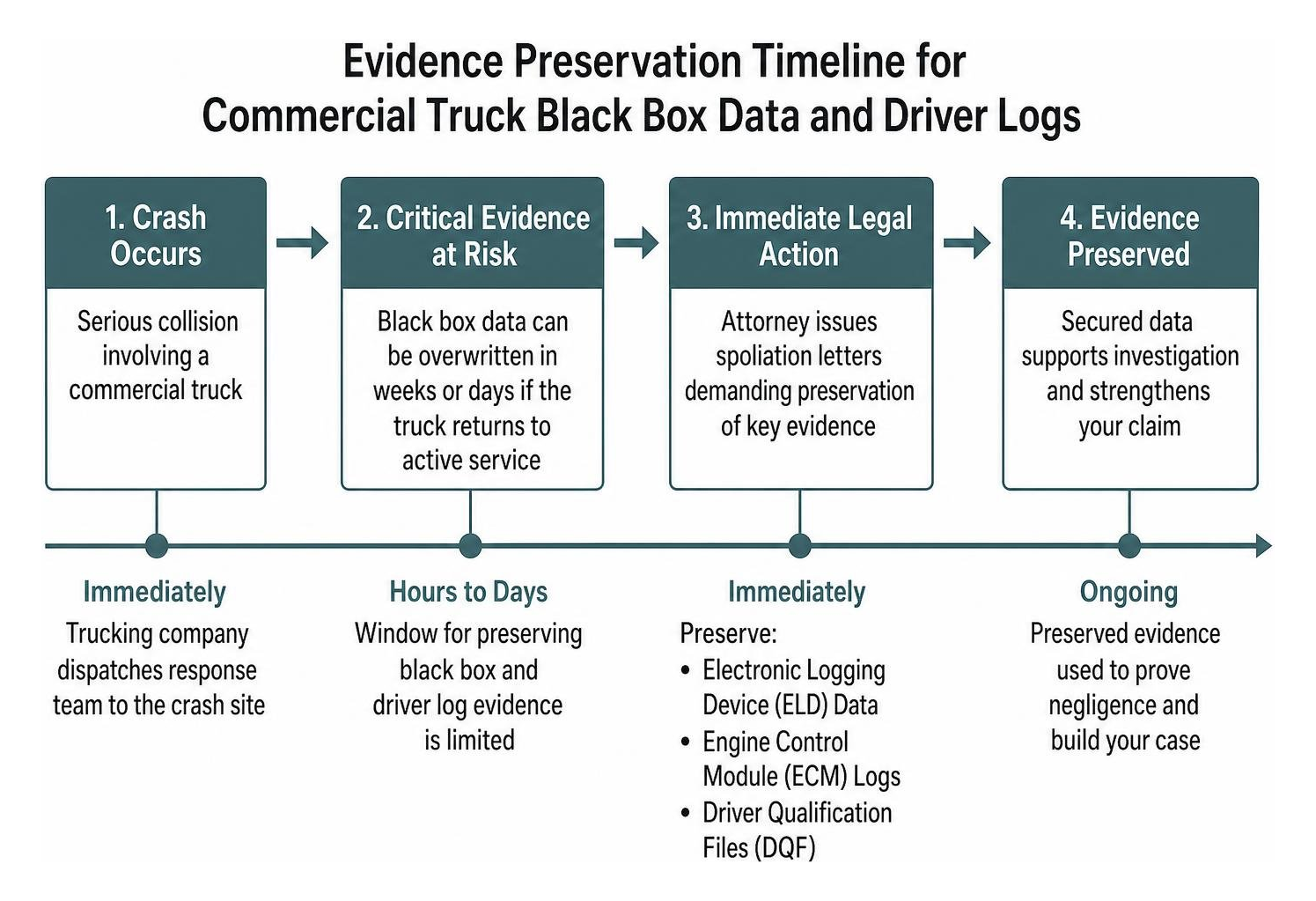
When we take your case, we immediately issue formal spoliation letters to the trucking company, demanding the preservation of:
- Electronic Logging Device (ELD) Data: Proves driving hours and potential HOS violations.
- Engine Control Module (ECM) Logs: Records vehicle speed, throttle position, brake application, and steering inputs in the seconds leading up to the impact.
- Driver Qualification Files (DQF): Contains the driver’s employment application, medical certificates, background checks, and driving record.
- Dashcam and In-Cab Video Footage: Captures outward road views and inward driver behavior at the moment of impact.
- Post-Accident Drug and Alcohol Screenings: Mandatory federal toxicology tests administered following serious crashes.
- Maintenance and Inspection Logs: Documenting pre-trip inspections and past repair histories.
Countering Aggressive Tactics from Commercial Insurance Adjusters
Commercial insurance adjusters are skilled negotiators tasked with protecting corporate profits. They frequently reach out to unrepresented victims while they are still in the hospital or recovering at home, offering quick, lowball settlement amounts before the full extent of their medical needs is known. Accepting an early settlement releases all defendants from future liability, leaving you personally responsible for subsequent surgeries, ongoing therapy, or lost income.
Adjusters may also ask you to provide a recorded statement, carefully framing questions to make you inadvertently admit fault. When you work with our firm, we handle all communications with these insurance adjusters directly. Retaining a dedicated commercial truck lawyer in New Orleans ensures your claim is built on verified facts and accurate long-term financial calculations. According to industry research, truck accident victims who hire an attorney receive settlements that average 3.5 times higher than those who attempt to handle claims alone.
Recovering Full Compensation and Navigating Louisiana Filing Deadlines

A severe big rig crash impacts every part of your life—from mounting hospital bills to emotional trauma. Our goal is to secure comprehensive financial recovery covering all your losses.
Economic and Non-Economic Damages in Semi-Truck Settlements
Compensation in commercial truck claims covers both objective financial losses and subjective personal suffering:
- Economic Damages:
- Past, current, and future medical treatment, surgeries, physical rehabilitation, and prescription costs.
- Lost wages during recovery and loss of future earning capacity if you cannot return to your previous occupation.
- In-home nursing care, assistive mobility equipment, and home modifications (such as wheelchair ramps).
- Property damage repair or complete vehicle replacement.
- Non-Economic Damages:
- Physical pain, suffering, and physical impairment.
- Emotional distress, depression, anxiety, and post-traumatic stress disorder (PTSD).
- Loss of enjoyment of life and inability to engage in beloved hobbies or family activities.
- Loss of consortium and companionship for affected spouses.
Because commercial policies carry high limits, average settlements for catastrophic 18-wheeler injury cases frequently range from $100,000 to well over $1,000,000 depending on the severity of the permanent harm. Learn more about the factors that influence your big rig accident settlement in New Orleans to understand what your case may be worth.
When to Consult an 18-Wheeler Injury Attorney to Protect Your Claim Deadline
Under Louisiana Civil Code Article 3492, the prescriptive period (statute of limitations) for personal injury claims has historically been strict. Recent updates under Louisiana law establish the timeline within which an injured party must formally file a lawsuit in civil court. Missing this statutory deadline forever forfeits your legal right to seek financial compensation from the negligent parties.
Following the 6 crucial steps for your big rig accident claim in Gretna ensures that you document your injuries properly, gather essential records, and consult an attorney well before any filing deadlines approach.
Frequently Asked Questions About Commercial Truck Accident Claims
How long do I have to file an 18-wheeler accident lawsuit in Louisiana?
In Louisiana, personal injury claims are governed by specific prescriptive periods outlined in state law. Depending on the date of your incident and recent legislative revisions, your filing window is strictly enforced. It is critical to contact an attorney immediately following a wreck to ensure all pleadings are filed on time.
What makes 18-wheeler accidents different from standard car crashes?
Commercial truck crashes involve significantly higher vehicle weights, catastrophic injury severities, overlapping federal regulations (FMCSA), multi-million-dollar insurance policies, and multiple potentially liable corporate entities, including freight brokers, maintenance vendors, and motor carriers.
What should I do at the accident scene to protect my rights?
Prioritize your physical safety. Call 911 immediately to ensure local police and emergency medical teams respond. If your physical condition allows, photograph the damage to all vehicles, skid marks, road conditions, and the trucking company name displayed on the cab door. Exchange contact and insurance information, seek a comprehensive medical exam immediately, and avoid discussing fault with the truck driver or their insurer.
Taking Action Against Big Rig Insurers to Rebuild Your Life
A commercial truck accident can instantly disrupt your financial security, physical health, and family life. Big rig trucking companies and their corporate insurers have dedicated legal teams focused on protecting their bottom line. You do not have to confront them on your own.
At J Reese Law Firm, we stand up for injured individuals across Gretna and the greater New Orleans area. We take on the burden of investigating the crash, dealing with insurance adjusters, preserving black box evidence, and pursuing the full financial compensation you need to move forward. To explore your legal options and protect your rights, schedule a consultation with a New Orleans truck accident attorney with our firm today.