Wrongful Death Claims in Louisiana: Who Can File and When
If someone else’s actions caused a family member’s death, a wrongful death claim in Louisiana may allow eligible relatives to seek compensation. The right to file follows a set order: surviving spouse and children first, then parents, siblings, and grandparents. For most claims covered by the 2025 law, the filing deadline is one year from death or two years from the injury, whichever is longer. Medical malpractice has different rules, so check the deadline promptly.
I’m Justin Reese, a Louisiana civil trial attorney who has handled wrongful death cases since 2011. If you searched wrongful death claim louisiana, this guide will help you understand your rights and the steps to protect them.
Wrongful death claim louisiana helpful reading:
- Catastrophic Injuries Lawyer
- Louisiana Traumatic Brain Injury Lawyer
- Spinal Cord Injury Lawyer New Orleans
Who Has Legal Standing for a Wrongful Death Claim in Louisiana?
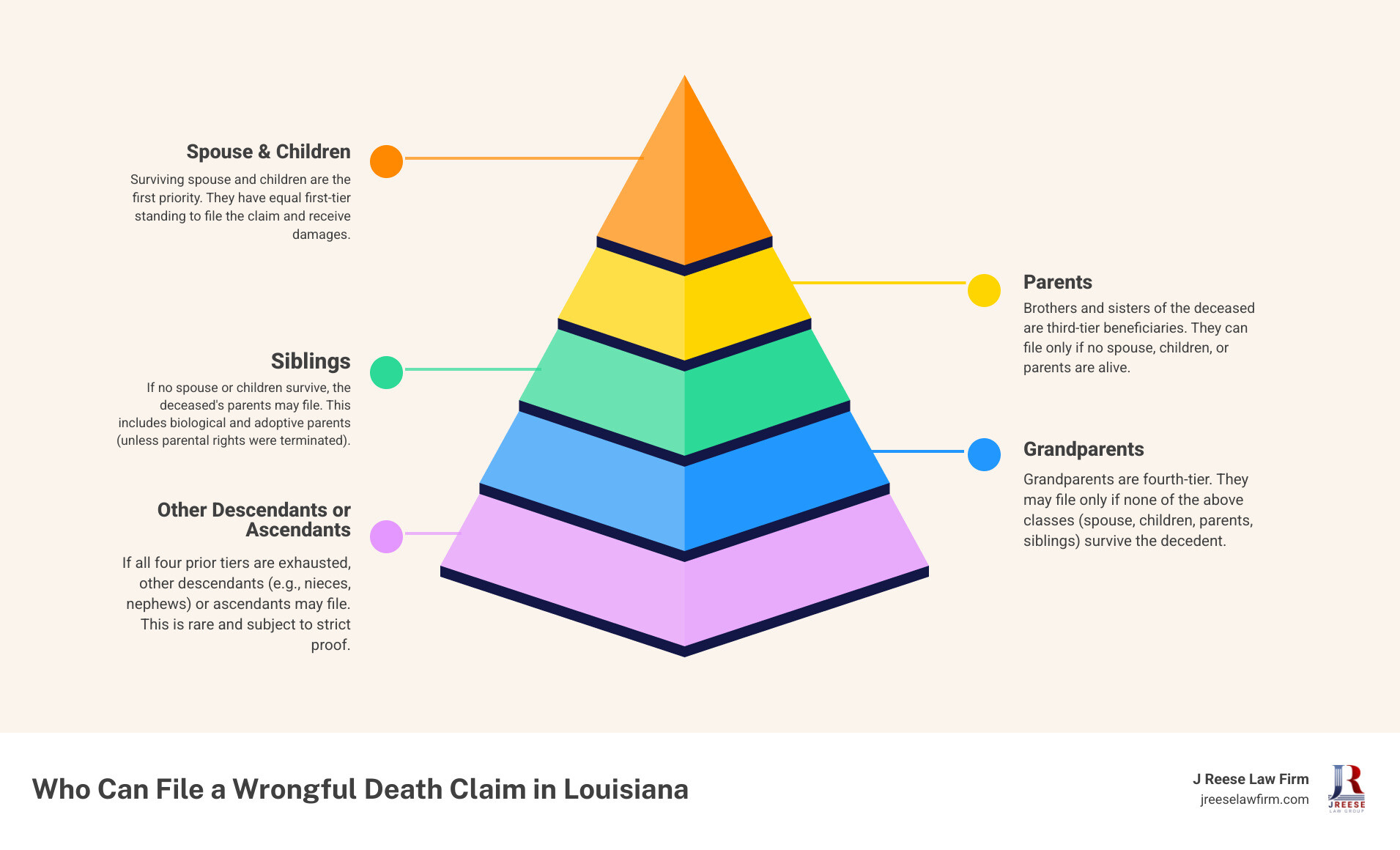
When a fatal tragedy strikes a household in Gretna or across Jefferson Parish, families often assume that any close relative can immediately step forward to file a civil lawsuit. However, Louisiana law enforces rigid boundaries. Under Louisiana Civil Code Article 2315.2, legal standing to pursue a claim is governed by an exclusive, statutory hierarchy. If a relative in a higher category exists, all relatives in subsequent tiers are legally barred from bringing an action.
Working with a knowledgeable wrongful death claims attorney is critical to confirm legal standing before initiating formal litigation, ensuring that the proper beneficiaries are named and protected from early defense challenges.
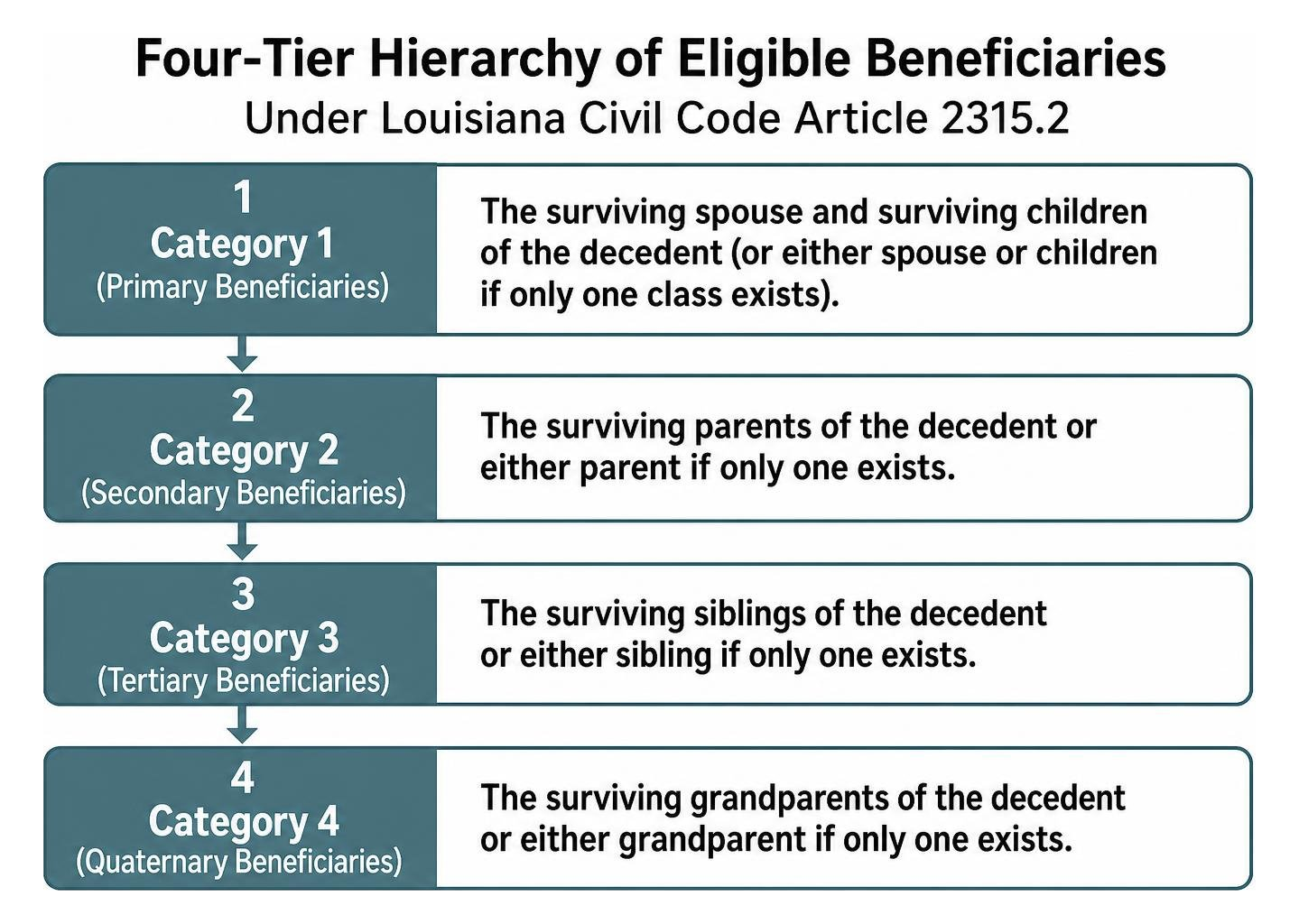
The Four-Tier Beneficiary Hierarchy Under Civil Code Article 2315.2
Louisiana Civil Code Article 2315.2 establishes four distinct tiers of eligible beneficiaries:
- Category 1 (Primary Beneficiaries): The surviving spouse and surviving children of the decedent (or either spouse or children if only one class exists).
- Category 2 (Parents): The surviving mother and father of the decedent, but only if the deceased left no surviving spouse or children.
- Category 3 (Siblings): The surviving brothers and sisters of the decedent, but only if the deceased left no surviving spouse, children, or parents.
- Category 4 (Grandparents): The surviving grandparents of the decedent, but only if the deceased left no surviving spouse, children, parents, or siblings.
The practical impact of this rule means higher-tier beneficiaries completely exclude lower tiers. For example, in the federal court ruling Knight v. City of East Baton Rouge, a mother of a deceased adult was determined to lack standing to bring a claim because the decedent was survived by a minor daughter. Because a first-category beneficiary existed, the mother—a second-tier beneficiary—could not maintain a wrongful death claim under Louisiana law.
Rules for Adopted Relatives and Exclusions for Abandoning Parents
Louisiana statutes explicitly address non-traditional and adoptive family dynamics:
- Adopted Family Members: Under Civil Code Article 2315.2, the words “child,” “parent,” “brother,” “sister,” and “grandparent” include relationships created through legal adoption. An adopted child possesses the exact same standing as a biological child to bring an action for the wrongful death of an adoptive parent, and vice versa.
- The Abandonment Exclusion Rule: Louisiana law places a strict moral and financial limitation on biological parents. A parent who abandoned the deceased child during their minority is legally deemed not to have survived the child. Under the law, abandonment is presumed if a parent left the child without providing support or care for a period of at least twelve consecutive months during the child’s minority. In such cases, the abandoning parent is disqualified from recovering any financial compensation.
Wrongful Death Actions vs. Survival Actions Under Louisiana Law
Many families facing a fatal accident assume that a single legal action covers all losses. In reality, Louisiana law recognizes two entirely separate causes of action: a wrongful death action (Civil Code Art. 2315.2) and a survival action (Civil Code Art. 2315.1). Both claims can—and usually should—be filed simultaneously in the same lawsuit.
| Legal Claim | Governing Statute | Who Is Compensated? | Primary Damages Covered |
|---|---|---|---|
| Wrongful Death Action | La. Civ. Code art. 2315.2 | Surviving beneficiaries | Survivors’ grief, loss of companionship, loss of future financial support, funeral costs |
| Survival Action | La. Civ. Code art. 2315.1 | Estate / Beneficiaries | Decedent’s pre-death pain and suffering, mental anguish, and incurred medical expenses |
Key Distinctions Between Survival and Wrongful Death Claims
To understand the difference, consider what each claim seeks to remedy:
- A Survival Action compensates for the harm suffered directly by the decedent from the moment of injury until the moment of death. If a loved one was injured in a collision on the Westbank Expressway, survived for several days in the hospital, and ultimately passed away, the survival action allows the family to recover for the physical pain, emotional distress, and medical bills the victim personally endured.
- A Wrongful Death Action compensates the surviving relatives for their own separate losses resulting from the death. This includes the emotional anguish of losing a spouse or parent, loss of love and companionship, and the loss of financial contributions the decedent would have provided over their lifetime.
When you consult our team as your New Orleans wrongful death attorney, we analyze medical records and witness testimony to build both actions thoroughly.
Filing Deadlines and the 2025 Prescriptive Period Amendments
Historically, Louisiana was known for its strict prescriptive period, requiring actions to be filed within one year of the incident. However, legislative changes enacted through the Act 176 (HB 291) 2025 Regular Session digest modernized these rules.
Under current Louisiana law, the prescriptive period for both wrongful death actions (Art. 2315.2) and survival actions (Art. 2315.1) is one year from the date of the death of the deceased OR two years from the day that the injury or damage was sustained, whichever period is longer.
- Standard Injury-to-Death Scenario: If a victim is injured in a serious crash on January 1, 2026, and passes away six months later on July 1, 2026, the family may calculate their filing deadline based on two years from the injury date (January 1, 2028) or one year from the death (July 1, 2027). Under the statute, they receive whichever date provides the longer window.
- Medical Malpractice Exception: The expanded two-year provision does not apply across all injury types. Wrongful death and survival actions arising from medical malpractice remain strictly governed by R.S. 9:5628, meaning those claims generally prescribe one year from the date of death.
Because navigating Louisiana’s one year statute of limitations and the expanded prescriptive periods requires strict legal calculations, families should never delay reviewing their timeline.
Establishing Liability and Recoverable Damages in Fatal Injury Cases

Securing compensation in a civil fatal accident claim requires establishing liability under Louisiana’s standard of proof: a preponderance of the evidence. This standard requires showing that it is more likely than not that the defendant’s negligent or intentional acts directly caused the fatality.
Whether dealing with commercial trucking collisions, industrial plant disasters, or holding negligent administrators responsible for nursing home wrongful death, plaintiffs must demonstrate four foundational elements:
- Duty: The defendant owed a legal duty of care to the victim.
- Breach: The defendant breached that duty through reckless, careless, or intentional conduct.
- Causation: The defendant’s breach was a direct and proximate cause of the fatal harm.
- Damages: The surviving beneficiaries and the decedent’s estate suffered actual, legally compensable harm.
Proving Fault in a Fatal Accident or Negligence Lawsuit
Civil defense teams and commercial insurers move quickly to shield themselves from exposure. Preserving evidence immediately following a fatal event is the most critical phase of any lawsuit.
When evaluating what to look for in a wrongful death attorney near me, families should look for legal counsel capable of conducting swift investigations. In slip and fall fatalities or premise liability cases, this includes taking immediate high-resolution photographs of any hazardous substances, floor defects, or the absence of warning signs before property owners alter the scene. In auto crashes, it involves securing electronic logging devices (black boxes), gathering dashcam and surveillance video, obtaining police crash reports, and interviewing eyewitnesses.
Louisiana also follows a pure comparative fault system (Civil Code Art. 2323). If the defense argues that the deceased was partially at fault for the accident, any recovery is reduced by their percentage of fault rather than barred entirely.
Calculating Economic and Non-Economic Damages for Surviving Families
Fatal accident claims encompass both tangible financial losses and non-economic human suffering.
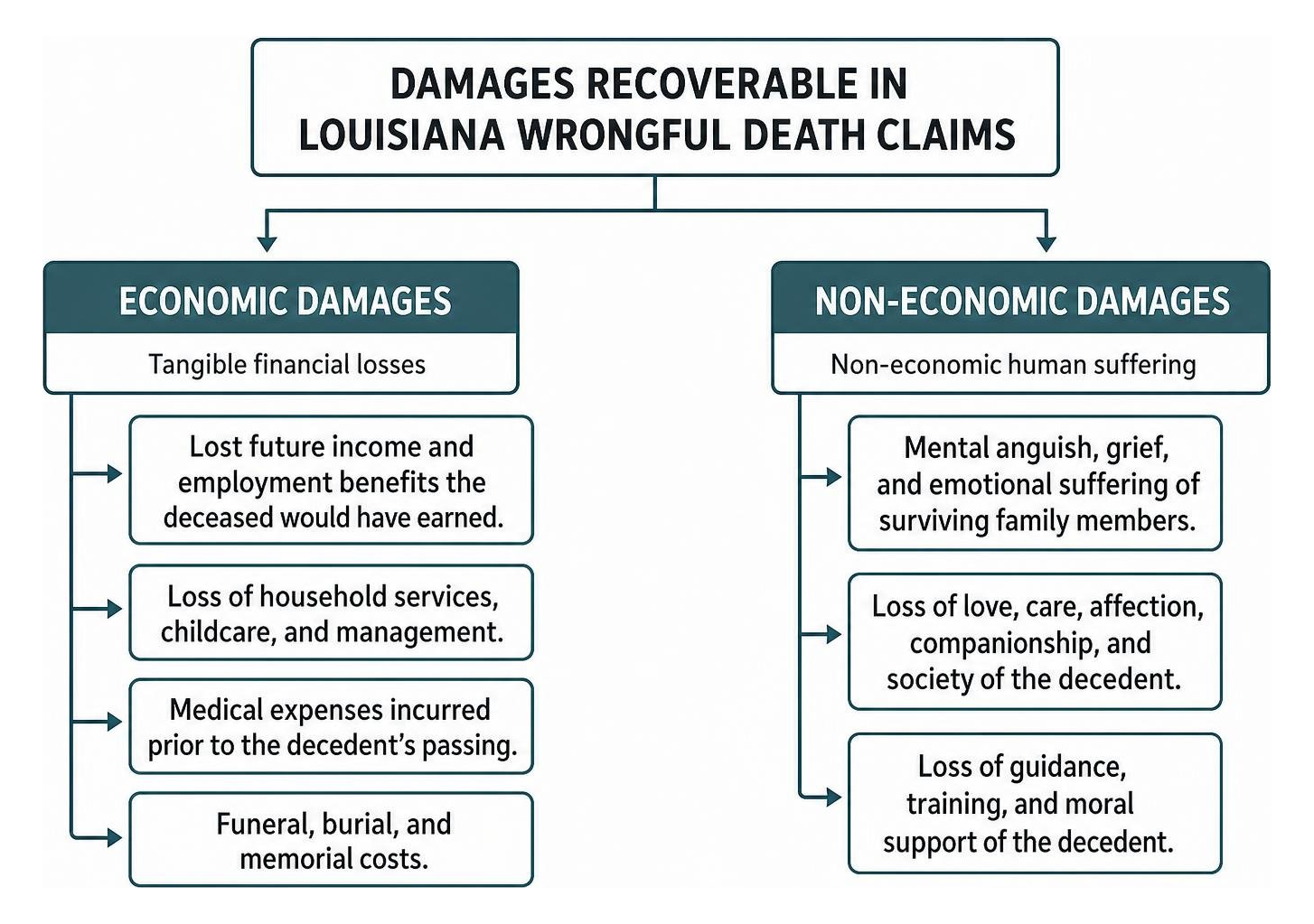
- Economic Damages:
- Lost future income and employment benefits the deceased would have earned.
- Loss of household services, childcare, and management.
- Medical expenses incurred prior to the decedent’s passing.
- Funeral, burial, and memorial costs.
- Non-Economic Damages:
- Mental anguish, grief, and emotional distress experienced by the surviving family.
- Loss of love, companionship, society, and moral guidance.
- Loss of consortium for a surviving spouse.
To review common settlement factors, visit our breakdown of wrongful death settlement amounts or use our wrongful death settlement calculator to see how economic variables shape case valuations.
Navigating Settlements, Criminal Investigations, and Litigation Strategy
Fatal accidents often involve multi-layered legal procedures, particularly if the defendant’s conduct involved drunk driving, manslaughter, or gross criminal recklessness. Handling these dual tracks requires a clear litigation plan.
How a Pending Criminal Case Affects a Wrongful Death Claim in Louisiana
When an event triggers both a criminal prosecution by the district attorney and a civil claim by the family, parallel legal rules come into play. As explained in guides on How Wrongful Death Lawsuits and Settlements Work, civil and criminal cases operate independently:
- Civil Court Stays and Motions to Quash: In cases involving active law enforcement inquiries, prosecutors or defendants often file motions to stay civil discovery or quash subpoenas issued to police departments. Under Louisiana Revised Statute 44.3, investigative records held by law enforcement are generally shielded from public records requests and civil discovery until the criminal litigation is fully concluded.
- Different Standards of Proof: Criminal charges require proof “beyond a reasonable doubt”—the highest evidentiary threshold. Civil wrongful death actions require only a “preponderance of the evidence” (more likely than not). Consequently, even if a defendant is acquitted or charges are dismissed in criminal court, the family can still successfully prevail in a civil lawsuit.
Structuring Payouts and Settlements for a Wrongful Death Claim in Louisiana
Once liability is established or an insurer agrees to resolve a claim, the settlement must be distributed among the eligible statutory beneficiaries.
- Lump-Sum vs. Structured Settlements: Beneficiaries can elect to receive compensation via a single lump-sum payout or through structured settlements (annuities). Structured settlements provide periodic, guaranteed payments over years or decades, which can be advantageous for minor children or providing lifetime financial support to a surviving spouse.
- Judicial Approval for Minor Children: If damages are awarded to surviving minor children, Louisiana courts require a formal minor settlement approval process. A judge reviews the proposed settlement to verify that attorney fees are fair, outstanding healthcare liens are resolved, and the net funds are safely preserved in a blocked trust or annuity until the child reaches adulthood.
Frequently Asked Questions About Louisiana Wrongful Death Claims
How long do surviving family members have to file a wrongful death lawsuit in Louisiana?
For claims governed by the updated Louisiana law, eligible family members have either one year from the date of the victim’s death or two years from the date the initial injury was sustained, whichever date is longer. However, wrongful death actions related to medical malpractice must still be brought within one year of death.
Can multiple family members recover damages in a single wrongful death lawsuit?
Yes. If multiple beneficiaries exist within the same eligible statutory tier (for example, a surviving spouse and three surviving children), they can all join as plaintiffs in a single civil lawsuit. Each claimant’s recovery is evaluated individually based on their specific relationship with the deceased, emotional suffering, and economic dependency.
What happens to a civil wrongful death claim if criminal charges are dropped?
A civil wrongful death claim can proceed even if criminal charges are dropped or the defendant is found not guilty. Civil claims are governed by a lower standard of proof (preponderance of the evidence) than criminal cases, allowing families to recover damages even when criminal prosecutors decline to move forward.
Protecting Your Family’s Future and Preserving Your Legal Rights
Navigating the emotional aftermath of a fatal accident while dealing with aggressive insurance adjusters and complex procedural deadlines can be overwhelming. Louisiana’s hierarchical standing rules, evidence preservation requirements, and updated prescriptive windows leave no room for delay.
Our team at J Reese Law Firm is committed to standing beside surviving families in Gretna, New Orleans, and throughout Louisiana. We handle every aspect of the investigation, reconstruct the incident, calculate lifetime economic losses, and pursue full accountability against negligent individuals and corporations. If your family has experienced a fatal loss, visit our practice area for catastrophic injury representation to schedule a confidential case consultation.