
What wrongful death law means for Gretna families
Wrongful death law lets eligible family members seek compensation when another person’s wrongful act causes a death. In Louisiana, the law sets an order for which relatives may bring a claim. A wrongful death lawsuit is a civil case, so it can proceed even if no one is convicted of a crime.
The claim addresses losses caused by the death, such as lost support. A separate survival action addresses certain losses the person suffered before dying. Who may file, what damages are available, and the filing deadline all depend on state law.
I’m Justin Reese, and I’ve handled civil litigation and personal injury cases, including wrongful death matters, since 2011. I’ll explain how wrongful death law applies to families in Gretna and what to check before a filing deadline passes.
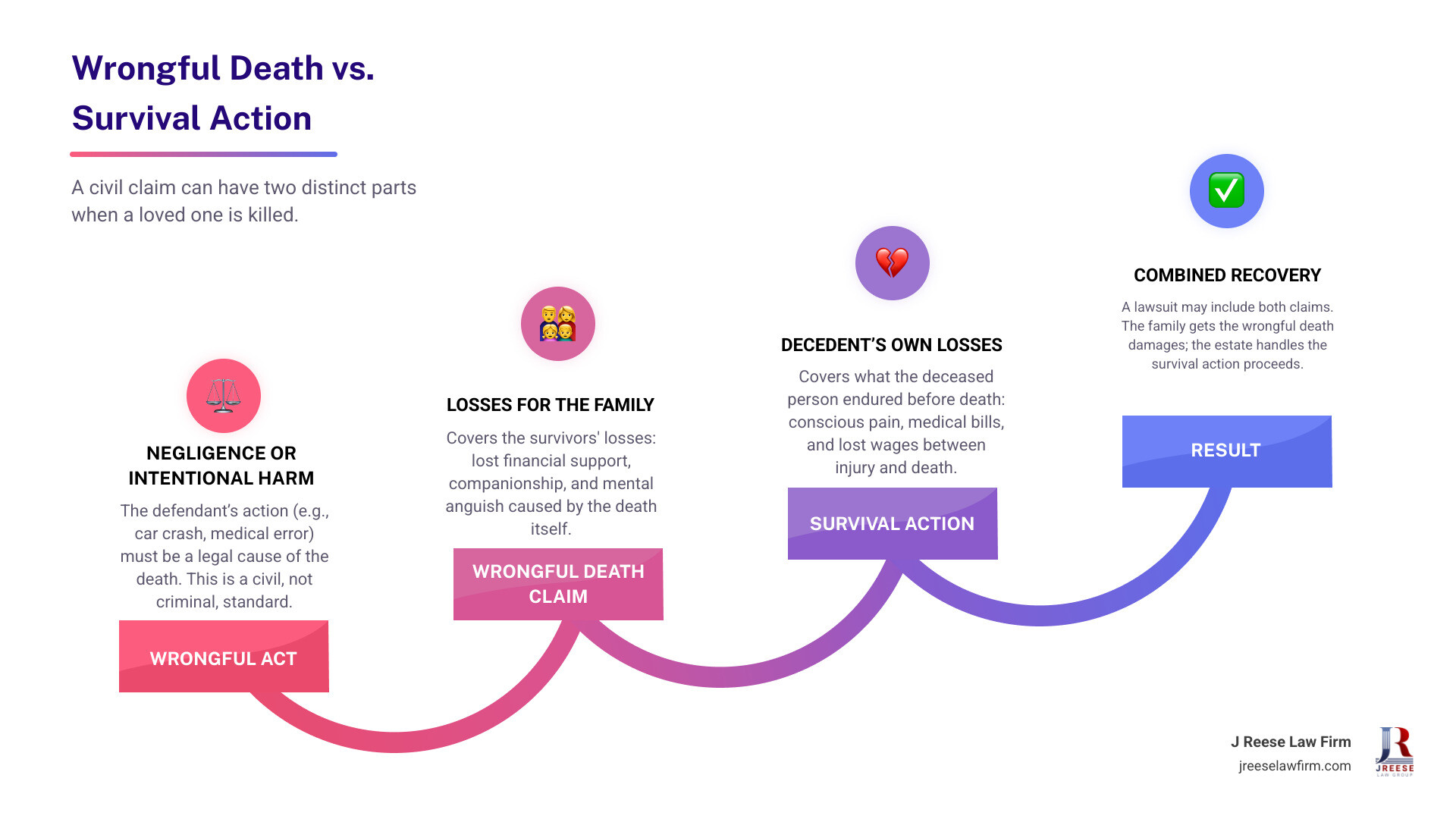
Wrongful death law vocab explained:
How wrongful death law works—and how it differs from a criminal case
When a fatal incident occurs due to negligence, recklessness, or intentional misconduct, the legal system addresses the act through distinct civil and criminal mechanisms. A civil wrongful death claim is brought by surviving beneficiaries or an estate representative to recover monetary compensation for the losses caused by the death. In contrast, a criminal homicide prosecution is initiated by the government to penalize unlawful conduct through incarceration, probation, or fines.
Because these proceedings are entirely separate, a civil wrongful death action can be pursued regardless of whether criminal charges are filed, dismissed, or result in an acquittal. The primary distinction lies in the standard of proof. In criminal court, the state must prove guilt beyond a reasonable doubt. In civil court, liability is established under a preponderance of the evidence standard, meaning it is more likely than not that the defendant’s wrongful act caused the fatal outcome. Understanding what a wrongful death claim may involve allows families to take proactive legal action even if law enforcement does not secure a conviction. Comprehensive legal definitions of these actions are detailed by the Cornell Law School Legal Information Institute.
What must be proved in a wrongful death law claim?
To prevail in a civil wrongful death lawsuit based on negligence, plaintiffs must establish four essential legal elements by a preponderance of the evidence:
- Duty of Care: The defendant owed the decedent a legal duty to act with reasonable care (e.g., motorists obeying traffic signals, property owners maintaining safe premises, or medical providers adhering to professional standards).
- Breach of Duty: The defendant failed to uphold that standard through an act of negligence, omission, or intentional misconduct.
- Causation: The defendant’s breach directly and proximately caused the fatal injuries.
- Damages: The surviving beneficiaries or estate suffered measurable economic and noneconomic harm as a direct result of the fatality.
Establishing these elements requires gathering objective evidence promptly, such as physical crash data, medical records, and incident reports.
How is a wrongful death claim different from a survival action?
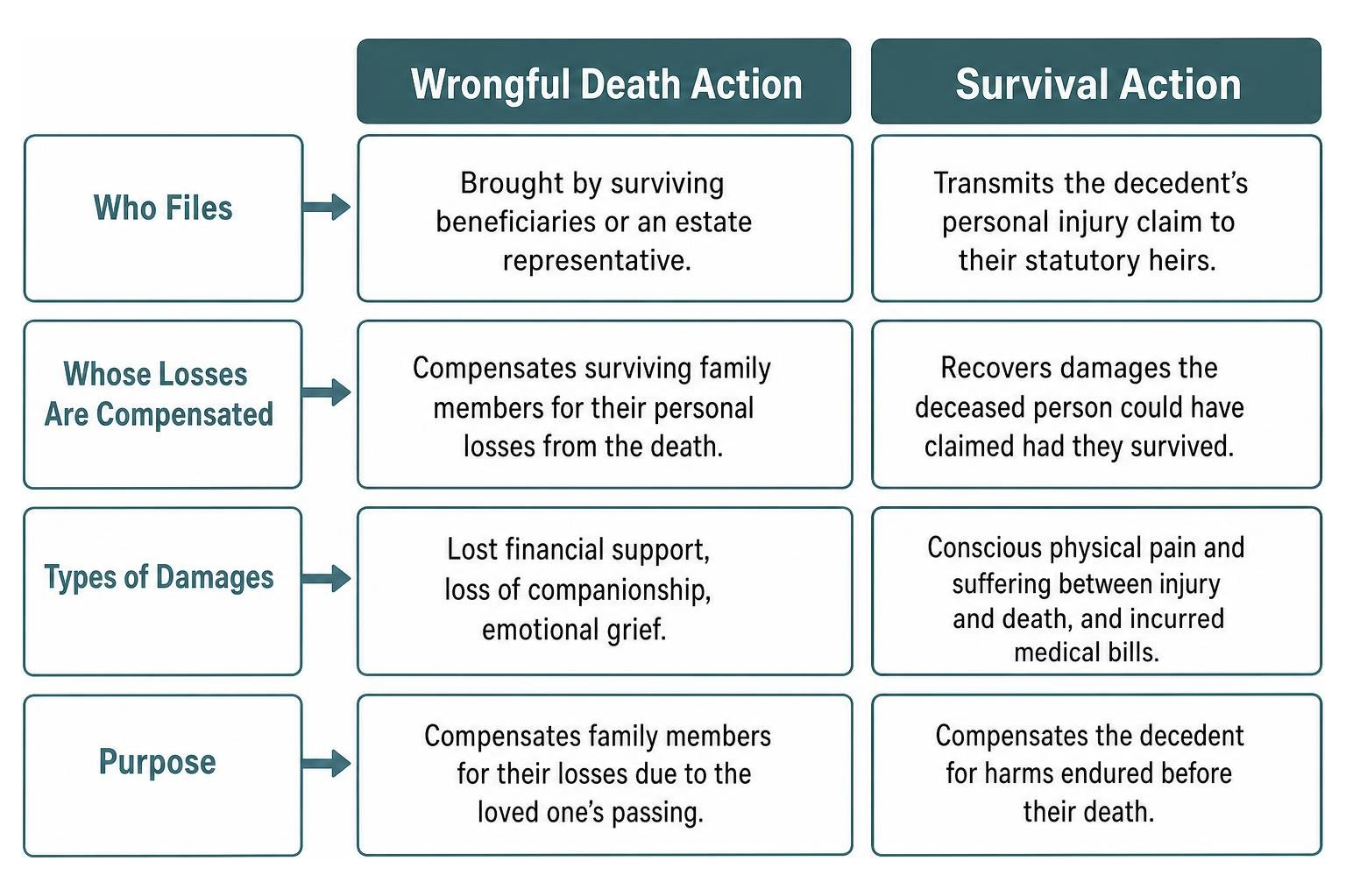
While often filed concurrently, wrongful death claims and survival actions compensate different categories of harm:
- Wrongful Death Action: Compensates surviving family members for their personal losses resulting from the loved one’s passing, including lost financial support, loss of companionship, and emotional grief.
- Survival Action: Transmits the decedent’s own personal injury claim to their statutory heirs. It allows the recovery of damages the deceased person could have claimed had they survived, such as conscious physical pain and suffering between the initial injury and death, as well as incurred medical bills.
Who may file under wrongful death law?
Eligibility to initiate a wrongful death lawsuit varies across jurisdictions. Many states require the personal representative of the decedent’s estate to file on behalf of all statutory beneficiaries, while others permit direct filing by designated family members according to a strict priority hierarchy. Reviewing Louisiana filing rules for local families ensures that claims are filed by the correct statutory parties. A nationwide breakdown of standing rules can be reviewed through the Justia 50-State Wrongful Death Survey.

Who may file a wrongful death law claim in Louisiana?
In Louisiana, wrongful death actions are governed by Louisiana Civil Code Article 2315.2. The statute establishes an exclusive, tiered priority order. The existence of a qualifying relative in a higher category completely excludes individuals in lower categories from bringing a claim or recovering damages:
- Tier 1: The surviving spouse and surviving children (including legally adopted children), or either group if the other does not exist.
- Tier 2: The surviving father and mother (including adoptive parents) if the decedent left no surviving spouse or child.
- Tier 3: The surviving brothers and sisters (including adopted siblings) if no spouse, child, or parent survives.
- Tier 4: The surviving grandfathers and grandmothers (including adoptive grandparents) if no spouse, child, parent, or sibling survives.
Under amendments codified in 2022, Louisiana explicitly protects adoptive family relationships across all statutory tiers.
What does the personal representative or executor do?
In states that follow an estate-representation model—such as Florida, Michigan, Ohio, and New York—individual family members do not file directly. Instead, an executor or court-appointed personal representative initiates the lawsuit on behalf of the estate and all eligible beneficiaries.
The personal representative is responsible for identifying statutory beneficiaries in the complaint, serving formal legal notices, managing litigation decisions, and submitting proposed settlements for judicial approval. Once an award or settlement is secured, the court oversees the equitable distribution of proceeds to prevent conflicts among heirs.
What damages can wrongful death law allow?
Damages awarded in wrongful death actions generally fall into economic, noneconomic, and punitive categories. Economic damages account for direct financial contributions the deceased would have provided, while noneconomic damages address intangible emotional trauma and loss of consortium. Our breakdown of wrongful death settlement amounts and our wrongful death settlement calculator illustrate how these damages translate into recovery.
| State | Primary Filing Party | Eligible Beneficiaries | Key Recoverable Damages | Statutory Caps / Restrictions |
|---|---|---|---|---|
| Florida | Personal Representative | Surviving spouse, minor children, parents, dependent relatives, and estate | Lost support/services, companionship, mental pain and suffering, estate net accumulations | Adult children/parents restricted in medical negligence claims |
| Michigan | Personal Representative | Surviving spouse, descendants, parents, grandparents, siblings, devisees | Medical/funeral costs, conscious pain, loss of support, society and companionship | Fair and equitable standard; 30-day notice requirement |
| Ohio | Personal Representative | Surviving spouse, children, parents (presumed damaged); next of kin | Loss of support, services, society, prospective inheritance, mental anguish | Abandoning parents barred under Chapter 2125 – Ohio Revised Code |
| Delaware | Beneficiaries Directly / Single Action | Spouse, parents, children, siblings; or relatives by blood/marriage | Pecuniary loss, support, services, mental anguish, funeral expenses | Funeral costs capped at $7,000 (or statutory threshold); punitive damages require malice/willful acts |
| New York | Personal Representative | Distributees / Intestate Heirs | Purely economic losses, funeral costs, lost financial support, conscious pain | No recovery for survivor grief/mental anguish |
What damages does wrongful death law allow in different states?
State legislatures place diverse limitations and requirements on wrongful death recovery:
- Economic-Only States: Alabama and New York are notable outliers. New York limits recovery strictly to pecuniary losses and the decedent’s conscious pain, denying recovery for family grief. Alabama restricts wrongful death recovery entirely to punitive damages to punish wrongdoers.
- Wisconsin: Under Wisconsin Statutes Section 895.03, additional damages for loss of society and companionship must not exceed $500,000 per occurrence for a deceased minor or $350,000 for a deceased adult.
- Kansas: Non-pecuniary damages sustained by an heir at law cannot exceed $250,000 in the aggregate plus costs.
- New Hampshire: A surviving spouse’s recovery for loss of comfort, society, and companionship is capped at $150,000.
- Maine: Juries may award up to $750,000 for loss of comfort, society, and companionship, with punitive damages capped at $250,000.
- Massachusetts: If death results from malicious, willful, wanton, or reckless conduct, or gross negligence, punitive damages must be awarded in an amount no less than $5,000.
- Texas: Family members and estate representatives operate under Texas wrongful death statutes, which allow recovery for lost income, companionship, mental anguish, and exemplary damages for gross negligence.
How have wrongful death statutes changed?
Modern wrongful death statutes originate from England’s Lord Campbell’s Act of 1846, enacted to prevent industrial accident victims’ families from falling into destitution. Because early laws focused strictly on replacing a wage earner’s income, noneconomic damages for emotional grief were excluded.
As documented in the American Bar Association’s legislative analysis, wrongful death statutes have evolved significantly over the past decade. States have expanded standing to include adoptive, step, and domestic partners, while recognizing broader noneconomic damages for grief and mental anguish. Although reform bills like New York’s Grieving Families Act faced executive vetoes over concerns regarding liability insurance rates, the national trend continues toward recognizing non-traditional family structures.

When must a wrongful death claim be filed?
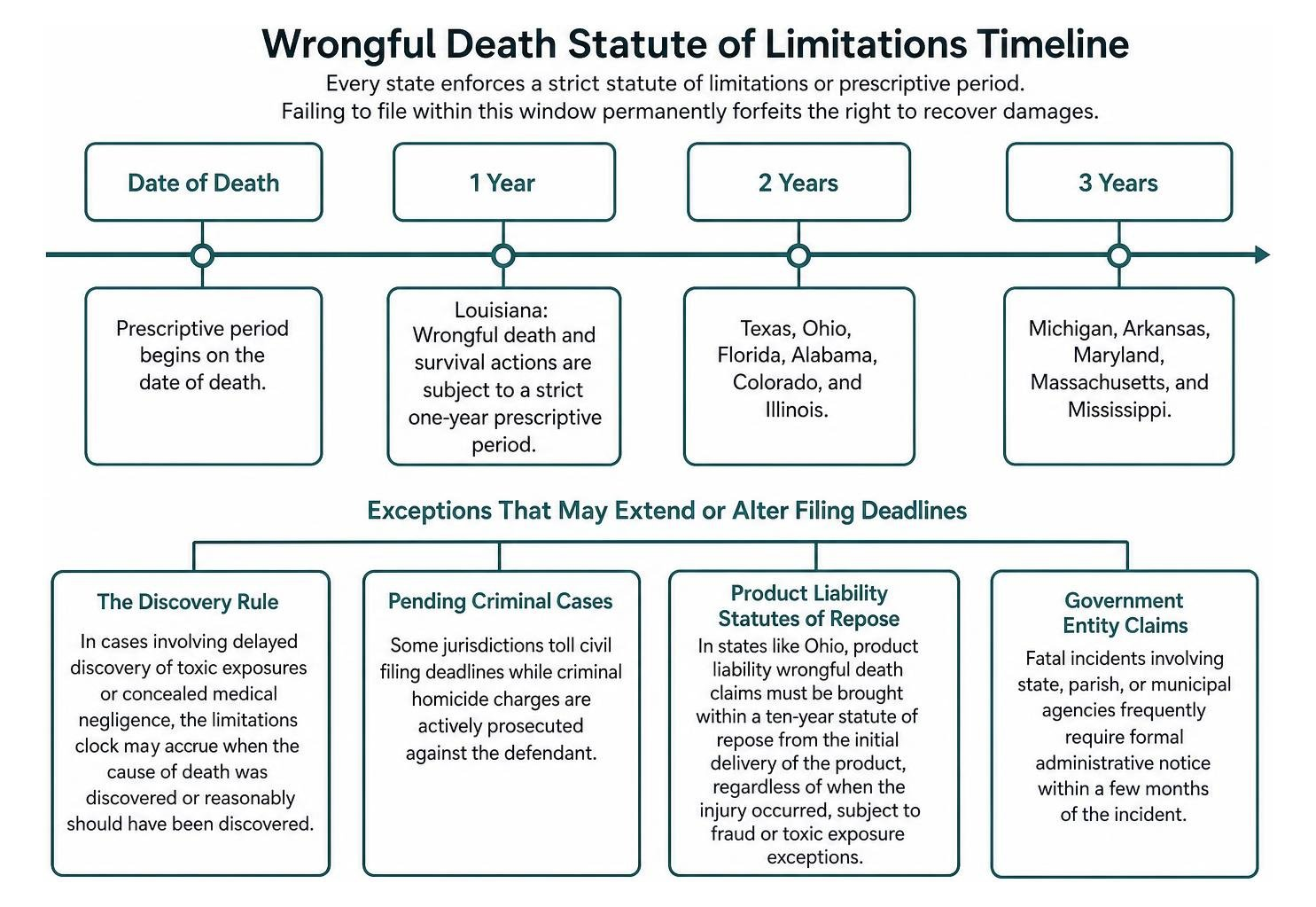
Every state enforces a strict statute of limitations or prescriptive period. Failing to file a lawsuit within this window permanently forfeits the right to recover damages.
In Louisiana, wrongful death and survival actions are subject to a strict one-year prescriptive period, running from the date of death. Other states allow broader windows:
- Two Years: Texas, Ohio, Florida, Alabama, Colorado, and Illinois.
- Three Years: Michigan, Arkansas, Maryland, Massachusetts, and Mississippi.
Are there exceptions to wrongful death filing deadlines?
Certain narrow legal exceptions may extend or alter these filing deadlines:
- The Discovery Rule: In cases involving delayed discovery of toxic exposures or concealed medical negligence, the limitations clock may accrue when the cause of death was discovered or reasonably should have been discovered.
- Pending Criminal Cases: Some jurisdictions toll civil filing deadlines while criminal homicide charges are actively prosecuted against the defendant.
- Product Liability Statutes of Repose: In states like Ohio, product liability wrongful death claims must be brought within a ten-year statute of repose from the initial delivery of the product, regardless of when the injury occurred, subject to fraud or toxic exposure exceptions.
- Government Entity Claims: Fatal incidents involving state, parish, or municipal agencies frequently require formal administrative notice within a few months of the incident.
What evidence helps prove a wrongful death claim?
Constructing a solid wrongful death claim requires gathering objective evidence before it is lost, altered, or overwritten. We focus on securing:
- Official police crash reports, commercial vehicle black box data, and dashcam footage.
- Complete medical records and autopsy findings establishing the direct mechanism of fatal injury.
- Witness statements, 911 dispatch audio recordings, and workplace safety inspection reports.
- Comprehensive financial records, including tax returns, pay stubs, pension valuations, and life expectancy tables.
- In premises liability matters such as slip-and-fall incidents, photographing conditions, documenting spilled liquids, and verifying the absence of warning signs.
- In institutional settings, reviewing staffing logs and records to determine accountability for nursing home deaths.
Because Louisiana applies pure comparative fault rules, damages are reduced in direct proportion to any percentage of fault assigned to the decedent. Preserving physical evidence early protects the claim against bad-faith comparative fault defenses.
What should families do after a potentially wrongful death?
Following a fatal accident, families must navigate several critical steps:
- Preserve Documentation: Collect all death certificates, medical invoices, funeral and burial receipts, and incident correspondence.
- Decline Unrepresented Statements: Insurance adjusters frequently seek recorded statements to minimize liability. Decline these requests until you have secured legal counsel.
- Identify Statutory Heirs: Clarify family standing under state priority rules or initiate probate proceedings if a personal representative is required.
- Consult Legal Counsel Promptly: Reviewing guidance on choosing a wrongful death attorney helps your family retain an attorney who will protect evidence and monitor filing deadlines. You can also explore our broader wrongful death legal resources for additional case insights.
Frequently Asked Questions about Wrongful Death Law
Can a wrongful death lawsuit proceed if there is no criminal conviction?
Yes. Civil wrongful death lawsuits proceed independently of criminal prosecutions. Because civil claims carry a lower standard of proof (preponderance of the evidence) than criminal trials (beyond a reasonable doubt), defendants acquitted in criminal court can still be held liable for civil damages.
Can siblings or other relatives file a wrongful death claim?
It depends entirely on state law. In Louisiana, siblings may only file if the decedent left no surviving spouse, child, or parent. In states following an estate model, siblings may recover proceeds only if they are recognized as statutory next of kin or named beneficiaries under probate rules.
Are wrongful death settlements taxable or divided equally?
Compensatory wrongful death proceeds for physical injury and emotional distress are generally non-taxable under federal tax law, whereas punitive damages may be subject to taxation. Settlement proceeds are not divided equally by default; courts distribute funds based on each beneficiary’s demonstrable economic dependency and emotional loss.
Securing Accountability for Your Family’s Future
When a family faces an unexpected fatality, dealing with legal procedures can feel overwhelming. Meeting tight filing deadlines, establishing statutory standing, and preserving crucial physical evidence are essential steps toward securing financial stability and holding negligent parties accountable.
If you have questions about your rights following a fatal accident in Gretna or the greater New Orleans area, speak with a local wrongful death attorney at J Reese Law Firm to ensure your family’s legal rights are protected from day one.