How to Hire Nursing Home Abuse Attorneys on a Budget
You do not need upfront money or personal savings to hire nursing home abuse attorneys. Most reputable elder injury lawyers work on a contingency fee basis, which means you pay nothing out of pocket unless they win your case.
To secure affordable legal help quickly:
- Choose contingency representation: Ensure legal fees are paid only as an agreed percentage of your final settlement or trial recovery.
- Clarify upfront case costs: Verify that the law firm covers necessary expenses, such as medical record requests and court filings, with zero out-of-pocket charges to you.
- Use free case evaluations: Speak with prospective firms at no cost to evaluate the strength of your claim, review arbitration clauses, and discuss potential compensation.
With more than 1.5 million Americans living in long-term care facilities, corporate negligence and understaffing remain widespread. Finding quality legal representation should never depend on your budget when your family member’s health and safety are on the line.
I am Justin Reese, a trial attorney who has spent over 15 years helping families partner with dedicated nursing home abuse attorneys to demand justice from negligent care corporations. My focus is ensuring that every family has direct access to aggressive courtroom advocacy and meaningful financial recovery regardless of their current financial situation.

Nursing home abuse attorneys terms simplified:
- average nursing home neglect settlement
- how long does a nursing home lawsuit take
- nursing home neglect resulting in death
Understanding Fee Structures Used by Nursing Home Abuse Attorneys
When facing the emotional shock of elder mistreatment, the last thing anyone wants to worry about is legal bills. Knowing why hiring a nursing home abuse lawyer is a smart move begins with understanding how billing works in injury law. Most injury claims do not use standard hourly retainers. Instead, attorneys handle these claims using contingency agreements.

A contingency fee model aligns our goals directly with yours: we only get paid if we recover compensation for your loved one through a settlement or a court verdict. If there is no recovery, you owe no attorney fees.
| Fee Model | Upfront Cost to Client | Ongoing Hourly Invoices | How the Firm Gets Paid |
|---|---|---|---|
| Contingency Fee | $0 | None | Agreed percentage of the recovery |
| Hourly Retainer | $3,000 – $10,000+ | Yes ($300–$600/hr) | Monthly bills regardless of case outcome |
| Flat Fee | Full amount upfront | None | Fixed sum regardless of trial needs |
Evaluating Free Consultations and Case Assessments
Before signing any contract, you should take full advantage of initial case reviews. A no-cost case assessment lets us examine medical notes, discuss facility conditions, and review the admission paperwork.
During this initial conversation, transparent lawyers will walk you through the fee agreement, answer your questions, and explain realistic timelines. Following a practical guide to choosing nursing home lawyers in city locations helps families assess communication styles and avoid firms that hide administrative charges in confusing contracts.
Navigating Court Costs and Advance Legal Expenses
Building a strong elder neglect claim requires obtaining comprehensive medical records, securing formal depositions, and filing legal documents with the court. These litigation costs are separate from attorney fees.
Reputable law firms advance all of these litigation expenses on your behalf. These costs are reimbursed only from the final settlement or verdict proceeds. Reviewing what goes into an average nursing home neglect settlement shows that handling expenses this way allows families to challenge well-funded corporate care facilities without financial strain.
Key Steps to Identify Neglect, Abuse, and Liable Parties
Holding a facility accountable requires identifying the exact type of harm your loved one endured. Elder mistreatment generally falls into two distinct categories: intentional abuse and administrative neglect.
Intentional abuse involves deliberate acts designed to cause physical trauma, fear, or financial loss. Neglect occurs when a facility fails to provide the basic standard of care, such as regular assistance with meals, hydration, medication, and hygiene.

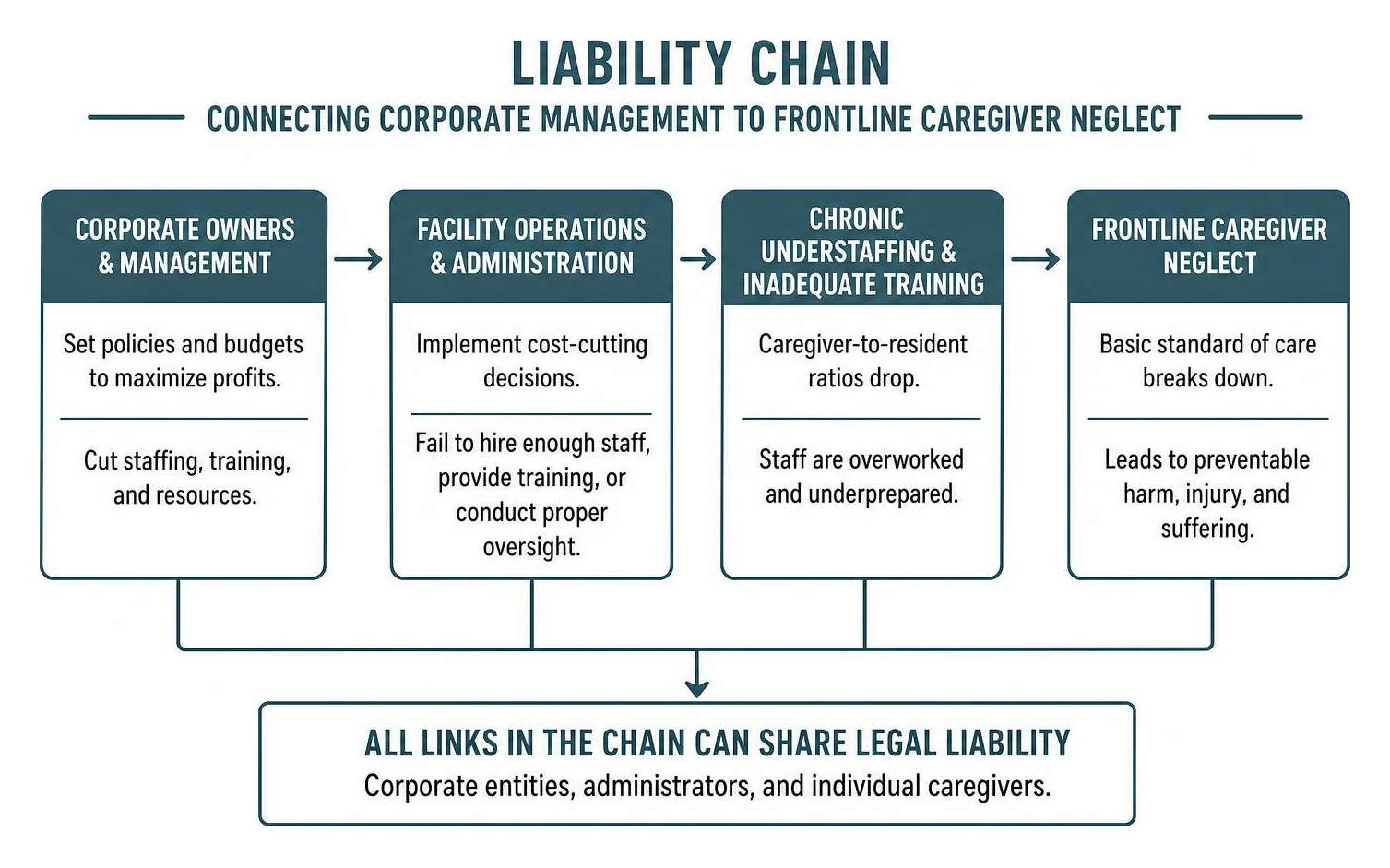
Both forms of mistreatment warrant immediate action. In our nursing home abuse practice, we frequently find that facility neglect stems directly from corporate budget cuts and chronic understaffing. When caregiver-to-resident ratios drop, basic care breaks down. In fact, research indicates that 51 percent of certified nursing assistants (CNAs) surveyed admitted to yelling at residents, often as a result of severe workplace stress and inadequate behavioral training.
Recognizing Critical Warning Signs and Abuse Types
Family members are the most effective line of defense against elder mistreatment. You should watch closely for physical and behavioral indicators of harm, including:
- Advanced Bedsores: Stage 3 and Stage 4 decubitus ulcers on the lower back, heels, or hips, which are almost entirely preventable with regular repositioning and clean bedding.
- Unexplained Fractures and Bruises: Injuries consistent with unassisted transfers, dropped residents, or physical restraint marks around wrists and ankles.
- Dehydration and Rapid Weight Loss: Sunken eyes, extreme thirst, dry skin, or rapid weight drops caused by staff failing to provide feeding assistance.
- Medication Mistakes and Lethargy: Overmedication used as a chemical restraint to keep residents docile, or skipped doses of vital prescriptions.
- Wandering and Elopement: Residents with cognitive impairments leaving secure areas or exiting the building unnoticed due to broken alarms and absent hallway monitoring.
- Poor Living Hygiene: Soiled clothing, unchanged adult briefs, foul odors, or infestations in living quarters.
Establishing Corporate and Staff Liability
Accountability in an elder injury claim does not stop at the frontline aide. While individual workers can be held responsible for intentional battery or theft, corporate owners and management companies often bear direct legal liability.
When a facility cuts staffing numbers to increase profit margins, fails to conduct criminal background checks, or skips necessary staff training, the corporate entity can be sued for systemic negligence. Learning how to hold facilities accountable for nursing home wrongful death requires identifying every responsible party, including third-party healthcare providers, staffing agencies, and parent operating entities.
Practical Steps to Prepare Your Case and Lower Legal Costs
You can strengthen your claim and streamline legal preparation by gathering key records early on. Having your documentation organized allows your legal team to act swiftly while keeping administrative costs low.
- Keep a Detailed Care Journal: Note every visit, missed meal, delayed call-light response, strange interaction with staff, and visible physical mark.
- Take Clear Photographic Evidence: Photograph bedsores, bruising patterns, broken equipment, unsanitary bedding, and poor facility conditions. If a resident suffers a slip and fall, take pictures of the liquid or substance on the floor and take note of missing wet floor signs.
- Secure Official Records Immediately: Request full copies of the resident’s complete medical chart, admission agreements, daily care sheets, and medication administration records.
- Report to Regulatory Authorities: File formal complaints with Adult Protective Services and your state health department. Official state inspection reports and citations provide valuable supporting evidence for civil claims.
- Preserve Financial and Billing Records: Save all out-of-pocket medical bills, prescription receipts, and invoices for emergency medical transfers.
How Nursing Home Abuse Attorneys Investigate and Build Claims
Once you retain legal representation, our legal team launches a formal investigation into the facility’s operations. Understanding what happens when fighting back against elder abuse: what a nursing home neglect attorney does involves several key steps:
- Subpoenaing electronic keycard access records and internal staffing shift logs to prove whether the facility met state-mandated staffing ratios.
- Reviewing historical health inspection violations and Centers for Medicare & Medicaid Services (CMS) quality ratings.
- Deposing administrators, supervising nurses, and former employees regarding internal care policies and budget cutbacks.
- Consulting medical professionals to prove how delayed care or improper wound management directly caused the resident’s injuries.
Overcoming Mandatory Arbitration Clauses and Time Limits
Nursing home admission packets often contain fine-print mandatory arbitration clauses designed to block families from filing lawsuits in open court. These clauses are not always legally binding.
Courts regularly invalidate arbitration agreements if they were signed by an unauthorized family member without explicit power of attorney, if the resident lacked mental capacity at the time of signing, or if the terms are unconscionable. Our team reviews these contracts to preserve your right to trial.
Additionally, you must be mindful of strict filing deadlines. For example, in California, CIV § 335.1 sets a two-year time limit to file a personal injury lawsuit from the date the injury occurred or was discovered. In other jurisdictions, deadlines may be as short as a single year. Understanding how long does a nursing home lawsuit take? estimate timeline factors will help ensure all filings are submitted before statutory deadlines expire.
Essential Criteria for Selecting Affordable Legal Representation
Not all personal injury attorneys focus their practices on elder law. Nursing home claims involve complex state and federal care regulations, corporate structuring, and specialized medical standards. Reviewing the top qualities to look for in an elder neglect lawyer will help ensure you partner with the right team:
- Contingency Fee Commitment: Clear, upfront terms confirming zero out-of-pocket costs and no hourly billing.
- Dedicated Elder Care Experience: A proven track record of handling claims involving pressure sores, medication errors, falls, and facility understaffing.
- Willingness to Go to Trial: Care corporations offer higher settlements when they know opposing counsel is fully prepared to present the case to a jury.
- Direct Communication: Accessible attorneys who keep you informed through every stage of the legal process.
If you suspect severe neglect, contacting J Reese Law Firm allows you to discuss your options directly with a team dedicated to elder justice in New Orleans and beyond.
When to Schedule Free Consultations with Nursing Home Abuse Attorneys
You should seek legal guidance the moment you suspect your loved one is in danger. Waiting allows care facilities to misplace shift logs, alter documentation, or explain away preventable injuries as natural aging.
If severe neglect has resulted in the loss of a family member, consulting a wrongful death claims attorney immediately helps preserve electronic records and ensures your family’s legal rights remain protected. To explore all our legal services, you can review our full practice area offerings.
Frequently Asked Questions about Hiring Elder Care Lawyers
Can I afford an elder abuse lawyer if I have no upfront money?
Yes. Elder injury lawyers work on a contingency fee basis. We advance all initial costs required to investigate and litigate your claim, from filing fees to medical records retrieval. You pay nothing out of pocket, and our fees are paid only as an agreed-upon percentage of the money recovered on your behalf.
What if my family member signed an arbitration agreement upon admission?
An arbitration clause does not automatically prevent you from pursuing legal action. Many arbitration agreements are unenforceable because they were signed under duress, executed by a family member who lacked legal power of attorney, or drafted with terms that violate state public policy. An attorney can evaluate the admission contract and challenge the clause in court.
What is the statute of limitations for filing a nursing home abuse lawsuit?
The statute of limitations varies depending on the state where the facility is located. For instance, California CIV § 335.1 gives plaintiffs two years from the date of the injury to file a lawsuit, whereas other states may allow only one year. Because missing this deadline forfeits your right to seek compensation, it is important to consult an attorney as soon as you notice signs of mistreatment.
Demanding Justice and Protecting Your Family’s Rights
Placing an elderly family member in a long-term care facility is a decision built on trust. When corporate operators cut staff, ignore basic hygiene, or allow vulnerable residents to suffer preventable injuries, they must be held accountable. Quality legal representation should be accessible to every family, regardless of income.
At J Reese Law Firm, we stand up to negligent care facilities and corporate owners to secure the justice, dignity, and compensation your family deserves. If you suspect your loved one is suffering from neglect or mistreatment, reach out to our team today to schedule your free consultation through our nursing home abuse legal support team.